Open Education: The Business
and
Policy Case for OER
Dr. Cable Green
Director of Global Learning
cable@creativecommons.org
@cgreen
Except where otherwise noted, this work is licensed under:
http://creativecommons.org/licenses/by/3.0
Children Reading Pratham Books and Akshara By Ryan Lobo http://www.flickr.com/photos/prathambooks/3291CC BY
“Nearly one-third of the world’s
population (29.3%) is under
15. Today there are 158 million
people enrolled in tertiary
education1. Projections
suggest that that participation
will peak at 263 million2 in
2025. Accommodating the
additional 105 million students
would require more than four
major universities (30,000
students) to open every week
for the next fifteen years.1 ISCED levels 5 & 6 UNESCO Institute of Statistics figures
2 British Council and IDP Australia projections
By: COL
http://www.col.org/SiteCollectio
s/JohnDaniel_2008_3x5.jpg
Dreaming Girls Head By: Elfleda http://www.flickr.com/photos/carolinespics/1531CC BY-NC-ND
http://www.capetowndeclaration.org
By: UNESCO: http://www.moveoneinc.com/blog/wp-
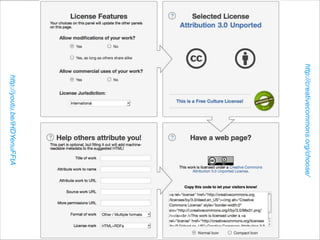
A simple, standardized
way to grant copyright
permissions to your
creative work.
Step 1: Choose Conditions
Attribution
ShareAlike
NonCommercial
NoDerivatives
Step 2: Receive a License
most free
least free
http://creativecommons.org/choose/
http://youtu.be/iHDYenuFFtA
Over 500 million items
Our vision is nothing less than realizing the full potential of the Internet – universal access to research,
education, & full participation in culture, driving a new era of development, growth, & productivity.
Develops, supports, & stewards legal and technical infrastructure that maximizes digital creativity, sharing, & innovation.
Over 77,000 contributors
working on over 22 million
articles in 285 languages
175+ Million CC Licensed Photos on Flickr
2
Higher Ed
By: MIT OCW: http://conferences.ocwconsortium.org/2011/cambridge/images/logo-ocwc-
Primary
Open Educational Resources (OER)
OER are
teaching, learning, and
research materials in any
medium that reside in the
public domain or have been
released under an open
license that permits their free
use and re-purposing by
Education grant making
Search & Discovery
Translations & Accessibility
Customization & Affordability
What is the
Business / Policy
Case for OER?
vs.
Rivalrous vs. Non-Rivalrous
Resources
BY SA: By Harvey Barrison http://www.flickr.com/photos/hbarrison/6920142558/
Cost of “Copy”
For one 250 page book:
• Copy by hand - $1,000
• Copy by print on demand - $4.90
• Copy by computer - $0.00084
CC BY: David Wiley, BYU
Cost of “Distribute”
For one 250 page book:
• Distribute by mail - $5.20
• $0 with print-on-demand (2000+ copies)
• Distribute by internet - $0.00072
CC BY: David Wiley, BYU
Copy and Distribute are “Free”
This changes everything
CC BY: David Wiley, BYU
Movies, TV Shows, Songs, and
Textbooks
Movies and TV Shows:
• Amazon Prime – $6.59/month
($79/year) for access to 10,000 movies
and TV shows
• Netflix – $7.99/month for access to
20,000 movies and TV shows
• Hulu Plus – $7.99/month for access to
45,000 movies and TV shows
CC BY: David Wiley: http://opencontent.org/blog/archives/2348
Movies, TV Shows, Songs, and
Textbooks
Music:
• Spotify – $9.99/month for access to 15
million songs
• Rhapsody – $14.99/month for access
to 14 million songs
CC BY: David Wiley: http://opencontent.org/blog/archives/2348
CC BY ND / Delta Initiative / http://tinyurl.com/bw3ztnt
When the Marginal Cost of Sharing is $0…
- educators have an ethical obligation to share
- governments need to get maximum ROI by
requiring publicly funded resources be openly
licensed resources
- governments and educators need openly
licensed content: (a) so you can revise & remix
(b) buying and maintaining is cheaper than
leasing (w/time bombs)
There is a direct relationship between
textbook costs and student success






60%+ do not purchase textbooks
at some point due to cost
35% take fewer courses due
to textbook cost
31% choose not to register for
a course due to textbook cost
23% regularly go without
textbooks due to cost
14% have dropped a
course due to textbook cost
10% have withdrawn from a
course due to textbook cost
Source: 2012 student survey
by Florida Virtual Campus
www.projectkaleidoscope.org
The Vision

100% of students have
100% free, digital access to all materials on day
1
Drive student success by
designing, adopting, measuring and
improving OER-based courses
www.projectkaleidoscop
Student ratings of quality of open texts
0 10 20 30 40 50 60 70 80
Better quality
Same quality
Worse quality
Number of Students
• “It was very concise and aligned with exactly what we were
working on in the class.”
• “Having the textbook catered to us by our teacher was
perfect.”
3%
56%
41%
Source: Bliss, Hilton, Wiley, Thanos (2012
Student preference for Kaleidoscope
courses
0 20 40 60 80 100
Prefer Kscope
Prefer traditional
No preference
Number of Students
• “I enjoy having online texts provided for me because I'm
poor. I spend the money I have left after rent on school, so
having free online texts provided for me benefits me very
much.”
• “GREAT WAY TO DO ONLINE CLASSES!!!!”
13%
13%
73%
Source: Bliss, Hilton, Wiley, Thanos (2012
Partner with Governments
who care about:
(a) efficient use of national /
state tax dollars;
(b) saving students money;
increasing access to publicly
funded research and data;
(c) increasing access to
CC-BY licensed textbooks
for 110 university courses
$500 million – Round 2
($2 billion over four years)
“as a condition of the receipt of a TAACCCT
grant, the grantee will be required to license to
the public (not including the Federal
Government) all work created with the support
of the grant (Work) under a Creative Commons
Attribution 3.0 (CC BY) license. Work that
must be licensed under the CCBY includes
both new content created with the grant funds
and modifications made to pre-existing,
grantee-owned content using grant funds.”
SGA, Round 2 (p. 8 / Section I.D.5 )
White House issues directive supporting
public access to publicly funded research
Publicly funded
resources should be
openly licensed
resources.
The Opportunity
English Composition I
• 55,000+ enrollments / year
• x $175 textbook
• = $9.6+ Million every year
English Composition I
• 55,000+ enrollments / year
• x $175 textbook
• = $9.6+ Million every year
http://opencourselibrary.org
Does it make any sense WA State and
K-12 Districts together spend
$130M/year
on textbooks and the results are:
• Books are (on average) 7-10 years out of
date
• Paper only / no digital versions.
• Students can’t write / highlight in books
• Students can’t keep books at end of
year
• All rights reserved… teachers can’t
massive change By: sookieCC BY
U.S. House Appropriations Committee draft FY2012
Labor, Health and Human Services funding bill
SEC. 124. None of the funds made available by this Act
for the Department of Labor may be used to develop
new courses, modules, learning materials, or projects in
carrying out education or career job training grant
programs unless the Secretary of Labor
certifies, after a comprehensive market-based
analysis, that such courses, modules, learning
materials, or projects are not otherwise available for
purchase or licensing in the marketplace or under
development for students who require them to
participate in such education or career job training grant
programs.
http://appropriations.house.gov/UploadedFiles/FY_2012_Final_LHHSE.pdf
U.S. House Appropriations Committee draft FY2012
Labor, Health and Human Services funding bill
SEC. 124. None of the funds made available by this Act
for the Department of Labor may be used to develop
new courses, modules, learning materials, or projects in
carrying out education or career job training grant
programs unless the Secretary of Labor
certifies, after a comprehensive market-based
analysis, that such courses, modules, learning
materials, or projects are not otherwise available for
purchase or licensing in the marketplace or under
development for students who require them to
participate in such education or career job training grant
programs.
http://appropriations.house.gov/UploadedFiles/FY_2012_Final_LHHSE.pdf
CC BY-NC-ND
046: Rule #2: See Rule #1 By: William Couch
http://www.flickr.com/photos/wcouch/226861055
ByMichaelGwyther-Jones
http://www.flickr.com/photos/12587661@N06/
7906811250/
CC BY
• Efficient use of public funds to
increase student success and
access to quality educational
materials.
• Everything else (including all
existing business models) is
secondary.
Only ONE thing Matters:
the opposite of open isn’t “closed”
the opposite of open is “broken”
Attribution: John Wilbanks
Dr. Cable Green
Director of Global Learning
cable@creativecommons.org
twitter: cgreen

Open Education: The Business & Policy Case for OER

  • 1.
    Open Education: TheBusiness and Policy Case for OER Dr. Cable Green Director of Global Learning cable@creativecommons.org @cgreen
  • 2.
    Except where otherwisenoted, this work is licensed under: http://creativecommons.org/licenses/by/3.0
  • 3.
    Children Reading PrathamBooks and Akshara By Ryan Lobo http://www.flickr.com/photos/prathambooks/3291CC BY
  • 4.
    “Nearly one-third ofthe world’s population (29.3%) is under 15. Today there are 158 million people enrolled in tertiary education1. Projections suggest that that participation will peak at 263 million2 in 2025. Accommodating the additional 105 million students would require more than four major universities (30,000 students) to open every week for the next fifteen years.1 ISCED levels 5 & 6 UNESCO Institute of Statistics figures 2 British Council and IDP Australia projections By: COL http://www.col.org/SiteCollectio s/JohnDaniel_2008_3x5.jpg
  • 5.
    Dreaming Girls HeadBy: Elfleda http://www.flickr.com/photos/carolinespics/1531CC BY-NC-ND
  • 6.
  • 7.
  • 9.
    A simple, standardized wayto grant copyright permissions to your creative work.
  • 10.
    Step 1: ChooseConditions Attribution ShareAlike NonCommercial NoDerivatives
  • 11.
    Step 2: Receivea License
  • 12.
  • 15.
  • 16.
  • 18.
    Our vision isnothing less than realizing the full potential of the Internet – universal access to research, education, & full participation in culture, driving a new era of development, growth, & productivity. Develops, supports, & stewards legal and technical infrastructure that maximizes digital creativity, sharing, & innovation.
  • 20.
    Over 77,000 contributors workingon over 22 million articles in 285 languages
  • 21.
    175+ Million CCLicensed Photos on Flickr 2
  • 22.
  • 23.
    By: MIT OCW:http://conferences.ocwconsortium.org/2011/cambridge/images/logo-ocwc-
  • 24.
  • 25.
  • 26.
    OER are teaching, learning,and research materials in any medium that reside in the public domain or have been released under an open license that permits their free use and re-purposing by
  • 27.
  • 28.
  • 29.
  • 30.
  • 31.
    What is the Business/ Policy Case for OER?
  • 32.
  • 33.
    BY SA: ByHarvey Barrison http://www.flickr.com/photos/hbarrison/6920142558/
  • 34.
    Cost of “Copy” Forone 250 page book: • Copy by hand - $1,000 • Copy by print on demand - $4.90 • Copy by computer - $0.00084 CC BY: David Wiley, BYU
  • 35.
    Cost of “Distribute” Forone 250 page book: • Distribute by mail - $5.20 • $0 with print-on-demand (2000+ copies) • Distribute by internet - $0.00072 CC BY: David Wiley, BYU
  • 36.
    Copy and Distributeare “Free” This changes everything CC BY: David Wiley, BYU
  • 37.
    Movies, TV Shows,Songs, and Textbooks Movies and TV Shows: • Amazon Prime – $6.59/month ($79/year) for access to 10,000 movies and TV shows • Netflix – $7.99/month for access to 20,000 movies and TV shows • Hulu Plus – $7.99/month for access to 45,000 movies and TV shows CC BY: David Wiley: http://opencontent.org/blog/archives/2348
  • 38.
    Movies, TV Shows,Songs, and Textbooks Music: • Spotify – $9.99/month for access to 15 million songs • Rhapsody – $14.99/month for access to 14 million songs CC BY: David Wiley: http://opencontent.org/blog/archives/2348
  • 39.
    CC BY ND/ Delta Initiative / http://tinyurl.com/bw3ztnt
  • 40.
    When the MarginalCost of Sharing is $0… - educators have an ethical obligation to share - governments need to get maximum ROI by requiring publicly funded resources be openly licensed resources - governments and educators need openly licensed content: (a) so you can revise & remix (b) buying and maintaining is cheaper than leasing (w/time bombs)
  • 41.
    There is adirect relationship between textbook costs and student success       60%+ do not purchase textbooks at some point due to cost 35% take fewer courses due to textbook cost 31% choose not to register for a course due to textbook cost 23% regularly go without textbooks due to cost 14% have dropped a course due to textbook cost 10% have withdrawn from a course due to textbook cost Source: 2012 student survey by Florida Virtual Campus www.projectkaleidoscope.org
  • 42.
    The Vision  100% ofstudents have 100% free, digital access to all materials on day 1 Drive student success by designing, adopting, measuring and improving OER-based courses www.projectkaleidoscop
  • 43.
    Student ratings ofquality of open texts 0 10 20 30 40 50 60 70 80 Better quality Same quality Worse quality Number of Students • “It was very concise and aligned with exactly what we were working on in the class.” • “Having the textbook catered to us by our teacher was perfect.” 3% 56% 41% Source: Bliss, Hilton, Wiley, Thanos (2012
  • 44.
    Student preference forKaleidoscope courses 0 20 40 60 80 100 Prefer Kscope Prefer traditional No preference Number of Students • “I enjoy having online texts provided for me because I'm poor. I spend the money I have left after rent on school, so having free online texts provided for me benefits me very much.” • “GREAT WAY TO DO ONLINE CLASSES!!!!” 13% 13% 73% Source: Bliss, Hilton, Wiley, Thanos (2012
  • 45.
    Partner with Governments whocare about: (a) efficient use of national / state tax dollars; (b) saving students money; increasing access to publicly funded research and data; (c) increasing access to
  • 46.
    CC-BY licensed textbooks for110 university courses
  • 47.
    $500 million –Round 2 ($2 billion over four years)
  • 48.
    “as a conditionof the receipt of a TAACCCT grant, the grantee will be required to license to the public (not including the Federal Government) all work created with the support of the grant (Work) under a Creative Commons Attribution 3.0 (CC BY) license. Work that must be licensed under the CCBY includes both new content created with the grant funds and modifications made to pre-existing, grantee-owned content using grant funds.” SGA, Round 2 (p. 8 / Section I.D.5 )
  • 51.
    White House issuesdirective supporting public access to publicly funded research
  • 52.
    Publicly funded resources shouldbe openly licensed resources.
  • 53.
  • 54.
    English Composition I •55,000+ enrollments / year • x $175 textbook • = $9.6+ Million every year
  • 55.
    English Composition I •55,000+ enrollments / year • x $175 textbook • = $9.6+ Million every year
  • 56.
  • 57.
    Does it makeany sense WA State and K-12 Districts together spend $130M/year on textbooks and the results are: • Books are (on average) 7-10 years out of date • Paper only / no digital versions. • Students can’t write / highlight in books • Students can’t keep books at end of year • All rights reserved… teachers can’t
  • 58.
    massive change By:sookieCC BY
  • 59.
    U.S. House AppropriationsCommittee draft FY2012 Labor, Health and Human Services funding bill SEC. 124. None of the funds made available by this Act for the Department of Labor may be used to develop new courses, modules, learning materials, or projects in carrying out education or career job training grant programs unless the Secretary of Labor certifies, after a comprehensive market-based analysis, that such courses, modules, learning materials, or projects are not otherwise available for purchase or licensing in the marketplace or under development for students who require them to participate in such education or career job training grant programs. http://appropriations.house.gov/UploadedFiles/FY_2012_Final_LHHSE.pdf
  • 60.
    U.S. House AppropriationsCommittee draft FY2012 Labor, Health and Human Services funding bill SEC. 124. None of the funds made available by this Act for the Department of Labor may be used to develop new courses, modules, learning materials, or projects in carrying out education or career job training grant programs unless the Secretary of Labor certifies, after a comprehensive market-based analysis, that such courses, modules, learning materials, or projects are not otherwise available for purchase or licensing in the marketplace or under development for students who require them to participate in such education or career job training grant programs. http://appropriations.house.gov/UploadedFiles/FY_2012_Final_LHHSE.pdf
  • 61.
    CC BY-NC-ND 046: Rule#2: See Rule #1 By: William Couch http://www.flickr.com/photos/wcouch/226861055
  • 62.
  • 63.
    • Efficient useof public funds to increase student success and access to quality educational materials. • Everything else (including all existing business models) is secondary. Only ONE thing Matters:
  • 65.
    the opposite ofopen isn’t “closed”
  • 66.
    the opposite ofopen is “broken” Attribution: John Wilbanks
  • 67.
    Dr. Cable Green Directorof Global Learning cable@creativecommons.org twitter: cgreen