Balamurugan Tangiisuran, PhD Discipline of Clinical Pharmacy School of Pharmaceutical Sciences Universiti Sains Malaysia b.tangiisuran@gmail.com 
BPHARM PROGRAMME
Learning Objectives 
•Upon completion of this lecture, you should be able to learn and on the techniques of handling several devices. 
•Able to understand the key counselling points for the following devices and dosage form
INHALERS
INHALERS 
•Inhalers are designed to help medication to be delivered directly into the lung 
•There are a number of different types of inhaler available: 
–Metered dose inhaler (MDIs) also called aerosol inhalers 
–Metered dose inhalers used with spacer attachment 
–Dry powder inhalers: 
•Turbohalers 
•Accuhalers 
–Breath-actuated inhalers such as Easi-Breathe
How to use MDI 
1.Remove the cap covering the mouthpiece and check that there is no fluff or dirt in the mouthpiece 
2.Shake the inhaler 
3.If the inhaler is new or has not been used for some time it will need to be tested. To test: Hold the inhaler away from the body. Press the top of the aerosol canister once. A fine mist should be puffed into the air. The inhaler is now ready to use
How to use MDI 
4.Tilt head back slightly 
5.Breathe out gently 
6.Place the mouthpiece in the mouth between the teeth (do not bite!). Close lips around the mouthpiece 
7.Start to breathe in slowly through the mouth, at the same time press down on the inhaler to release the medicine in to the lungs 
8.Hold breath for between 5 and 10 seconds, then breath out slowly
How to use MDI 
9.If a second dose is required, wait approximately 30 seconds and repeat the process 
10.Replace the cap and if the inhaler is a corticosteroid inhaler, rinse the mouth out with water
Key Points 
When using MDIs 
•Practice the use of the inhaler in front of a mirror to ensure inhalation technique is correct 
•For patients with arthritis or stiff hands, the inhaler can be held with both hands rather than one hand 
•Use of a spacer device will make the inhaler easier to use successfully 
•To keep inhaler clean, remove the canister from the plastic mouthpiece and wash in warm water twice a week
Key Points 
When using MDIs 
•It is important to try to keep track of the amount of medicine left in the inhaler in order to ensure a constant supply 
•If more than one type of inhaled medication is taken, it is important to take the correct order
Mistakes in Techniques
Breath Actuated Pressurized MDIs 
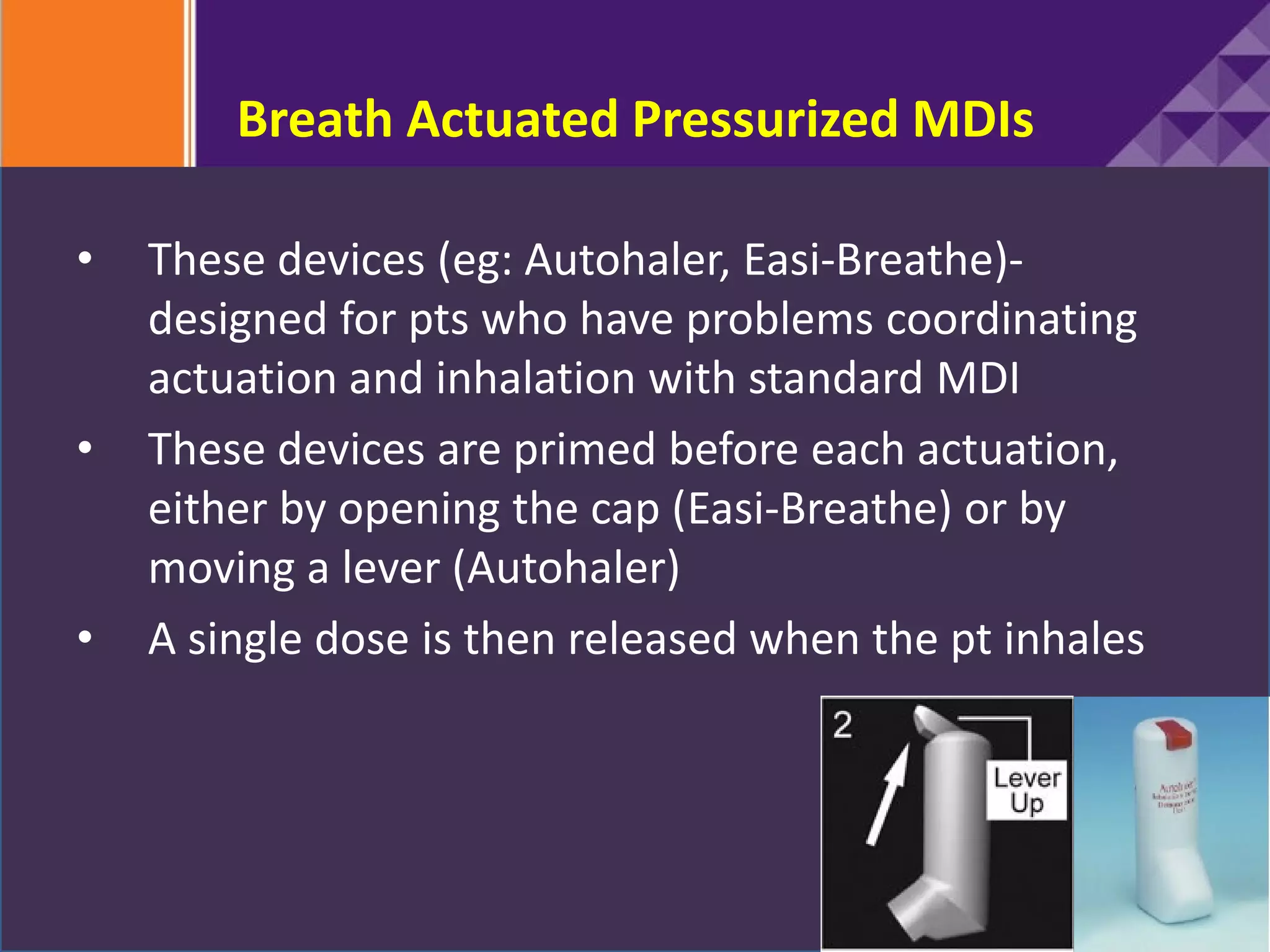
•These devices (eg: Autohaler, Easi-Breathe)- designed for pts who have problems coordinating actuation and inhalation with standard MDI 
•These devices are primed before each actuation, either by opening the cap (Easi-Breathe) or by moving a lever (Autohaler) 
•A single dose is then released when the pt inhales
Autohaler
Haleraid
Spacer Devices 
•Spacer increase the amount of medication getting to the airways 
•Beneficial for 
–Pts with poor puffer coordination 
–All pts on inhaled preventers 
–Used with a reliever puffer during an acute asthma attack
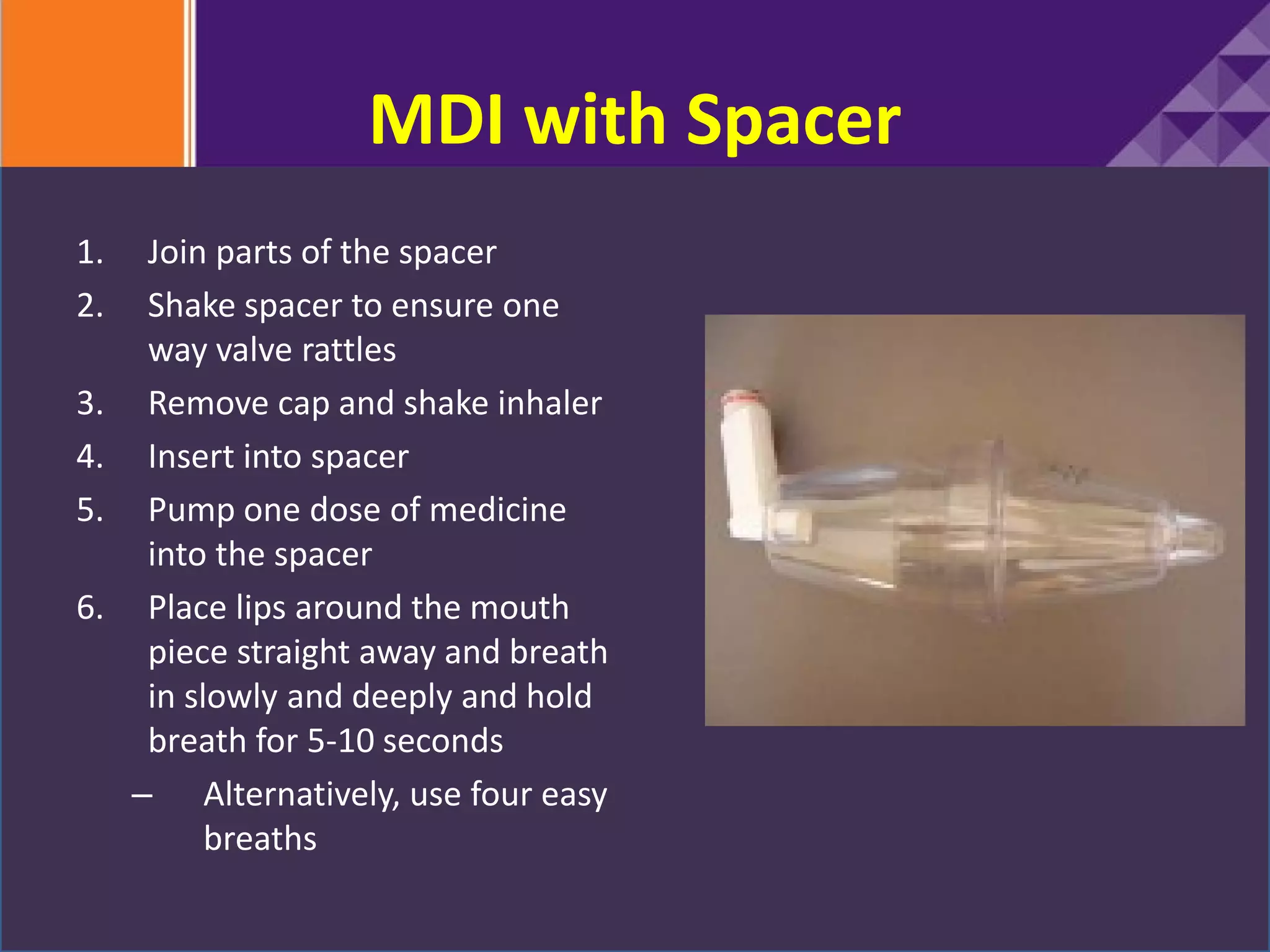
MDI with Spacer 
1.Join parts of the spacer 
2.Shake spacer to ensure one way valve rattles 
3.Remove cap and shake inhaler 
4.Insert into spacer 
5.Pump one dose of medicine into the spacer 
6.Place lips around the mouth piece straight away and breath in slowly and deeply and hold breath for 5-10 seconds 
–Alternatively, use four easy breaths
Key Points: Using Spacer 
•If more than a single dose is required, do one puff at a time 
•Start breathing in ASAP after releasing a puff into the spacer 
•Remember to shake the inhaler and spacer between puffs 
•Static charge can build up on spacer devices and this will attract particles of the drug, providing less drug for inhalation
Key Points: Using Spacer 
•Check regularly that the valve opens and closes with each breath 
•Spacers should be replaced every 12 months, especially if they are used daily
Cleaning Spacer
Turbuhaler
Key Points: Using Turbuhaler 
•When approximately 20 doses are left a red mark appears to prompt the patient to order a new inhaler 
•Never wash the Turbuhaler as if water or other fluids gets into the inhaler it may prevent it from working properly 
•If you accidently drop or shake the inhalers after it has been primed the dose will be lost
Key Points: Using Turbuhaler 
•Some Turbuhaler have no taste and pts changed onto these inhalers from MDI need reassurance that they have inhaled a dose as they do not get the sensation of the dose hitting the back of the throat 
•Pts with poor manual dexterity can obtain a ‘winged’ attachment for the Turbuhaler to make it easier to twist
Accuhalers
Key Points: Using Accuhalers 
•The Accuhaler requires no maintenance or refillling 
•A counter on the Accuhaler counts down from 60 to 0 to show how many doses are left in the inhaler 
•Accuhalers are not suitable for very young or old pts, someone having a severe attack or people unable to generate enough airflow to deposit medicine in the lungs
Spiriva Handihaler
Spiriva Handihaler 
1.Open dust cap by pulling up 
2.Open mouthpiece 
3.Insert capsule into centre of chamber 
4.Close mouthpiece firmly with a click 
5.Hold device with mouthpiece up and press in green button once and release 
6.Breath out completely 
7.Place lips around mouthpiece 
8.Breath in slowly and deeply 
9.Hold breath for 5-10 seconds 
10.Repeat steps 6 to 8. This will completely empty capsule 
11.Tip out used capsule and replace mouthpiece
Nebulisers
Cleaning of Devices
BLOOD PRESSURE
Sources of error in BP measuring
BP Assessment: Pt preparation and posture 
http://www.guideline.gov/content.aspx?id=6527
Recommended technique for BP measurement
PEAK FLOW METER
Peak Flow Meter 
•A peak flow meter is a portable, lightweight device which measures the amount of air flowing through your lung 
•The peak flow meter readings may assist you to monitor your asthma 
•Peak Flow monitoring MAY be suitable for children 7 years of age and older adults
Peak Flow Meter 
•Normal values are related to the patient's height as follows: 
•An easy to remember approximation is: PEFR (L/min) = [Height (cm) - 80] x 5 
Height (cm) 
PEFR (L/min)* 
120 
215 
130 
260 
140 
300 
150 
350 
160 
400 
170 
450 
180 
500
Peak Flow Meter
Peak Flow Meter
Peak Flow Meter
INSULIN INJECTION
Syringe and vial: Preparation 
2. Wash hands; 
apply gloves 
3. Clean the rubber top of the insulin vial with an alcohol swab
Syringe and vial: Preparation 
4. Select injection site 
5. Clean the injection site and wait to dry
Syringe and vial: Preparation 
6. Check the insulin dose 
7. Remove the cap from syringe
Syringe and vial: Preparation 
8. Pull the plunger down to number of units to be administered 
9. Inject air into bottle.
Syringe and vial: Preparation 
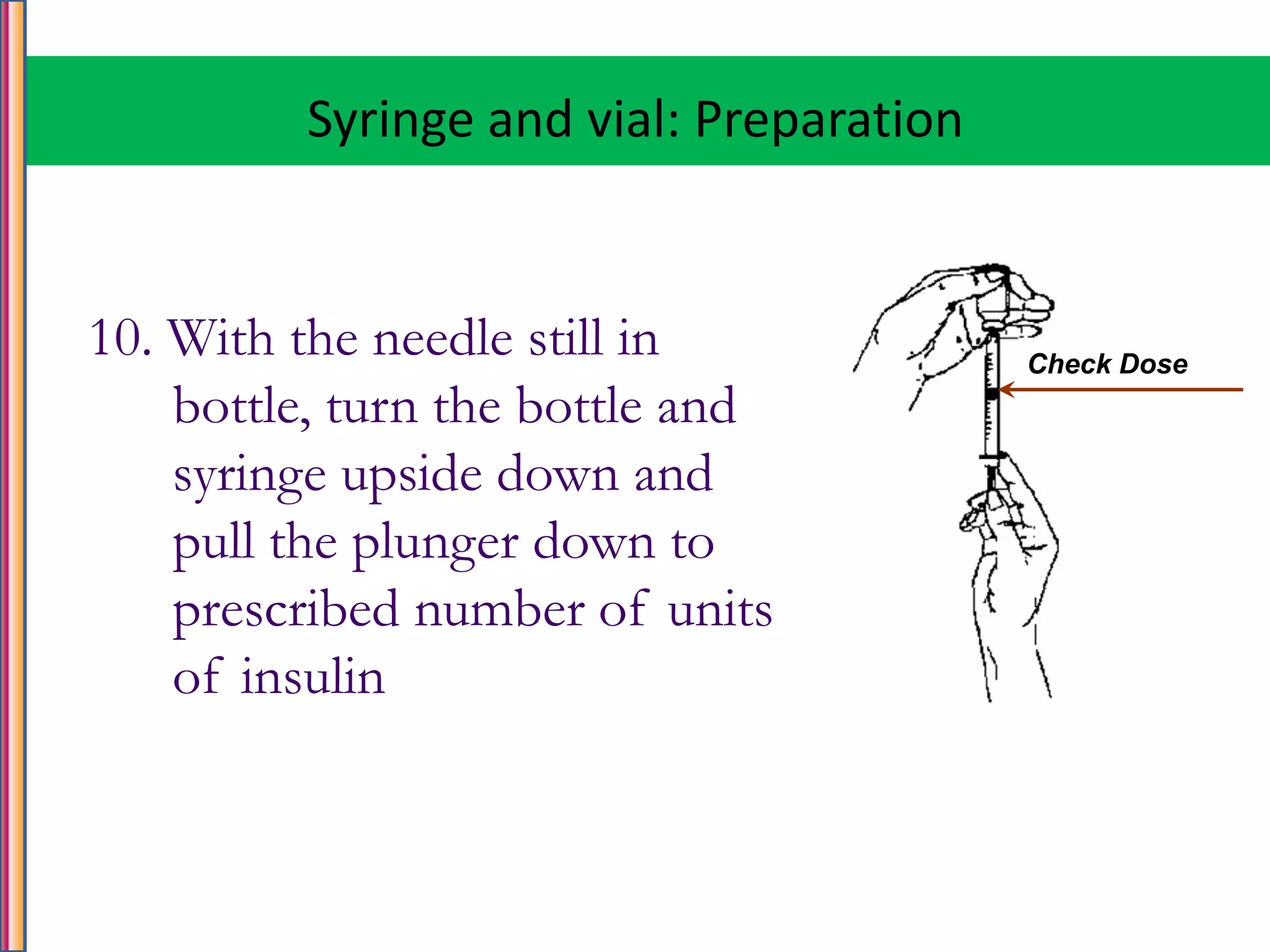
Check Dose 
10. With the needle still in bottle, turn the bottle and syringe upside down and pull the plunger down to prescribed number of units of insulin
Syringe and vial: Preparation 
47 
11. Pinch up the skin 
12. Push needle into skin at 90 
13. Release pinch 
14. Push the plunger in 
15. Count to “5” 
16. Remove needle and dispose of syringe 
17. Document time, dosage, site, and blood glucose value
On Target! 
•Rotating sites is important to insulin absorption 
•Common preferred sites are the abdomen, thighs, buttocks, and upper arms
Insulin Injection techniques using pen 
1.Choose an acceptable spot on your body to inject your insulin 
2.Apply your alcohol swab to the tip of the pen and the injection site 
3.Screw the needle on the top of your pen and remove the plastic safety caps 
4.Dial your pen to two units and press the plunger to prime your pen 
5.Set your pen to the correct dose and pinch your fat up at the injection site 
6.Insert the needle and press the plunger down and wait 5 seconds after the entire dose has been delivered 
7.Pull out the needle and dispose of the needle in a sharps container 
8. Re-cap your pen and clean up all trash
Insulin Injection techniques using pen
Insulin Injection techniques using pen 
Caution: If insulin does not appear, repeat the priming step until insulin flow is seen. If you not prime until insulin comes out, you could get a wrong insulin dose.
Insulin Injection techniques using pen
Insulin Injection techniques
Insulin Mixing Procedure
Glucose test devise 
1.Clean the finger with soap and warm water. 
2.Preferably avoid Alcohol Swabs/ Medicated Spirit. In case you use the same ensure that you wait at least 2-3 minute for it to dry completely 
3.Massage your finger gently so that the blood flow to the tip improves 
4.Prick your finger and take the test result from the first drop of blood 
5.If you want to repeat, press your finger gently and wipe the droplet of blood (it will contain minute clots) 
6.Take the next drop of sample 
http://www.roche-diagnostics.com.my/swf/Accu-Chek_Advantage/Accu- Chek_Advantage_Flash.html
How to use eye drops 
•Wash your hands and sit or stand in front of a mirror. 
•Take off the top of the bottle. 
•Bend your head backwards and gently pull your lower eyelid down. 
•Hold the dropper above one eye. Squeeze one drop into the pocket formed by gently pulling down the lower eyelid. Try not to touch your eye, eyelashes, or anything else with the dropper tip. 
•Let go of the eyelid and keep the eye closed for as long as possible after application of the eye drop.
How to use eye drops 
•Wipe away any liquid that falls onto your cheek with a tissue 
•Repeat in the other eye if the drop is prescribed for both eyes 
•When two different eye drop preparations are used at the same time of day, wait for at least five minutes before putting the second drop into an eye. This allows the first drop to 'settle in' and not be washed out by a second drop if it is put in too quickly
Dr. BalamuruganBalamurugan TangiisuranTangiisuran | School of Pharmaceutical SciencesSchool Sciences b.tangiisuran@gmail.com @DrTangiisuran http://geriatricpharmacy.wordpress.com/

Techniques of Handling Devices

  • 1.
    Balamurugan Tangiisuran, PhDDiscipline of Clinical Pharmacy School of Pharmaceutical Sciences Universiti Sains Malaysia b.tangiisuran@gmail.com BPHARM PROGRAMME
  • 2.
    Learning Objectives •Uponcompletion of this lecture, you should be able to learn and on the techniques of handling several devices. •Able to understand the key counselling points for the following devices and dosage form
  • 3.
  • 4.
    INHALERS •Inhalers aredesigned to help medication to be delivered directly into the lung •There are a number of different types of inhaler available: –Metered dose inhaler (MDIs) also called aerosol inhalers –Metered dose inhalers used with spacer attachment –Dry powder inhalers: •Turbohalers •Accuhalers –Breath-actuated inhalers such as Easi-Breathe
  • 5.
    How to useMDI 1.Remove the cap covering the mouthpiece and check that there is no fluff or dirt in the mouthpiece 2.Shake the inhaler 3.If the inhaler is new or has not been used for some time it will need to be tested. To test: Hold the inhaler away from the body. Press the top of the aerosol canister once. A fine mist should be puffed into the air. The inhaler is now ready to use
  • 6.
    How to useMDI 4.Tilt head back slightly 5.Breathe out gently 6.Place the mouthpiece in the mouth between the teeth (do not bite!). Close lips around the mouthpiece 7.Start to breathe in slowly through the mouth, at the same time press down on the inhaler to release the medicine in to the lungs 8.Hold breath for between 5 and 10 seconds, then breath out slowly
  • 7.
    How to useMDI 9.If a second dose is required, wait approximately 30 seconds and repeat the process 10.Replace the cap and if the inhaler is a corticosteroid inhaler, rinse the mouth out with water
  • 8.
    Key Points Whenusing MDIs •Practice the use of the inhaler in front of a mirror to ensure inhalation technique is correct •For patients with arthritis or stiff hands, the inhaler can be held with both hands rather than one hand •Use of a spacer device will make the inhaler easier to use successfully •To keep inhaler clean, remove the canister from the plastic mouthpiece and wash in warm water twice a week
  • 9.
    Key Points Whenusing MDIs •It is important to try to keep track of the amount of medicine left in the inhaler in order to ensure a constant supply •If more than one type of inhaled medication is taken, it is important to take the correct order
  • 10.
  • 11.
    Breath Actuated PressurizedMDIs •These devices (eg: Autohaler, Easi-Breathe)- designed for pts who have problems coordinating actuation and inhalation with standard MDI •These devices are primed before each actuation, either by opening the cap (Easi-Breathe) or by moving a lever (Autohaler) •A single dose is then released when the pt inhales
  • 12.
  • 13.
  • 14.
    Spacer Devices •Spacerincrease the amount of medication getting to the airways •Beneficial for –Pts with poor puffer coordination –All pts on inhaled preventers –Used with a reliever puffer during an acute asthma attack
  • 15.
    MDI with Spacer 1.Join parts of the spacer 2.Shake spacer to ensure one way valve rattles 3.Remove cap and shake inhaler 4.Insert into spacer 5.Pump one dose of medicine into the spacer 6.Place lips around the mouth piece straight away and breath in slowly and deeply and hold breath for 5-10 seconds –Alternatively, use four easy breaths
  • 16.
    Key Points: UsingSpacer •If more than a single dose is required, do one puff at a time •Start breathing in ASAP after releasing a puff into the spacer •Remember to shake the inhaler and spacer between puffs •Static charge can build up on spacer devices and this will attract particles of the drug, providing less drug for inhalation
  • 17.
    Key Points: UsingSpacer •Check regularly that the valve opens and closes with each breath •Spacers should be replaced every 12 months, especially if they are used daily
  • 18.
  • 19.
  • 20.
    Key Points: UsingTurbuhaler •When approximately 20 doses are left a red mark appears to prompt the patient to order a new inhaler •Never wash the Turbuhaler as if water or other fluids gets into the inhaler it may prevent it from working properly •If you accidently drop or shake the inhalers after it has been primed the dose will be lost
  • 21.
    Key Points: UsingTurbuhaler •Some Turbuhaler have no taste and pts changed onto these inhalers from MDI need reassurance that they have inhaled a dose as they do not get the sensation of the dose hitting the back of the throat •Pts with poor manual dexterity can obtain a ‘winged’ attachment for the Turbuhaler to make it easier to twist
  • 22.
  • 23.
    Key Points: UsingAccuhalers •The Accuhaler requires no maintenance or refillling •A counter on the Accuhaler counts down from 60 to 0 to show how many doses are left in the inhaler •Accuhalers are not suitable for very young or old pts, someone having a severe attack or people unable to generate enough airflow to deposit medicine in the lungs
  • 24.
  • 25.
    Spiriva Handihaler 1.Opendust cap by pulling up 2.Open mouthpiece 3.Insert capsule into centre of chamber 4.Close mouthpiece firmly with a click 5.Hold device with mouthpiece up and press in green button once and release 6.Breath out completely 7.Place lips around mouthpiece 8.Breath in slowly and deeply 9.Hold breath for 5-10 seconds 10.Repeat steps 6 to 8. This will completely empty capsule 11.Tip out used capsule and replace mouthpiece
  • 26.
  • 27.
  • 28.
  • 29.
    Sources of errorin BP measuring
  • 30.
    BP Assessment: Ptpreparation and posture http://www.guideline.gov/content.aspx?id=6527
  • 31.
  • 32.
  • 33.
  • 34.
  • 35.
  • 36.
    Peak Flow Meter •A peak flow meter is a portable, lightweight device which measures the amount of air flowing through your lung •The peak flow meter readings may assist you to monitor your asthma •Peak Flow monitoring MAY be suitable for children 7 years of age and older adults
  • 37.
    Peak Flow Meter •Normal values are related to the patient's height as follows: •An easy to remember approximation is: PEFR (L/min) = [Height (cm) - 80] x 5 Height (cm) PEFR (L/min)* 120 215 130 260 140 300 150 350 160 400 170 450 180 500
  • 38.
  • 39.
  • 40.
  • 41.
  • 42.
    Syringe and vial:Preparation 2. Wash hands; apply gloves 3. Clean the rubber top of the insulin vial with an alcohol swab
  • 43.
    Syringe and vial:Preparation 4. Select injection site 5. Clean the injection site and wait to dry
  • 44.
    Syringe and vial:Preparation 6. Check the insulin dose 7. Remove the cap from syringe
  • 45.
    Syringe and vial:Preparation 8. Pull the plunger down to number of units to be administered 9. Inject air into bottle.
  • 46.
    Syringe and vial:Preparation Check Dose 10. With the needle still in bottle, turn the bottle and syringe upside down and pull the plunger down to prescribed number of units of insulin
  • 47.
    Syringe and vial:Preparation 47 11. Pinch up the skin 12. Push needle into skin at 90 13. Release pinch 14. Push the plunger in 15. Count to “5” 16. Remove needle and dispose of syringe 17. Document time, dosage, site, and blood glucose value
  • 48.
    On Target! •Rotatingsites is important to insulin absorption •Common preferred sites are the abdomen, thighs, buttocks, and upper arms
  • 49.
    Insulin Injection techniquesusing pen 1.Choose an acceptable spot on your body to inject your insulin 2.Apply your alcohol swab to the tip of the pen and the injection site 3.Screw the needle on the top of your pen and remove the plastic safety caps 4.Dial your pen to two units and press the plunger to prime your pen 5.Set your pen to the correct dose and pinch your fat up at the injection site 6.Insert the needle and press the plunger down and wait 5 seconds after the entire dose has been delivered 7.Pull out the needle and dispose of the needle in a sharps container 8. Re-cap your pen and clean up all trash
  • 50.
  • 51.
  • 52.
  • 53.
  • 54.
  • 55.
    Insulin Injection techniquesusing pen Caution: If insulin does not appear, repeat the priming step until insulin flow is seen. If you not prime until insulin comes out, you could get a wrong insulin dose.
  • 56.
  • 57.
  • 58.
  • 59.
  • 60.
  • 61.
  • 62.
  • 63.
  • 64.
  • 65.
  • 66.
  • 67.
  • 68.
    Glucose test devise 1.Clean the finger with soap and warm water. 2.Preferably avoid Alcohol Swabs/ Medicated Spirit. In case you use the same ensure that you wait at least 2-3 minute for it to dry completely 3.Massage your finger gently so that the blood flow to the tip improves 4.Prick your finger and take the test result from the first drop of blood 5.If you want to repeat, press your finger gently and wipe the droplet of blood (it will contain minute clots) 6.Take the next drop of sample http://www.roche-diagnostics.com.my/swf/Accu-Chek_Advantage/Accu- Chek_Advantage_Flash.html
  • 69.
    How to useeye drops •Wash your hands and sit or stand in front of a mirror. •Take off the top of the bottle. •Bend your head backwards and gently pull your lower eyelid down. •Hold the dropper above one eye. Squeeze one drop into the pocket formed by gently pulling down the lower eyelid. Try not to touch your eye, eyelashes, or anything else with the dropper tip. •Let go of the eyelid and keep the eye closed for as long as possible after application of the eye drop.
  • 70.
    How to useeye drops •Wipe away any liquid that falls onto your cheek with a tissue •Repeat in the other eye if the drop is prescribed for both eyes •When two different eye drop preparations are used at the same time of day, wait for at least five minutes before putting the second drop into an eye. This allows the first drop to 'settle in' and not be washed out by a second drop if it is put in too quickly
  • 71.
    Dr. BalamuruganBalamurugan TangiisuranTangiisuran| School of Pharmaceutical SciencesSchool Sciences b.tangiisuran@gmail.com @DrTangiisuran http://geriatricpharmacy.wordpress.com/