August 2015
Prescribing
update
July 2015- PRESCRIBING UPDATE
Items for this month –
1. Pregabalin – If using Rewisca – takes 24 hours for pharmacies to obtain
2. Vitamin D prices and pathway – Use Osteocaps d3 brand until new pathway is developed (costs
much higher if generic colecalciferol used)
3. CRB-65 tool – Use in cases of Community Acquired Pneumonia – if one or more risk factor (over
65) consider admitting – if 3 or 4 risk factors patient is at high risk of death!
4. Baby milk update – Avoid Lactose free and only use Neocate in patients seen or referred to
Paediatric dietitians
5. Safety searches – information – Searches are on all GP systems to allow practices to review
MHRA alerts
6. CPE and GDH & PVL – CPE and GDH letters include instructions from Microbiology – PVL is still
relatively rare but more cases are being identified in Bolton – Information is in the link attached
or contact specialist that identifies PVL for advice if practice needs further information
7. CSOG updates – MHRA
– Aceclofenac – only 2 prescriptions issued in April 2015 by Kearsley and Wyresdale Road – Use alternatives
in Cardiac disease
– Mycophenolate – flag infections or concerns early to transplant specialists
– Tiotropium – no increased risk with Respimat device but do consider cardiac risks before prescribing
August 2015
• Sirdupla switch
• Duoresp
• Longtec/Shortec options
• Transfer of patients back to specialists
• Stop prescribing items
• CCG do not prescribe list
• SGLT2s (GLIPTINS)
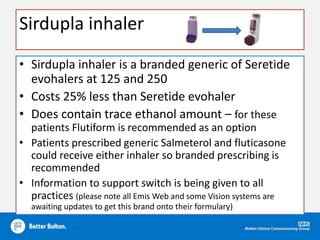
Sirdupla inhaler
• Sirdupla inhaler is a branded generic of Seretide
evohalers at 125 and 250
• Costs 25% less than Seretide evohaler
• Does contain trace ethanol amount – for these
patients Flutiform is recommended as an option
• Patients prescribed generic Salmeterol and fluticasone
could receive either inhaler so branded prescribing is
recommended
• Information to support switch is being given to all
practices (please note all Emis Web and some Vision systems are
awaiting updates to get this brand onto their formulary)
Sirdupla key info
• Only available in 125 and 250 strengths
• Only licenced in over 18s
• Licensed dose is Two Puffs Twice a day – doses
outside of this will be highlighted to practices
for review
• Patient letter will include inhaler
questionnaire to aid review of patients (best
care scores)
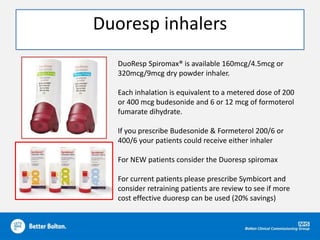
Duoresp inhalers
DuoResp Spiromax® is available 160mcg/4.5mcg or
320mcg/9mcg dry powder inhaler.
Each inhalation is equivalent to a metered dose of 200
or 400 mcg budesonide and 6 or 12 mcg of formoterol
fumarate dihydrate.
If you prescribe Budesonide & Formeterol 200/6 or
400/6 your patients could receive either inhaler
For NEW patients consider the Duoresp spiromax
For current patients please prescribe Symbicort and
consider retraining patients are review to see if more
cost effective duoresp can be used (20% savings)
Oxycontin Longtec update
• Previously recommended to consider
LONGTEC and SHORTEC brands as not
complete in strengths
• In the near future all strength will become
available so the Scriptswitch messages will
change to recommend a switch
• Cost saving of around 20% - please ensure as
few strengths prescribed as possible and
breakthrough doses are appropriate
Simple cost savings this month
• Please ensure the following are chosen
– Azithromycin tablets not capsules
– Cetirizine tablets not capsules
– Fybogel – not Fybogel Hi-Fibre
– Nebivolol 5mg tablets (can be halved but ensure
dose is tritrated) not 2.5mg
– Levothyroxine tablets not capsules
• All of these are on scriptswitch and being
highlighted in practices but please ensure all
prescribers in your practice know to avoid these
Bolton do not prescribe list
(and Bolton Maybe list)
• There are forms for you to add you ideas for the
Medicines Optimisation to bring to the next
leads meeting
• Include list of definite No items (Dental Rx, mouth
wash, purchase items, Red drugs, Paracetamol or
Ibuprofen liquid when no symptoms )
• Option to include Only if items (rosuvastatin –
atorva and simva been tried) Pregabalin –
Amitrip/gaba or SSRI tried
Repatriation of for immunosuppressants kidney
or pancreas transplant recipients
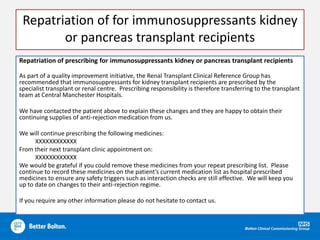
Repatriation of prescribing for immunosuppressants kidney or pancreas transplant recipients
As part of a quality improvement initiative, the Renal Transplant Clinical Reference Group has
recommended that immunosuppressants for kidney transplant recipients are prescribed by the
specialist transplant or renal centre. Prescribing responsibility is therefore transferring to the transplant
team at Central Manchester Hospitals.
We have contacted the patient above to explain these changes and they are happy to obtain their
continuing supplies of anti-rejection medication from us.
We will continue prescribing the following medicines:
XXXXXXXXXXXX
From their next transplant clinic appointment on:
XXXXXXXXXXXX
We would be grateful if you could remove these medicines from your repeat prescribing list. Please
continue to record these medicines on the patient’s current medication list as hospital prescribed
medicines to ensure any safety triggers such as interaction checks are still effective. We will keep you
up to date on changes to their anti-rejection regime.
If you require any other information please do not hesitate to contact us.
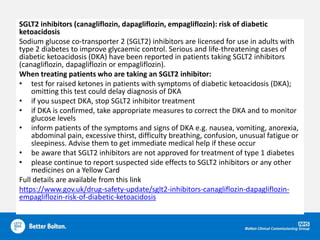
SGLT2 inhibitors (canagliflozin, dapagliflozin, empagliflozin): risk of diabetic
ketoacidosis
Sodium glucose co-transporter 2 (SGLT2) inhibitors are licensed for use in adults with
type 2 diabetes to improve glycaemic control. Serious and life-threatening cases of
diabetic ketoacidosis (DKA) have been reported in patients taking SGLT2 inhibitors
(canagliflozin, dapagliflozin or empagliflozin).
When treating patients who are taking an SGLT2 inhibitor:
• test for raised ketones in patients with symptoms of diabetic ketoacidosis (DKA);
omitting this test could delay diagnosis of DKA
• if you suspect DKA, stop SGLT2 inhibitor treatment
• if DKA is confirmed, take appropriate measures to correct the DKA and to monitor
glucose levels
• inform patients of the symptoms and signs of DKA e.g. nausea, vomiting, anorexia,
abdominal pain, excessive thirst, difficulty breathing, confusion, unusual fatigue or
sleepiness. Advise them to get immediate medical help if these occur
• be aware that SGLT2 inhibitors are not approved for treatment of type 1 diabetes
• please continue to report suspected side effects to SGLT2 inhibitors or any other
medicines on a Yellow Card
Full details are available from this link
https://www.gov.uk/drug-safety-update/sglt2-inhibitors-canagliflozin-dapagliflozin-
empagliflozin-risk-of-diabetic-ketoacidosis
Any Questions
• Thanks
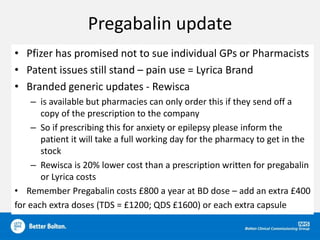
Pregabalin update
• Pfizer has promised not to sue individual GPs or Pharmacists
• Patent issues still stand – pain use = Lyrica Brand
• Branded generic updates - Rewisca
– is available but pharmacies can only order this if they send off a
copy of the prescription to the company
– So if prescribing this for anxiety or epilepsy please inform the
patient it will take a full working day for the pharmacy to get in the
stock
– Rewisca is 20% lower cost than a prescription written for pregabalin
or Lyrica costs
• Remember Pregabalin costs £800 a year at BD dose – add an extra £400
for each extra doses (TDS = £1200; QDS £1600) or each extra capsule
Recommendations from Meds Opt
• Review all naïve for gabapentin/amitriptyline
• For patients not naïve
– Where pain is an indication use Lyrica brand
– Generic pregabalin costs the practice the same as
lyrica branded prescription
– Anxiety or Epilepsy indications can be prescribed as
REWISCA brand and patient needs to be informed
that pharmacies will always have to order the stock
in for the next working day.
Vitamin D
• New licenced products are now available
• If you prescribe generic colecalciferol it will
cost around £30 a course
– Osteocaps D3 is still on our guideline and costs £2
per course
• New guidelines will be out soon but until then
please follow the current guidelines
CRB65 Screening Tool
• To be used when diagnosis of Community
Based Pneumonia is made
• Mortality in those admitted with pneumonia
is between 5 – 14%.
Diagnosis
• Cough and more than 1 LRTI symptoms
– sputum production
– Breathlessness
– wheeze
– chest pain.
• New focal chest signs on examination
• Either sweating, fever >38oC, shivers, aches
and pains
• With no other explanation.
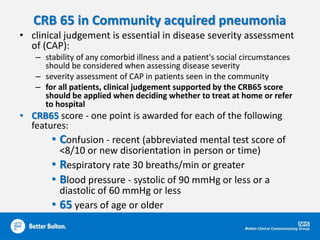
CRB 65 in Community acquired pneumonia
• clinical judgement is essential in disease severity assessment
of (CAP):
– stability of any comorbid illness and a patient's social circumstances
should be considered when assessing disease severity
– severity assessment of CAP in patients seen in the community
– for all patients, clinical judgement supported by the CRB65 score
should be applied when deciding whether to treat at home or refer
to hospital
• CRB65 score - one point is awarded for each of the following
features:
• Confusion - recent (abbreviated mental test score of
<8/10 or new disorientation in person or time)
• Respiratory rate 30 breaths/min or greater
• Blood pressure - systolic of 90 mmHg or less or a
diastolic of 60 mmHg or less
• 65 years of age or older
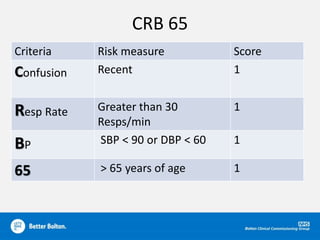
CRB 65
Criteria Risk measure Score
Confusion Recent 1
Resp Rate Greater than 30
Resps/min
1
BP SBP < 90 or DBP < 60 1
65 > 65 years of age 1
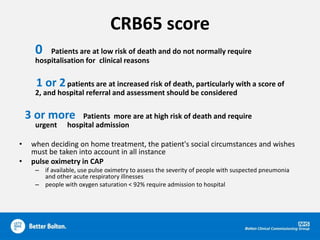
CRB65 score
0 Patients are at low risk of death and do not normally require
hospitalisation for clinical reasons
1 or 2patients are at increased risk of death, particularly with a score of
2, and hospital referral and assessment should be considered
3 or more Patients more are at high risk of death and require
urgent hospital admission
• when deciding on home treatment, the patient's social circumstances and wishes
must be taken into account in all instance
• pulse oximetry in CAP
– if available, use pulse oximetry to assess the severity of people with suspected pneumonia
and other acute respiratory illnesses
– people with oxygen saturation < 92% require admission to hospital
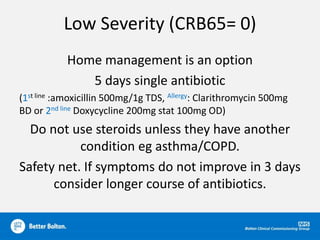
Low Severity (CRB65= 0)
Home management is an option
5 days single antibiotic
(1st line :amoxicillin 500mg/1g TDS, Allergy: Clarithromycin 500mg
BD or 2nd line Doxycycline 200mg stat 100mg OD)
Do not use steroids unless they have another
condition eg asthma/COPD.
Safety net. If symptoms do not improve in 3 days
consider longer course of antibiotics.
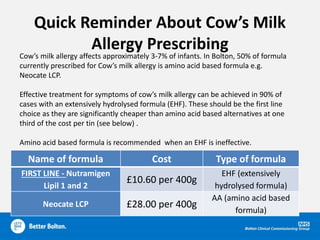
Quick Reminder About Cow’s Milk
Allergy Prescribing
Name of formula Cost Type of formula
FIRST LINE - Nutramigen
Lipil 1 and 2
£10.60 per 400g
EHF (extensively
hydrolysed formula)
Neocate LCP £28.00 per 400g
AA (amino acid based
formula)
Cow’s milk allergy affects approximately 3-7% of infants. In Bolton, 50% of formula
currently prescribed for Cow’s milk allergy is amino acid based formula e.g.
Neocate LCP.
Effective treatment for symptoms of cow’s milk allergy can be achieved in 90% of
cases with an extensively hydrolysed formula (EHF). These should be the first line
choice as they are significantly cheaper than amino acid based alternatives at one
third of the cost per tin (see below) .
Amino acid based formula is recommended when an EHF is ineffective.
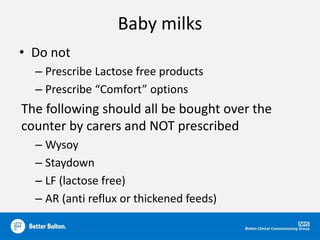
Baby milks
• Do not
– Prescribe Lactose free products
– Prescribe “Comfort” options
The following should all be bought over the
counter by carers and NOT prescribed
– Wysoy
– Staydown
– LF (lactose free)
– AR (anti reflux or thickened feeds)
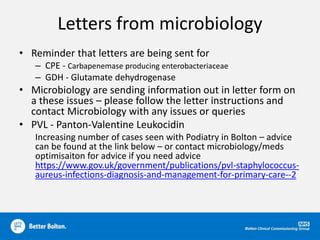
Letters from microbiology
• Reminder that letters are being sent for
– CPE - Carbapenemase producing enterobacteriaceae
– GDH - Glutamate dehydrogenase
• Microbiology are sending information out in letter form on
a these issues – please follow the letter instructions and
contact Microbiology with any issues or queries
• PVL - Panton-Valentine Leukocidin
Increasing number of cases seen with Podiatry in Bolton – advice
can be found at the link below – or contact microbiology/meds
optimisaiton for advice if you need advice
https://www.gov.uk/government/publications/pvl-staphylococcus-
aureus-infections-diagnosis-and-management-for-primary-care--2
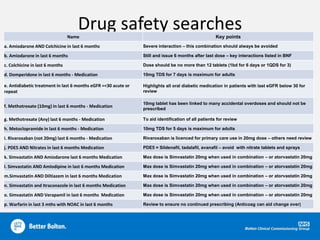
Drug safety searchesName Key points
a. Amiodarone AND Colchicine in last 6 months Severe interaction – this combination should always be avoided
b. Amiodarone in last 6 months Still and issue 6 months after last dose – key interactions listed in BNF
c. Colchicine in last 6 months Dose should be no more than 12 tablets (1bd for 6 days or 1QDS for 3)
d. Domperidone in last 6 months - Medication 10mg TDS for 7 days is maximum for adults
e. Antidiabetic treatment in last 6 months eGFR =<30 acute or
repeat
Highlights all oral diabetic medication in patients with last eGFR below 30 for
review
f. Methotrexate (10mg) in last 6 months - Medication
10mg tablet has been linked to many accidental overdoses and should not be
prescribed
g. Methotrexate (Any) last 6 months - Medication To aid identification of all patients for review
h. Metoclopramide in last 6 months - Medication 10mg TDS for 5 days is maximum for adults
i. Rivaroxaban (not 20mg) last 6 months - Medication Rivaroxaban is licenced for primary care use in 20mg dose – others need review
j. PDE5 AND Nitrates in last 6 months Medication PDE5 = Sildenafil, tadalafil, avanafil – avoid with nitrate tablets and sprays
k. Simvastatin AND Amiodarone last 6 months Medication Max dose is Simvastatin 20mg when used in combination – or atorvastatin 20mg
l. Simvastatin AND Amlodipine in last 6 months Medication Max dose is Simvastatin 20mg when used in combination – or atorvastatin 20mg
m.Simvastatin AND Diltiazem in last 6 months Medication Max dose is Simvastatin 20mg when used in combination – or atorvastatin 20mg
n. Simvastatin and Itraconazole in last 6 months Medication Max dose is Simvastatin 20mg when used in combination – or atorvastatin 20mg
o. Simvastatin AND Verapamil in last 6 months Medication Max dose is Simvastatin 20mg when used in combination – or atorvastatin 20mg
p. Warfarin in last 3 mths with NOAC in last 6 months Review to ensure no continued prescribing (Anticoag can aid change over)
Drug safety searches continued
• Practices can run as often as they wish
– Recommendation would be Quarterly
• Supporting information from Meds Opt if
needed
• MHRA alerts are online (e.g. google “MHRA
Domperidone”) or search at
https://www.gov.uk/drug-safety-update
• Further safety searches can be suggested to
Jole.Hannan@nhs.net
Previous MHRA alerts - reminders
• Aceclofenac
– avoid in patients with cardiovascular disease
• Mycophenolate
– Be vigilant for recurrent infections in transplant
patients. Consider bronchiectasis or pulmonary
fibrosis if patients develop persistent respiratory
symptoms.
• Tiotropium
– Consider if alternatives can be used in patients that
have had MI in last 6 months, cardiac arrhythmia or
Heart failure

August prescribing update

  • 1.
  • 2.
    July 2015- PRESCRIBINGUPDATE Items for this month – 1. Pregabalin – If using Rewisca – takes 24 hours for pharmacies to obtain 2. Vitamin D prices and pathway – Use Osteocaps d3 brand until new pathway is developed (costs much higher if generic colecalciferol used) 3. CRB-65 tool – Use in cases of Community Acquired Pneumonia – if one or more risk factor (over 65) consider admitting – if 3 or 4 risk factors patient is at high risk of death! 4. Baby milk update – Avoid Lactose free and only use Neocate in patients seen or referred to Paediatric dietitians 5. Safety searches – information – Searches are on all GP systems to allow practices to review MHRA alerts 6. CPE and GDH & PVL – CPE and GDH letters include instructions from Microbiology – PVL is still relatively rare but more cases are being identified in Bolton – Information is in the link attached or contact specialist that identifies PVL for advice if practice needs further information 7. CSOG updates – MHRA – Aceclofenac – only 2 prescriptions issued in April 2015 by Kearsley and Wyresdale Road – Use alternatives in Cardiac disease – Mycophenolate – flag infections or concerns early to transplant specialists – Tiotropium – no increased risk with Respimat device but do consider cardiac risks before prescribing
  • 3.
    August 2015 • Sirduplaswitch • Duoresp • Longtec/Shortec options • Transfer of patients back to specialists • Stop prescribing items • CCG do not prescribe list • SGLT2s (GLIPTINS)
  • 4.
    Sirdupla inhaler • Sirduplainhaler is a branded generic of Seretide evohalers at 125 and 250 • Costs 25% less than Seretide evohaler • Does contain trace ethanol amount – for these patients Flutiform is recommended as an option • Patients prescribed generic Salmeterol and fluticasone could receive either inhaler so branded prescribing is recommended • Information to support switch is being given to all practices (please note all Emis Web and some Vision systems are awaiting updates to get this brand onto their formulary)
  • 5.
    Sirdupla key info •Only available in 125 and 250 strengths • Only licenced in over 18s • Licensed dose is Two Puffs Twice a day – doses outside of this will be highlighted to practices for review • Patient letter will include inhaler questionnaire to aid review of patients (best care scores)
  • 6.
    Duoresp inhalers DuoResp Spiromax®is available 160mcg/4.5mcg or 320mcg/9mcg dry powder inhaler. Each inhalation is equivalent to a metered dose of 200 or 400 mcg budesonide and 6 or 12 mcg of formoterol fumarate dihydrate. If you prescribe Budesonide & Formeterol 200/6 or 400/6 your patients could receive either inhaler For NEW patients consider the Duoresp spiromax For current patients please prescribe Symbicort and consider retraining patients are review to see if more cost effective duoresp can be used (20% savings)
  • 7.
    Oxycontin Longtec update •Previously recommended to consider LONGTEC and SHORTEC brands as not complete in strengths • In the near future all strength will become available so the Scriptswitch messages will change to recommend a switch • Cost saving of around 20% - please ensure as few strengths prescribed as possible and breakthrough doses are appropriate
  • 8.
    Simple cost savingsthis month • Please ensure the following are chosen – Azithromycin tablets not capsules – Cetirizine tablets not capsules – Fybogel – not Fybogel Hi-Fibre – Nebivolol 5mg tablets (can be halved but ensure dose is tritrated) not 2.5mg – Levothyroxine tablets not capsules • All of these are on scriptswitch and being highlighted in practices but please ensure all prescribers in your practice know to avoid these
  • 9.
    Bolton do notprescribe list (and Bolton Maybe list) • There are forms for you to add you ideas for the Medicines Optimisation to bring to the next leads meeting • Include list of definite No items (Dental Rx, mouth wash, purchase items, Red drugs, Paracetamol or Ibuprofen liquid when no symptoms ) • Option to include Only if items (rosuvastatin – atorva and simva been tried) Pregabalin – Amitrip/gaba or SSRI tried
  • 10.
    Repatriation of forimmunosuppressants kidney or pancreas transplant recipients Repatriation of prescribing for immunosuppressants kidney or pancreas transplant recipients As part of a quality improvement initiative, the Renal Transplant Clinical Reference Group has recommended that immunosuppressants for kidney transplant recipients are prescribed by the specialist transplant or renal centre. Prescribing responsibility is therefore transferring to the transplant team at Central Manchester Hospitals. We have contacted the patient above to explain these changes and they are happy to obtain their continuing supplies of anti-rejection medication from us. We will continue prescribing the following medicines: XXXXXXXXXXXX From their next transplant clinic appointment on: XXXXXXXXXXXX We would be grateful if you could remove these medicines from your repeat prescribing list. Please continue to record these medicines on the patient’s current medication list as hospital prescribed medicines to ensure any safety triggers such as interaction checks are still effective. We will keep you up to date on changes to their anti-rejection regime. If you require any other information please do not hesitate to contact us.
  • 11.
    SGLT2 inhibitors (canagliflozin,dapagliflozin, empagliflozin): risk of diabetic ketoacidosis Sodium glucose co-transporter 2 (SGLT2) inhibitors are licensed for use in adults with type 2 diabetes to improve glycaemic control. Serious and life-threatening cases of diabetic ketoacidosis (DKA) have been reported in patients taking SGLT2 inhibitors (canagliflozin, dapagliflozin or empagliflozin). When treating patients who are taking an SGLT2 inhibitor: • test for raised ketones in patients with symptoms of diabetic ketoacidosis (DKA); omitting this test could delay diagnosis of DKA • if you suspect DKA, stop SGLT2 inhibitor treatment • if DKA is confirmed, take appropriate measures to correct the DKA and to monitor glucose levels • inform patients of the symptoms and signs of DKA e.g. nausea, vomiting, anorexia, abdominal pain, excessive thirst, difficulty breathing, confusion, unusual fatigue or sleepiness. Advise them to get immediate medical help if these occur • be aware that SGLT2 inhibitors are not approved for treatment of type 1 diabetes • please continue to report suspected side effects to SGLT2 inhibitors or any other medicines on a Yellow Card Full details are available from this link https://www.gov.uk/drug-safety-update/sglt2-inhibitors-canagliflozin-dapagliflozin- empagliflozin-risk-of-diabetic-ketoacidosis
  • 12.
  • 13.
    Pregabalin update • Pfizerhas promised not to sue individual GPs or Pharmacists • Patent issues still stand – pain use = Lyrica Brand • Branded generic updates - Rewisca – is available but pharmacies can only order this if they send off a copy of the prescription to the company – So if prescribing this for anxiety or epilepsy please inform the patient it will take a full working day for the pharmacy to get in the stock – Rewisca is 20% lower cost than a prescription written for pregabalin or Lyrica costs • Remember Pregabalin costs £800 a year at BD dose – add an extra £400 for each extra doses (TDS = £1200; QDS £1600) or each extra capsule
  • 14.
    Recommendations from MedsOpt • Review all naïve for gabapentin/amitriptyline • For patients not naïve – Where pain is an indication use Lyrica brand – Generic pregabalin costs the practice the same as lyrica branded prescription – Anxiety or Epilepsy indications can be prescribed as REWISCA brand and patient needs to be informed that pharmacies will always have to order the stock in for the next working day.
  • 15.
    Vitamin D • Newlicenced products are now available • If you prescribe generic colecalciferol it will cost around £30 a course – Osteocaps D3 is still on our guideline and costs £2 per course • New guidelines will be out soon but until then please follow the current guidelines
  • 16.
    CRB65 Screening Tool •To be used when diagnosis of Community Based Pneumonia is made • Mortality in those admitted with pneumonia is between 5 – 14%.
  • 17.
    Diagnosis • Cough andmore than 1 LRTI symptoms – sputum production – Breathlessness – wheeze – chest pain. • New focal chest signs on examination • Either sweating, fever >38oC, shivers, aches and pains • With no other explanation.
  • 18.
    CRB 65 inCommunity acquired pneumonia • clinical judgement is essential in disease severity assessment of (CAP): – stability of any comorbid illness and a patient's social circumstances should be considered when assessing disease severity – severity assessment of CAP in patients seen in the community – for all patients, clinical judgement supported by the CRB65 score should be applied when deciding whether to treat at home or refer to hospital • CRB65 score - one point is awarded for each of the following features: • Confusion - recent (abbreviated mental test score of <8/10 or new disorientation in person or time) • Respiratory rate 30 breaths/min or greater • Blood pressure - systolic of 90 mmHg or less or a diastolic of 60 mmHg or less • 65 years of age or older
  • 19.
    CRB 65 Criteria Riskmeasure Score Confusion Recent 1 Resp Rate Greater than 30 Resps/min 1 BP SBP < 90 or DBP < 60 1 65 > 65 years of age 1
  • 20.
    CRB65 score 0 Patientsare at low risk of death and do not normally require hospitalisation for clinical reasons 1 or 2patients are at increased risk of death, particularly with a score of 2, and hospital referral and assessment should be considered 3 or more Patients more are at high risk of death and require urgent hospital admission • when deciding on home treatment, the patient's social circumstances and wishes must be taken into account in all instance • pulse oximetry in CAP – if available, use pulse oximetry to assess the severity of people with suspected pneumonia and other acute respiratory illnesses – people with oxygen saturation < 92% require admission to hospital
  • 21.
    Low Severity (CRB65=0) Home management is an option 5 days single antibiotic (1st line :amoxicillin 500mg/1g TDS, Allergy: Clarithromycin 500mg BD or 2nd line Doxycycline 200mg stat 100mg OD) Do not use steroids unless they have another condition eg asthma/COPD. Safety net. If symptoms do not improve in 3 days consider longer course of antibiotics.
  • 22.
    Quick Reminder AboutCow’s Milk Allergy Prescribing Name of formula Cost Type of formula FIRST LINE - Nutramigen Lipil 1 and 2 £10.60 per 400g EHF (extensively hydrolysed formula) Neocate LCP £28.00 per 400g AA (amino acid based formula) Cow’s milk allergy affects approximately 3-7% of infants. In Bolton, 50% of formula currently prescribed for Cow’s milk allergy is amino acid based formula e.g. Neocate LCP. Effective treatment for symptoms of cow’s milk allergy can be achieved in 90% of cases with an extensively hydrolysed formula (EHF). These should be the first line choice as they are significantly cheaper than amino acid based alternatives at one third of the cost per tin (see below) . Amino acid based formula is recommended when an EHF is ineffective.
  • 23.
    Baby milks • Donot – Prescribe Lactose free products – Prescribe “Comfort” options The following should all be bought over the counter by carers and NOT prescribed – Wysoy – Staydown – LF (lactose free) – AR (anti reflux or thickened feeds)
  • 24.
    Letters from microbiology •Reminder that letters are being sent for – CPE - Carbapenemase producing enterobacteriaceae – GDH - Glutamate dehydrogenase • Microbiology are sending information out in letter form on a these issues – please follow the letter instructions and contact Microbiology with any issues or queries • PVL - Panton-Valentine Leukocidin Increasing number of cases seen with Podiatry in Bolton – advice can be found at the link below – or contact microbiology/meds optimisaiton for advice if you need advice https://www.gov.uk/government/publications/pvl-staphylococcus- aureus-infections-diagnosis-and-management-for-primary-care--2
  • 25.
    Drug safety searchesNameKey points a. Amiodarone AND Colchicine in last 6 months Severe interaction – this combination should always be avoided b. Amiodarone in last 6 months Still and issue 6 months after last dose – key interactions listed in BNF c. Colchicine in last 6 months Dose should be no more than 12 tablets (1bd for 6 days or 1QDS for 3) d. Domperidone in last 6 months - Medication 10mg TDS for 7 days is maximum for adults e. Antidiabetic treatment in last 6 months eGFR =<30 acute or repeat Highlights all oral diabetic medication in patients with last eGFR below 30 for review f. Methotrexate (10mg) in last 6 months - Medication 10mg tablet has been linked to many accidental overdoses and should not be prescribed g. Methotrexate (Any) last 6 months - Medication To aid identification of all patients for review h. Metoclopramide in last 6 months - Medication 10mg TDS for 5 days is maximum for adults i. Rivaroxaban (not 20mg) last 6 months - Medication Rivaroxaban is licenced for primary care use in 20mg dose – others need review j. PDE5 AND Nitrates in last 6 months Medication PDE5 = Sildenafil, tadalafil, avanafil – avoid with nitrate tablets and sprays k. Simvastatin AND Amiodarone last 6 months Medication Max dose is Simvastatin 20mg when used in combination – or atorvastatin 20mg l. Simvastatin AND Amlodipine in last 6 months Medication Max dose is Simvastatin 20mg when used in combination – or atorvastatin 20mg m.Simvastatin AND Diltiazem in last 6 months Medication Max dose is Simvastatin 20mg when used in combination – or atorvastatin 20mg n. Simvastatin and Itraconazole in last 6 months Medication Max dose is Simvastatin 20mg when used in combination – or atorvastatin 20mg o. Simvastatin AND Verapamil in last 6 months Medication Max dose is Simvastatin 20mg when used in combination – or atorvastatin 20mg p. Warfarin in last 3 mths with NOAC in last 6 months Review to ensure no continued prescribing (Anticoag can aid change over)
  • 26.
    Drug safety searchescontinued • Practices can run as often as they wish – Recommendation would be Quarterly • Supporting information from Meds Opt if needed • MHRA alerts are online (e.g. google “MHRA Domperidone”) or search at https://www.gov.uk/drug-safety-update • Further safety searches can be suggested to Jole.Hannan@nhs.net
  • 27.
    Previous MHRA alerts- reminders • Aceclofenac – avoid in patients with cardiovascular disease • Mycophenolate – Be vigilant for recurrent infections in transplant patients. Consider bronchiectasis or pulmonary fibrosis if patients develop persistent respiratory symptoms. • Tiotropium – Consider if alternatives can be used in patients that have had MI in last 6 months, cardiac arrhythmia or Heart failure

Editor's Notes

  • #20 Interesting Articles on this subject are at http://bmjopenrespres.bmj.com/content/1/1/e000038.full
  • #22 Interesting Articles on this subject are at http://bmjopenrespres.bmj.com/content/1/1/e000038.full
  • #28 Aceclofenac – only 1 prescription issued in April 2015 b y Kearsley and Wyresdale Road Mycophenolate prescribing Practice Items in April 2015 STONEHILL MEDICAL CENTRE 11 UNSWORTH GROUP PRACTICE 10 EGERTON/DUNSCAR HEALTH CENTRE 9 MANDALAY MEDICAL CENTRE 7 HEATON MEDICAL CENTRE 6 HARWOOD MEDICAL CENTRE 5 PIKES LANE 2 5 GREAT LEVER PRACTICE 4 SHANTI MEDICAL CENTRE 4 SWAN LANE MEDICAL CENTRE 4 WALMSLEY-CROMPTON HEALTH CENTRE 4 BOLTON COMMUNITY PRACTICE 3 DR MALHOTRA & PARTNERS 3 HALLIWELL SURGERY 2 3 LEVER CHAMBERS 1 3 THE DUNSTAN PARTNERSHIP 3 AL FAL MEDICAL GROUP 2 BEEHIVE SURGERY 2 CORNERSTONE SURGERY 2 EDGWORTH MEDICAL CENTRE 2 KEARSLEY MEDICAL CENTRE 2 KIRBY-CROMPTON HEALTH CENTRE 2 LEVER CHAMBERS 2 2 PIKES LANE 1 2 SPRING HOUSE SURGERY 2 STABLE FOLD SURGERY 2 BRADFORD STREET SURGERY 1 CHARLOTTE STREET SURGERY 1 DEANE MEDICAL CENTRE 1 GREAT LEVER HEALTH CENTRE 1 1 HALLIWELL SURGERY 1 1 LITTLE LEVER HEALTH CENTRE 1 1 LITTLE LEVER HEALTH CENTRE 2 1 ST HELENS ROAD PRACTICE 1 THE ALASTAIR ROSS MEDICAL PRACTICE 1 TONGE FOLD HEALTH CENTRE 1