IMRaD: Manuscript
Structure
Balamurugan Tangiisuran, PhD
Pusat Racun Negara
Universiti Sains Malaysia
bala@usm.my
@DrTangiisuran
Definition & Importance
IMRAD format
Reporting Guidelines
Summary & Questions
Content
 Standard structure of the body of
research manuscripts:
 I: Introduction
 M: Materials and Methods
 R: Results
 a: and
 D: Discussion
DEFINITION
Philip Abraham.TheIMRaD format.Retrieved on30 March2019 from
http://www.jpgmonline.com/wc_pdf/day1/1045_PA_IMRaD-3.pdf
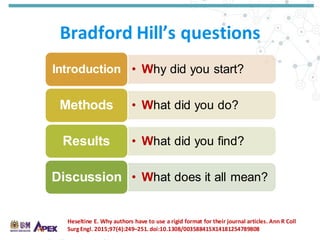
Bradford Hill’s questions
Heseltine E. Why authors have to use a rigid format for their journal articles. Ann R Coll
Surg Engl. 2015;97(4):249–251. doi:10.1308/003588415X14181254789808
• Why did you start?Introduction
• What did you do?Methods
• What did you find?Results
• What does it all mean?Discussion
wwwhww
WHAT WHY WHEN
HOW WHERE WHO
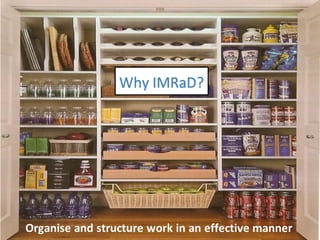
Why IMRaD?
Organise and structure work in an effective manner
IMRaD format
o IMRaD format  way of structuring a
scientific article
o Theses structured using the IMRaD
format are usually short and concise
o The language will be as plain and as
unambiguousas possible
Heseltine E. Why authors have to use a rigid format for their journal articles. Ann
R Coll Surg Engl. 2015;97(4):249–251. doi:10.1308/003588415X14181254789808
Introduction
 Inverted pyramid: general opening, sharp
rationale, objectives
 Explain what we know, and what we are
uncertain about
 Selective literature review
 Short
 End with sharp focus
Methods
 Validity and Reliability
 Shows how you arrived at your results
 Cite method papers including any
modification or adaptation
 i.e. “This was a randomised controlled
trial comparing”
Results
o Present the findings
o Organise, classify, analyse and (if
relevant) categorise
o Tables and Figures (perhaps)
o i.e. “We found that……”
Discussion
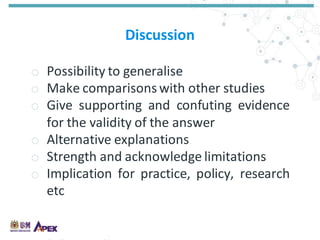
o Possibility to generalise
o Make comparisons with other studies
o Give supporting and confuting evidence
for the validity of the answer
o Alternative explanations
o Strength and acknowledge limitations
o Implication for practice, policy, research
etc
Conclusion
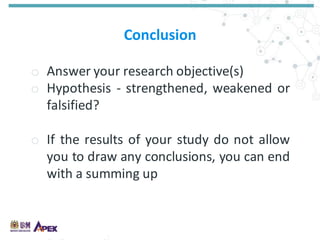
o Answer your research objective(s)
o Hypothesis - strengthened, weakened or
falsified?
o If the results of your study do not allow
you to draw any conclusions, you can end
with a summing up
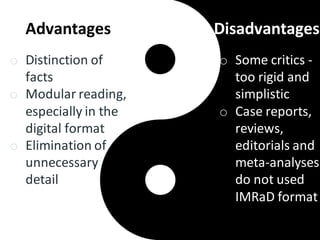
Advantages
o Distinction of
facts
o Modular reading,
especially in the
digital format
o Elimination of
unnecessary
detail
Disadvantages
o Some critics -
too rigid and
simplistic
o Case reports,
reviews,
editorials and
meta-analyses
do not used
IMRaD format
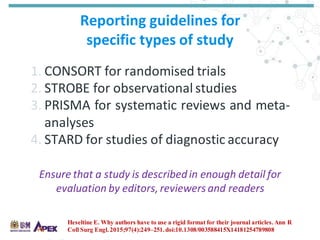
Reporting guidelines for
specific types of study
1. CONSORT for randomised trials
2. STROBE for observational studies
3. PRISMA for systematic reviews and meta-
analyses
4. STARD for studies of diagnostic accuracy
Heseltine E. Why authors have to use a rigid format for their journal articles. Ann R
Coll Surg Engl. 2015;97(4):249–251.doi:10.1308/003588415X14181254789808
Ensure that a study is describedin enough detail for
evaluation by editors,reviewers and readers
Checklists to help you get
the IMRAD structure right
Editage Insight. Checklists to help you
get the IMRAD structure right.
Retrieved from
https://www.editage.com/files/IMR
AD_checklist.pdf
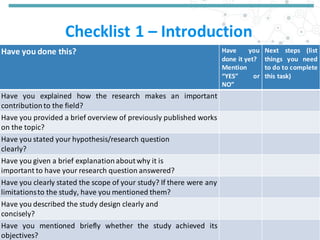
Checklist 1 – Introduction
Have you done this? Have you
done it yet?
Mention
“YES” or
NO”
Next steps (list
things you need
to do to complete
this task)
Have you explained how the research makes an important
contributionto the field?
Have you provided a brief overview of previously published works
on the topic?
Have you stated your hypothesis/research question
clearly?
Have you given a brief explanation aboutwhy it is
important to have your research question answered?
Have you clearly stated the scope of your study? If there were any
limitationsto the study, have you mentioned them?
Have you described the study design clearly and
concisely?
Have you mentioned briefly whether the study achieved its
objectives?
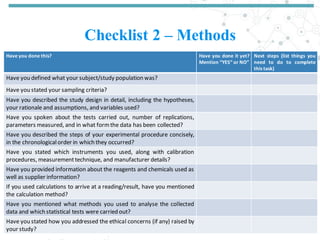
Checklist 2 – Methods
Have you done this? Have you done it yet?
Mention “YES” or NO”
Next steps (list things you
need to do to complete
this task)
Have you defined what your subject/study population was?
Have you stated your sampling criteria?
Have you described the study design in detail, including the hypotheses,
your rationale and assumptions, and variables used?
Have you spoken about the tests carried out, number of replications,
parameters measured, and in what formthe data has been collected?
Have you described the steps of your experimental procedure concisely,
in the chronologicalorder in which they occurred?
Have you stated which instruments you used, along with calibration
procedures, measurementtechnique, and manufacturer details?
Have you provided information about the reagents and chemicals used as
well as supplier information?
If you used calculations to arrive at a reading/result, have you mentioned
the calculation method?
Have you mentioned what methods you used to analyse the collected
data and which statistical tests were carried out?
Have you stated how you addressed the ethical concerns (if any) raised by
your study?
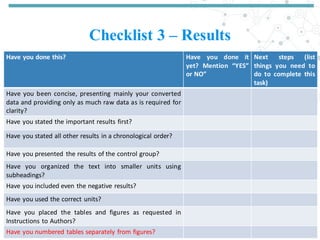
Checklist 3 – Results
Have you done this? Have you done it
yet? Mention “YES”
or NO”
Next steps (list
things you need to
do to complete this
task)
Have you been concise, presenting mainly your converted
data and providing only as much raw data as is required for
clarity?
Have you stated the important results first?
Have you stated all other results in a chronological order?
Have you presented the results of the control group?
Have you organized the text into smaller units using
subheadings?
Have you included even the negative results?
Have you used the correct units?
Have you placed the tables and figures as requested in
Instructions to Authors?
Have you numbered tables separately from figures?
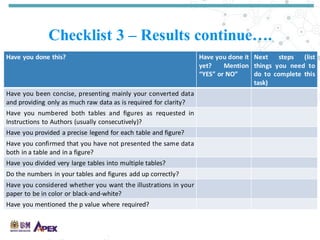
Checklist 3 – Results continue….
Have you done this? Have you done it
yet? Mention
“YES” or NO”
Next steps (list
things you need to
do to complete this
task)
Have you been concise, presenting mainly your converted data
and providing only as much raw data as is required for clarity?
Have you numbered both tables and figures as requested in
Instructions to Authors (usually consecutively)?
Have you provided a precise legend for each table and figure?
Have you confirmed that you have not presented the same data
both in a table and in a figure?
Have you divided very large tables into multiple tables?
Do the numbers in your tables and figures add up correctly?
Have you considered whether you want the illustrations in your
paper to be in color or black-and-white?
Have you mentioned the p value where required?
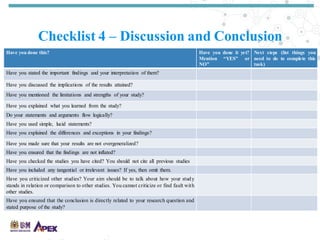
Checklist 4 – Discussion and Conclusion
Have you done this? Have you done it yet?
Mention “YES” or
NO”
Next steps (list things you
need to do to complete this
task)
Have you stated the important findings and your interpretation of them?
Have you discussed the implications of the results attained?
Have you mentioned the limitations and strengths of your study?
Have you explained what you learned from the study?
Do your statements and arguments flow logically?
Have you used simple, lucid statements?
Have you explained the differences and exceptions in your findings?
Have you made sure that your results are not overgeneralized?
Have you ensured that the findings are not inflated?
Have you checked the studies you have cited? You should not cite all previous studies
Have you included any tangential or irrelevant issues? If yes, then omit them.
Have you criticized other studies? Your aim should be to talk about how your study
stands in relation or comparison to other studies. You cannot criticize or find fault with
other studies.
Have you ensured that the conclusion is directly related to your research question and
stated purpose of the study?
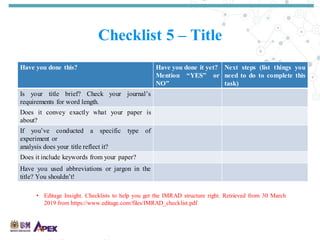
Checklist 5 – Title
Have you done this? Have you done it yet?
Mention “YES” or
NO”
Next steps (list things you
need to do to complete this
task)
Is your title brief? Check your journal’s
requirements for word length.
Does it convey exactly what your paper is
about?
If you’ve conducted a specific type of
experiment or
analysis does your title reflect it?
Does it include keywords from your paper?
Have you used abbreviations or jargon in the
title? You shouldn’t!
• Editage Insight. Checklists to help you get the IMRAD structure right. Retrieved from 30 March
2019 from https://www.editage.com/files/IMRAD_checklist.pdf
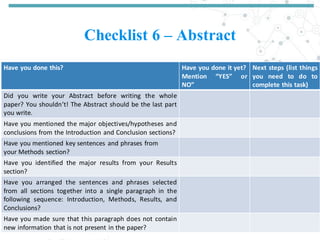
Checklist 6 – Abstract
Have you done this? Have you done it yet?
Mention “YES” or
NO”
Next steps (list things
you need to do to
complete this task)
Did you write your Abstract before writing the whole
paper? You shouldn’t! The Abstract should be the last part
you write.
Have you mentioned the major objectives/hypotheses and
conclusions from the Introduction and Conclusion sections?
Have you mentioned key sentences and phrases from
your Methods section?
Have you identified the major results from your Results
section?
Have you arranged the sentences and phrases selected
from all sections together into a single paragraph in the
following sequence: Introduction, Methods, Results, and
Conclusions?
Have you made sure that this paragraph does not contain
new information that is not present in the paper?
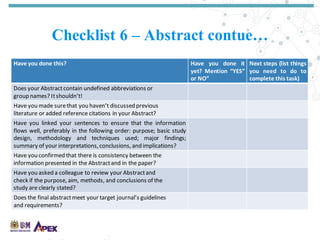
Checklist 6 – Abstract contue…
Have you done this? Have you done it
yet? Mention “YES”
or NO”
Next steps (list things
you need to do to
complete this task)
Does your Abstractcontain undefined abbreviations or
group names? Itshouldn’t!
Have you made surethat you haven’t discussed previous
literature or added reference citations in your Abstract?
Have you linked your sentences to ensure that the information
flows well, preferably in the following order: purpose; basic study
design, methodology and techniques used; major findings;
summary of your interpretations, conclusions, and implications?
Have you confirmed that there is consistency between the
information presented in the Abstractand in the paper?
Have you asked a colleague to review your Abstractand
check if the purpose, aim, methods, and conclusions of the
study are clearly stated?
Does the final abstractmeet your target journal’s guidelines
and requirements?
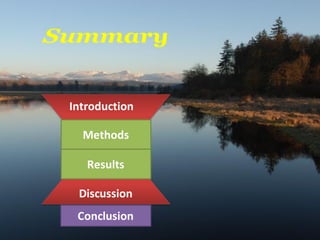
Discussion
Introduction
Methods
Results
Conclusion
Dr. BalamuruganTangiisuran
@DrTangiisuran
Dr. Balamurugan Tangiisuran | PUSAT RACUN NEGARA
b.tangiisuran@gmail.com
@DrTangiisuran

Scientific Writing Series: IMRaD

  • 1.
    IMRaD: Manuscript Structure Balamurugan Tangiisuran,PhD Pusat Racun Negara Universiti Sains Malaysia bala@usm.my @DrTangiisuran
  • 2.
    Definition & Importance IMRADformat Reporting Guidelines Summary & Questions Content
  • 3.
     Standard structureof the body of research manuscripts:  I: Introduction  M: Materials and Methods  R: Results  a: and  D: Discussion DEFINITION Philip Abraham.TheIMRaD format.Retrieved on30 March2019 from http://www.jpgmonline.com/wc_pdf/day1/1045_PA_IMRaD-3.pdf
  • 4.
    Bradford Hill’s questions HeseltineE. Why authors have to use a rigid format for their journal articles. Ann R Coll Surg Engl. 2015;97(4):249–251. doi:10.1308/003588415X14181254789808 • Why did you start?Introduction • What did you do?Methods • What did you find?Results • What does it all mean?Discussion
  • 5.
  • 6.
    Why IMRaD? Organise andstructure work in an effective manner
  • 7.
    IMRaD format o IMRaDformat  way of structuring a scientific article o Theses structured using the IMRaD format are usually short and concise o The language will be as plain and as unambiguousas possible Heseltine E. Why authors have to use a rigid format for their journal articles. Ann R Coll Surg Engl. 2015;97(4):249–251. doi:10.1308/003588415X14181254789808
  • 8.
    Introduction  Inverted pyramid:general opening, sharp rationale, objectives  Explain what we know, and what we are uncertain about  Selective literature review  Short  End with sharp focus
  • 9.
    Methods  Validity andReliability  Shows how you arrived at your results  Cite method papers including any modification or adaptation  i.e. “This was a randomised controlled trial comparing”
  • 10.
    Results o Present thefindings o Organise, classify, analyse and (if relevant) categorise o Tables and Figures (perhaps) o i.e. “We found that……”
  • 11.
    Discussion o Possibility togeneralise o Make comparisons with other studies o Give supporting and confuting evidence for the validity of the answer o Alternative explanations o Strength and acknowledge limitations o Implication for practice, policy, research etc
  • 12.
    Conclusion o Answer yourresearch objective(s) o Hypothesis - strengthened, weakened or falsified? o If the results of your study do not allow you to draw any conclusions, you can end with a summing up
  • 13.
    Advantages o Distinction of facts oModular reading, especially in the digital format o Elimination of unnecessary detail Disadvantages o Some critics - too rigid and simplistic o Case reports, reviews, editorials and meta-analyses do not used IMRaD format
  • 14.
    Reporting guidelines for specifictypes of study 1. CONSORT for randomised trials 2. STROBE for observational studies 3. PRISMA for systematic reviews and meta- analyses 4. STARD for studies of diagnostic accuracy Heseltine E. Why authors have to use a rigid format for their journal articles. Ann R Coll Surg Engl. 2015;97(4):249–251.doi:10.1308/003588415X14181254789808 Ensure that a study is describedin enough detail for evaluation by editors,reviewers and readers
  • 15.
    Checklists to helpyou get the IMRAD structure right Editage Insight. Checklists to help you get the IMRAD structure right. Retrieved from https://www.editage.com/files/IMR AD_checklist.pdf
  • 16.
    Checklist 1 –Introduction Have you done this? Have you done it yet? Mention “YES” or NO” Next steps (list things you need to do to complete this task) Have you explained how the research makes an important contributionto the field? Have you provided a brief overview of previously published works on the topic? Have you stated your hypothesis/research question clearly? Have you given a brief explanation aboutwhy it is important to have your research question answered? Have you clearly stated the scope of your study? If there were any limitationsto the study, have you mentioned them? Have you described the study design clearly and concisely? Have you mentioned briefly whether the study achieved its objectives?
  • 17.
    Checklist 2 –Methods Have you done this? Have you done it yet? Mention “YES” or NO” Next steps (list things you need to do to complete this task) Have you defined what your subject/study population was? Have you stated your sampling criteria? Have you described the study design in detail, including the hypotheses, your rationale and assumptions, and variables used? Have you spoken about the tests carried out, number of replications, parameters measured, and in what formthe data has been collected? Have you described the steps of your experimental procedure concisely, in the chronologicalorder in which they occurred? Have you stated which instruments you used, along with calibration procedures, measurementtechnique, and manufacturer details? Have you provided information about the reagents and chemicals used as well as supplier information? If you used calculations to arrive at a reading/result, have you mentioned the calculation method? Have you mentioned what methods you used to analyse the collected data and which statistical tests were carried out? Have you stated how you addressed the ethical concerns (if any) raised by your study?
  • 18.
    Checklist 3 –Results Have you done this? Have you done it yet? Mention “YES” or NO” Next steps (list things you need to do to complete this task) Have you been concise, presenting mainly your converted data and providing only as much raw data as is required for clarity? Have you stated the important results first? Have you stated all other results in a chronological order? Have you presented the results of the control group? Have you organized the text into smaller units using subheadings? Have you included even the negative results? Have you used the correct units? Have you placed the tables and figures as requested in Instructions to Authors? Have you numbered tables separately from figures?
  • 19.
    Checklist 3 –Results continue…. Have you done this? Have you done it yet? Mention “YES” or NO” Next steps (list things you need to do to complete this task) Have you been concise, presenting mainly your converted data and providing only as much raw data as is required for clarity? Have you numbered both tables and figures as requested in Instructions to Authors (usually consecutively)? Have you provided a precise legend for each table and figure? Have you confirmed that you have not presented the same data both in a table and in a figure? Have you divided very large tables into multiple tables? Do the numbers in your tables and figures add up correctly? Have you considered whether you want the illustrations in your paper to be in color or black-and-white? Have you mentioned the p value where required?
  • 20.
    Checklist 4 –Discussion and Conclusion Have you done this? Have you done it yet? Mention “YES” or NO” Next steps (list things you need to do to complete this task) Have you stated the important findings and your interpretation of them? Have you discussed the implications of the results attained? Have you mentioned the limitations and strengths of your study? Have you explained what you learned from the study? Do your statements and arguments flow logically? Have you used simple, lucid statements? Have you explained the differences and exceptions in your findings? Have you made sure that your results are not overgeneralized? Have you ensured that the findings are not inflated? Have you checked the studies you have cited? You should not cite all previous studies Have you included any tangential or irrelevant issues? If yes, then omit them. Have you criticized other studies? Your aim should be to talk about how your study stands in relation or comparison to other studies. You cannot criticize or find fault with other studies. Have you ensured that the conclusion is directly related to your research question and stated purpose of the study?
  • 21.
    Checklist 5 –Title Have you done this? Have you done it yet? Mention “YES” or NO” Next steps (list things you need to do to complete this task) Is your title brief? Check your journal’s requirements for word length. Does it convey exactly what your paper is about? If you’ve conducted a specific type of experiment or analysis does your title reflect it? Does it include keywords from your paper? Have you used abbreviations or jargon in the title? You shouldn’t! • Editage Insight. Checklists to help you get the IMRAD structure right. Retrieved from 30 March 2019 from https://www.editage.com/files/IMRAD_checklist.pdf
  • 22.
    Checklist 6 –Abstract Have you done this? Have you done it yet? Mention “YES” or NO” Next steps (list things you need to do to complete this task) Did you write your Abstract before writing the whole paper? You shouldn’t! The Abstract should be the last part you write. Have you mentioned the major objectives/hypotheses and conclusions from the Introduction and Conclusion sections? Have you mentioned key sentences and phrases from your Methods section? Have you identified the major results from your Results section? Have you arranged the sentences and phrases selected from all sections together into a single paragraph in the following sequence: Introduction, Methods, Results, and Conclusions? Have you made sure that this paragraph does not contain new information that is not present in the paper?
  • 23.
    Checklist 6 –Abstract contue… Have you done this? Have you done it yet? Mention “YES” or NO” Next steps (list things you need to do to complete this task) Does your Abstractcontain undefined abbreviations or group names? Itshouldn’t! Have you made surethat you haven’t discussed previous literature or added reference citations in your Abstract? Have you linked your sentences to ensure that the information flows well, preferably in the following order: purpose; basic study design, methodology and techniques used; major findings; summary of your interpretations, conclusions, and implications? Have you confirmed that there is consistency between the information presented in the Abstractand in the paper? Have you asked a colleague to review your Abstractand check if the purpose, aim, methods, and conclusions of the study are clearly stated? Does the final abstractmeet your target journal’s guidelines and requirements?
  • 24.
  • 25.
    Dr. BalamuruganTangiisuran @DrTangiisuran Dr. BalamuruganTangiisuran | PUSAT RACUN NEGARA b.tangiisuran@gmail.com @DrTangiisuran