Dr. Theja Huruggamuwa
 Intermittent lower-airway obstruction that is
reversible either spontaneously or as the result
of treatment
 Inflammation and edema
 Bronchial smooth-muscle spasm
 Mucous plugging
Asthma exacerbation:
symptoms that require a change in medication from
baseline
Status asthmaticus:
increasingly severe asthma that is not responsive to
drugs that are usually effective
Medical History
 Symptoms
 Coughing
 Wheezing
 Shortness of breath
 Chest tightness
 Symptom Patterns
 Severity
 Family History
 Troublesome cough, particularly at night
 Awakened by coughing
 Coughing or wheezing after physical activity
 Breathing problems during particular seasons
 Coughing, wheezing, or chest tightness after
allergen exposure
 Colds that last more than 10 days
 Relief when medication is used
 Wheezing sounds during normal breathing
 Hyperexpansion of the thorax
 Increased nasal secretions or nasal polyps
 Atopic dermatitis, eczema, or other allergic
skin conditions
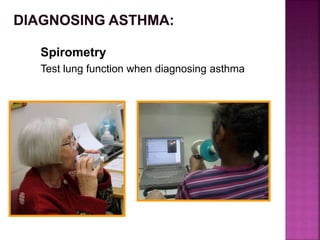
Spirometry
Test lung function when diagnosing asthma
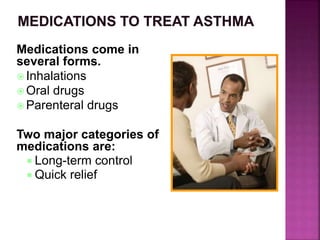
Medications come in
several forms.
 Inhalations
 Oral drugs
 Parenteral drugs
Two major categories of
medications are:
 Long-term control
 Quick relief
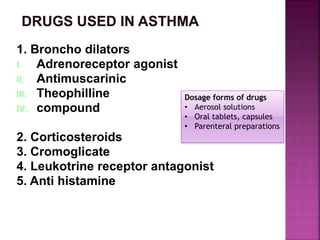
1. Broncho dilators
I. Adrenoreceptor agonist
II. Antimuscarinic
III. Theophilline
IV. compound
2. Corticosteroids
3. Cromoglicate
4. Leukotrine receptor antagonist
5. Anti histamine
Dosage forms of drugs
• Aerosol solutions
• Oral tablets, capsules
• Parenteral preparations
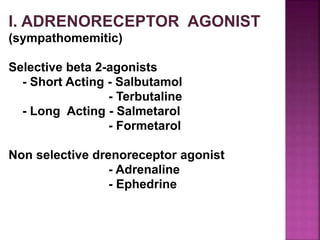
I. ADRENORECEPTOR AGONIST
(sympathomemitic)
Selective beta 2-agonists
- Short Acting - Salbutamol
- Terbutaline
- Long Acting - Salmetarol
- Formetarol
Non selective drenoreceptor agonist
- Adrenaline
- Ephedrine
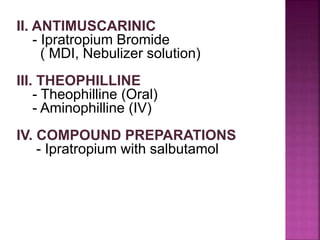
II. ANTIMUSCARINIC
- Ipratropium Bromide
( MDI, Nebulizer solution)
III. THEOPHILLINE
- Theophilline (Oral)
- Aminophilline (IV)
IV. COMPOUND PREPARATIONS
- Ipratropium with salbutamol
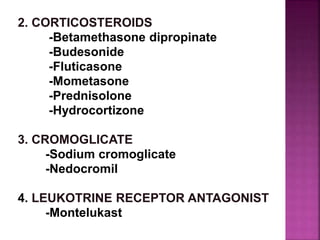
2. CORTICOSTEROIDS
-Betamethasone dipropinate
-Budesonide
-Fluticasone
-Mometasone
-Prednisolone
-Hydrocortizone
3. CROMOGLICATE
-Sodium cromoglicate
-Nedocromil
4. LEUKOTRINE RECEPTOR ANTAGONIST
-Montelukast
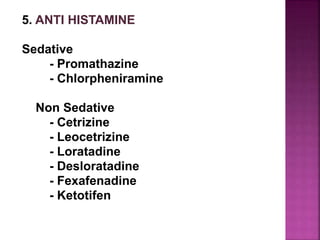
5. ANTI HISTAMINE
Sedative
- Promathazine
- Chlorpheniramine
Non Sedative
- Cetrizine
- Leocetrizine
- Loratadine
- Desloratadine
- Fexafenadine
- Ketotifen
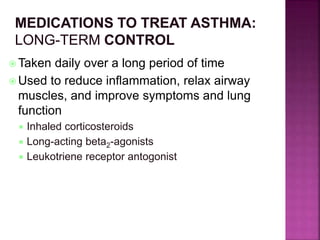
 Taken daily over a long period of time
 Used to reduce inflammation, relax airway
muscles, and improve symptoms and lung
function
 Inhaled corticosteroids
 Long-acting beta2-agonists
 Leukotriene receptor antogonist
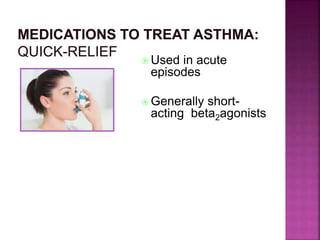
 Used in acute
episodes
 Generally short-
acting beta2agonists
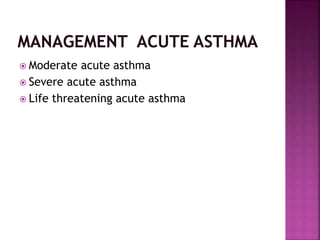
 Moderate acute asthma
 Severe acute asthma
 Life threatening acute asthma
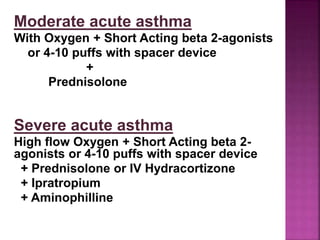
Moderate acute asthma
With Oxygen + Short Acting beta 2-agonists
or 4-10 puffs with spacer device
+
Prednisolone
Severe acute asthma
High flow Oxygen + Short Acting beta 2-
agonists or 4-10 puffs with spacer device
+ Prednisolone or IV Hydracortizone
+ Ipratropium
+ Aminophilline
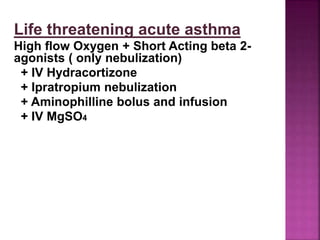
Life threatening acute asthma
High flow Oxygen + Short Acting beta 2-
agonists ( only nebulization)
+ IV Hydracortizone
+ Ipratropium nebulization
+ Aminophilline bolus and infusion
+ IV MgSO4
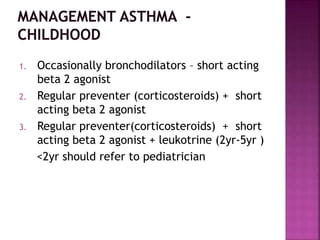
1. Occasionally bronchodilators – short acting
beta 2 agonist
2. Regular preventer (corticosteroids) + short
acting beta 2 agonist
3. Regular preventer(corticosteroids) + short
acting beta 2 agonist + leukotrine (2yr-5yr )
<2yr should refer to pediatrician
1. Occasionally bronchodilators – short acting
beta 2 agonist
2. Regular preventer(corticosteroids) + short
acting beta 2 agonist
3. Regular preventer(corticosteroids) + short
acting beta 2 agonist + long acting beta 2
agonist +(one of )leukotrine or Theophilline
or oral beta 2 agonist
4. Regular preventer(corticosteroids) + short
acting beta 2 agonist+ long acting beta 2
agonist +(one of )leukotrine or Theophilline
or oral beta 2 agonist
5. regular oral corticosteroids + no 4
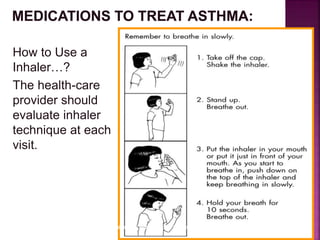
How to Use a
Inhaler…?
The health-care
provider should
evaluate inhaler
technique at each
visit.
Source: “What You and Your Family Can Do About Asthma” by the Global Initiative for
Asthma Created and funded by NIH/NHLBI
1. Take off the cap and shake well
2. Stand up or keep the thorax in straight position.
3. Keep vertically, hold with thumb and middle or index
finger
4. Keep with teeth and seal by lips (should be tightly closed)
5. Inhale through the mouth when breathing in the
medication, not the nose
6. Take a slow, deep breath at the same time you press down
on the medication canister
7. If using spacer device can exhale inside to device
8. Hold the breath for 10sec and then breath out
9. If need to use one more puff rest for 1-2 min
10.If using corticosteroids should wash the mouth and throat
11.Determine when an inhaler is empty and replace new
inhaler
Technique of using MDI inhaler
1. Remove the cap. For single use devices, load a capsule
into the device as directed.
2. Breathe out slowly and completely (not into the
mouthpiece).
3. Place the mouthpiece between the front teeth and
seal the lips around it.
4. Breathe in through the mouth quickly and deeply over
2-3 seconds.
5. Remove the inhaler from the mouth. Hold your breath
for as long as possible (4 to 10 seconds).
6. Breathe out slowly.
How to use a DPI
The instructions for using a DPI depend upon the
individual type and brand.
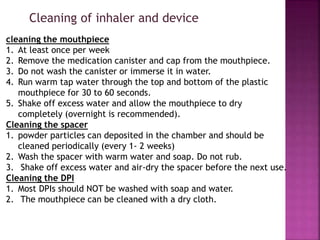
cleaning the mouthpiece
1. At least once per week
2. Remove the medication canister and cap from the mouthpiece.
3. Do not wash the canister or immerse it in water.
4. Run warm tap water through the top and bottom of the plastic
mouthpiece for 30 to 60 seconds.
5. Shake off excess water and allow the mouthpiece to dry
completely (overnight is recommended).
Cleaning the spacer
1. powder particles can deposited in the chamber and should be
cleaned periodically (every 1- 2 weeks)
2. Wash the spacer with warm water and soap. Do not rub.
3. Shake off excess water and air-dry the spacer before the next use.
Cleaning the DPI
1. Most DPIs should NOT be washed with soap and water.
2. The mouthpiece can be cleaned with a dry cloth.
Cleaning of inhaler and device
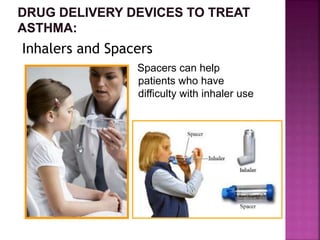
Spacers can help
patients who have
difficulty with inhaler use
Inhalers and Spacers
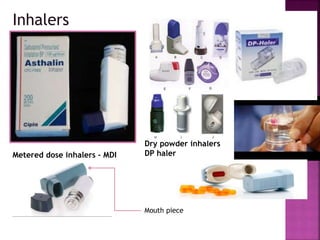
Metered dose inhalers - MDI
Dry powder inhalers
DP haler
Inhalers
Mouth piece
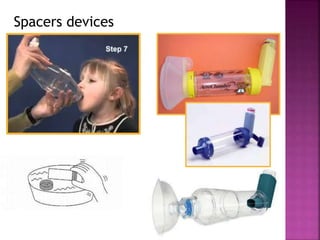
Spacers devices
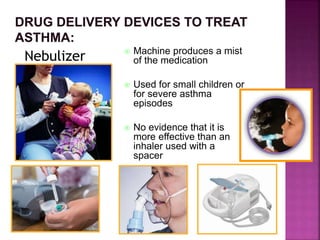
 Machine produces a mist
of the medication
 Used for small children or
for severe asthma
episodes
 No evidence that it is
more effective than an
inhaler used with a
spacer
Nebulizer
 Achieve and maintain control of symptoms
 Maintain normal activity levels, including exercise
 Maintain pulmonary function as close to normal
levels as possible
 Prevent asthma exacerbations
 Avoid adverse effects from asthma medications
 Prevent asthma mortality
• Educate patients and families about all
aspects of plan of management
• Recognizing symptoms
• Medication benefits and side effects

management of asthma

  • 1.
  • 2.
     Intermittent lower-airwayobstruction that is reversible either spontaneously or as the result of treatment  Inflammation and edema  Bronchial smooth-muscle spasm  Mucous plugging Asthma exacerbation: symptoms that require a change in medication from baseline Status asthmaticus: increasingly severe asthma that is not responsive to drugs that are usually effective
  • 3.
    Medical History  Symptoms Coughing  Wheezing  Shortness of breath  Chest tightness  Symptom Patterns  Severity  Family History
  • 4.
     Troublesome cough,particularly at night  Awakened by coughing  Coughing or wheezing after physical activity  Breathing problems during particular seasons  Coughing, wheezing, or chest tightness after allergen exposure  Colds that last more than 10 days  Relief when medication is used
  • 5.
     Wheezing soundsduring normal breathing  Hyperexpansion of the thorax  Increased nasal secretions or nasal polyps  Atopic dermatitis, eczema, or other allergic skin conditions
  • 6.
    Spirometry Test lung functionwhen diagnosing asthma
  • 7.
    Medications come in severalforms.  Inhalations  Oral drugs  Parenteral drugs Two major categories of medications are:  Long-term control  Quick relief
  • 8.
    1. Broncho dilators I.Adrenoreceptor agonist II. Antimuscarinic III. Theophilline IV. compound 2. Corticosteroids 3. Cromoglicate 4. Leukotrine receptor antagonist 5. Anti histamine Dosage forms of drugs • Aerosol solutions • Oral tablets, capsules • Parenteral preparations
  • 9.
    I. ADRENORECEPTOR AGONIST (sympathomemitic) Selectivebeta 2-agonists - Short Acting - Salbutamol - Terbutaline - Long Acting - Salmetarol - Formetarol Non selective drenoreceptor agonist - Adrenaline - Ephedrine
  • 10.
    II. ANTIMUSCARINIC - IpratropiumBromide ( MDI, Nebulizer solution) III. THEOPHILLINE - Theophilline (Oral) - Aminophilline (IV) IV. COMPOUND PREPARATIONS - Ipratropium with salbutamol
  • 11.
    2. CORTICOSTEROIDS -Betamethasone dipropinate -Budesonide -Fluticasone -Mometasone -Prednisolone -Hydrocortizone 3.CROMOGLICATE -Sodium cromoglicate -Nedocromil 4. LEUKOTRINE RECEPTOR ANTAGONIST -Montelukast
  • 12.
    5. ANTI HISTAMINE Sedative -Promathazine - Chlorpheniramine Non Sedative - Cetrizine - Leocetrizine - Loratadine - Desloratadine - Fexafenadine - Ketotifen
  • 13.
     Taken dailyover a long period of time  Used to reduce inflammation, relax airway muscles, and improve symptoms and lung function  Inhaled corticosteroids  Long-acting beta2-agonists  Leukotriene receptor antogonist
  • 14.
     Used inacute episodes  Generally short- acting beta2agonists
  • 15.
     Moderate acuteasthma  Severe acute asthma  Life threatening acute asthma
  • 16.
    Moderate acute asthma WithOxygen + Short Acting beta 2-agonists or 4-10 puffs with spacer device + Prednisolone Severe acute asthma High flow Oxygen + Short Acting beta 2- agonists or 4-10 puffs with spacer device + Prednisolone or IV Hydracortizone + Ipratropium + Aminophilline
  • 17.
    Life threatening acuteasthma High flow Oxygen + Short Acting beta 2- agonists ( only nebulization) + IV Hydracortizone + Ipratropium nebulization + Aminophilline bolus and infusion + IV MgSO4
  • 18.
    1. Occasionally bronchodilators– short acting beta 2 agonist 2. Regular preventer (corticosteroids) + short acting beta 2 agonist 3. Regular preventer(corticosteroids) + short acting beta 2 agonist + leukotrine (2yr-5yr ) <2yr should refer to pediatrician
  • 19.
    1. Occasionally bronchodilators– short acting beta 2 agonist 2. Regular preventer(corticosteroids) + short acting beta 2 agonist 3. Regular preventer(corticosteroids) + short acting beta 2 agonist + long acting beta 2 agonist +(one of )leukotrine or Theophilline or oral beta 2 agonist 4. Regular preventer(corticosteroids) + short acting beta 2 agonist+ long acting beta 2 agonist +(one of )leukotrine or Theophilline or oral beta 2 agonist 5. regular oral corticosteroids + no 4
  • 20.
    How to Usea Inhaler…? The health-care provider should evaluate inhaler technique at each visit. Source: “What You and Your Family Can Do About Asthma” by the Global Initiative for Asthma Created and funded by NIH/NHLBI
  • 21.
    1. Take offthe cap and shake well 2. Stand up or keep the thorax in straight position. 3. Keep vertically, hold with thumb and middle or index finger 4. Keep with teeth and seal by lips (should be tightly closed) 5. Inhale through the mouth when breathing in the medication, not the nose 6. Take a slow, deep breath at the same time you press down on the medication canister 7. If using spacer device can exhale inside to device 8. Hold the breath for 10sec and then breath out 9. If need to use one more puff rest for 1-2 min 10.If using corticosteroids should wash the mouth and throat 11.Determine when an inhaler is empty and replace new inhaler Technique of using MDI inhaler
  • 22.
    1. Remove thecap. For single use devices, load a capsule into the device as directed. 2. Breathe out slowly and completely (not into the mouthpiece). 3. Place the mouthpiece between the front teeth and seal the lips around it. 4. Breathe in through the mouth quickly and deeply over 2-3 seconds. 5. Remove the inhaler from the mouth. Hold your breath for as long as possible (4 to 10 seconds). 6. Breathe out slowly. How to use a DPI The instructions for using a DPI depend upon the individual type and brand.
  • 23.
    cleaning the mouthpiece 1.At least once per week 2. Remove the medication canister and cap from the mouthpiece. 3. Do not wash the canister or immerse it in water. 4. Run warm tap water through the top and bottom of the plastic mouthpiece for 30 to 60 seconds. 5. Shake off excess water and allow the mouthpiece to dry completely (overnight is recommended). Cleaning the spacer 1. powder particles can deposited in the chamber and should be cleaned periodically (every 1- 2 weeks) 2. Wash the spacer with warm water and soap. Do not rub. 3. Shake off excess water and air-dry the spacer before the next use. Cleaning the DPI 1. Most DPIs should NOT be washed with soap and water. 2. The mouthpiece can be cleaned with a dry cloth. Cleaning of inhaler and device
  • 24.
    Spacers can help patientswho have difficulty with inhaler use Inhalers and Spacers
  • 25.
    Metered dose inhalers- MDI Dry powder inhalers DP haler Inhalers Mouth piece
  • 26.
  • 27.
     Machine producesa mist of the medication  Used for small children or for severe asthma episodes  No evidence that it is more effective than an inhaler used with a spacer Nebulizer
  • 28.
     Achieve andmaintain control of symptoms  Maintain normal activity levels, including exercise  Maintain pulmonary function as close to normal levels as possible  Prevent asthma exacerbations  Avoid adverse effects from asthma medications  Prevent asthma mortality • Educate patients and families about all aspects of plan of management • Recognizing symptoms • Medication benefits and side effects