A
SEMINAR PRESENTATION
ON
“HOLOSONIC AUDIO SPOTLIGHT”
SUBMITTED BY:
AYUSH GAUTAM
11EJCEC038
JECRC 1
2
CONTENTS
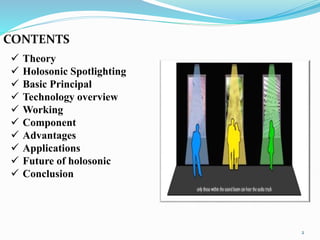
 Theory
 Holosonic Spotlighting
 Basic Principal
 Technology overview
 Working
 Component
 Advantages
 Applications
 Future of holosonic
 Conclusion
THEORY
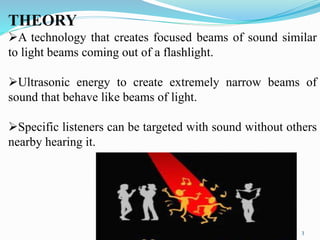
A technology that creates focused beams of sound similar
to light beams coming out of a flashlight.
Ultrasonic energy to create extremely narrow beams of
sound that behave like beams of light.
Specific listeners can be targeted with sound without others
nearby hearing it.
3
HOLOSONIC SPOTLIGHTING
The Holosonic Spotlight & Hyper Sonic Sound Technology
(developed by American Technology Corporation), uses
ultrasonic energy to create extremely narrow beams of sound
that behave like beams of light.
Audio spotlighting exploits the property of non-linearity of
air.
Sound Spotlighting is to focus sound into a coherent and
highly directional beam.
4
Basic Principle:
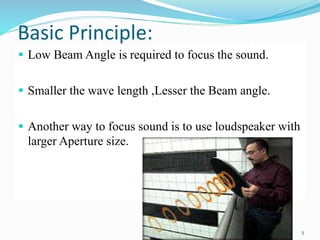
 Low Beam Angle is required to focus the sound.
 Smaller the wave length ,Lesser the Beam angle.
 Another way to focus sound is to use loudspeaker with
larger Aperture size.dio spot lighting works by
emitting harmless high frequency ultrasonic
tones that human ear cannot hear.
5
TECHNOLOGY OVERVIEW
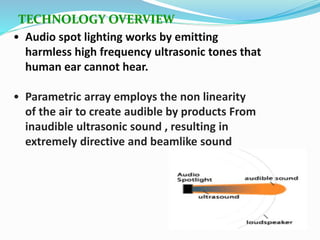
• Audio spot lighting works by emitting
harmless high frequency ultrasonic tones that
human ear cannot hear.
• Parametric array employs the non linearity
of the air to create audible by products From
inaudible ultrasonic sound , resulting in
extremely directive and beamlike sound
WORKING:-
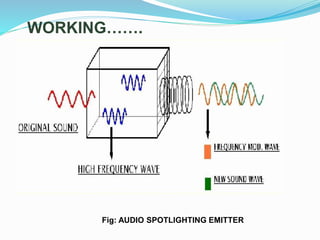
• The original low frequency sound wave such as
human speech or music is applied into an audio
spotlight emitter device.
• This low frequency signal is frequency
modulated with ultrasonic frequencies range with
wave length of few millimeters.
• Since the wavelength is smaller the beam angle
will be around 3 degree, as a result the sound beam
will be a narrow one with a small dispersion.
Fig: AUDIO SPOTLIGHTING EMITTER
WORKING…….
WORKING…….
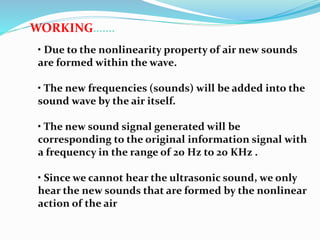
• Due to the nonlinearity property of air new sounds
are formed within the wave.
• The new frequencies (sounds) will be added into the
sound wave by the air itself.
• The new sound signal generated will be
corresponding to the original information signal with
a frequency in the range of 20 Hz to 20 KHz .
• Since we cannot hear the ultrasonic sound, we only
hear the new sounds that are formed by the nonlinear
action of the air
COMPONENT OF HOLOSONIC SPOTLIGHTING SYSTEM
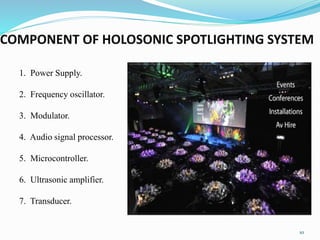
1. Power Supply.
2. Frequency oscillator.
3. Modulator.
4. Audio signal processor.
5. Microcontroller.
6. Ultrasonic amplifier.
7. Transducer.
10
11
POWER SUPPLY
 Works on DC voltage.
 Ultrasonic amplifier requires 48V DC.
 FREQUENCY OSCILLATOR
 Generates ultrasonic frequency signals in the range
of (21,000 Hz to 28,000 Hz) which is required for
the modulation of information signals.
MODULATOR
 Convert the source signal material into ultrasonic signal.
 Error correction is needed to reduce distortion without
loss of efficiency.
 AUDIO SIGNAL PROCESSOR
 Equalization and distortion control are performed in order to produce
a good quality sound signal
 ULTRASONIC
 Amplifiers amplifies the frequency modulated wave in order to
match the impedance of the integrated transducers.
 TRANSDUCER
 It is 1.27 cm thick and 17” in diameter.
 Capable of producing audibility up to 200 meters with better clarity of
sound.
 Exploit the nonlinearity property of air.
12
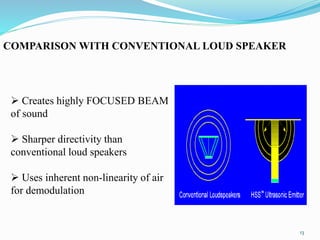
 Creates highly FOCUSED BEAM
of sound
 Sharper directivity than
conventional loud speakers
 Uses inherent non-linearity of air
for demodulation
13
COMPARISON WITH CONVENTIONAL LOUD SPEAKER
14
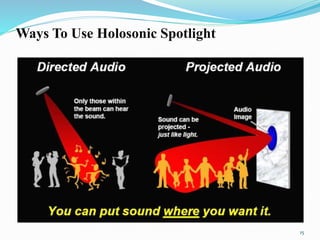
HOW TO USE HOLOSONIC SPOTLIGHT ?
There are two ways to use Audio Spotlight.
First it can direct sound at a specific target creating
a contained area of listening space which is called
“Direct Audio”.
Second it can bounce off of a second object
creating an audio image.
15
Ways To Use Holosonic Spotlight
ADVANTAGES
Can focus sound only at the place you want.
The focused or directed sound travels much faster in a straight
line than conventional loudspeakers.
Dispersion can be controlled – very narrow or wider to cover
more listening area.
Can reduce or eliminate the feedback from microphones.
Highly cost effective as the maintenance required is less as
compared to conventional loud speakers.
16
APPLICATIONS
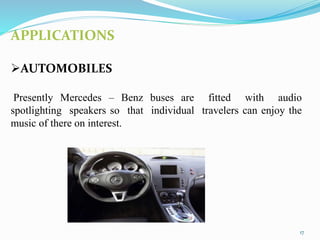
AUTOMOBILES
Presently Mercedes – Benz buses are fitted with audio
spotlighting speakers so that individual travelers can enjoy the
music of there on interest.
17
RETAIL SALES
Provide targeted directly at the point of purchase.
18
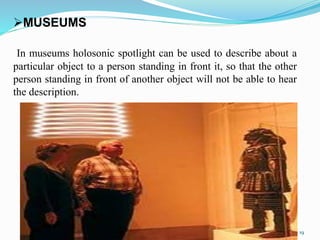
MUSEUMS
In museums holosonic spotlight can be used to describe about a
particular object to a person standing in front it, so that the other
person standing in front of another object will not be able to hear
the description.
19
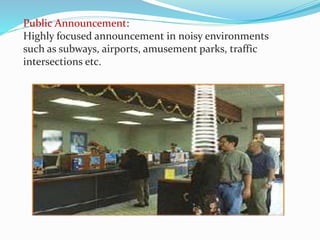
Public Announcement:
Highly focused announcement in noisy environments
such as subways, airports, amusement parks, traffic
intersections etc.
Military applications: Ship – to – ship communications and
shipboard announcements.
.
Entertainment system:
In home theatre system rear speakers can be eliminated
by the implementation of audio spotlighting and the
properties of sound can be improved
FUTURE OF AUDIO SPOT LIGHTENING
Holds the promise of replacing conventional
speakers.
It allows the user to control the
direction of propagation of sound. Will force the
people to rethink their relationship with the sound.
It really “put sound where you want it”.
CONCLUSION
Holosonic Audio spotlighting is really going to make a
revolution in sound transmission.
User can decide the path in which audio signal should
propagate.
Holosonic Audio spotlighting system is going to shape the
future of sound and will serve our ears with magical
experience.
23
24
Query
25

Holosonic audio spot light seminar ppt

  • 1.
    A SEMINAR PRESENTATION ON “HOLOSONIC AUDIOSPOTLIGHT” SUBMITTED BY: AYUSH GAUTAM 11EJCEC038 JECRC 1
  • 2.
    2 CONTENTS  Theory  HolosonicSpotlighting  Basic Principal  Technology overview  Working  Component  Advantages  Applications  Future of holosonic  Conclusion
  • 3.
    THEORY A technology thatcreates focused beams of sound similar to light beams coming out of a flashlight. Ultrasonic energy to create extremely narrow beams of sound that behave like beams of light. Specific listeners can be targeted with sound without others nearby hearing it. 3
  • 4.
    HOLOSONIC SPOTLIGHTING The HolosonicSpotlight & Hyper Sonic Sound Technology (developed by American Technology Corporation), uses ultrasonic energy to create extremely narrow beams of sound that behave like beams of light. Audio spotlighting exploits the property of non-linearity of air. Sound Spotlighting is to focus sound into a coherent and highly directional beam. 4
  • 5.
    Basic Principle:  LowBeam Angle is required to focus the sound.  Smaller the wave length ,Lesser the Beam angle.  Another way to focus sound is to use loudspeaker with larger Aperture size.dio spot lighting works by emitting harmless high frequency ultrasonic tones that human ear cannot hear. 5
  • 6.
    TECHNOLOGY OVERVIEW • Audiospot lighting works by emitting harmless high frequency ultrasonic tones that human ear cannot hear. • Parametric array employs the non linearity of the air to create audible by products From inaudible ultrasonic sound , resulting in extremely directive and beamlike sound
  • 7.
    WORKING:- • The originallow frequency sound wave such as human speech or music is applied into an audio spotlight emitter device. • This low frequency signal is frequency modulated with ultrasonic frequencies range with wave length of few millimeters. • Since the wavelength is smaller the beam angle will be around 3 degree, as a result the sound beam will be a narrow one with a small dispersion.
  • 8.
    Fig: AUDIO SPOTLIGHTINGEMITTER WORKING…….
  • 9.
    WORKING……. • Due tothe nonlinearity property of air new sounds are formed within the wave. • The new frequencies (sounds) will be added into the sound wave by the air itself. • The new sound signal generated will be corresponding to the original information signal with a frequency in the range of 20 Hz to 20 KHz . • Since we cannot hear the ultrasonic sound, we only hear the new sounds that are formed by the nonlinear action of the air
  • 10.
    COMPONENT OF HOLOSONICSPOTLIGHTING SYSTEM 1. Power Supply. 2. Frequency oscillator. 3. Modulator. 4. Audio signal processor. 5. Microcontroller. 6. Ultrasonic amplifier. 7. Transducer. 10
  • 11.
    11 POWER SUPPLY  Workson DC voltage.  Ultrasonic amplifier requires 48V DC.  FREQUENCY OSCILLATOR  Generates ultrasonic frequency signals in the range of (21,000 Hz to 28,000 Hz) which is required for the modulation of information signals. MODULATOR  Convert the source signal material into ultrasonic signal.  Error correction is needed to reduce distortion without loss of efficiency.
  • 12.
     AUDIO SIGNALPROCESSOR  Equalization and distortion control are performed in order to produce a good quality sound signal  ULTRASONIC  Amplifiers amplifies the frequency modulated wave in order to match the impedance of the integrated transducers.  TRANSDUCER  It is 1.27 cm thick and 17” in diameter.  Capable of producing audibility up to 200 meters with better clarity of sound.  Exploit the nonlinearity property of air. 12
  • 13.
     Creates highlyFOCUSED BEAM of sound  Sharper directivity than conventional loud speakers  Uses inherent non-linearity of air for demodulation 13 COMPARISON WITH CONVENTIONAL LOUD SPEAKER
  • 14.
    14 HOW TO USEHOLOSONIC SPOTLIGHT ? There are two ways to use Audio Spotlight. First it can direct sound at a specific target creating a contained area of listening space which is called “Direct Audio”. Second it can bounce off of a second object creating an audio image.
  • 15.
    15 Ways To UseHolosonic Spotlight
  • 16.
    ADVANTAGES Can focus soundonly at the place you want. The focused or directed sound travels much faster in a straight line than conventional loudspeakers. Dispersion can be controlled – very narrow or wider to cover more listening area. Can reduce or eliminate the feedback from microphones. Highly cost effective as the maintenance required is less as compared to conventional loud speakers. 16
  • 17.
    APPLICATIONS AUTOMOBILES Presently Mercedes –Benz buses are fitted with audio spotlighting speakers so that individual travelers can enjoy the music of there on interest. 17
  • 18.
    RETAIL SALES Provide targeteddirectly at the point of purchase. 18
  • 19.
    MUSEUMS In museums holosonicspotlight can be used to describe about a particular object to a person standing in front it, so that the other person standing in front of another object will not be able to hear the description. 19
  • 20.
    Public Announcement: Highly focusedannouncement in noisy environments such as subways, airports, amusement parks, traffic intersections etc.
  • 21.
    Military applications: Ship– to – ship communications and shipboard announcements. . Entertainment system: In home theatre system rear speakers can be eliminated by the implementation of audio spotlighting and the properties of sound can be improved
  • 22.
    FUTURE OF AUDIOSPOT LIGHTENING Holds the promise of replacing conventional speakers. It allows the user to control the direction of propagation of sound. Will force the people to rethink their relationship with the sound. It really “put sound where you want it”.
  • 23.
    CONCLUSION Holosonic Audio spotlightingis really going to make a revolution in sound transmission. User can decide the path in which audio signal should propagate. Holosonic Audio spotlighting system is going to shape the future of sound and will serve our ears with magical experience. 23
  • 24.
  • 25.