BY:
Niaz Hussain
niaz.hussain@iba-suk.edu.pk
Department Of electrical Enginnering at
Sukkur IBA
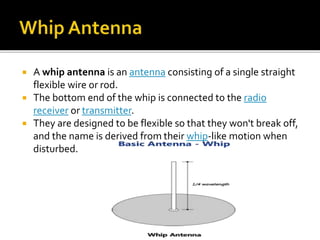
 A whip antenna is an antenna consisting of a single straight
flexible wire or rod.
 The bottom end of the whip is connected to the radio
receiver or transmitter.
 They are designed to be flexible so that they won't break off,
and the name is derived from their whip-like motion when
disturbed.
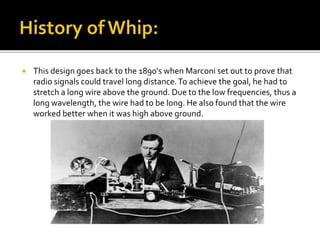
 This design goes back to the 1890's when Marconi set out to prove that
radio signals could travel long distance.To achieve the goal, he had to
stretch a long wire above the ground. Due to the low frequencies, thus a
long wavelength, the wire had to be long. He also found that the wire
worked better when it was high above ground.
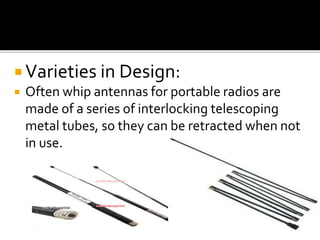
 Varieties in Design:
 Often whip antennas for portable radios are
made of a series of interlocking telescoping
metal tubes, so they can be retracted when not
in use.
 The whip can be made as a trace on a printed
circuit board (PCB).This is very practical at
frequencies over 800 MHz.
Length:
 The length of the antenna rod is determined by
the wavelength of the radio waves used.
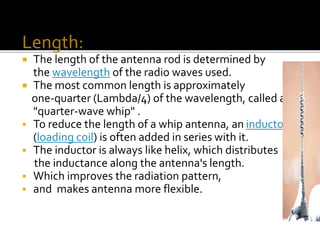
 The most common length is approximately
one-quarter (Lambda/4) of the wavelength, called a
"quarter-wave whip" .
 To reduce the length of a whip antenna, an inductor
(loading coil) is often added in series with it.
 The inductor is always like helix, which distributes
the inductance along the antenna's length.
 Which improves the radiation pattern,
 and makes antenna more flexible.
 Gain and radiation resistance:
 If mounted above a perfect ground plane, a quarter-wave whip has
a gain twice that of a half wave dipole, or 5.19dBi.
 radiation resistance of 36.8ohms.
 However without a ground plane the gain is reduced
 and the radiation resistance increased.
 Whips mounted on vehicles use the metal skin of the vehicle as a
ground plane.
 In hand-held devices usually no explicit ground plane is provided,
and the ground side of the antenna's feed line is just connected to
the ground on the device's circuit board.
 [Therefore the radio itself, and possibly the user's hand, serves as a
rudimentary ground plane.
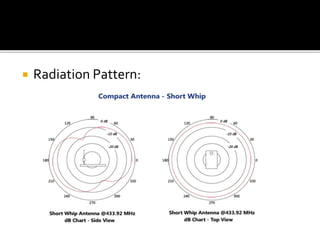
 Radiation Pattern:
Features:
 A whip-style antenna provides exceptional
performance and stability.
 A straight whip has a wide bandwidth and is
easily designed and integrated.
 A whip can also be made by cutting a piece of
wire or rod to the appropriate length.
 It can be used in HF and UHF bands.
 widely used for hand-held radios such as
 cell phones,
 cordless phones,
 walkie-talkies,
 FM radios,
 boom boxes,
 Wifi
 GPS receivers.
 Also attached to vehicles as the antennas for
car radios
 two way radios for police,
 fire and aircraft.
 Larger versions mounted on roofs or radio
masts are used as base station antennas for
police, fire, ambulance, taxi and other vehicle
dispatchers.
Whip antenna
Whip antenna

Whip antenna

  • 1.
  • 2.
     A whipantenna is an antenna consisting of a single straight flexible wire or rod.  The bottom end of the whip is connected to the radio receiver or transmitter.  They are designed to be flexible so that they won't break off, and the name is derived from their whip-like motion when disturbed.
  • 3.
     This designgoes back to the 1890's when Marconi set out to prove that radio signals could travel long distance.To achieve the goal, he had to stretch a long wire above the ground. Due to the low frequencies, thus a long wavelength, the wire had to be long. He also found that the wire worked better when it was high above ground.
  • 4.
     Varieties inDesign:  Often whip antennas for portable radios are made of a series of interlocking telescoping metal tubes, so they can be retracted when not in use.
  • 7.
     The whipcan be made as a trace on a printed circuit board (PCB).This is very practical at frequencies over 800 MHz.
  • 8.
    Length:  The lengthof the antenna rod is determined by the wavelength of the radio waves used.  The most common length is approximately one-quarter (Lambda/4) of the wavelength, called a "quarter-wave whip" .  To reduce the length of a whip antenna, an inductor (loading coil) is often added in series with it.  The inductor is always like helix, which distributes the inductance along the antenna's length.  Which improves the radiation pattern,  and makes antenna more flexible.
  • 9.
     Gain andradiation resistance:  If mounted above a perfect ground plane, a quarter-wave whip has a gain twice that of a half wave dipole, or 5.19dBi.  radiation resistance of 36.8ohms.  However without a ground plane the gain is reduced  and the radiation resistance increased.  Whips mounted on vehicles use the metal skin of the vehicle as a ground plane.  In hand-held devices usually no explicit ground plane is provided, and the ground side of the antenna's feed line is just connected to the ground on the device's circuit board.  [Therefore the radio itself, and possibly the user's hand, serves as a rudimentary ground plane.
  • 10.
  • 11.
    Features:  A whip-styleantenna provides exceptional performance and stability.  A straight whip has a wide bandwidth and is easily designed and integrated.  A whip can also be made by cutting a piece of wire or rod to the appropriate length.
  • 12.
     It canbe used in HF and UHF bands.  widely used for hand-held radios such as  cell phones,  cordless phones,  walkie-talkies,  FM radios,  boom boxes,  Wifi  GPS receivers.
  • 14.
     Also attachedto vehicles as the antennas for car radios  two way radios for police,  fire and aircraft.  Larger versions mounted on roofs or radio masts are used as base station antennas for police, fire, ambulance, taxi and other vehicle dispatchers.