Surround Sound Presented by:-
What Is Surround Sound?   Refers to the use of multiple audio tracks to envelop the movie watching or music listening audience. And making them feel like they're in the middle of the action or a concert.
 
The surround sound allows the audience to hear sounds coming from all around them. "Suspended disbelief" is when the audience is completely captivated by the movie experience and is no longer aware of their real-world surroundings.
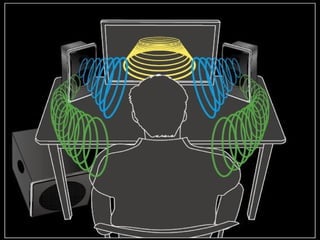
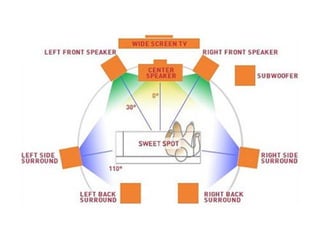
There is one center speaker which carries most of the dialogue and part of the soundtrack.  There are left and right front speakers that carry most of the soundtrack and may carry parts of the dialogue
There is a pair of surround sound speakers that is placed to the side (and slightly above) of the audience to provide the surround sound and ambient effects.   Finally, a subwoofer can be used to reproduce the low and very low frequency effects (LFE) that come with certain movies
 
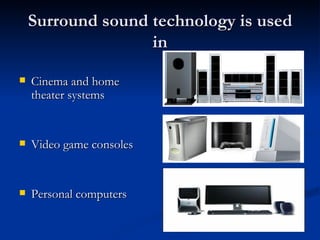
Surround sound technology is used in Cinema and home theater systems Video game consoles Personal computers
Monoaural The simplest method, and the one used in the earliest sound movies, is called  monaural  or simply  mono . Mono means that all the sound is recorded onto one  audio track  or  channel
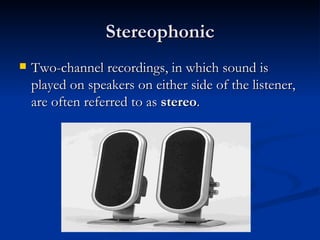
Stereophonic Two-channel recordings, in which sound is played on speakers on either side of the listener, are often referred to as  stereo .
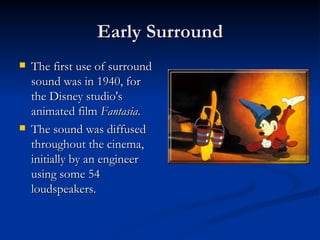
Early Surround The first use of surround sound was in 1940, for the Disney studio's animated film  Fantasia .  The sound was diffused throughout the cinema, initially by an engineer using some 54 loudspeakers.
Creating surround sound The first and simplest method is using a surround sound recording microphone technique   A second approach is processing the audio with psychoacoustic sound localization methods   A third approach, based on Huygens' principle,
Monophonic Sound   Monophonic sound is a single-channel, unidirectional type of sound reproduction. To the ear, all the elements of the sound, voice, instruments, effects, etc... appear to originate from the same point in space.
Stereophonic Sound   Stereophonic Sound is a more open type of sound reproduction  Although not totally realistic, stereophonic sound lets the listener experience the correct sound staging of the performance.
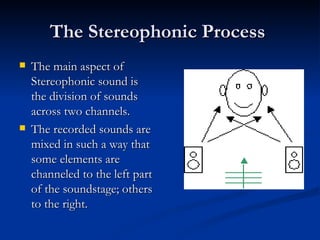
The Stereophonic Process  The main aspect of Stereophonic sound is the division of sounds across two channels. The recorded sounds are mixed in such a way that some elements are channeled to the left part of the soundstage; others to the right.
Limitations Of Stereo Sound  Some recordings resulted in a "ping-pong" effect. Also, even though the sound was more realistic, the lack of ambience information, such as acoustics or other elements, left Stereophonic sound with a "wall effect"
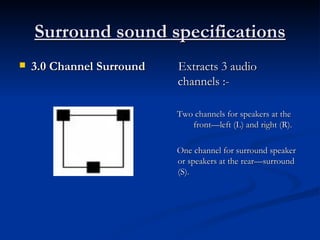
Surround sound specifications 3.0 Channel Surround Extracts 3 audio  channels :- Two channels for speakers at the  front—left (L) and right (R).  One channel for surround speaker or speakers at the rear—surround (S).
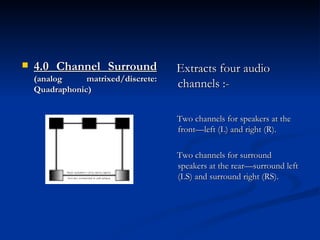
4.0 Channel Surround   (analog matrixed/discrete: Quadraphonic) Extracts four audio channels :- Two channels for speakers at the front—left (L) and right (R).  Two channels for surround speakers at the rear—surround left (LS) and surround right (RS).
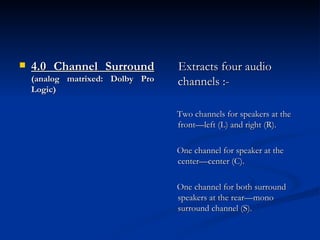
4.0 Channel Surround   (analog matrixed: Dolby Pro Logic) Extracts four audio channels :- Two channels for speakers at the front—left (L) and right (R).  One channel for speaker at the center—center (C).  One channel for both surround speakers at the rear—mono surround channel (S).
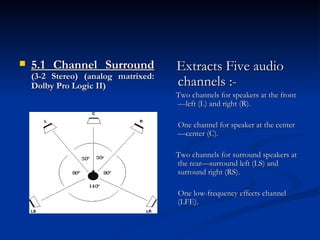
5.1 Channel Surround   (3-2 Stereo) (analog matrixed: Dolby Pro Logic II) Extracts Five audio channels :- Two channels for speakers at the front—left (L) and right (R).  One channel for speaker at the center—center (C).  Two channels for surround speakers at the rear—surround left (LS) and surround right (RS).  One low-frequency effects channel (LFE).
6.1 Channel Surround   (analog matrixed: Dolby Pro Logic IIx) Extracts six audio channels and one low-frequency channel :- Two channels for speakers at the front—left (L) and right (R).  One channel for speaker at the center—center (C).  Two channels for surround speakers at the sides—side left (LS) and side right (RS).  One channel for surround speakers at the rear—back surround channel (BS).
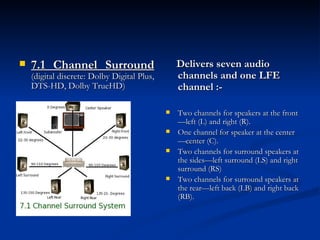
7.1 Channel Surround   (digital discrete: Dolby Digital Plus, DTS-HD, Dolby TrueHD) Delivers seven audio channels and one LFE channel  :- Two channels for speakers at the front—left (L) and right (R).  One channel for speaker at the center—center (C).  Two channels for surround speakers at the sides—left surround (LS) and right surround (RS) Two channels for surround speakers at the rear—left back (LB) and right back (RB).
Surround Sound Formats   Dolby Pro Logic   Dolby Digital   DTS   THX Surround EX
Dolby Pro Logic   It is the simplest, cheapest format.  It has 4 channels that are compressed into two analog channels, so you can record it on your stereo VCR and it can also broadcasted even over analog radio or cable TV.
Dolby Digital  It is a 6-channel format, referred to as 5.1-channel  Advantages over Dolby Pro Logic include the fact that all channels are digital, discrete and 5 of them are full-bandwidth.  Additionally, the surround speakers use separate left and right channels (stereo).
DTS  DTS  is also a 6-channel format (5.1-channel).  The main difference from Dolby Digital is that DTS uses less compression thus providing marginally better sound  DTS is less widespread than Dolby Digital.
THX Surround EX  THX Surround EX  takes the Dolby Digital signal and creates another additional matrixed channel, which is then sent to one or two surround speakers, thus giving a 6.1 or 7.1 sound.
Dolby Surround Basics  The Dolby Surround process involves encoding four channels of information--Front Left, Center, Front Right, and Rear Surround into a two channel signal  A decoding chip then decodes the four channels and sends them to the appropriate destination, the Left, Right, Rear, and Phantom Center
The Limitation Of Dolby Surround  With the rear channel being basically passive, it lacks precise directionality.  Also, overall separation between channels is much less than a typical Stereophonic recording.
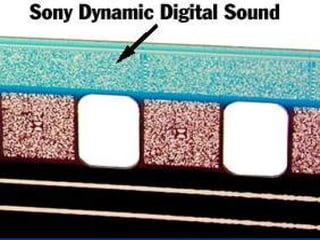
SDDS   The latest entry in cinema digital sound, Sony Dynamic Digital Sound® (SDDS) It boasts five separate channels at the front of the theater as well as left and right surround channels, for a total of eight available channels including the subwoofer.
 
Conclusion - For Now...   Today's surround sound experience is the result of decades of evolution. The surround sound experience is now easily accessible, practical, and affordable for the consumer. Go get surrounded!!!!!!!!!!!!
THANK YOU

Surround Sound

  • 1.
  • 2.
    What Is SurroundSound? Refers to the use of multiple audio tracks to envelop the movie watching or music listening audience. And making them feel like they're in the middle of the action or a concert.
  • 3.
  • 4.
    The surround soundallows the audience to hear sounds coming from all around them. "Suspended disbelief" is when the audience is completely captivated by the movie experience and is no longer aware of their real-world surroundings.
  • 5.
    There is onecenter speaker which carries most of the dialogue and part of the soundtrack.  There are left and right front speakers that carry most of the soundtrack and may carry parts of the dialogue
  • 6.
    There is apair of surround sound speakers that is placed to the side (and slightly above) of the audience to provide the surround sound and ambient effects.  Finally, a subwoofer can be used to reproduce the low and very low frequency effects (LFE) that come with certain movies
  • 7.
  • 8.
    Surround sound technologyis used in Cinema and home theater systems Video game consoles Personal computers
  • 9.
    Monoaural The simplestmethod, and the one used in the earliest sound movies, is called monaural or simply mono . Mono means that all the sound is recorded onto one audio track or channel
  • 10.
    Stereophonic Two-channel recordings,in which sound is played on speakers on either side of the listener, are often referred to as stereo .
  • 11.
    Early Surround Thefirst use of surround sound was in 1940, for the Disney studio's animated film Fantasia . The sound was diffused throughout the cinema, initially by an engineer using some 54 loudspeakers.
  • 12.
    Creating surround soundThe first and simplest method is using a surround sound recording microphone technique A second approach is processing the audio with psychoacoustic sound localization methods A third approach, based on Huygens' principle,
  • 13.
    Monophonic Sound Monophonic sound is a single-channel, unidirectional type of sound reproduction. To the ear, all the elements of the sound, voice, instruments, effects, etc... appear to originate from the same point in space.
  • 14.
    Stereophonic Sound Stereophonic Sound is a more open type of sound reproduction Although not totally realistic, stereophonic sound lets the listener experience the correct sound staging of the performance.
  • 15.
    The Stereophonic Process The main aspect of Stereophonic sound is the division of sounds across two channels. The recorded sounds are mixed in such a way that some elements are channeled to the left part of the soundstage; others to the right.
  • 16.
    Limitations Of StereoSound Some recordings resulted in a "ping-pong" effect. Also, even though the sound was more realistic, the lack of ambience information, such as acoustics or other elements, left Stereophonic sound with a "wall effect"
  • 17.
    Surround sound specifications3.0 Channel Surround Extracts 3 audio channels :- Two channels for speakers at the front—left (L) and right (R). One channel for surround speaker or speakers at the rear—surround (S).
  • 18.
    4.0 Channel Surround (analog matrixed/discrete: Quadraphonic) Extracts four audio channels :- Two channels for speakers at the front—left (L) and right (R). Two channels for surround speakers at the rear—surround left (LS) and surround right (RS).
  • 19.
    4.0 Channel Surround (analog matrixed: Dolby Pro Logic) Extracts four audio channels :- Two channels for speakers at the front—left (L) and right (R). One channel for speaker at the center—center (C). One channel for both surround speakers at the rear—mono surround channel (S).
  • 20.
    5.1 Channel Surround (3-2 Stereo) (analog matrixed: Dolby Pro Logic II) Extracts Five audio channels :- Two channels for speakers at the front—left (L) and right (R). One channel for speaker at the center—center (C). Two channels for surround speakers at the rear—surround left (LS) and surround right (RS). One low-frequency effects channel (LFE).
  • 21.
    6.1 Channel Surround (analog matrixed: Dolby Pro Logic IIx) Extracts six audio channels and one low-frequency channel :- Two channels for speakers at the front—left (L) and right (R). One channel for speaker at the center—center (C). Two channels for surround speakers at the sides—side left (LS) and side right (RS). One channel for surround speakers at the rear—back surround channel (BS).
  • 22.
    7.1 Channel Surround (digital discrete: Dolby Digital Plus, DTS-HD, Dolby TrueHD) Delivers seven audio channels and one LFE channel :- Two channels for speakers at the front—left (L) and right (R). One channel for speaker at the center—center (C). Two channels for surround speakers at the sides—left surround (LS) and right surround (RS) Two channels for surround speakers at the rear—left back (LB) and right back (RB).
  • 23.
    Surround Sound Formats Dolby Pro Logic Dolby Digital DTS THX Surround EX
  • 24.
    Dolby Pro Logic It is the simplest, cheapest format. It has 4 channels that are compressed into two analog channels, so you can record it on your stereo VCR and it can also broadcasted even over analog radio or cable TV.
  • 25.
    Dolby Digital It is a 6-channel format, referred to as 5.1-channel Advantages over Dolby Pro Logic include the fact that all channels are digital, discrete and 5 of them are full-bandwidth. Additionally, the surround speakers use separate left and right channels (stereo).
  • 26.
    DTS DTS is also a 6-channel format (5.1-channel). The main difference from Dolby Digital is that DTS uses less compression thus providing marginally better sound DTS is less widespread than Dolby Digital.
  • 27.
    THX Surround EX THX Surround EX takes the Dolby Digital signal and creates another additional matrixed channel, which is then sent to one or two surround speakers, thus giving a 6.1 or 7.1 sound.
  • 28.
    Dolby Surround Basics The Dolby Surround process involves encoding four channels of information--Front Left, Center, Front Right, and Rear Surround into a two channel signal A decoding chip then decodes the four channels and sends them to the appropriate destination, the Left, Right, Rear, and Phantom Center
  • 29.
    The Limitation OfDolby Surround With the rear channel being basically passive, it lacks precise directionality. Also, overall separation between channels is much less than a typical Stereophonic recording.
  • 30.
    SDDS The latest entry in cinema digital sound, Sony Dynamic Digital Sound® (SDDS) It boasts five separate channels at the front of the theater as well as left and right surround channels, for a total of eight available channels including the subwoofer.
  • 31.
  • 32.
    Conclusion - ForNow... Today's surround sound experience is the result of decades of evolution. The surround sound experience is now easily accessible, practical, and affordable for the consumer. Go get surrounded!!!!!!!!!!!!
  • 33.