A seminar on
AUDIO SPOTLIGHTING
Presented by
RAKESH B
(1BY06EC044)
Under the guidance of Prof. ANIL KUMAR D
CONTENTS
1. INTRODUCTION
2. THEORY
3. WORKING
4. COMPONENTS AND BLOCK DIAGRAM
5. TYPES OF MODES
6. ADVANTAGES
7. APPLICATIONS
8. CONCLUSION
9. BIBLIOGRAPHY
 Audio Spotlighting was invented by Dr. F. Joseph
Pompei.
 Production of focused beams of sound.
 Uses ultrasonic energy to create narrow beams of
sound.
 Non-linearity of the air aid the device for its
working.
 Device used: Parametric Loudspeaker or Array.
INTRODUCTION
 Audio spot lighting is a technology that creates
focused beams of sound similar to light beams
coming out of a flashlight.
 By ‘shining’ sound to one location, specific
listeners can be targeted with sound without
others nearby hearing it.
 The Audio Spotlight uses ultrasonic energy to
create extremely narrow beams of sound that
behave like beams of light.
THEORY
 Ultrasonic sound has very small wavelength in the
millimeter range and lies beyond the threshold of
human hearing.
Low Beam Angle is required to focus the sound.
Smaller the wavelength, lesser the beam angle.
Another way to focus sound is to increase aperture
size of speakers(10m diameter for 20Hz) practically
difficult.
Cont…
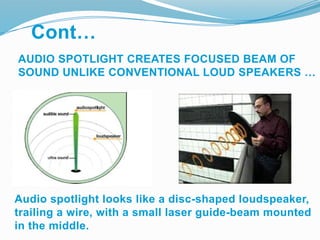
AUDIO SPOTLIGHT CREATES FOCUSED BEAM OF
SOUND UNLIKE CONVENTIONAL LOUD SPEAKERS …
Audio spotlight looks like a disc-shaped loudspeaker,
trailing a wire, with a small laser guide-beam mounted
in the middle.
Cont…
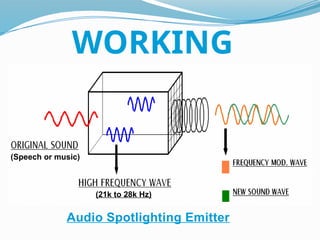
WORKING
Audio Spotlighting Emitter
(21k to 28k Hz)
(Speech or music)
Cont…
 Frequency modulated signal travels through air, non-
linearity property of air comes into action which slightly
changes the sound wave.
 Due to change in a sound wave(ultrasonic), new sounds are
formed within the wave.
 New sound signal corresponds to the original information
signal in the range 20Hz to 20kHz.
 Inherent non-linearity of the air works as a
de-modulator and thus de-modulated sounds impinge on our
eardrums. We can hear those sounds.
 The ultrasonic envelope acts as an airborne speaker.
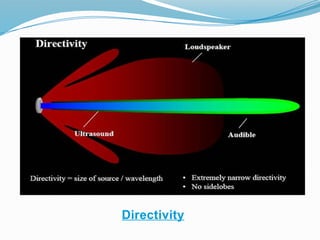
Directivity
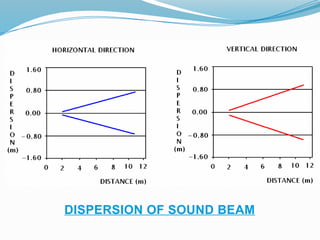
DISPERSION OF SOUND BEAM
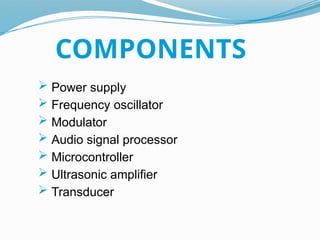
COMPONENTS
 Power supply
 Frequency oscillator
 Modulator
 Audio signal processor
 Microcontroller
 Ultrasonic amplifier
 Transducer
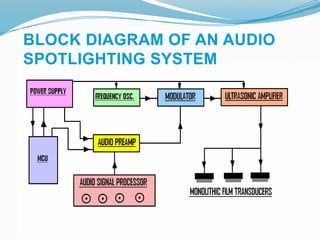
BLOCK DIAGRAM OF AN AUDIO
SPOTLIGHTING SYSTEM
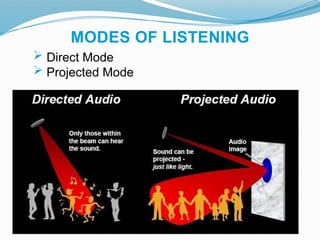
MODES OF LISTENING
 Direct Mode
 Projected Mode
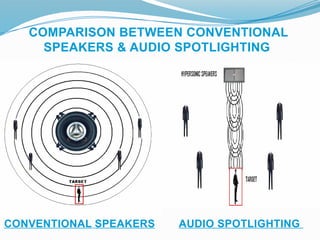
CONVENTIONAL SPEAKERS AUDIO SPOTLIGHTING
COMPARISON BETWEEN CONVENTIONAL
SPEAKERS & AUDIO SPOTLIGHTING
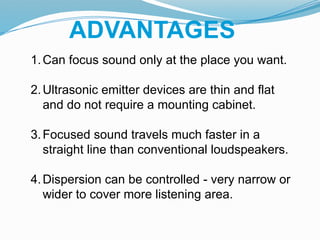
ADVANTAGES
1.Can focus sound only at the place you want.
2.Ultrasonic emitter devices are thin and flat
and do not require a mounting cabinet.
3.Focused sound travels much faster in a
straight line than conventional loudspeakers.
4.Dispersion can be controlled - very narrow or
wider to cover more listening area.
5. Highly cost effective.
6. Low maintenance and longer life span.
7. Requires low power.
8. No lag in reproducing the sound.
Cont…
APPLICATIONS
1. Automobiles: Beam alert signals can be directly
propagated from an announcement device in the
dashboard to the driver.
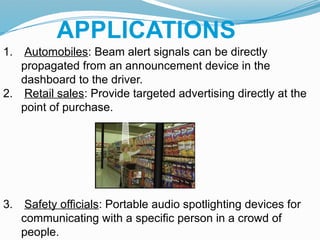
2. Retail sales: Provide targeted advertising directly at the
point of purchase.
3. Safety officials: Portable audio spotlighting devices for
communicating with a specific person in a crowd of
people.
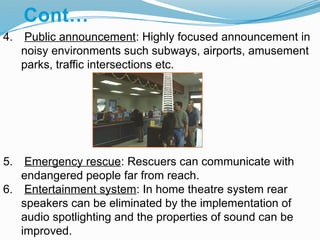
4. Public announcement: Highly focused announcement in
noisy environments such subways, airports, amusement
parks, traffic intersections etc.
5. Emergency rescue: Rescuers can communicate with
endangered people far from reach.
6. Entertainment system: In home theatre system rear
speakers can be eliminated by the implementation of
audio spotlighting and the properties of sound can be
improved.
Cont…
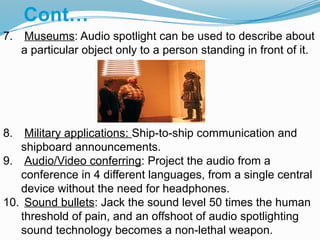
7. Museums: Audio spotlight can be used to describe about
a particular object only to a person standing in front of it.
8. Military applications: Ship-to-ship communication and
shipboard announcements.
9. Audio/Video conferring: Project the audio from a
conference in 4 different languages, from a single central
device without the need for headphones.
10. Sound bullets: Jack the sound level 50 times the human
threshold of pain, and an offshoot of audio spotlighting
sound technology becomes a non-lethal weapon.
Cont…
FUTURE OF AUDIO SPOTLIGHTING
Audio spotlighting system holds the promise of
replacing conventional speakers.
It allows the user to control the direction of
propagation of sound.
The audio spotlight will force people to think
their relationship with sound. Audio spotlighting
really “put sound where you want”.
CONCLUSION
Audio spotlighting is really going to make a revolution
in sound transmission and the user can decide the
path in which audio signal should propagate.
 Audio spotlighting system is going to shape the
future of sound and will serve our ears with magical
experience.
So we can conclude- Audio Spotlighting really “put
sound where you want it” and will be
“A REAL BOON TO THE FUTURE.”
BIBLIOGRAPHY
 F. Joseph Pompei: The use of airborne
ultrasonics for generating audible sound beams.
 www.silentsound.co.za – Silent sound.
 www.wikipedia.org - Sound from Ultrasound.
 www.howstuffworks.com
 www.holosonics.com
 Electronics For You – Vol. 40 January 2008.
THANK YOU 

70724829-Audio-Spotlighting-07-Normal.pptx

  • 1.
    A seminar on AUDIOSPOTLIGHTING Presented by RAKESH B (1BY06EC044) Under the guidance of Prof. ANIL KUMAR D
  • 2.
    CONTENTS 1. INTRODUCTION 2. THEORY 3.WORKING 4. COMPONENTS AND BLOCK DIAGRAM 5. TYPES OF MODES 6. ADVANTAGES 7. APPLICATIONS 8. CONCLUSION 9. BIBLIOGRAPHY
  • 3.
     Audio Spotlightingwas invented by Dr. F. Joseph Pompei.  Production of focused beams of sound.  Uses ultrasonic energy to create narrow beams of sound.  Non-linearity of the air aid the device for its working.  Device used: Parametric Loudspeaker or Array. INTRODUCTION
  • 4.
     Audio spotlighting is a technology that creates focused beams of sound similar to light beams coming out of a flashlight.  By ‘shining’ sound to one location, specific listeners can be targeted with sound without others nearby hearing it.  The Audio Spotlight uses ultrasonic energy to create extremely narrow beams of sound that behave like beams of light. THEORY
  • 5.
     Ultrasonic soundhas very small wavelength in the millimeter range and lies beyond the threshold of human hearing. Low Beam Angle is required to focus the sound. Smaller the wavelength, lesser the beam angle. Another way to focus sound is to increase aperture size of speakers(10m diameter for 20Hz) practically difficult. Cont…
  • 6.
    AUDIO SPOTLIGHT CREATESFOCUSED BEAM OF SOUND UNLIKE CONVENTIONAL LOUD SPEAKERS … Audio spotlight looks like a disc-shaped loudspeaker, trailing a wire, with a small laser guide-beam mounted in the middle. Cont…
  • 7.
    WORKING Audio Spotlighting Emitter (21kto 28k Hz) (Speech or music)
  • 8.
    Cont…  Frequency modulatedsignal travels through air, non- linearity property of air comes into action which slightly changes the sound wave.  Due to change in a sound wave(ultrasonic), new sounds are formed within the wave.  New sound signal corresponds to the original information signal in the range 20Hz to 20kHz.  Inherent non-linearity of the air works as a de-modulator and thus de-modulated sounds impinge on our eardrums. We can hear those sounds.  The ultrasonic envelope acts as an airborne speaker.
  • 9.
  • 10.
  • 11.
    COMPONENTS  Power supply Frequency oscillator  Modulator  Audio signal processor  Microcontroller  Ultrasonic amplifier  Transducer
  • 12.
    BLOCK DIAGRAM OFAN AUDIO SPOTLIGHTING SYSTEM
  • 13.
    MODES OF LISTENING Direct Mode  Projected Mode
  • 14.
    CONVENTIONAL SPEAKERS AUDIOSPOTLIGHTING COMPARISON BETWEEN CONVENTIONAL SPEAKERS & AUDIO SPOTLIGHTING
  • 15.
    ADVANTAGES 1.Can focus soundonly at the place you want. 2.Ultrasonic emitter devices are thin and flat and do not require a mounting cabinet. 3.Focused sound travels much faster in a straight line than conventional loudspeakers. 4.Dispersion can be controlled - very narrow or wider to cover more listening area.
  • 16.
    5. Highly costeffective. 6. Low maintenance and longer life span. 7. Requires low power. 8. No lag in reproducing the sound. Cont…
  • 17.
    APPLICATIONS 1. Automobiles: Beamalert signals can be directly propagated from an announcement device in the dashboard to the driver. 2. Retail sales: Provide targeted advertising directly at the point of purchase. 3. Safety officials: Portable audio spotlighting devices for communicating with a specific person in a crowd of people.
  • 18.
    4. Public announcement:Highly focused announcement in noisy environments such subways, airports, amusement parks, traffic intersections etc. 5. Emergency rescue: Rescuers can communicate with endangered people far from reach. 6. Entertainment system: In home theatre system rear speakers can be eliminated by the implementation of audio spotlighting and the properties of sound can be improved. Cont…
  • 19.
    7. Museums: Audiospotlight can be used to describe about a particular object only to a person standing in front of it. 8. Military applications: Ship-to-ship communication and shipboard announcements. 9. Audio/Video conferring: Project the audio from a conference in 4 different languages, from a single central device without the need for headphones. 10. Sound bullets: Jack the sound level 50 times the human threshold of pain, and an offshoot of audio spotlighting sound technology becomes a non-lethal weapon. Cont…
  • 20.
    FUTURE OF AUDIOSPOTLIGHTING Audio spotlighting system holds the promise of replacing conventional speakers. It allows the user to control the direction of propagation of sound. The audio spotlight will force people to think their relationship with sound. Audio spotlighting really “put sound where you want”.
  • 21.
    CONCLUSION Audio spotlighting isreally going to make a revolution in sound transmission and the user can decide the path in which audio signal should propagate.  Audio spotlighting system is going to shape the future of sound and will serve our ears with magical experience. So we can conclude- Audio Spotlighting really “put sound where you want it” and will be “A REAL BOON TO THE FUTURE.”
  • 22.
    BIBLIOGRAPHY  F. JosephPompei: The use of airborne ultrasonics for generating audible sound beams.  www.silentsound.co.za – Silent sound.  www.wikipedia.org - Sound from Ultrasound.  www.howstuffworks.com  www.holosonics.com  Electronics For You – Vol. 40 January 2008.
  • 23.