Presented By
N.Venkata Lokesh
2nd ECE B-section
INTRODUCTION
 Audio Spotlighting was invented by Dr. F. Joseph
Pompei developed by American technology
corporation.
 Uses ultrasonic wave as carrier signal.
 Audio spot lighting is a very recent technology that
creates a focussed beams of sound similar to light
beams coming out of a flash light.
 Specific listeners can be targeted with sound without
others nearby hearing it.
 It makes use of non-linearity property of air.
Comparison b/w conventional speakers and audio
spotlighting
How is sound into a narrow beam?
 Maintain a low beam angle that is dictated by
wavelength.
 The smaller the wavelength,the less the beam angle,
the more focussed will be the sound.
 The audio spot light uses ultrasonic energy to create
extremely narrow beams of sound .
How ultrasound wave works?
 The ultrasound column acts as a airborne speaker,and
as the beam moves through the air gradual distortion
takes place in a predictable way.this gives rise to
audible components that can be accurately predicted
and controlled
WHAT IS AUDIO SPOTLIGHTING?
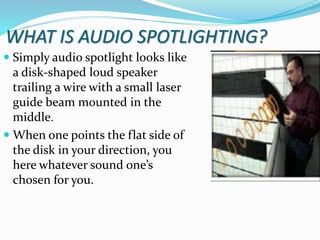
 Simply audio spotlight looks like
a disk-shaped loud speaker
trailing a wire with a small laser
guide beam mounted in the
middle.
 When one points the flat side of
the disk in your direction, you
here whatever sound one’s
chosen for you.
Range of hearing
 Human ear - 20 Hz to20,000Hz.
 No single loud speaker can operate
efficiently over such wide range of
frequencies.
 By using this technology it is
possible to design a perfect
transducer which can work over a
wide range of frequency which is
audible to the human ear.
WORKING PRINCIPLE
 The original low frequency sound wave such as human
speech or music is applied into an audio spotlight
emitter device.
 This low frequency signal is frequency modulated with
ultrasonic frequencies range with wave length of few
millimeters.
 Since the wavelength is smaller the beam angle will be
around 3 degree, as a result the sound beam will be a
narrow one with a small dispersion.
Working of audio spot light emitter
working
 Due to the nonlinearity property of air new sounds
are formed within the wave.
 The new frequencies (sounds) will be added into the
sound wave by the air itself.
 The new sound signal generated will be
corresponding to the original information signal with
a frequency in the range of 20 Hz to 20 KHz .
 Since we cannot here the ultrasonic sound, we only
hear the new sounds that are formed by the
nonlinear action of the air
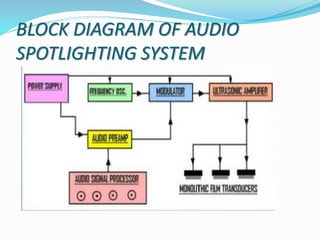
BLOCK DIAGRAM OF AUDIO
SPOTLIGHTING SYSTEM
Components of audio spotlighting
Power supply
Frequency oscillator
Modulator
Audio signal processor
Micro controller
Ultrasonic amplifier
transducer
1. Power Supply: works off DC, ultra sonic amplifier
requires 48v for working and low voltage for other
components.
2. Frequency oscillator: generates ultra sonic
frequency signals (21,000 Hz to 28,000Hz).
3. Modulator : convert the source information into
ultrasonic signals. In addition, error correction is
needed to reduce distortion without loss of energy.
4. Microcontroller: takes care of the functional management of
the system.
5. Audio signal processor: The audio signal is sent to an
electronic signal processor circuit where equalization, dynamic
range control, distortion control and precise modulation are
performed to produce a good quality sound signal.
6. Ultrasonic amplifier: High- efficiency ultrasonic power
amplifies the frequency modulated wave in order to match the
impedance of the integrated transducers. So that the output of
the emitter will be more powerful and can cover more distance.
7. Transducer : It is1.27 cm thick and17”diameter.Produces
audibility up to 200 meters with better clarity of sound.
• Has the ability of real time sound reproduction with zero
lag.
• These transducers are arranged in form of an array called
parametric array in order to propagate the ultrasonic signals
from the emitter and thereby to exploit the nonlinearity
property of air.
Modes of listening
 Direct audio
 Projected audio
Modes of listening
Direct Mode:
 Requires a clear line of approach from the sound system unit to the poi
nt where the listener can hear the audio.
 To restrict the audio in a specific area this method is appropriate.
Projected mode:
 For this mode of operation the sound beam from an emitter
is made to reflect from a reflecting surface.
 A virtual sound source creates an illusion of sound source
that emanates from a surface.
 This method is appropriate when we want to send the
information to a large number of people.
ADVANTAGES
 Small size
 Single source
 Ultimate control in audio placement
 Minimizes noise pollution
 Ease of installation
 Lowest maintenance cost
 Reduced feedback
DISADVANTAGES
 Lack of mass production i.e, each unit must be handmade.
 The most common form of distortion is clipping.
An LED on top of the Audio spotlight system reports
clipping, which is also perceptible to the listener as a kind
of a 'chirping' effect. If any signal produces distortion,
the input level of the source is reduced until perceptible
distortion is eliminated.
APPLICATIONS
 SAFETY OFFICIALS: Portable audio spotlighting
devices for communicating with a specific person in
the crowd of people.
 MUSEUMS: In museums audio spotlight can be used
to describe about a particular object to a person
standing in front of it, so that the other person
standing in front of the other object will not be able to
here the discription
 MILITARY APPS :Ship to ship communication &
shipboard announcement.
Conclusion
 Audio spotlighting system is going to shape the future
of sound and will serve our ears with magical
experience. So we can conclude- Audio Spotlighting
really “put sound where you want it” and will be
“A REAL BOON TO THE FUTURE.”
Audio spotlighting
Audio spotlighting

Audio spotlighting

  • 1.
  • 2.
    INTRODUCTION  Audio Spotlightingwas invented by Dr. F. Joseph Pompei developed by American technology corporation.  Uses ultrasonic wave as carrier signal.  Audio spot lighting is a very recent technology that creates a focussed beams of sound similar to light beams coming out of a flash light.  Specific listeners can be targeted with sound without others nearby hearing it.  It makes use of non-linearity property of air.
  • 3.
    Comparison b/w conventionalspeakers and audio spotlighting
  • 4.
    How is soundinto a narrow beam?  Maintain a low beam angle that is dictated by wavelength.  The smaller the wavelength,the less the beam angle, the more focussed will be the sound.  The audio spot light uses ultrasonic energy to create extremely narrow beams of sound .
  • 5.
    How ultrasound waveworks?  The ultrasound column acts as a airborne speaker,and as the beam moves through the air gradual distortion takes place in a predictable way.this gives rise to audible components that can be accurately predicted and controlled
  • 6.
    WHAT IS AUDIOSPOTLIGHTING?  Simply audio spotlight looks like a disk-shaped loud speaker trailing a wire with a small laser guide beam mounted in the middle.  When one points the flat side of the disk in your direction, you here whatever sound one’s chosen for you.
  • 7.
    Range of hearing Human ear - 20 Hz to20,000Hz.  No single loud speaker can operate efficiently over such wide range of frequencies.  By using this technology it is possible to design a perfect transducer which can work over a wide range of frequency which is audible to the human ear.
  • 8.
    WORKING PRINCIPLE  Theoriginal low frequency sound wave such as human speech or music is applied into an audio spotlight emitter device.  This low frequency signal is frequency modulated with ultrasonic frequencies range with wave length of few millimeters.  Since the wavelength is smaller the beam angle will be around 3 degree, as a result the sound beam will be a narrow one with a small dispersion.
  • 9.
    Working of audiospot light emitter
  • 10.
    working  Due tothe nonlinearity property of air new sounds are formed within the wave.  The new frequencies (sounds) will be added into the sound wave by the air itself.  The new sound signal generated will be corresponding to the original information signal with a frequency in the range of 20 Hz to 20 KHz .  Since we cannot here the ultrasonic sound, we only hear the new sounds that are formed by the nonlinear action of the air
  • 11.
    BLOCK DIAGRAM OFAUDIO SPOTLIGHTING SYSTEM
  • 12.
    Components of audiospotlighting Power supply Frequency oscillator Modulator Audio signal processor Micro controller Ultrasonic amplifier transducer
  • 13.
    1. Power Supply:works off DC, ultra sonic amplifier requires 48v for working and low voltage for other components. 2. Frequency oscillator: generates ultra sonic frequency signals (21,000 Hz to 28,000Hz). 3. Modulator : convert the source information into ultrasonic signals. In addition, error correction is needed to reduce distortion without loss of energy.
  • 14.
    4. Microcontroller: takescare of the functional management of the system. 5. Audio signal processor: The audio signal is sent to an electronic signal processor circuit where equalization, dynamic range control, distortion control and precise modulation are performed to produce a good quality sound signal. 6. Ultrasonic amplifier: High- efficiency ultrasonic power amplifies the frequency modulated wave in order to match the impedance of the integrated transducers. So that the output of the emitter will be more powerful and can cover more distance.
  • 15.
    7. Transducer :It is1.27 cm thick and17”diameter.Produces audibility up to 200 meters with better clarity of sound. • Has the ability of real time sound reproduction with zero lag. • These transducers are arranged in form of an array called parametric array in order to propagate the ultrasonic signals from the emitter and thereby to exploit the nonlinearity property of air.
  • 16.
    Modes of listening Direct audio  Projected audio
  • 17.
    Modes of listening DirectMode:  Requires a clear line of approach from the sound system unit to the poi nt where the listener can hear the audio.  To restrict the audio in a specific area this method is appropriate. Projected mode:  For this mode of operation the sound beam from an emitter is made to reflect from a reflecting surface.  A virtual sound source creates an illusion of sound source that emanates from a surface.  This method is appropriate when we want to send the information to a large number of people.
  • 18.
    ADVANTAGES  Small size Single source  Ultimate control in audio placement  Minimizes noise pollution  Ease of installation  Lowest maintenance cost  Reduced feedback
  • 19.
    DISADVANTAGES  Lack ofmass production i.e, each unit must be handmade.  The most common form of distortion is clipping. An LED on top of the Audio spotlight system reports clipping, which is also perceptible to the listener as a kind of a 'chirping' effect. If any signal produces distortion, the input level of the source is reduced until perceptible distortion is eliminated.
  • 20.
    APPLICATIONS  SAFETY OFFICIALS:Portable audio spotlighting devices for communicating with a specific person in the crowd of people.  MUSEUMS: In museums audio spotlight can be used to describe about a particular object to a person standing in front of it, so that the other person standing in front of the other object will not be able to here the discription  MILITARY APPS :Ship to ship communication & shipboard announcement.
  • 21.
    Conclusion  Audio spotlightingsystem is going to shape the future of sound and will serve our ears with magical experience. So we can conclude- Audio Spotlighting really “put sound where you want it” and will be “A REAL BOON TO THE FUTURE.”