DanielleCarlock
 To bring interactive, hands-on, information
literacy instruction to courses throughout the
College
 Students need hands on, web based training to
learn how to access & evaluate information
 Overcome lack of technology
 Increase student engagement & student effort
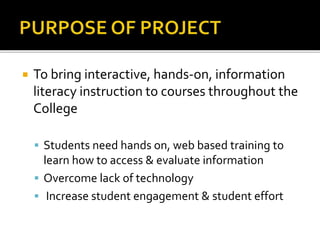
 16 iPads were funded byTIIP grant
 Faculty offered the option of scheduling library
instruction in their own classroom using iPads.
 A total of 33 iPad sessions were conducted in the
following areas:
Nursing Reading Communications
English Interior Design HRM
Biology Exercise Sci College Success
 Information literacy instruction-to teach
students how to:
 Access & evaluate information
 Use information ethically
 Instruction customized to course content,
objectives, and assignments
 BIO 181, students learn how to locate peer
reviewed, primary literature in the life
sciences using iPads.
 In COM 100, students learn how to evaluate
websites and collaboratively construct a
Google doc with their results, using iPads
 In larger classes, sharing of iPads reduced the
quality of the sessions
 Wifi connectivity
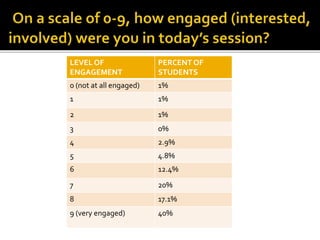
on?
LEVEL OF
ENGAGEMENT
PERCENT OF
STUDENTS
0 (not at all engaged) 1%
1 1%
2 1%
3 0%
4 2.9%
5 4.8%
6 12.4%
7 20%
8 17.1%
9 (very engaged) 40%
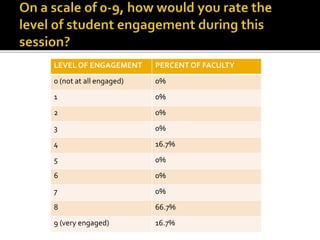
LEVEL OF ENGAGEMENT PERCENT OF FACULTY
0 (not at all engaged) 0%
1 0%
2 0%
3 0%
4 16.7%
5 0%
6 0%
7 0%
8 66.7%
9 (very engaged) 16.7%
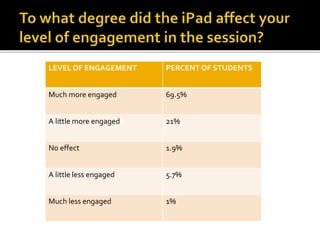
LEVEL OF ENGAGEMENT PERCENT OF STUDENTS
Much more engaged 69.5%
A little more engaged 21%
No effect 1.9%
A little less engaged 5.7%
Much less engaged 1%
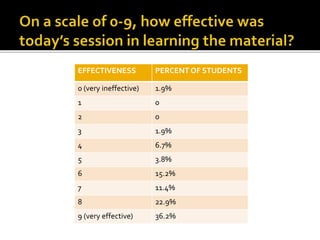
EFFECTIVENESS PERCENT OF STUDENTS
0 (very ineffective) 1.9%
1 0
2 0
3 1.9%
4 6.7%
5 3.8%
6 15.2%
7 11.4%
8 22.9%
9 (very effective) 36.2%
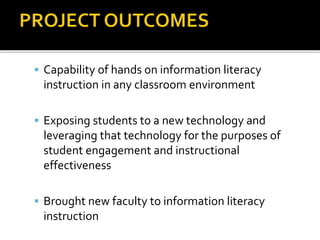
 Capability of hands on information literacy
instruction in any classroom environment
 Exposing students to a new technology and
leveraging that technology for the purposes of
student engagement and instructional
effectiveness
 Brought new faculty to information literacy
instruction

Tech tools presentation, 2012

  • 1.
  • 2.
     To bringinteractive, hands-on, information literacy instruction to courses throughout the College  Students need hands on, web based training to learn how to access & evaluate information  Overcome lack of technology  Increase student engagement & student effort
  • 3.
     16 iPadswere funded byTIIP grant  Faculty offered the option of scheduling library instruction in their own classroom using iPads.  A total of 33 iPad sessions were conducted in the following areas: Nursing Reading Communications English Interior Design HRM Biology Exercise Sci College Success
  • 4.
     Information literacyinstruction-to teach students how to:  Access & evaluate information  Use information ethically  Instruction customized to course content, objectives, and assignments
  • 5.
     BIO 181,students learn how to locate peer reviewed, primary literature in the life sciences using iPads.  In COM 100, students learn how to evaluate websites and collaboratively construct a Google doc with their results, using iPads
  • 6.
     In largerclasses, sharing of iPads reduced the quality of the sessions  Wifi connectivity
  • 7.
    on? LEVEL OF ENGAGEMENT PERCENT OF STUDENTS 0(not at all engaged) 1% 1 1% 2 1% 3 0% 4 2.9% 5 4.8% 6 12.4% 7 20% 8 17.1% 9 (very engaged) 40%
  • 8.
    LEVEL OF ENGAGEMENTPERCENT OF FACULTY 0 (not at all engaged) 0% 1 0% 2 0% 3 0% 4 16.7% 5 0% 6 0% 7 0% 8 66.7% 9 (very engaged) 16.7%
  • 9.
    LEVEL OF ENGAGEMENTPERCENT OF STUDENTS Much more engaged 69.5% A little more engaged 21% No effect 1.9% A little less engaged 5.7% Much less engaged 1%
  • 10.
    EFFECTIVENESS PERCENT OFSTUDENTS 0 (very ineffective) 1.9% 1 0 2 0 3 1.9% 4 6.7% 5 3.8% 6 15.2% 7 11.4% 8 22.9% 9 (very effective) 36.2%
  • 11.
     Capability ofhands on information literacy instruction in any classroom environment  Exposing students to a new technology and leveraging that technology for the purposes of student engagement and instructional effectiveness  Brought new faculty to information literacy instruction