Understanding Peer Reviewed,
    Scientific Literature
            BIO 105
          Spring 2013
RESEARCH ARTICLES
• Report the results of a single study or experiment

• The author(s) is/are the person(s) who conducted the
  study or experiment; i.e. it is firsthand information

• Answers: Why, how, what was found, what does it
  mean

Example: Habitat Selection, Home Range, and Activity of
  the White-Nosed Coati (Nasua narica) in a Mexican
  Tropical Dry Forest
RESEARCH ARTICLES HAVE A TYPICAL
            FORMAT
• Detailed title
• Authors with their credentials and/or
  affiliations given
• Summary/abstract
• Purpose of study & literature review
• How the study was conducted
• What was found and what it means
• Reference list
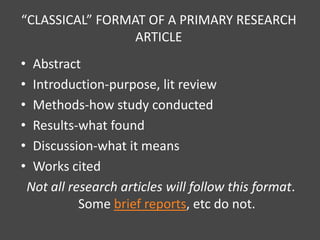
“CLASSICAL” FORMAT OF A PRIMARY RESEARCH
                 ARTICLE
•    Abstract
•    Introduction-purpose, lit review
•    Methods-how study conducted
•    Results-what found
•    Discussion-what it means
•    Works cited
    Not all research articles will follow this format.
              Some brief reports, etc do not.
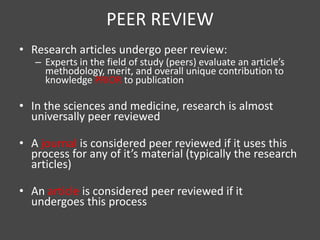
PEER REVIEW
• Research articles undergo peer review:
   – Experts in the field of study (peers) evaluate an article’s
     methodology, merit, and overall unique contribution to
     knowledge PRIOR to publication

• In the sciences and medicine, research is almost
  universally peer reviewed

• A journal is considered peer reviewed if it uses this
  process for any of it’s material (typically the research
  articles)

• An article is considered peer reviewed if it
  undergoes this process
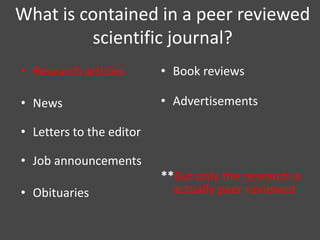
What is contained in a peer reviewed
         scientific journal?
• Research articles       • Book reviews

• News                    • Advertisements

• Letters to the editor

• Job announcements
                          **But only the research is
• Obituaries                actually peer reviewed
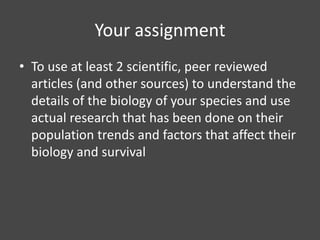
Your assignment
• To use at least 2 scientific, peer reviewed
  articles (and other sources) to understand the
  details of the biology of your species and use
  actual research that has been done on their
  population trends and factors that affect their
  biology and survival
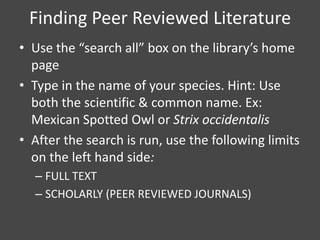
Finding Peer Reviewed Literature
• Use the “search all” box on the library’s home
  page
• Type in the name of your species. Hint: Use
  both the scientific & common name. Ex:
  Mexican Spotted Owl or Strix occidentalis
• After the search is run, use the following limits
  on the left hand side:
  – FULL TEXT
  – SCHOLARLY (PEER REVIEWED JOURNALS)
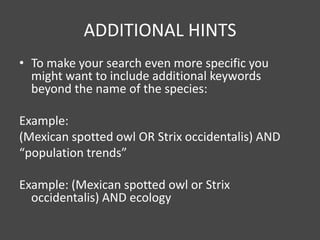
ADDITIONAL HINTS
• To make your search even more specific you
  might want to include additional keywords
  beyond the name of the species:

Example:
(Mexican spotted owl OR Strix occidentalis) AND
“population trends”

Example: (Mexican spotted owl or Strix
  occidentalis) AND ecology
For more help
• Call or come to the library whenever we are
  open
• Use our 24/7 chat assistance
• Contact Danielle Carlock at 480 425 6765 or
  d.carlock@scottsdalecc.edu

Understanding Peer Reviewed, Scientific Literature

  • 1.
    Understanding Peer Reviewed, Scientific Literature BIO 105 Spring 2013
  • 2.
    RESEARCH ARTICLES • Reportthe results of a single study or experiment • The author(s) is/are the person(s) who conducted the study or experiment; i.e. it is firsthand information • Answers: Why, how, what was found, what does it mean Example: Habitat Selection, Home Range, and Activity of the White-Nosed Coati (Nasua narica) in a Mexican Tropical Dry Forest
  • 3.
    RESEARCH ARTICLES HAVEA TYPICAL FORMAT • Detailed title • Authors with their credentials and/or affiliations given • Summary/abstract • Purpose of study & literature review • How the study was conducted • What was found and what it means • Reference list
  • 4.
    “CLASSICAL” FORMAT OFA PRIMARY RESEARCH ARTICLE • Abstract • Introduction-purpose, lit review • Methods-how study conducted • Results-what found • Discussion-what it means • Works cited Not all research articles will follow this format. Some brief reports, etc do not.
  • 5.
    PEER REVIEW • Researcharticles undergo peer review: – Experts in the field of study (peers) evaluate an article’s methodology, merit, and overall unique contribution to knowledge PRIOR to publication • In the sciences and medicine, research is almost universally peer reviewed • A journal is considered peer reviewed if it uses this process for any of it’s material (typically the research articles) • An article is considered peer reviewed if it undergoes this process
  • 6.
    What is containedin a peer reviewed scientific journal? • Research articles • Book reviews • News • Advertisements • Letters to the editor • Job announcements **But only the research is • Obituaries actually peer reviewed
  • 7.
    Your assignment • Touse at least 2 scientific, peer reviewed articles (and other sources) to understand the details of the biology of your species and use actual research that has been done on their population trends and factors that affect their biology and survival
  • 8.
    Finding Peer ReviewedLiterature • Use the “search all” box on the library’s home page • Type in the name of your species. Hint: Use both the scientific & common name. Ex: Mexican Spotted Owl or Strix occidentalis • After the search is run, use the following limits on the left hand side: – FULL TEXT – SCHOLARLY (PEER REVIEWED JOURNALS)
  • 9.
    ADDITIONAL HINTS • Tomake your search even more specific you might want to include additional keywords beyond the name of the species: Example: (Mexican spotted owl OR Strix occidentalis) AND “population trends” Example: (Mexican spotted owl or Strix occidentalis) AND ecology
  • 10.
    For more help •Call or come to the library whenever we are open • Use our 24/7 chat assistance • Contact Danielle Carlock at 480 425 6765 or d.carlock@scottsdalecc.edu