Clinical Care/Education/Nutrition
 O R I G I N A L                        A R T I C L E


A Low-Fat Vegan Diet Improves Glycemic
Control and Cardiovascular Risk Factors in
a Randomized Clinical Trial in Individuals
With Type 2 Diabetes
NEAL D. BARNARD, MD1,2                                               BRENT JASTER, MD2         used in the absence of exercise, was asso-
JOSHUA COHEN, MD1                                                    KIM SEIDL, MS, RD2        ciated with increased insulin sensitivity
DAVID J.A. JENKINS, MD, PHD3                                         AMBER A. GREEN, RD2       and reduced body weight in nondiabetic
GABRIELLE TURNER-MCGRIEVY, MS, RD4                                   STANLEY TALPERS, MD1      overweight women (4).
LISE GLOEDE, RD, CDE5                                                                               We therefore conducted a random-
                                                                                               ized controlled trial of a vegan diet with
                                                                                               exercise held constant to test the hypoth-
OBJECTIVE — We sought to investigate whether a low-fat vegan diet improves glycemic esis that, in individuals with type 2 diabe-
                                                                        Authors' credentials (medical doctors
control and cardiovascular risk factors in individuals with type 2 diabetes.                   tes, a low-fat plant-based diet improves
                                                                        and registered dieticians) plasma lipid, and weight con-
                                                                                               glycemic, are given.
RESEARCH DESIGN AND METHODS — Individuals with type 2 diabetes (n ϭ 99)
                                                                                               trol compared with a diet based on cur-
were randomly assigned to a low-fat vegan diet (n ϭ 49) or a diet following the American
Diabetes Association (ADA) guidelines (n ϭ 50). Participants were evaluated at baseline and 22 rent ADA guidelines.
weeks.
                                                                                                                                          RESEARCH DESIGN AND
RESULTS — Forty-three percent (21 of 49) of the vegan group and 26% (13 of 50) of the ADA                                                 METHODS — Individuals with type 2
group participants reduced diabetes medications. Including all participants, HbA1c (A1C) de-                                              diabetes, defined by a fasting plasma glu-
creased 0.96 percentage points in the vegan group and 0.56 points in the ADA group (P ϭ                                                   cose concentration Ͼ6.9 mmol/l on two
0.089). Excluding those who changed medications, A1C fell 1.23 points in the vegan group                                                  occasions or a prior diagnosis of type 2
compared with 0.38 points in the ADA group (P ϭ 0.01). Body weight decreased 6.5 kg in the
vegan group and 3.1 kg in the ADA group (P Ͻ 0.001). Body weight change correlated with A1C
                                                                                                                                          diabetes with the use of hypoglycemic
change (r ϭ 0.51, n ϭ 57, P Ͻ 0.0001). Among those who did not change lipid-lowering                                                      medications for Ն6 months, were re-
medications, LDL cholesterol fell 21.2% in the vegan group and 10.7% in the ADA group (P ϭ                                                                       Technical
                                                                                                                                          cruited through newspaper advertise-
0.02). After adjustment for baseline values, urinary albumin reductions were greater in the vegan                                         ments in the Washington, DC, area on
                                                                                                                                                                 language, common
group (15.9 mg/24h) than in the ADA group (10.9 mg/24 h) (P ϭ 0.013).                                                                     two occasions (October 2003 through
                                                                                                                                                                 in scholarly articles
                                                                                                                                          December 2003 and October 2004
CONCLUSIONS — Both a low-fat vegan diet and a diet based on ADA guidelines improved                                                       through December 2004) to complete the
glycemic and lipid control in type 2 diabetic patients. These improvements were greater with a                                            study from January 2004 through June
low-fat vegan diet.                                                                                                                       2004 and January 2005 through June
                                                                                                                                          2005, respectively. Exclusion criteria
                                                                                Diabetes Care 29:1777–1783, 2006
                                                                                                                                          were an HbA1c (A1C) Ͻ6.5 or Ͼ10.5%,
                                                                                                                                          use of insulin for Ͼ5 years, current smok-


D
       iabetes prevalence is relatively low                          fects. In a 12-week pilot trial of a low-fat                         ing, alcohol or drug abuse, pregnancy,
       among individuals following plant-                            vegan diet in individuals with type 2 dia-                           unstable medical status, and current use
       based and vegetarian diets, and                               betes, conducted without increased exer-                             of a low-fat vegetarian diet. The protocol
clinical trials using such diets have shown                          cise, fasting serum glucose concentration                            was approved by the George Washington
improvements in glycemic control and                                 dropped 28% compared with 12% in the                                 University Institutional Review Board. All
cardiovascular health (1,2). Most of these                           control group following a diet based on                              participants gave written informed
trials have also included exercise, thus                             American Diabetes Association (ADA)                                  consent.
making it impossible to isolate diet ef-                             guidelines (P Ͻ 0.05) (3). A similar diet,
                                                                                                                                         Authors affiliations are given.
                                                                                                                                               A1C was assayed using affinity chro-
                                                                                                                                         From this and an Abbott IMx analyzer
                                                                                                                                          matography on the credentials
● ● ● ● ● ● ● ● ● ● ● ● ● ● ● ● ● ● ● ● ● ● ● ● ● ● ● ● ● ● ● ● ● ● ● ● ● ● ● ● ● ● ● ● ● ● ● ● ●
                                                                                                                                         above we know they arein order of
                                                                                                                                          (5). Volunteers were ranked
From the 1Department of Medicine, George Washington University School of Medicine, Washington, DC;
the 2Physicians Committee for Responsible Medicine, Washington, DC; the 3Department of Nutritional                                       experts in their field. randomly as-
                                                                                                                                          A1C concentrations and
Sciences, Faculty of Medicine, University of Toronto, and the Clinical Nutrition and Risk Factor Modification                              signed in sequential pairs, using a ran-
Center, St. Michael’s Hospital, Toronto, Canada; the 4Department of Nutrition, School of Public Health,                                   dom-number table, to a low-fat vegan diet
University of North Carolina, Chapel Hill, North Carolina; and 5Private practice, Arlington, Virginia.                                    or a diet following the 2003 ADA guide-
   Address correspondence and reprint requests to Neal D. Barnard, MD, 5100 Wisconsin Ave., Suite 400,                                    lines (6) for 22 weeks. Because assign-
Washington, DC 20016. E-mail: nbarnard@pcrm.org.
   Received for publication 20 March 2006 and accepted in revised form 15 May 2006.                                                       ment was done simultaneously, allocation
   Abbreviations: ADA, American Diabetes Association.                                                                                     concealment was unnecessary.
   A table elsewhere in this issue shows conventional and Systeme International (SI) units and conversion
                                                                 `                                                                             The vegan diet (ϳ10% of energy from
factors for many substances.                                                                                                              fat, 15% protein, and 75% carbohydrate)
   DOI: 10.2337/dc06-0606. Clinical trial reg. no. NCT00276939, clinicaltrials.gov.                                                       consisted of vegetables, fruits, grains, and
   © 2006 by the American Diabetes Association.
  The costs of publication of this article were defrayed in part by the payment of page charges. This article must therefore be hereby    legumes. Participants were asked to avoid
marked “advertisement” in accordance with 18 U.S.C. Section 1734 solely to indicate this fact.                                            animal products and added fats and to

DIABETES CARE, VOLUME 29, NUMBER 8, AUGUST 2006                                                                                                                            1777
Low-fat vegan diet and type 2 diabetes

favor low– glycemic index foods, such as 24-h recalls or incidentally at any point,         ence was measured at the maximal pro-
beans and green vegetables. Portion sizes, as saturated fat Յ5% and total fat Յ25%          trusion of the buttocks.
energy intake, and carbohydrate intake of energy, and as average daily cholesterol              Blood pressure was measured after
were unrestricted.                            intake Յ50 mg on 3-day dietary records        participants had rested in a seated posi-
     The ADA diet (15–20% protein, Ͻ7% at 22 weeks. Adherence for the ADA                   tion for 5 min using a digital monitor
saturated fat, 60 –70% carbohydrate and group was defined as average daily energy            (Omron HEM-711) and a standard cuff
monounsaturated fats, and cholesterol intake on the 22-week 3-day dietary                   maintained at the level of the heart. Three
Յ200 mg/day) was individualized, based records being no more than 200 kcal in               measurements were taken at 2-min inter-
on body weight and plasma lipid concen- excess of the intake prescribed by the reg-         vals; the first measurement was disre-
trations (6). ADA group participants with istered dietitian and saturated fat Յ10%          garded, and a mean was calculated for the
a BMI Ͼ25 kg/m2 (all but three ADA of energy. Individuals who attended                      remaining two values.
group participants) were prescribed en- fewer than 10 of the 22 weekly sessions
ergy intake deficits of 500 –1,000 kcal.       were also considered nonadherent on ei-       Statistical analyses
     No meals were provided. To meet the ther diet.                                         To have an 80% chance of detecting a
vitamin B12 needs of the vegan group              Participants were asked to continue       1.5–percentage point between-group
while maintaining the same intervention their preexisting medication regimens,              A1C difference as significant (at the two-
in the ADA group, all participants were except when fasting plasma glucose deter-           sided 5% level), with an assumed SD of
provided a vitamin B12 supplement (100 minations fell below 4.4 mmol/l or hypo-             1.9% and a loss to follow-up of 26%, 34
␮g) to be taken every other day. For both glycemic symptoms were accompanied                participants were required per group. An
groups, alcoholic beverages were limited by a capillary glucose reading Ͻ3.6                interim analysis indicated group differ-
to one per day for women and two per day mmol/l. In such cases, medications were            ences of 0.8% with an SD of 1.3%; there-
for men. Participants were asked not to reduced for participant safety by a study           fore, a revised power analysis was
alter their exercise habits during the inter- endocrinologist, who remained blind to        conducted. To have an 80% chance of de-
vention period.                               group assignment, following an estab-         tecting a 0.8% difference as significant
     Each participant met for 1 h with a lished protocol.                                   with an SD of 1.3% and loss to follow-up
registered dietitian experienced in the use       Laboratory measurements were made         of 33%, an additional 15 participants
of the assigned diet to establish an appro- after a 12-h fast by technicians blind to       were required per group.
priate diet plan. Thereafter, participants group assignment. A1C (the primary end                Between-subject t tests were calcu-
attended weekly 1-h meetings of their as- point) was assayed at 0, 11, and 22 weeks,        lated for each measure to determine
signed groups for nutrition and cooking as described above. All other measures              whether the changes associated with the
instruction conducted by a physician and were assessed at baseline and 22 weeks,            intervention diet were greater than those
a registered dietitian and/or a cooking in- except as noted. Plasma glucose was mea-        associated with the control diet. Within
structor. Sessions for the two groups were sured by the glucose oxidase method us-          each diet group, paired comparison t tests
similar in duration and content, except ing an Abbott Spectrum analyzer (Abbott             were calculated to test whether the
with regard to dietary details. Group lead- Park, IL) (8). Plasma cholesterol and tri-      change from baseline to 22 weeks was sig-
ers were instructed to make no comment glyceride concentrations were measured               nificantly different from zero. The pri-
favoring either diet over the other.          by enzymatic methods using an Abbott          mary analysis of the main end point was
     At weeks 4, 8, 13, and 20, a registered Spectrum analyzer (9,10). HDL choles-          intention to treat and included all partic-
dietitian made unannounced telephone terol was measured after double precipi-               ipants. Because medication changes influ-
calls to each participant to administer a tation with dextran and MgCl2 (11). LDL           ence the dependent measures,
24-h diet recall. These recalls were not cholesterol was estimated using the                exploratory analyses were performed for
statistically analyzed, but allowed the in- Friedewald equation (12). In individuals        the subgroup whose medications re-
vestigators to check for poor adherence whose plasma triglyceride concentrations            mained constant. An ␣ of 0.05 was used
and provide additional dietary counseling exceeded 400 mg/dl, LDL cholesterol was           for all statistical tests, with no adjustment
as needed.                                    measured directly by precipitation and        for multiple comparisons.
     In addition, a 3-day dietary record magnetic separation (LipiDirect; Poly-                  Regression analyses assessed whether
was completed by each participant at medco, Cortlandt Manor, NY). Non-HDL                   the diet group effects on A1C and body
weeks 0, 11, and 22, on 2 weekdays and 1 cholesterol concentration was calculated           weight were significant, while controlling
weekend day, using a food scale, after par- as the difference between total and HDL         for baseline values, and whether the diet
ticipants had completed a 3-day practice cholesterol. Urinary albumin was mea-              group effect on A1C was significant, while
record. Using the Nutrition Data System sured on 24-h samples using an anionic              controlling for baseline A1C and changes
for Research software version 5.0 (Food dye– binding assay (13).                            in body weight. Pearson correlations were
and Nutrient Database 35 [released May            Physical activity was assessed over a     calculated for the relationship between
2004]; Nutrition Coordinating Center, 3-day period by pedometer (Omron HJ-                  A1C change and weight change.
University of Minnesota, Minneapolis, 112) and with the Bouchard 3-Day Phys-                     An interim analysis was performed af-
MN) (7), a registered dietitian certified by ical Activity Record (14). Body weight          ter week 11 to assess whether benefits
                                             Note the use of
the Nutrition Coordinating Center ana- was determined at 0, 11, and 22 weeks,               or adverse outcomes were statistically
lyzed all 3-day dietary records and diet structured headings
                                              before breakfast while participants wore      unusual.
recalls. For purposes of statistical analy- (research design a digital scale accu-
                                              hospital gowns, using
sis, dietary adherence for the vegan group and methods,Waist circumference was
                                              rate to 0.1 kg.                               RESULTS — Of 1,049 individuals
was defined as the absence of meat, poul- measured with a tape measure placed 2.5            screened by telephone, 99 met participa-
try, fish, dairy, or egg intake reported on results, conclusions, Hip circumfer-
                                              cm above the umbilicus.                       tion criteria and were randomly assigned
                                          etc.)
1778                                                                                      DIABETES CARE, VOLUME 29, NUMBER 8, AUGUST 2006
Barnard and Associates

Table 1—Baseline demographic and clinical variables                                                                g/day, P Ͻ 0.0001; ADA 23 Ϯ 12 to 14 Ϯ
                                                                                                                   6 g/day, P Ͻ 0.0001 [between-group P Ͻ
                                                   Vegan group                ADA group                P value     0.001]) and cholesterol (vegan 291 Ϯ
                                                                                                                   223 to 24 Ϯ 57 mg/day, P Ͻ 0.0001; ADA
n                                                       49                        50                               317 Ϯ 200 to 189 Ϯ 89 mg/day, P Ͻ
Age (years)                                        56.7 (35–82)              54.6 (27–80)               0.29       0.0001 [between-group P ϭ 0.002]). Fi-
Sex                                                                                                     0.26       ber increased only among vegans (18.8 Ϯ
  Male                                               22 (45)                   17 (34)                             6.4 to 36.3 Tables g/day, P Ͻ 0.0001;
                                                                                                                                 Ϯ 13.3 of results
  Female                                             27 (55)                   33 (66)                             ADA 19.5 Ϯ 6.9 to 19.0 Ϯ 7.9 g/day, P ϭ
Race, ethnicity                                                                                         0.71*      0.73 [between-group P Ͻ in
                                                                                                                                are typical 0.001]).
  Black, non-Hispanic                                22 (45)                   22 (44)                                          scholarly articles.
                                                                                                                       Pedometer readings and self-reported
  White, non-Hispanic                                21 (43)                   22 (44)                             energy expenditure revealed no signifi-
  White, Hispanic                                     4 (8)                     2 (4)                              cant between-group differences. Group-
  Asian, non-Hispanic                                 2 (4)                     4 (8)                              specific dietary adherence criteria were
Marital status                                                                                          0.08       met by 67% (33 of 49) of vegan group
  Not married                                        20 (41)                   26 (52)                             participants and 44% (22 of 50) of ADA
  Married                                            29 (59)                   24 (48)                             group participants. During the interven-
Education                                                                                               0.69       tion period, 43% (21 of 49) of vegan
  High school, partial or graduate                    6 (12)                    3 (6)                              group participants and 26% (13 of 50) of
  College, partial or graduate                       26 (53)                   25 (50)                             ADA group participants reduced their di-
  Graduate degree                                    17 (35)                   22 (44)                             abetes medications, mainly as necessi-
Occupation                                                                                              0.04       tated by hypoglycemia, while 8% (4 of
  Service occupation                                  3 (6)                     7 (14)                             49) of vegans and 8% (4 of 50) of ADA
  Technical, sales, administrative                   16 (33)                   18 (36)                             participants increased medications with-
  Professional or managerial                         15 (31)                   21 (42)                             out investigators’ authorization.
  Retired                                            15 (31)                    4 (8)                                  A1C fell 0.96 percentage points (P Ͻ
On insulin                                           11 (22)                    5 (10)                  0.09       0.0001) in the vegan group and 0.56 per-
On metformin                                         34 (69)                   39 (78)                  0.33       centage points (P ϭ 0.0009) in the ADA
On sulfonylurea                                      25 (51)                   29 (58)                  0.49       group (between-group P ϭ 0.089; base-
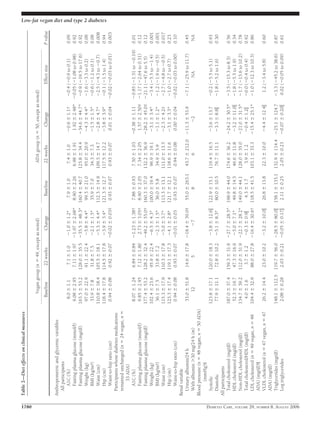
On thiazolidinedione                                 16 (33)                   15 (30)                  0.78       line-adjusted P ϭ 0.091; Table 2 and Fig.
On other diabetes medications                         1 (2)                     2 (4)                   0.57       1). Among participants whose diabetes
On blood pressure medications                        31 (63)                   38 (76)                  0.17       medications remained unchanged
On lipid-lowering medications                        27 (55)                   27 (54)                  0.88       throughout (n ϭ 24 vegan and n ϭ 33
History of eye involvement                            9 (18)                   10 (20)                  0.82       ADA), A1C fell 1.23 points in the vegan
History of renal involvement                          6 (12)                    4 (8)                   0.48       group and 0.38 points in the ADA group
History of neuropathy                                18 (37)                   24 (48)                  0.25       (P ϭ 0.01; baseline-adjusted P ϭ 0.007).
Mean BMI (kg/m2)                                       33.9                      35.9                   0.18       Subanalyses were conducted to assess the
  Ͻ25 kg/m2                                           5 (10)                    2 (4)                              effects of dietary adherence. For those
  25–29.9 kg/m2                                      14 (29)                    5 (10)                             who met adherence criteria (n ϭ 33 vegan
  Ն30 kg/m2                                          30 (61)                   43 (86)                             and n ϭ 22 ADA), the A1C changes were
Data are mean (range) or n (%) unless otherwise indicated. P values refer to t test for continuous variables and   Ϫ1.20% for the vegan group and
␹2 for categorical variables. *P value calculated for race distribution; for ethnicity (Hispanic vs. non-His-      Ϫ0.88% for the ADA group (P ϭ 0.31).
panic), P ϭ 0.39.
                                                                                                                   For those who were both adherent and
                                                                                                                   medication stable (n ϭ 17 vegan and n ϭ
to the vegan (n ϭ 49) or ADA (n ϭ 50)                    duced energy intake (vegan 1,759 Ϯ 468                    12 ADA), A1C changes were Ϫ1.48% for
groups. The reasons for exclusion were                   to 1,425 Ϯ 427 kcal/day, P Ͻ 0.0001;                      the vegan group and Ϫ0.81% for the ADA
A1C values outside the required range                    ADA 1,846 Ϯ 597 to 1,391 Ϯ 382 kcal/                      group (P ϭ 0.15).
(n ϭ 201), failure to meet other participa-              day, P Ͻ 0.0001 [between-group P ϭ                            To test whether the effect of diet on
tion criteria (n ϭ 279), inability to attend             0.22]) and protein intake (vegan 77 Ϯ 27                  A1C was mediated by body weight
scheduled meetings (n ϭ 187), failure to                 to 51 Ϯ 16 g/day, P Ͻ 0.0001; ADA 85 Ϯ                    changes, a regression model was con-
keep interview appointment (n ϭ 153),                    27 to 73 Ϯ 23 g/day, P ϭ 0.002 [between                   structed, including baseline A1C, weight
reluctance to change diet (n ϭ 72), and                  group P ϭ 0.01]). Carbohydrate intake                     change, and diet group as predictors of
other or unspecified (n ϭ 58). The partic-                increased in the vegan group from 205 Ϯ                   A1C change, among those whose hypo-
ipants’ demographic and clinical charac-                 69 to 251 Ϯ 70 g/day (P Ͻ 0.0001) but                     glycemic medications remained constant.
teristics (Table 1) were similar to those of             fell in the ADA group from 213 Ϯ 70 to                    In this model, the effect of diet group was
individuals with type 2 diabetes in the                  165 Ϯ 51 g/day (P Ͻ 0.0001 [between-                      no longer significant (P ϭ 0.23). Control-
Washington, DC, area. All participants                   group P Ͻ 0.001]).                                        ling for diet group and for baseline A1C
completed laboratory assessments at 22                        Fat intake fell in both groups (vegan                scores, weight change was significantly
weeks.                                                   72 Ϯ 28 to 30 Ϯ 19 g/day, P Ͻ 0.0001;                     associated with A1C change; each kilo-
     Three vegan participants and eight                  ADA 73 Ϯ 35 to 52 Ϯ 21 g/day, P Ͻ                         gram of weight loss was associated with a
ADA participants failed to complete 22-                  0.0001 [between-group P ϭ 0.002]), as                     0.12% drop in A1C. For the subgroup
week dietary records. Both groups re-                    did saturated fat (vegan 23 Ϯ 10 to 6 Ϯ 4                 that did not change diabetes medications,

DIABETES CARE, VOLUME 29, NUMBER 8, AUGUST 2006                                                                                                          1779
Table 2—Diet effects on clinical measures


1780
                                                                                                  Vegan group (n ϭ 49, except as noted)                        ADA group (n ϭ 50, except as noted)
                                                                                                 Baseline      22 weeks         Change          Baseline       22 weeks         Change               Effect size      P value

                                                  Anthropometric and glycemic variables
                                                    All participants
                                                       A1C (%)                                  8.0 Ϯ 1.1       7.1 Ϯ 1.0     Ϫ1.0 Ϯ 1.2*      7.9 Ϯ 1.0       7.4 Ϯ 1.0     Ϫ0.6 Ϯ 1.1†      Ϫ0.4 (Ϫ0.9 to 0.1)      0.09
                                                       Fasting plasma glucose (mmol/l)         9.08 Ϯ 2.95     7.11 Ϯ 1.97   Ϫ1.97 Ϯ 2.68*    8.90 Ϯ 2.26     6.98 Ϯ 1.91    1.92 Ϯ 2.48*    Ϫ0.05 (Ϫ1.08 to 0.98)    0.92
                                                       Fasting plasma glucose (mg/dl)         163.5 Ϯ 53.2    128.0 Ϯ 35.5   Ϫ35.5 Ϯ 48.3*   160.4 Ϯ 40.7    125.8 Ϯ 34.4   Ϫ34.6 Ϯ 44.7*     Ϫ0.9 (Ϫ19.5 to 17.6)    0.92
                                                       Weight (kg)                             97.0 Ϯ 22.9     91.1 Ϯ 22.4    Ϫ5.8 Ϯ 4.4*     99.3 Ϯ 21.0     95.0 Ϯ 20.9    Ϫ4.3 Ϯ 4.4*      Ϫ1.6 (Ϫ3.3 to 0.2)      0.08
                                                       BMI (kg/m²)                             33.9 Ϯ 7.8      31.8 Ϯ 7.5     Ϫ2.1 Ϯ 1.5*     35.9 Ϯ 7.0      34.3 Ϯ 7.3     Ϫ1.5 Ϯ 1.5*      Ϫ0.6 (Ϫ1.2 to 0.1)      0.08
                                                       Waist (cm)                             110.8 Ϯ 18.4    105.5 Ϯ 18.1    Ϫ5.3 Ϯ 4.4*    112.3 Ϯ 14.9    109.5 Ϯ 14.7    Ϫ2.8 Ϯ 4.7*      Ϫ2.5 (Ϫ4.3 to Ϫ0.7)     0.008
                                                                                                                                                                                                                                Low-fat vegan diet and type 2 diabetes


                                                       Hip (cm)                               118.4 Ϯ 17.8    114.5 Ϯ 17.8    Ϫ3.9 Ϯ 3.4*    121.3 Ϯ 12.7    117.5 Ϯ 12.2    Ϫ3.8 Ϯ 3.9*      Ϫ0.1 (Ϫ1.5 to 1.4)      0.94
                                                       Waist-to-hip ratio (cm)                 0.94 Ϯ 0.08     0.92 Ϯ 0.07   Ϫ0.02 Ϯ 0.03‡    0.93 Ϯ 0.07     0.93 Ϯ 0.07    0.01 Ϯ 0.04     Ϫ0.02 (Ϫ0.03 to 0.01)    0.003
                                                    Participants whose diabetes medications
                                                    remained unchanged (n ϭ 24 vegan, n ϭ
                                                          33 ADA)
                                                       A1C (%)                                 8.07 Ϯ 1.24     6.84 Ϯ 0.84   Ϫ1.23 Ϯ 1.38†    7.88 Ϯ 0.93     7.50 Ϯ 1.03   Ϫ0.38 Ϯ 1.11     Ϫ0.85 (Ϫ1.51 to Ϫ0.19)   0.01
                                                       Fasting plasma glucose (mmol/l)         9.85 Ϯ 2.95     7.12 Ϯ 1.80    2.73 Ϯ 3.05†    8.90 Ϯ 2.05     7.34 Ϯ 2.05    1.57 Ϯ 2.50‡    Ϫ1.17 (Ϫ2.64 to 0.31)    0.12
                                                       Fasting plasma glucose (mg/dl)         177.4 Ϯ 53.2    128.2 Ϯ 32.4   Ϫ49.2 Ϯ 55.0†   160.3 Ϯ 37.0    132.2 Ϯ 36.9   Ϫ28.2 Ϯ 45.0‡    Ϫ21.1 (Ϫ47.6 to 5.5)     0.12
                                                       Weight (kg)                            102.4 Ϯ 23.6     95.9 Ϯ 22.4    Ϫ6.5 Ϯ 4.3*    100.0 Ϯ 19.4     96.9 Ϯ 19.1    Ϫ3.1 Ϯ 3.4*      Ϫ3.4 (Ϫ5.5 to Ϫ1.4)     0.001
                                                       BMI (kg/m²)                             36.1 Ϯ 7.5      33.8 Ϯ 7.2     Ϫ2.3 Ϯ 1.5*     36.0 Ϯ 5.8      34.9 Ϯ 5.9     Ϫ1.1 Ϯ 1.2*      Ϫ1.2 (Ϫ1.9 to Ϫ0.5)     0.001
                                                       Waist (cm)                             115.3 Ϯ 17.9    110.3 Ϯ 17.8    Ϫ5.0 Ϯ 3.7*    113.3 Ϯ 13.1    111.0 Ϯ 13.5    Ϫ2.3 Ϯ 4.2‡      Ϫ2.7 (Ϫ4.8 to Ϫ0.5)     0.017
                                                       Hip (cm)                               123.3 Ϯ 17.4    119.1 Ϯ 17.3    Ϫ4.1 Ϯ 2.8*    121.7 Ϯ 12.1    118.6 Ϯ 11.6    Ϫ3.1 Ϯ 3.3*      Ϫ1.0 (Ϫ2.7 to 0.7)      0.23
                                                       Waist-to-hip ratio (cm)                 0.94 Ϯ 0.08     0.93 Ϯ 0.07   Ϫ0.01 Ϯ 0.03     0.93 Ϯ 0.07     0.94 Ϯ 0.08    0.00 Ϯ 0.04     Ϫ0.02 (Ϫ0.03 to 0.00)    0.10
                                                  Renal variable
                                                    Urinary albumin/24 h                       33.0 Ϯ 51.8     14.6 Ϯ 17.8   Ϫ18.4 Ϯ 39.0‡    55.0 Ϯ 263.1    43.7 Ϯ 212.0 Ϫ11.3 Ϯ 53.9       Ϫ7.1 (Ϫ25.9 to 11.7)    0.45
                                                     With albumin Ͼ30 mg/24 h (m)                   12              5             Ϫ7               8               6            Ϫ2                    NA               NA
                                                  Blood pressure (n ϭ 48 vegan, n ϭ 50 ADA)
                                                          (mmHg)§
                                                     Systolic                                 123.8 Ϯ 17.1    120.0 Ϯ 18.3    Ϫ3.8 Ϯ 12.6ʈ   122.9 Ϯ 15.1    119.4 Ϯ 16.5    Ϫ3.6 Ϯ 13.7      Ϫ0.2 (Ϫ5.5 to 5.1)      0.93
                                                     Diastolic                                 77.9 Ϯ 11.1     72.8 Ϯ 10.2    Ϫ5.1 Ϯ 8.3*     80.0 Ϯ 10.5     76.7 Ϯ 11.1    Ϫ3.3 Ϯ 8.8ʈ      Ϫ1.8 (Ϫ5.2 to 1.6)      0.30
                                                  All participants
                                                     Total cholesterol (mg/dl)                187.0 Ϯ 37.4    159.3 Ϯ 31.9   Ϫ27.7 Ϯ 28.5*   198.9 Ϯ 44.0    174.6 Ϯ 36.2   Ϫ24.2 Ϯ 30.5*     Ϫ3.5 (Ϫ15.3 to 8.3)     0.56
                                                     HDL cholesterol (mg/dl)                   52.3 Ϯ 19.7     47.3 Ϯ 16.9    Ϫ5.0 Ϯ 7.1*     49.8 Ϯ 14.5     46.6 Ϯ 11.8    Ϫ3.2 Ϯ 11.0ʈ     Ϫ1.8 (Ϫ5.5 to 1.9)      0.34
                                                     Non-HDL cholesterol (mg/dl)              134.7 Ϯ 39.2    112.0 Ϯ 31.9   Ϫ22.7 Ϯ 28.2*   149.0 Ϯ 44.1    128.0 Ϯ 35.0   Ϫ21.0 Ϯ 31.5*     Ϫ1.7 (Ϫ13.6 to 10.2)    0.78
                                                     Total cholesterol/HDL (mg/dl)              4.0 Ϯ 1.6       3.7 Ϯ 1.2     Ϫ0.3 Ϯ 0.9ʈ      4.3 Ϯ 1.7       3.9 Ϯ 1.2     Ϫ0.4 Ϯ 1.2ʈ      Ϫ0.0 (Ϫ0.4 to 0.4)      0.92
                                                     LDL cholesterol (n ϭ 49 vegan, n ϭ 48    104.4 Ϯ 32.9     88.0 Ϯ 27.8   Ϫ16.4 Ϯ 30.6†   118.5 Ϯ 41.5    103.1 Ϯ 33.3   Ϫ15.4 Ϯ 25.1*     Ϫ1.0 (Ϫ12.3 to 10.3)    0.86
                                                     ADA) (mg/dl)¶
                                                     VLDL cholesterol (n ϭ 47 vegan, n ϭ 47    26.2 Ϯ 14.4     23.0 Ϯ 10.2    Ϫ3.2 Ϯ 10.0ʈ    26.8 Ϯ 13.8     22.3 Ϯ 10.0    Ϫ4.4 Ϯ 12.4ʈ       1.2 (Ϫ3.4 to 5.8)     0.60
                                                     ADA) (mg/dl)
                                                     Triglycerides (mg/dl)                    148.1 Ϯ 112.5   119.7 Ϯ 56.0   Ϫ28.5 Ϯ 80.0ʈ   158.1 Ϯ 133.1   132.9 Ϯ 114.4 Ϫ25.1 Ϯ 124.7      Ϫ3.3 (Ϫ45.2 to 38.6)    0.87
                                                     Log triglycerides                         2.08 Ϯ 0.28     2.03 Ϯ 0.21   Ϫ0.05 Ϯ 0.17ʈ    2.11 Ϯ 0.25     2.05 Ϯ 0.23  Ϫ0.07 Ϯ 0.20ʈ      0.02 (Ϫ0.05 to 0.09)    0.61


DIABETES CARE, VOLUME 29, NUMBER 8, AUGUST 2006
Barnard and Associates


                                                                                      Data are means Ϯ SD unless otherwise indicated. Listed P values are for comparisons of between-group (vegan vs. ADA) changes (baseline to 22 weeks).*P Ͻ 0.0001, †P Ͻ 0.001, ‡P Ͻ 0.01, and ʈP Ͻ 0.05 for
                                                                                      within-group changes. §Blood pressure was not determined on one vegan group participant due to equipment failure. ¶When triglycerides exceeded 400 mg/dl, LDL was calculated via direct-LDL; two ADA-group
                                                                                                                                                                                                                                                                                                   the Pearson’s correlation of weight change

           0.01
           0.14
           0.05
           0.98
           0.02

                                    0.89

                                                          0.98
                                                          0.68
                                                                                                                                                                                                                                                                                                   with A1C change was r ϭ 0.51, P Ͻ
                                                                                                                                                                                                                                                                                                   0.0001 (within the vegan group [n ϭ 24],
                                                                                                                                                                                                                                                                                                   r ϭ 0.39, P ϭ 0.05; within the ADA group
          Ϫ14.5 (Ϫ25.8 to Ϫ3.2)


          Ϫ11.9 (Ϫ22.2 to Ϫ1.7)


                                                           0.6 (Ϫ45.9 to 47.2)
          Ϫ11.3 (Ϫ22.9 to 0.3)                                                                                                                                                                                                                                                                     [n ϭ 33], r ϭ 0.49, P ϭ 0.004).


                                                                                      individuals were excluded due to lack of sufficient plasma samples. SI conversion: to convert HDL, LDL, and total cholesterol to mmol/l, multiply by 0.0259; for tryiglycerides, multiply by 0.0113.
           Ϫ3.2 (Ϫ7.5 to 1.1)

           Ϫ0.0 (Ϫ0.4 to 0.4)


                                    0.4 (Ϫ4.8 to 5.6)


                                                          0.02 (Ϫ0.1 to 0.1)
                                                                                                                                                                                                                                                                                                        Body weight fell 5.8 kg in the vegan
                                                                                                                                                                                                                                                                                                   group (P Ͻ 0.0001) and 4.3 kg in the
                                                                                                                                                                                                                                                                                                   ADA group (P Ͻ 0.0001) (between-group
                                                                                                                                                                                                                                                                                                   P ϭ 0.082; baseline-adjusted P ϭ 0.066).
                                                                                                                                                                                                                                                                                                   Among medication-stable participants,
                                                                                                                                                                                                                                                                                                   vegan participants lost 6.5 kg compared
                                                                                                                                                                                                                                                                                                   with 3.1 kg for ADA participants (P Ͻ
                                                                                                                                                                                                                                                                                                   0.001; baseline-adjusted P ϭ 0.001).
          Ϫ19.0 Ϯ 28.5*
           Ϫ2.8 Ϯ 11.6
          Ϫ16.3 Ϯ 30.1ʈ
            Ϫ0.3 Ϯ 1.2
          Ϫ10.7 Ϯ 23.3ʈ

                                  Ϫ3.8 Ϯ 12.1

                                                        134.6 Ϯ 122.9 Ϫ22.8 Ϯ 134.3
                                                                       Ϫ0.06 Ϯ 0.21

                                                                                                                                                                                                                                                                                                        The reduction in urinary albumin was
                                                                                                                                                                                                                                                                                                   significant in the vegan group (P ϭ 0.002)
                                                                                                                                                                                                                                                                                                   but not in the ADA group (P ϭ 0.14). The
                                                                                                                                                                                                                                                                                                   unadjusted between-group difference
                                                                                                                                                                                                                                                                                                   was not significant. However, after adjust-
                                                                                                                                                                                                                                                                                                   ment for baseline values, the effect of diet
          175.9 Ϯ 36.2
           46.4 Ϯ 12.2
          129.4 Ϯ 35.9
             4.0 Ϯ 1.3
          104.6 Ϯ 33.7

                                  21.7 Ϯ 9.0


                                                          2.05 Ϯ 0.24


                                                                                                                                                                                                                                                                                                   was significant (P ϭ 0.013).
                                                                                                                                                                                                                                                                                                        For the entire sample, there were no
                                                                                                                                                                                                                                                                                                   between-group differences in lipid val-
                                                                                                                                                                                                                                                                                                   ues. Among those whose lipid-controlling
                                                                                                                                                                                                                                                                                                   medications remained constant (80% [39
                                                                                                                                                                                                                                                                                                   of 49] of vegan group, 82% [41 of 50] of
                                  25.5 Ϯ 13.2

                                                        157.4 Ϯ 143.0
                                                          2.11 Ϯ 0.25
          194.9 Ϯ 40.9
           49.2 Ϯ 15.5
          145.7 Ϯ 42.9
             4.4 Ϯ 1.8
          115.3 Ϯ 40.4


                                                                                                                                                                                                                                                                                                   ADA group), reductions in total choles-
                                                                                                                                                                                                                                                                                                   terol were Ϫ0.866 mmol/l (Ϫ33.5 mg/dl,
                                                                                                                                                                                                                                                                                                   Ϫ17.6%) for the vegan group and
                                                                                                                                                                                                                                                                                                   Ϫ0.491 mmol/l (Ϫ19.0 mg/dl, Ϫ9.7%)
                                                                                                                                                                                                                                                                                                   for the ADA group (P ϭ 0.0125). Changes
                                                                                                                                                                                                                                                                                                   in LDL cholesterol were Ϫ0.58 mmol/l
                                  Ϫ3.5 Ϯ 10.5ʈ

                                                        Ϫ22.2 Ϯ 58.5ʈ
                                                        Ϫ0.04 Ϯ 0.16
          Ϫ33.5 Ϯ 21.5*
           Ϫ6.0 Ϯ 6.8*
          Ϫ27.6 Ϯ 21.1*
           Ϫ0.3 Ϯ 0.6‡
          Ϫ22.6 Ϯ 22.0*


                                                                                                                                                                                                                                                                                                   (Ϫ22.6 mg/dl, Ϫ21.2%) for the vegan
                                                                                                                                                                                                                                                                                                   group and Ϫ0.277 mmol/l (Ϫ10.7 mg/dl,
                                                                                                                                                                                                                                                                                                   Ϫ9.3%) for the ADA group (P ϭ 0.023).
                                                                                                                                                                                                                                                                                                   Changes in HDL cholesterol were Ϫ0.16
                                                                                                                                                                                                                                                                                                   mmol/l (Ϫ6.0 mg/dl, Ϫ11.0%) for the
                                                                                                                                                                                                                                                                                                   vegan group and Ϫ0.07 mmol/l (Ϫ2.8
                                  23.1 Ϯ 10.9

                                                        118.2 Ϯ 57.3
                                                         2.02 Ϯ 0.22
          156.9 Ϯ 25.1
           48.6 Ϯ 18.4
          108.3 Ϯ 25.6
             3.6 Ϯ 1.2
           84.6 Ϯ 22.5


                                                                                                                                                                                                                                                                                                   mg/dl, Ϫ5.7%) for the ADA group (P ϭ
                                                                                                                                                                                                                                                                                                   0.14). The total-to-HDL cholesterol ratio
                                                                                                                                                                                                                                                                                                   fell for both groups, as did triglyceride
                                                                                                                                                                                                                                                                                                   concentrations.
                                                                                                                                                                                                                                                                                                        There were no treatment-related seri-
                                  26.6 Ϯ 15.4

                                                        140.3 Ϯ 89.1
                                                         2.06 Ϯ 0.28
          190.5 Ϯ 36.8
           54.6 Ϯ 21.0
          135.9 Ϯ 38.4
             3.9 Ϯ 1.5
          107.3 Ϯ 34.3


                                                                                                                                                                                                                                                                                                   ous adverse events.

                                                                                                                                                                                                                                                                                                   CONCLUSIONS — Both diets were
                                                                                                                                                                                                                                                                                                   associated with significant clinical im-
                                                                                                                                                                                                                                                                                                   provements, as indicated by reductions in
                                                                                                                                                                                                                                                                                                   A1C, body weight, plasma lipid concen-
      controlling medications (n ϭ 39 vegan,


   VLDL cholesterol (n ϭ 38 n ϭ vegan, 38
   LDL cholesterol (n ϭ 39 vegan, n ϭ 39


                                                                                                                                                                                                                                                                                                   trations, and urinary albumin excretion.
                                                                                                                                                                                                                                                                                                   Among medication-stable participants,
 Participants with no changes to lipid-


                                                                                                                                                                                                                                                                                                   changes in A1C, weight, BMI, waist cir-
      n ϭ 41 ADA, except as noted)


   Total cholesterol/HDL (mg/dl)


                                                                                                                                                                                                                                                                                                   cumference, total cholesterol, and LDL
   Non-HDL cholesterol (mg/dl)


                                                                                                                                                                                                                                                                                                   cholesterol were significantly greater in
   Total cholesterol (mg/dl)
   HDL cholesterol (mg/dl)


                                                                                                                                                                                                                                                                                                   the vegan group. The magnitude of A1C
   Triglycerides (mg/dl)


                                                                                                                                                                                                                                                                                                   reduction in medication-stable vegan
                                                                                                                                                                                                                                                                                                   group participants, 1.23 percentage
   Log triglycerides
   ADA) (mg/dl)¶


                                                                                                                                                                                                                                                                                                   points, compares favorably with that ob-
   ADA) (mg/dl)


                                                                                                                                                                                                                                                                                                   served in single-agent therapy with oral
                                                                                                                                                                                                                                                                                                   diabetes drugs (15).
                                                                                                                                                                                                                                                                                                        A low-fat plant-based diet influences
                                                                                                                                                                                                                                                                                                   nutrient intake and body composition in
                                                                                                                                                                                                                                                                                                   several ways that may, in turn, affect in-

DIABETES CARE, VOLUME 29, NUMBER 8, AUGUST 2006                                                                                                                                                                                                                                                                                          1781
Low-fat vegan diet and type 2 diabetes

                                                                                                     portions can, as a result, easily exceed rec-
                                                                                                     ommended limits on saturated fat. In con-
                                                                                                     trast, the vegan diet includes no animal
                                                                                                     fat, so variations in food quantity are less
                                                                                                     likely to result in substantial increases in
                                                                                                     saturated fat intake. Because the vegan
                                                                                                     diet is based on the elimination of certain
                                                                                                     foods, it may be easier to understand than
                                                                                                     regimens that limit quantities of certain
                                                                                                     foods without proscribing any. The ac-
                                                                                                     ceptability of low-fat vegan diets in clini-
                                                                                                     cal studies is similar to that of seemingly
                                                                                                     more moderate diets (27).
                                                                                                          This study’s strengths include its
                                                                                                     analysis of dependent measures without
                                                                                                     regard to variations in dietary adherence
                                                                                                     and applicability outside the research set-
                                                                                                     ting. A study limitation was that both di-
                                                                                                     ets made participants vulnerable to the
Figure 1—A1C at baseline and at 11 and 22 weeks. Open circles: all vegan group participants
                                                                                                     hypoglycemic effect of their diabetes
(n ϭ 49); closed circles: medication-stable vegan group participants (n ϭ 24); open squares: all
ADA group participants (n ϭ 50); closed squares: medication-stable ADA group participants (n ϭ       medications, resulting in medication re-
33). Error bars represent SE of the mean. P ϭ 0.09 for between-group comparison from baseline        ductions that confound the interpretation
to 22 weeks for full sample; P ϭ 0.01 for medication-stable participants (vegan vs. ADA).            of A1C changes and necessitating a sub-
                                                                                                     group analysis of medication-stable par-
                                                                                                     ticipants. Because these episodes
sulin sensitivity. First, because such diets     fore diabetes manifests (20). This lipid            occurred early in the trial, there was no
are low in fat and high in fiber, they typ-       accumulation may be responsive to diet.             opportunity to bring interim laboratory
ically cause associated reductions in di-        High-fat diets appear to downregulate the           values forward. Also, most study partici-
etary energy density and energy intake,          genes required for mitochondrial oxida-             pants were taking antihypertensive med-
which are not fully compensated for by           tive phosphorylation in skeletal muscle             ications, which may have blunted the
increased food intake (16,17). Our data          (21). In contrast, a case-control study             effect of diet on blood pressure.
suggest that the weight-reducing effect of       found that soleus muscle intramyocellu-                  In conclusion, in individuals with
the vegan diet (4) is responsible for a sub-     lar lipid concentrations were significantly          type 2 diabetes participating in a 22-week
stantial portion of its effect on A1C.           lower in a group of 21 vegans compared              clinical trial, both a low-fat vegan diet and
     Independent of their effect on body         with 25 omnivores (Ϫ9.7 [95% CI Ϫ16.2               a diet following ADA guidelines improved
weight, reductions in total fat intake and       to Ϫ3.3], P ϭ 0.01) (22).                           glycemic control; however, the changes
in the proportion of dietary saturated to             The lipid-lowering effect of vegan di-         were greater in the vegan group. Further
unsaturated fat increase insulin sensitivity     ets, attributable to their absence of dietary       research is necessary to establish longer-
(18), as do increased intake of low–             cholesterol, low saturated fat content, and         term diet effects and sustainability.
glycemic index and high-fiber foods (1).          a specific cholesterol-reducing effect of
     Finally, limited evidence suggests          soluble fiber and other plant constituents
that reductions in iron stores increase in-      (23), is particularly important given that          Acknowledgments — The study was sup-
sulin sensitivity (19). A vegan diet pro-        cardiovascular complications are the pri-           ported by grant R01 DK059362-01A2 from
vides iron in its nonheme form, which is         mary cause of morbidity and mortality in            the National Institute of Diabetes and Diges-
                                                                                                     tive and Kidney Diseases and by the Diabetes
somewhat less absorbable than heme               diabetes. While diets high in refined car-           Action Research and Education Foundation.
iron. A study comparing 30 ovolactoveg-          bohydrate may increase triglyceride con-               The authors express appreciation to Paul
etarians and 30 meat eaters, all of whom         centrations, high-fiber and low– glycemic            Poppen, PhD, for statistical analyses.
were healthy and had BMIs Ͻ23 kg/m2,             index foods appear to have the opposite
showed that vegetarians had adequate,            result (24).
but lower, body iron stores, compared                 The limited compliance of the ADA              References
with meat eaters (serum ferritin concen-         group merits comment. Researchers have               1. Jenkins DJA, Kendall CWC, Marchie A,
tration 35 ␮g/l [95% CI 21– 49] vs. 72           long lamented the difficulties in adhering               Jenkins AL, Augustin LSA, Ludwig DS,
␮g/l [45–100]). The vegetarians also             to diets for diabetes (25). The A1C reduc-              Barnard ND, Anderson JW: Type 2 diabe-
demonstrated less insulin resistance             tion observed in the ADA group was sim-                 tes and the vegetarian diet. Am J Clin Nutr
(steady-state plasma glucose concentra-          ilar to that found in previous studies (26).            78:610S– 616S, 2003
tion 4.1 mmol/l [3.5–5.0] vs. 6.9 mmol/l         A potential weakness of the ADA guide-               2. Fraser GE: Vegetarianism and obesity, hy-
                                                                                                         pertension, diabetes, A comprehensive
                                                                                                                               and arthritis. In Diet,
[5.2–7.5], respectively) (19).                   lines is that they require portion size lim-            Life Expectancy, and Chronic Disease. Ox-
     Insulin resistance is related to lipid      its for overweight individuals, and                                           bibliography is
                                                                                                         ford, U.K., Oxford University Press,
accumulation within muscle cells (in-            limitations on saturated-fat intake are                 2003, p. 129 –148     typical in scholarly
tramyocellular lipid), apparently due to a       based on these limited energy intakes. In-           3. Nicholson AS, Sklar M, Barnard ND, Gore
                                                                                                                               publications
genetically based reduction in mitochon-         dividuals who exceed their prescribed en-               S, Sullivan R, Browning S: Toward im-
drial activity identifiable many years be-        ergy intake limits with overly large                    proved management of NIDDM: a ran-

1782                                                                                               DIABETES CARE, VOLUME 29, NUMBER 8, AUGUST 2006
Barnard and Associates

      domized, controlled, pilot intervention             density lipoprotein cholesterol in plasma            phosphorylation in skeletal muscle. Dia-
      using a low-fat, vegetarian diet. Prev Med          without use of the preparative ultracentri-          betes 54:1926 –1933, 2005
      29:87–91, 1999                                      fuge. Clin Chem 18:499 –502, 1972              22.   Goff LM, Bell JD, So PW, Dornhorst A,
 4.   Barnard ND, Scialli AR, Turner-McGrievy       13.   Corcoran RM, Durnan SM: Albumin de-                  Frost GS: Veganism and its relationship
      G, Lanou AJ, Glass J: The effects of a low-         termination by a modified bromocresol                 with insulin resistance and intramyocel-
      fat, plant-based dietary intervention on            green method (Letter). Clin Chem 23:                 lular lipid. Eur J Clin Nutr 59:291–298,
      body weight, metabolism, and insulin                765–766, 1977                                        2005
      sensitivity. Am J Med 118:991–997, 2005       14.   Bouchard C, Tremblay A, LeBlanc C,             23.   Jenkins DJ, Kendall CW, Marchie A,
 5.   Wilson DH, Bogacz JP, Forsythe CM,                  Lortie G, Savard R, Theriault G: A method            Faulkner DA, Wong JM, de Souza R,
      Turk PJ, Lane TL, Gates RC, Brandt DR:              to assess energy expenditure in children             Emam A, Parker TL, Vidgen E, Lapsley
      Fully automated assay of glycohemoglo-              and adults. Am J Clin Nutr 37:461– 467,
                                                                                                               KG, Trautwein EA, Josse RG, Leiter LA,
      bin with the Abbott IMx analyzer: novel             1983
                                                                                                               Connelly PW: Effects of a dietary portfolio
      approaches for separation and detection.      15.   Krentz AJ, Bailey CJ: Oral antidiabetic
      Clin Chem 39:2090 –2097, 1993                       agents: current role in type 2 diabetes              on cholesterol-lowering foods vs lova-
 6.   American Diabetes Association: Evi-                 mellitus (Review). Drugs 65:385– 411,                statin on serum lipids and C-reactive pro-
      dence-based nutrition principles and rec-           2005                                                 tein. JAMA 290:502–510, 2003
      ommendations for the treatment and            16.   Kendall A, Levitsky DA, Strupp BJ, Liss-       24.   Jenkins DJ, Wolever TM, Kalmusky J,
      prevention of diabetes and related com-             ner L: Weight loss on a low-fat diet: con-           Guidici S, Giordano C, Patten R, Wong
      plications (Position Statement). Diabetes           sequence of the imprecision of the control           GS, Bird JN, Hall M, Buckley G, et al.:
      Care 26 (Suppl. 1):S51–S61, 2003                    of food intake in humans. Am J Clin Nutr             Low-glycemic index diet in hyperlipid-
 7.   Schakel SF, Sievert YA, Buzzard IM:                 53:1124 –1129, 1991                                  emia: use of traditional starchy foods.
      Sources of data for developing and main-      17.   Howarth NC, Saltzman E, Roberts SB: Di-              Am J Clin Nutr 46:66 –71, 1987
      taining a nutrient database. J Am Diet As-          etary fiber and weight regulation (Re-          25.   Laitinen JH, Ahola IE, Sarkkinen ES, Win-
      soc 88:1268 –1271, 1988                             view). Nutr Rev 59:129 –139, 2001                    berg RL, Harmaakorpi-Iivonen PA, Uus-
 8.   Barthelmai W, Czok R: Enzymatic deter-        18.   Lovejoy JC, Windhauser MM, Rood JC,                  itupa MI: Impact of intensified dietary
      minations of glucose in the blood, cere-            de la Bretonne JA: Effect of a controlled            therapy on energy and nutrient intakes
      brospinal fluid and urine. Klin Wochenschr           high-fat versus low-fat diet on insulin sen-         and fatty acid composition of serum lipids
      40:585–589, 1962 [in German]                        sitivity and leptin levels in African-Amer-          in patients with recently diagnosed non-
 9.   Allain CC, Poon LS, Chan CSG, Rich-                 ican and Caucasian women. Metabolism                 insulin-dependent diabetes mellitus. J Am
      mond W, Fu PC: Enzymatic determina-                 47:1520 –1524, 1998                                  Diet Assoc 93:276 –283, 1993
      tion of total serum cholesterol. Clin Chem    19.   Hua NW, Stoohs RA, Facchini FS: Low
                                                                                                         26.   Franz MJ, Splett PL, Monk A, Barry B,
      20:470 – 475, 1974                                  iron status and enhanced insulin sensitiv-
                                                                                                               McClain K, Weaver T, Upham P, Bergen-
10.   Wieland H, Seidel D: A simple specific               ity in lacto-ovo vegetarians. Br J Nutr 86:
      method for precipitation of low density             515–519, 2001                                        stal R, Mazze RS: Cost-effectiveness of
      lipoproteins. J Lipid Res 24:904 –909,        20.   Petersen KF, Dufour S, Befroy D, Garcia              medical nutrition therapy provided by di-
      1983                                                R, Shulman GI: Impaired mitochondrial                etitians for persons with non-insulin-de-
11.   Finley PR, Schifman RB, Williams RJ,                activity in the insulin-resistant offspring          pendent diabetes mellitus. J Am Diet Assoc
      Licht DA: Cholesterol in high-density li-           of patients with type 2 diabetes. N Engl             95:1018 –1024, 1995
      poprotein: use of Mg2ϩ/dextran sulfate              J Med 350:664 – 671, 2004                      27.   Barnard ND, Scialli AR, Turner-McGrievy
      in its enzymatic measurement. Clin Chem       21.   Sparks LM, Xie H, Koza RA, Mynatt R,                 GM, Lanou AJ: Acceptability of a low-fat
      24:931–933, 1978                                    Hulver MW, Bray GA, Smith SR: A high-                vegan diet compares favorably to a step II
12.   Friedewald WT, Levy RI, Fredrickson DS:             fat diet coordinately downregulates genes            diet in a randomized, controlled trial.
      Estimation of the concentration of low-             required for mitochondrial oxidative                 J Cardiopulm Rehabil 24:229 –235, 2004


DIABETES CARE, VOLUME 29, NUMBER 8, AUGUST 2006                                                                                                     1783

Scholarly Article

  • 1.
    Clinical Care/Education/Nutrition OR I G I N A L A R T I C L E A Low-Fat Vegan Diet Improves Glycemic Control and Cardiovascular Risk Factors in a Randomized Clinical Trial in Individuals With Type 2 Diabetes NEAL D. BARNARD, MD1,2 BRENT JASTER, MD2 used in the absence of exercise, was asso- JOSHUA COHEN, MD1 KIM SEIDL, MS, RD2 ciated with increased insulin sensitivity DAVID J.A. JENKINS, MD, PHD3 AMBER A. GREEN, RD2 and reduced body weight in nondiabetic GABRIELLE TURNER-MCGRIEVY, MS, RD4 STANLEY TALPERS, MD1 overweight women (4). LISE GLOEDE, RD, CDE5 We therefore conducted a random- ized controlled trial of a vegan diet with exercise held constant to test the hypoth- OBJECTIVE — We sought to investigate whether a low-fat vegan diet improves glycemic esis that, in individuals with type 2 diabe- Authors' credentials (medical doctors control and cardiovascular risk factors in individuals with type 2 diabetes. tes, a low-fat plant-based diet improves and registered dieticians) plasma lipid, and weight con- glycemic, are given. RESEARCH DESIGN AND METHODS — Individuals with type 2 diabetes (n ϭ 99) trol compared with a diet based on cur- were randomly assigned to a low-fat vegan diet (n ϭ 49) or a diet following the American Diabetes Association (ADA) guidelines (n ϭ 50). Participants were evaluated at baseline and 22 rent ADA guidelines. weeks. RESEARCH DESIGN AND RESULTS — Forty-three percent (21 of 49) of the vegan group and 26% (13 of 50) of the ADA METHODS — Individuals with type 2 group participants reduced diabetes medications. Including all participants, HbA1c (A1C) de- diabetes, defined by a fasting plasma glu- creased 0.96 percentage points in the vegan group and 0.56 points in the ADA group (P ϭ cose concentration Ͼ6.9 mmol/l on two 0.089). Excluding those who changed medications, A1C fell 1.23 points in the vegan group occasions or a prior diagnosis of type 2 compared with 0.38 points in the ADA group (P ϭ 0.01). Body weight decreased 6.5 kg in the vegan group and 3.1 kg in the ADA group (P Ͻ 0.001). Body weight change correlated with A1C diabetes with the use of hypoglycemic change (r ϭ 0.51, n ϭ 57, P Ͻ 0.0001). Among those who did not change lipid-lowering medications for Ն6 months, were re- medications, LDL cholesterol fell 21.2% in the vegan group and 10.7% in the ADA group (P ϭ Technical cruited through newspaper advertise- 0.02). After adjustment for baseline values, urinary albumin reductions were greater in the vegan ments in the Washington, DC, area on language, common group (15.9 mg/24h) than in the ADA group (10.9 mg/24 h) (P ϭ 0.013). two occasions (October 2003 through in scholarly articles December 2003 and October 2004 CONCLUSIONS — Both a low-fat vegan diet and a diet based on ADA guidelines improved through December 2004) to complete the glycemic and lipid control in type 2 diabetic patients. These improvements were greater with a study from January 2004 through June low-fat vegan diet. 2004 and January 2005 through June 2005, respectively. Exclusion criteria Diabetes Care 29:1777–1783, 2006 were an HbA1c (A1C) Ͻ6.5 or Ͼ10.5%, use of insulin for Ͼ5 years, current smok- D iabetes prevalence is relatively low fects. In a 12-week pilot trial of a low-fat ing, alcohol or drug abuse, pregnancy, among individuals following plant- vegan diet in individuals with type 2 dia- unstable medical status, and current use based and vegetarian diets, and betes, conducted without increased exer- of a low-fat vegetarian diet. The protocol clinical trials using such diets have shown cise, fasting serum glucose concentration was approved by the George Washington improvements in glycemic control and dropped 28% compared with 12% in the University Institutional Review Board. All cardiovascular health (1,2). Most of these control group following a diet based on participants gave written informed trials have also included exercise, thus American Diabetes Association (ADA) consent. making it impossible to isolate diet ef- guidelines (P Ͻ 0.05) (3). A similar diet, Authors affiliations are given. A1C was assayed using affinity chro- From this and an Abbott IMx analyzer matography on the credentials ● ● ● ● ● ● ● ● ● ● ● ● ● ● ● ● ● ● ● ● ● ● ● ● ● ● ● ● ● ● ● ● ● ● ● ● ● ● ● ● ● ● ● ● ● ● ● ● ● above we know they arein order of (5). Volunteers were ranked From the 1Department of Medicine, George Washington University School of Medicine, Washington, DC; the 2Physicians Committee for Responsible Medicine, Washington, DC; the 3Department of Nutritional experts in their field. randomly as- A1C concentrations and Sciences, Faculty of Medicine, University of Toronto, and the Clinical Nutrition and Risk Factor Modification signed in sequential pairs, using a ran- Center, St. Michael’s Hospital, Toronto, Canada; the 4Department of Nutrition, School of Public Health, dom-number table, to a low-fat vegan diet University of North Carolina, Chapel Hill, North Carolina; and 5Private practice, Arlington, Virginia. or a diet following the 2003 ADA guide- Address correspondence and reprint requests to Neal D. Barnard, MD, 5100 Wisconsin Ave., Suite 400, lines (6) for 22 weeks. Because assign- Washington, DC 20016. E-mail: nbarnard@pcrm.org. Received for publication 20 March 2006 and accepted in revised form 15 May 2006. ment was done simultaneously, allocation Abbreviations: ADA, American Diabetes Association. concealment was unnecessary. A table elsewhere in this issue shows conventional and Systeme International (SI) units and conversion ` The vegan diet (ϳ10% of energy from factors for many substances. fat, 15% protein, and 75% carbohydrate) DOI: 10.2337/dc06-0606. Clinical trial reg. no. NCT00276939, clinicaltrials.gov. consisted of vegetables, fruits, grains, and © 2006 by the American Diabetes Association. The costs of publication of this article were defrayed in part by the payment of page charges. This article must therefore be hereby legumes. Participants were asked to avoid marked “advertisement” in accordance with 18 U.S.C. Section 1734 solely to indicate this fact. animal products and added fats and to DIABETES CARE, VOLUME 29, NUMBER 8, AUGUST 2006 1777
  • 2.
    Low-fat vegan dietand type 2 diabetes favor low– glycemic index foods, such as 24-h recalls or incidentally at any point, ence was measured at the maximal pro- beans and green vegetables. Portion sizes, as saturated fat Յ5% and total fat Յ25% trusion of the buttocks. energy intake, and carbohydrate intake of energy, and as average daily cholesterol Blood pressure was measured after were unrestricted. intake Յ50 mg on 3-day dietary records participants had rested in a seated posi- The ADA diet (15–20% protein, Ͻ7% at 22 weeks. Adherence for the ADA tion for 5 min using a digital monitor saturated fat, 60 –70% carbohydrate and group was defined as average daily energy (Omron HEM-711) and a standard cuff monounsaturated fats, and cholesterol intake on the 22-week 3-day dietary maintained at the level of the heart. Three Յ200 mg/day) was individualized, based records being no more than 200 kcal in measurements were taken at 2-min inter- on body weight and plasma lipid concen- excess of the intake prescribed by the reg- vals; the first measurement was disre- trations (6). ADA group participants with istered dietitian and saturated fat Յ10% garded, and a mean was calculated for the a BMI Ͼ25 kg/m2 (all but three ADA of energy. Individuals who attended remaining two values. group participants) were prescribed en- fewer than 10 of the 22 weekly sessions ergy intake deficits of 500 –1,000 kcal. were also considered nonadherent on ei- Statistical analyses No meals were provided. To meet the ther diet. To have an 80% chance of detecting a vitamin B12 needs of the vegan group Participants were asked to continue 1.5–percentage point between-group while maintaining the same intervention their preexisting medication regimens, A1C difference as significant (at the two- in the ADA group, all participants were except when fasting plasma glucose deter- sided 5% level), with an assumed SD of provided a vitamin B12 supplement (100 minations fell below 4.4 mmol/l or hypo- 1.9% and a loss to follow-up of 26%, 34 ␮g) to be taken every other day. For both glycemic symptoms were accompanied participants were required per group. An groups, alcoholic beverages were limited by a capillary glucose reading Ͻ3.6 interim analysis indicated group differ- to one per day for women and two per day mmol/l. In such cases, medications were ences of 0.8% with an SD of 1.3%; there- for men. Participants were asked not to reduced for participant safety by a study fore, a revised power analysis was alter their exercise habits during the inter- endocrinologist, who remained blind to conducted. To have an 80% chance of de- vention period. group assignment, following an estab- tecting a 0.8% difference as significant Each participant met for 1 h with a lished protocol. with an SD of 1.3% and loss to follow-up registered dietitian experienced in the use Laboratory measurements were made of 33%, an additional 15 participants of the assigned diet to establish an appro- after a 12-h fast by technicians blind to were required per group. priate diet plan. Thereafter, participants group assignment. A1C (the primary end Between-subject t tests were calcu- attended weekly 1-h meetings of their as- point) was assayed at 0, 11, and 22 weeks, lated for each measure to determine signed groups for nutrition and cooking as described above. All other measures whether the changes associated with the instruction conducted by a physician and were assessed at baseline and 22 weeks, intervention diet were greater than those a registered dietitian and/or a cooking in- except as noted. Plasma glucose was mea- associated with the control diet. Within structor. Sessions for the two groups were sured by the glucose oxidase method us- each diet group, paired comparison t tests similar in duration and content, except ing an Abbott Spectrum analyzer (Abbott were calculated to test whether the with regard to dietary details. Group lead- Park, IL) (8). Plasma cholesterol and tri- change from baseline to 22 weeks was sig- ers were instructed to make no comment glyceride concentrations were measured nificantly different from zero. The pri- favoring either diet over the other. by enzymatic methods using an Abbott mary analysis of the main end point was At weeks 4, 8, 13, and 20, a registered Spectrum analyzer (9,10). HDL choles- intention to treat and included all partic- dietitian made unannounced telephone terol was measured after double precipi- ipants. Because medication changes influ- calls to each participant to administer a tation with dextran and MgCl2 (11). LDL ence the dependent measures, 24-h diet recall. These recalls were not cholesterol was estimated using the exploratory analyses were performed for statistically analyzed, but allowed the in- Friedewald equation (12). In individuals the subgroup whose medications re- vestigators to check for poor adherence whose plasma triglyceride concentrations mained constant. An ␣ of 0.05 was used and provide additional dietary counseling exceeded 400 mg/dl, LDL cholesterol was for all statistical tests, with no adjustment as needed. measured directly by precipitation and for multiple comparisons. In addition, a 3-day dietary record magnetic separation (LipiDirect; Poly- Regression analyses assessed whether was completed by each participant at medco, Cortlandt Manor, NY). Non-HDL the diet group effects on A1C and body weeks 0, 11, and 22, on 2 weekdays and 1 cholesterol concentration was calculated weight were significant, while controlling weekend day, using a food scale, after par- as the difference between total and HDL for baseline values, and whether the diet ticipants had completed a 3-day practice cholesterol. Urinary albumin was mea- group effect on A1C was significant, while record. Using the Nutrition Data System sured on 24-h samples using an anionic controlling for baseline A1C and changes for Research software version 5.0 (Food dye– binding assay (13). in body weight. Pearson correlations were and Nutrient Database 35 [released May Physical activity was assessed over a calculated for the relationship between 2004]; Nutrition Coordinating Center, 3-day period by pedometer (Omron HJ- A1C change and weight change. University of Minnesota, Minneapolis, 112) and with the Bouchard 3-Day Phys- An interim analysis was performed af- MN) (7), a registered dietitian certified by ical Activity Record (14). Body weight ter week 11 to assess whether benefits Note the use of the Nutrition Coordinating Center ana- was determined at 0, 11, and 22 weeks, or adverse outcomes were statistically lyzed all 3-day dietary records and diet structured headings before breakfast while participants wore unusual. recalls. For purposes of statistical analy- (research design a digital scale accu- hospital gowns, using sis, dietary adherence for the vegan group and methods,Waist circumference was rate to 0.1 kg. RESULTS — Of 1,049 individuals was defined as the absence of meat, poul- measured with a tape measure placed 2.5 screened by telephone, 99 met participa- try, fish, dairy, or egg intake reported on results, conclusions, Hip circumfer- cm above the umbilicus. tion criteria and were randomly assigned etc.) 1778 DIABETES CARE, VOLUME 29, NUMBER 8, AUGUST 2006
  • 3.
    Barnard and Associates Table1—Baseline demographic and clinical variables g/day, P Ͻ 0.0001; ADA 23 Ϯ 12 to 14 Ϯ 6 g/day, P Ͻ 0.0001 [between-group P Ͻ Vegan group ADA group P value 0.001]) and cholesterol (vegan 291 Ϯ 223 to 24 Ϯ 57 mg/day, P Ͻ 0.0001; ADA n 49 50 317 Ϯ 200 to 189 Ϯ 89 mg/day, P Ͻ Age (years) 56.7 (35–82) 54.6 (27–80) 0.29 0.0001 [between-group P ϭ 0.002]). Fi- Sex 0.26 ber increased only among vegans (18.8 Ϯ Male 22 (45) 17 (34) 6.4 to 36.3 Tables g/day, P Ͻ 0.0001; Ϯ 13.3 of results Female 27 (55) 33 (66) ADA 19.5 Ϯ 6.9 to 19.0 Ϯ 7.9 g/day, P ϭ Race, ethnicity 0.71* 0.73 [between-group P Ͻ in are typical 0.001]). Black, non-Hispanic 22 (45) 22 (44) scholarly articles. Pedometer readings and self-reported White, non-Hispanic 21 (43) 22 (44) energy expenditure revealed no signifi- White, Hispanic 4 (8) 2 (4) cant between-group differences. Group- Asian, non-Hispanic 2 (4) 4 (8) specific dietary adherence criteria were Marital status 0.08 met by 67% (33 of 49) of vegan group Not married 20 (41) 26 (52) participants and 44% (22 of 50) of ADA Married 29 (59) 24 (48) group participants. During the interven- Education 0.69 tion period, 43% (21 of 49) of vegan High school, partial or graduate 6 (12) 3 (6) group participants and 26% (13 of 50) of College, partial or graduate 26 (53) 25 (50) ADA group participants reduced their di- Graduate degree 17 (35) 22 (44) abetes medications, mainly as necessi- Occupation 0.04 tated by hypoglycemia, while 8% (4 of Service occupation 3 (6) 7 (14) 49) of vegans and 8% (4 of 50) of ADA Technical, sales, administrative 16 (33) 18 (36) participants increased medications with- Professional or managerial 15 (31) 21 (42) out investigators’ authorization. Retired 15 (31) 4 (8) A1C fell 0.96 percentage points (P Ͻ On insulin 11 (22) 5 (10) 0.09 0.0001) in the vegan group and 0.56 per- On metformin 34 (69) 39 (78) 0.33 centage points (P ϭ 0.0009) in the ADA On sulfonylurea 25 (51) 29 (58) 0.49 group (between-group P ϭ 0.089; base- On thiazolidinedione 16 (33) 15 (30) 0.78 line-adjusted P ϭ 0.091; Table 2 and Fig. On other diabetes medications 1 (2) 2 (4) 0.57 1). Among participants whose diabetes On blood pressure medications 31 (63) 38 (76) 0.17 medications remained unchanged On lipid-lowering medications 27 (55) 27 (54) 0.88 throughout (n ϭ 24 vegan and n ϭ 33 History of eye involvement 9 (18) 10 (20) 0.82 ADA), A1C fell 1.23 points in the vegan History of renal involvement 6 (12) 4 (8) 0.48 group and 0.38 points in the ADA group History of neuropathy 18 (37) 24 (48) 0.25 (P ϭ 0.01; baseline-adjusted P ϭ 0.007). Mean BMI (kg/m2) 33.9 35.9 0.18 Subanalyses were conducted to assess the Ͻ25 kg/m2 5 (10) 2 (4) effects of dietary adherence. For those 25–29.9 kg/m2 14 (29) 5 (10) who met adherence criteria (n ϭ 33 vegan Ն30 kg/m2 30 (61) 43 (86) and n ϭ 22 ADA), the A1C changes were Data are mean (range) or n (%) unless otherwise indicated. P values refer to t test for continuous variables and Ϫ1.20% for the vegan group and ␹2 for categorical variables. *P value calculated for race distribution; for ethnicity (Hispanic vs. non-His- Ϫ0.88% for the ADA group (P ϭ 0.31). panic), P ϭ 0.39. For those who were both adherent and medication stable (n ϭ 17 vegan and n ϭ to the vegan (n ϭ 49) or ADA (n ϭ 50) duced energy intake (vegan 1,759 Ϯ 468 12 ADA), A1C changes were Ϫ1.48% for groups. The reasons for exclusion were to 1,425 Ϯ 427 kcal/day, P Ͻ 0.0001; the vegan group and Ϫ0.81% for the ADA A1C values outside the required range ADA 1,846 Ϯ 597 to 1,391 Ϯ 382 kcal/ group (P ϭ 0.15). (n ϭ 201), failure to meet other participa- day, P Ͻ 0.0001 [between-group P ϭ To test whether the effect of diet on tion criteria (n ϭ 279), inability to attend 0.22]) and protein intake (vegan 77 Ϯ 27 A1C was mediated by body weight scheduled meetings (n ϭ 187), failure to to 51 Ϯ 16 g/day, P Ͻ 0.0001; ADA 85 Ϯ changes, a regression model was con- keep interview appointment (n ϭ 153), 27 to 73 Ϯ 23 g/day, P ϭ 0.002 [between structed, including baseline A1C, weight reluctance to change diet (n ϭ 72), and group P ϭ 0.01]). Carbohydrate intake change, and diet group as predictors of other or unspecified (n ϭ 58). The partic- increased in the vegan group from 205 Ϯ A1C change, among those whose hypo- ipants’ demographic and clinical charac- 69 to 251 Ϯ 70 g/day (P Ͻ 0.0001) but glycemic medications remained constant. teristics (Table 1) were similar to those of fell in the ADA group from 213 Ϯ 70 to In this model, the effect of diet group was individuals with type 2 diabetes in the 165 Ϯ 51 g/day (P Ͻ 0.0001 [between- no longer significant (P ϭ 0.23). Control- Washington, DC, area. All participants group P Ͻ 0.001]). ling for diet group and for baseline A1C completed laboratory assessments at 22 Fat intake fell in both groups (vegan scores, weight change was significantly weeks. 72 Ϯ 28 to 30 Ϯ 19 g/day, P Ͻ 0.0001; associated with A1C change; each kilo- Three vegan participants and eight ADA 73 Ϯ 35 to 52 Ϯ 21 g/day, P Ͻ gram of weight loss was associated with a ADA participants failed to complete 22- 0.0001 [between-group P ϭ 0.002]), as 0.12% drop in A1C. For the subgroup week dietary records. Both groups re- did saturated fat (vegan 23 Ϯ 10 to 6 Ϯ 4 that did not change diabetes medications, DIABETES CARE, VOLUME 29, NUMBER 8, AUGUST 2006 1779
  • 4.
    Table 2—Diet effectson clinical measures 1780 Vegan group (n ϭ 49, except as noted) ADA group (n ϭ 50, except as noted) Baseline 22 weeks Change Baseline 22 weeks Change Effect size P value Anthropometric and glycemic variables All participants A1C (%) 8.0 Ϯ 1.1 7.1 Ϯ 1.0 Ϫ1.0 Ϯ 1.2* 7.9 Ϯ 1.0 7.4 Ϯ 1.0 Ϫ0.6 Ϯ 1.1† Ϫ0.4 (Ϫ0.9 to 0.1) 0.09 Fasting plasma glucose (mmol/l) 9.08 Ϯ 2.95 7.11 Ϯ 1.97 Ϫ1.97 Ϯ 2.68* 8.90 Ϯ 2.26 6.98 Ϯ 1.91 1.92 Ϯ 2.48* Ϫ0.05 (Ϫ1.08 to 0.98) 0.92 Fasting plasma glucose (mg/dl) 163.5 Ϯ 53.2 128.0 Ϯ 35.5 Ϫ35.5 Ϯ 48.3* 160.4 Ϯ 40.7 125.8 Ϯ 34.4 Ϫ34.6 Ϯ 44.7* Ϫ0.9 (Ϫ19.5 to 17.6) 0.92 Weight (kg) 97.0 Ϯ 22.9 91.1 Ϯ 22.4 Ϫ5.8 Ϯ 4.4* 99.3 Ϯ 21.0 95.0 Ϯ 20.9 Ϫ4.3 Ϯ 4.4* Ϫ1.6 (Ϫ3.3 to 0.2) 0.08 BMI (kg/m²) 33.9 Ϯ 7.8 31.8 Ϯ 7.5 Ϫ2.1 Ϯ 1.5* 35.9 Ϯ 7.0 34.3 Ϯ 7.3 Ϫ1.5 Ϯ 1.5* Ϫ0.6 (Ϫ1.2 to 0.1) 0.08 Waist (cm) 110.8 Ϯ 18.4 105.5 Ϯ 18.1 Ϫ5.3 Ϯ 4.4* 112.3 Ϯ 14.9 109.5 Ϯ 14.7 Ϫ2.8 Ϯ 4.7* Ϫ2.5 (Ϫ4.3 to Ϫ0.7) 0.008 Low-fat vegan diet and type 2 diabetes Hip (cm) 118.4 Ϯ 17.8 114.5 Ϯ 17.8 Ϫ3.9 Ϯ 3.4* 121.3 Ϯ 12.7 117.5 Ϯ 12.2 Ϫ3.8 Ϯ 3.9* Ϫ0.1 (Ϫ1.5 to 1.4) 0.94 Waist-to-hip ratio (cm) 0.94 Ϯ 0.08 0.92 Ϯ 0.07 Ϫ0.02 Ϯ 0.03‡ 0.93 Ϯ 0.07 0.93 Ϯ 0.07 0.01 Ϯ 0.04 Ϫ0.02 (Ϫ0.03 to 0.01) 0.003 Participants whose diabetes medications remained unchanged (n ϭ 24 vegan, n ϭ 33 ADA) A1C (%) 8.07 Ϯ 1.24 6.84 Ϯ 0.84 Ϫ1.23 Ϯ 1.38† 7.88 Ϯ 0.93 7.50 Ϯ 1.03 Ϫ0.38 Ϯ 1.11 Ϫ0.85 (Ϫ1.51 to Ϫ0.19) 0.01 Fasting plasma glucose (mmol/l) 9.85 Ϯ 2.95 7.12 Ϯ 1.80 2.73 Ϯ 3.05† 8.90 Ϯ 2.05 7.34 Ϯ 2.05 1.57 Ϯ 2.50‡ Ϫ1.17 (Ϫ2.64 to 0.31) 0.12 Fasting plasma glucose (mg/dl) 177.4 Ϯ 53.2 128.2 Ϯ 32.4 Ϫ49.2 Ϯ 55.0† 160.3 Ϯ 37.0 132.2 Ϯ 36.9 Ϫ28.2 Ϯ 45.0‡ Ϫ21.1 (Ϫ47.6 to 5.5) 0.12 Weight (kg) 102.4 Ϯ 23.6 95.9 Ϯ 22.4 Ϫ6.5 Ϯ 4.3* 100.0 Ϯ 19.4 96.9 Ϯ 19.1 Ϫ3.1 Ϯ 3.4* Ϫ3.4 (Ϫ5.5 to Ϫ1.4) 0.001 BMI (kg/m²) 36.1 Ϯ 7.5 33.8 Ϯ 7.2 Ϫ2.3 Ϯ 1.5* 36.0 Ϯ 5.8 34.9 Ϯ 5.9 Ϫ1.1 Ϯ 1.2* Ϫ1.2 (Ϫ1.9 to Ϫ0.5) 0.001 Waist (cm) 115.3 Ϯ 17.9 110.3 Ϯ 17.8 Ϫ5.0 Ϯ 3.7* 113.3 Ϯ 13.1 111.0 Ϯ 13.5 Ϫ2.3 Ϯ 4.2‡ Ϫ2.7 (Ϫ4.8 to Ϫ0.5) 0.017 Hip (cm) 123.3 Ϯ 17.4 119.1 Ϯ 17.3 Ϫ4.1 Ϯ 2.8* 121.7 Ϯ 12.1 118.6 Ϯ 11.6 Ϫ3.1 Ϯ 3.3* Ϫ1.0 (Ϫ2.7 to 0.7) 0.23 Waist-to-hip ratio (cm) 0.94 Ϯ 0.08 0.93 Ϯ 0.07 Ϫ0.01 Ϯ 0.03 0.93 Ϯ 0.07 0.94 Ϯ 0.08 0.00 Ϯ 0.04 Ϫ0.02 (Ϫ0.03 to 0.00) 0.10 Renal variable Urinary albumin/24 h 33.0 Ϯ 51.8 14.6 Ϯ 17.8 Ϫ18.4 Ϯ 39.0‡ 55.0 Ϯ 263.1 43.7 Ϯ 212.0 Ϫ11.3 Ϯ 53.9 Ϫ7.1 (Ϫ25.9 to 11.7) 0.45 With albumin Ͼ30 mg/24 h (m) 12 5 Ϫ7 8 6 Ϫ2 NA NA Blood pressure (n ϭ 48 vegan, n ϭ 50 ADA) (mmHg)§ Systolic 123.8 Ϯ 17.1 120.0 Ϯ 18.3 Ϫ3.8 Ϯ 12.6ʈ 122.9 Ϯ 15.1 119.4 Ϯ 16.5 Ϫ3.6 Ϯ 13.7 Ϫ0.2 (Ϫ5.5 to 5.1) 0.93 Diastolic 77.9 Ϯ 11.1 72.8 Ϯ 10.2 Ϫ5.1 Ϯ 8.3* 80.0 Ϯ 10.5 76.7 Ϯ 11.1 Ϫ3.3 Ϯ 8.8ʈ Ϫ1.8 (Ϫ5.2 to 1.6) 0.30 All participants Total cholesterol (mg/dl) 187.0 Ϯ 37.4 159.3 Ϯ 31.9 Ϫ27.7 Ϯ 28.5* 198.9 Ϯ 44.0 174.6 Ϯ 36.2 Ϫ24.2 Ϯ 30.5* Ϫ3.5 (Ϫ15.3 to 8.3) 0.56 HDL cholesterol (mg/dl) 52.3 Ϯ 19.7 47.3 Ϯ 16.9 Ϫ5.0 Ϯ 7.1* 49.8 Ϯ 14.5 46.6 Ϯ 11.8 Ϫ3.2 Ϯ 11.0ʈ Ϫ1.8 (Ϫ5.5 to 1.9) 0.34 Non-HDL cholesterol (mg/dl) 134.7 Ϯ 39.2 112.0 Ϯ 31.9 Ϫ22.7 Ϯ 28.2* 149.0 Ϯ 44.1 128.0 Ϯ 35.0 Ϫ21.0 Ϯ 31.5* Ϫ1.7 (Ϫ13.6 to 10.2) 0.78 Total cholesterol/HDL (mg/dl) 4.0 Ϯ 1.6 3.7 Ϯ 1.2 Ϫ0.3 Ϯ 0.9ʈ 4.3 Ϯ 1.7 3.9 Ϯ 1.2 Ϫ0.4 Ϯ 1.2ʈ Ϫ0.0 (Ϫ0.4 to 0.4) 0.92 LDL cholesterol (n ϭ 49 vegan, n ϭ 48 104.4 Ϯ 32.9 88.0 Ϯ 27.8 Ϫ16.4 Ϯ 30.6† 118.5 Ϯ 41.5 103.1 Ϯ 33.3 Ϫ15.4 Ϯ 25.1* Ϫ1.0 (Ϫ12.3 to 10.3) 0.86 ADA) (mg/dl)¶ VLDL cholesterol (n ϭ 47 vegan, n ϭ 47 26.2 Ϯ 14.4 23.0 Ϯ 10.2 Ϫ3.2 Ϯ 10.0ʈ 26.8 Ϯ 13.8 22.3 Ϯ 10.0 Ϫ4.4 Ϯ 12.4ʈ 1.2 (Ϫ3.4 to 5.8) 0.60 ADA) (mg/dl) Triglycerides (mg/dl) 148.1 Ϯ 112.5 119.7 Ϯ 56.0 Ϫ28.5 Ϯ 80.0ʈ 158.1 Ϯ 133.1 132.9 Ϯ 114.4 Ϫ25.1 Ϯ 124.7 Ϫ3.3 (Ϫ45.2 to 38.6) 0.87 Log triglycerides 2.08 Ϯ 0.28 2.03 Ϯ 0.21 Ϫ0.05 Ϯ 0.17ʈ 2.11 Ϯ 0.25 2.05 Ϯ 0.23 Ϫ0.07 Ϯ 0.20ʈ 0.02 (Ϫ0.05 to 0.09) 0.61 DIABETES CARE, VOLUME 29, NUMBER 8, AUGUST 2006
  • 5.
    Barnard and Associates Data are means Ϯ SD unless otherwise indicated. Listed P values are for comparisons of between-group (vegan vs. ADA) changes (baseline to 22 weeks).*P Ͻ 0.0001, †P Ͻ 0.001, ‡P Ͻ 0.01, and ʈP Ͻ 0.05 for within-group changes. §Blood pressure was not determined on one vegan group participant due to equipment failure. ¶When triglycerides exceeded 400 mg/dl, LDL was calculated via direct-LDL; two ADA-group the Pearson’s correlation of weight change 0.01 0.14 0.05 0.98 0.02 0.89 0.98 0.68 with A1C change was r ϭ 0.51, P Ͻ 0.0001 (within the vegan group [n ϭ 24], r ϭ 0.39, P ϭ 0.05; within the ADA group Ϫ14.5 (Ϫ25.8 to Ϫ3.2) Ϫ11.9 (Ϫ22.2 to Ϫ1.7) 0.6 (Ϫ45.9 to 47.2) Ϫ11.3 (Ϫ22.9 to 0.3) [n ϭ 33], r ϭ 0.49, P ϭ 0.004). individuals were excluded due to lack of sufficient plasma samples. SI conversion: to convert HDL, LDL, and total cholesterol to mmol/l, multiply by 0.0259; for tryiglycerides, multiply by 0.0113. Ϫ3.2 (Ϫ7.5 to 1.1) Ϫ0.0 (Ϫ0.4 to 0.4) 0.4 (Ϫ4.8 to 5.6) 0.02 (Ϫ0.1 to 0.1) Body weight fell 5.8 kg in the vegan group (P Ͻ 0.0001) and 4.3 kg in the ADA group (P Ͻ 0.0001) (between-group P ϭ 0.082; baseline-adjusted P ϭ 0.066). Among medication-stable participants, vegan participants lost 6.5 kg compared with 3.1 kg for ADA participants (P Ͻ 0.001; baseline-adjusted P ϭ 0.001). Ϫ19.0 Ϯ 28.5* Ϫ2.8 Ϯ 11.6 Ϫ16.3 Ϯ 30.1ʈ Ϫ0.3 Ϯ 1.2 Ϫ10.7 Ϯ 23.3ʈ Ϫ3.8 Ϯ 12.1 134.6 Ϯ 122.9 Ϫ22.8 Ϯ 134.3 Ϫ0.06 Ϯ 0.21 The reduction in urinary albumin was significant in the vegan group (P ϭ 0.002) but not in the ADA group (P ϭ 0.14). The unadjusted between-group difference was not significant. However, after adjust- ment for baseline values, the effect of diet 175.9 Ϯ 36.2 46.4 Ϯ 12.2 129.4 Ϯ 35.9 4.0 Ϯ 1.3 104.6 Ϯ 33.7 21.7 Ϯ 9.0 2.05 Ϯ 0.24 was significant (P ϭ 0.013). For the entire sample, there were no between-group differences in lipid val- ues. Among those whose lipid-controlling medications remained constant (80% [39 of 49] of vegan group, 82% [41 of 50] of 25.5 Ϯ 13.2 157.4 Ϯ 143.0 2.11 Ϯ 0.25 194.9 Ϯ 40.9 49.2 Ϯ 15.5 145.7 Ϯ 42.9 4.4 Ϯ 1.8 115.3 Ϯ 40.4 ADA group), reductions in total choles- terol were Ϫ0.866 mmol/l (Ϫ33.5 mg/dl, Ϫ17.6%) for the vegan group and Ϫ0.491 mmol/l (Ϫ19.0 mg/dl, Ϫ9.7%) for the ADA group (P ϭ 0.0125). Changes in LDL cholesterol were Ϫ0.58 mmol/l Ϫ3.5 Ϯ 10.5ʈ Ϫ22.2 Ϯ 58.5ʈ Ϫ0.04 Ϯ 0.16 Ϫ33.5 Ϯ 21.5* Ϫ6.0 Ϯ 6.8* Ϫ27.6 Ϯ 21.1* Ϫ0.3 Ϯ 0.6‡ Ϫ22.6 Ϯ 22.0* (Ϫ22.6 mg/dl, Ϫ21.2%) for the vegan group and Ϫ0.277 mmol/l (Ϫ10.7 mg/dl, Ϫ9.3%) for the ADA group (P ϭ 0.023). Changes in HDL cholesterol were Ϫ0.16 mmol/l (Ϫ6.0 mg/dl, Ϫ11.0%) for the vegan group and Ϫ0.07 mmol/l (Ϫ2.8 23.1 Ϯ 10.9 118.2 Ϯ 57.3 2.02 Ϯ 0.22 156.9 Ϯ 25.1 48.6 Ϯ 18.4 108.3 Ϯ 25.6 3.6 Ϯ 1.2 84.6 Ϯ 22.5 mg/dl, Ϫ5.7%) for the ADA group (P ϭ 0.14). The total-to-HDL cholesterol ratio fell for both groups, as did triglyceride concentrations. There were no treatment-related seri- 26.6 Ϯ 15.4 140.3 Ϯ 89.1 2.06 Ϯ 0.28 190.5 Ϯ 36.8 54.6 Ϯ 21.0 135.9 Ϯ 38.4 3.9 Ϯ 1.5 107.3 Ϯ 34.3 ous adverse events. CONCLUSIONS — Both diets were associated with significant clinical im- provements, as indicated by reductions in A1C, body weight, plasma lipid concen- controlling medications (n ϭ 39 vegan, VLDL cholesterol (n ϭ 38 n ϭ vegan, 38 LDL cholesterol (n ϭ 39 vegan, n ϭ 39 trations, and urinary albumin excretion. Among medication-stable participants, Participants with no changes to lipid- changes in A1C, weight, BMI, waist cir- n ϭ 41 ADA, except as noted) Total cholesterol/HDL (mg/dl) cumference, total cholesterol, and LDL Non-HDL cholesterol (mg/dl) cholesterol were significantly greater in Total cholesterol (mg/dl) HDL cholesterol (mg/dl) the vegan group. The magnitude of A1C Triglycerides (mg/dl) reduction in medication-stable vegan group participants, 1.23 percentage Log triglycerides ADA) (mg/dl)¶ points, compares favorably with that ob- ADA) (mg/dl) served in single-agent therapy with oral diabetes drugs (15). A low-fat plant-based diet influences nutrient intake and body composition in several ways that may, in turn, affect in- DIABETES CARE, VOLUME 29, NUMBER 8, AUGUST 2006 1781
  • 6.
    Low-fat vegan dietand type 2 diabetes portions can, as a result, easily exceed rec- ommended limits on saturated fat. In con- trast, the vegan diet includes no animal fat, so variations in food quantity are less likely to result in substantial increases in saturated fat intake. Because the vegan diet is based on the elimination of certain foods, it may be easier to understand than regimens that limit quantities of certain foods without proscribing any. The ac- ceptability of low-fat vegan diets in clini- cal studies is similar to that of seemingly more moderate diets (27). This study’s strengths include its analysis of dependent measures without regard to variations in dietary adherence and applicability outside the research set- ting. A study limitation was that both di- ets made participants vulnerable to the Figure 1—A1C at baseline and at 11 and 22 weeks. Open circles: all vegan group participants hypoglycemic effect of their diabetes (n ϭ 49); closed circles: medication-stable vegan group participants (n ϭ 24); open squares: all ADA group participants (n ϭ 50); closed squares: medication-stable ADA group participants (n ϭ medications, resulting in medication re- 33). Error bars represent SE of the mean. P ϭ 0.09 for between-group comparison from baseline ductions that confound the interpretation to 22 weeks for full sample; P ϭ 0.01 for medication-stable participants (vegan vs. ADA). of A1C changes and necessitating a sub- group analysis of medication-stable par- ticipants. Because these episodes sulin sensitivity. First, because such diets fore diabetes manifests (20). This lipid occurred early in the trial, there was no are low in fat and high in fiber, they typ- accumulation may be responsive to diet. opportunity to bring interim laboratory ically cause associated reductions in di- High-fat diets appear to downregulate the values forward. Also, most study partici- etary energy density and energy intake, genes required for mitochondrial oxida- pants were taking antihypertensive med- which are not fully compensated for by tive phosphorylation in skeletal muscle ications, which may have blunted the increased food intake (16,17). Our data (21). In contrast, a case-control study effect of diet on blood pressure. suggest that the weight-reducing effect of found that soleus muscle intramyocellu- In conclusion, in individuals with the vegan diet (4) is responsible for a sub- lar lipid concentrations were significantly type 2 diabetes participating in a 22-week stantial portion of its effect on A1C. lower in a group of 21 vegans compared clinical trial, both a low-fat vegan diet and Independent of their effect on body with 25 omnivores (Ϫ9.7 [95% CI Ϫ16.2 a diet following ADA guidelines improved weight, reductions in total fat intake and to Ϫ3.3], P ϭ 0.01) (22). glycemic control; however, the changes in the proportion of dietary saturated to The lipid-lowering effect of vegan di- were greater in the vegan group. Further unsaturated fat increase insulin sensitivity ets, attributable to their absence of dietary research is necessary to establish longer- (18), as do increased intake of low– cholesterol, low saturated fat content, and term diet effects and sustainability. glycemic index and high-fiber foods (1). a specific cholesterol-reducing effect of Finally, limited evidence suggests soluble fiber and other plant constituents that reductions in iron stores increase in- (23), is particularly important given that Acknowledgments — The study was sup- sulin sensitivity (19). A vegan diet pro- cardiovascular complications are the pri- ported by grant R01 DK059362-01A2 from vides iron in its nonheme form, which is mary cause of morbidity and mortality in the National Institute of Diabetes and Diges- tive and Kidney Diseases and by the Diabetes somewhat less absorbable than heme diabetes. While diets high in refined car- Action Research and Education Foundation. iron. A study comparing 30 ovolactoveg- bohydrate may increase triglyceride con- The authors express appreciation to Paul etarians and 30 meat eaters, all of whom centrations, high-fiber and low– glycemic Poppen, PhD, for statistical analyses. were healthy and had BMIs Ͻ23 kg/m2, index foods appear to have the opposite showed that vegetarians had adequate, result (24). but lower, body iron stores, compared The limited compliance of the ADA References with meat eaters (serum ferritin concen- group merits comment. Researchers have 1. Jenkins DJA, Kendall CWC, Marchie A, tration 35 ␮g/l [95% CI 21– 49] vs. 72 long lamented the difficulties in adhering Jenkins AL, Augustin LSA, Ludwig DS, ␮g/l [45–100]). The vegetarians also to diets for diabetes (25). The A1C reduc- Barnard ND, Anderson JW: Type 2 diabe- demonstrated less insulin resistance tion observed in the ADA group was sim- tes and the vegetarian diet. Am J Clin Nutr (steady-state plasma glucose concentra- ilar to that found in previous studies (26). 78:610S– 616S, 2003 tion 4.1 mmol/l [3.5–5.0] vs. 6.9 mmol/l A potential weakness of the ADA guide- 2. Fraser GE: Vegetarianism and obesity, hy- pertension, diabetes, A comprehensive and arthritis. In Diet, [5.2–7.5], respectively) (19). lines is that they require portion size lim- Life Expectancy, and Chronic Disease. Ox- Insulin resistance is related to lipid its for overweight individuals, and bibliography is ford, U.K., Oxford University Press, accumulation within muscle cells (in- limitations on saturated-fat intake are 2003, p. 129 –148 typical in scholarly tramyocellular lipid), apparently due to a based on these limited energy intakes. In- 3. Nicholson AS, Sklar M, Barnard ND, Gore publications genetically based reduction in mitochon- dividuals who exceed their prescribed en- S, Sullivan R, Browning S: Toward im- drial activity identifiable many years be- ergy intake limits with overly large proved management of NIDDM: a ran- 1782 DIABETES CARE, VOLUME 29, NUMBER 8, AUGUST 2006
  • 7.
    Barnard and Associates domized, controlled, pilot intervention density lipoprotein cholesterol in plasma phosphorylation in skeletal muscle. Dia- using a low-fat, vegetarian diet. Prev Med without use of the preparative ultracentri- betes 54:1926 –1933, 2005 29:87–91, 1999 fuge. Clin Chem 18:499 –502, 1972 22. Goff LM, Bell JD, So PW, Dornhorst A, 4. Barnard ND, Scialli AR, Turner-McGrievy 13. Corcoran RM, Durnan SM: Albumin de- Frost GS: Veganism and its relationship G, Lanou AJ, Glass J: The effects of a low- termination by a modified bromocresol with insulin resistance and intramyocel- fat, plant-based dietary intervention on green method (Letter). Clin Chem 23: lular lipid. Eur J Clin Nutr 59:291–298, body weight, metabolism, and insulin 765–766, 1977 2005 sensitivity. Am J Med 118:991–997, 2005 14. Bouchard C, Tremblay A, LeBlanc C, 23. Jenkins DJ, Kendall CW, Marchie A, 5. Wilson DH, Bogacz JP, Forsythe CM, Lortie G, Savard R, Theriault G: A method Faulkner DA, Wong JM, de Souza R, Turk PJ, Lane TL, Gates RC, Brandt DR: to assess energy expenditure in children Emam A, Parker TL, Vidgen E, Lapsley Fully automated assay of glycohemoglo- and adults. Am J Clin Nutr 37:461– 467, KG, Trautwein EA, Josse RG, Leiter LA, bin with the Abbott IMx analyzer: novel 1983 Connelly PW: Effects of a dietary portfolio approaches for separation and detection. 15. Krentz AJ, Bailey CJ: Oral antidiabetic Clin Chem 39:2090 –2097, 1993 agents: current role in type 2 diabetes on cholesterol-lowering foods vs lova- 6. American Diabetes Association: Evi- mellitus (Review). Drugs 65:385– 411, statin on serum lipids and C-reactive pro- dence-based nutrition principles and rec- 2005 tein. JAMA 290:502–510, 2003 ommendations for the treatment and 16. Kendall A, Levitsky DA, Strupp BJ, Liss- 24. Jenkins DJ, Wolever TM, Kalmusky J, prevention of diabetes and related com- ner L: Weight loss on a low-fat diet: con- Guidici S, Giordano C, Patten R, Wong plications (Position Statement). Diabetes sequence of the imprecision of the control GS, Bird JN, Hall M, Buckley G, et al.: Care 26 (Suppl. 1):S51–S61, 2003 of food intake in humans. Am J Clin Nutr Low-glycemic index diet in hyperlipid- 7. Schakel SF, Sievert YA, Buzzard IM: 53:1124 –1129, 1991 emia: use of traditional starchy foods. Sources of data for developing and main- 17. Howarth NC, Saltzman E, Roberts SB: Di- Am J Clin Nutr 46:66 –71, 1987 taining a nutrient database. J Am Diet As- etary fiber and weight regulation (Re- 25. Laitinen JH, Ahola IE, Sarkkinen ES, Win- soc 88:1268 –1271, 1988 view). Nutr Rev 59:129 –139, 2001 berg RL, Harmaakorpi-Iivonen PA, Uus- 8. Barthelmai W, Czok R: Enzymatic deter- 18. Lovejoy JC, Windhauser MM, Rood JC, itupa MI: Impact of intensified dietary minations of glucose in the blood, cere- de la Bretonne JA: Effect of a controlled therapy on energy and nutrient intakes brospinal fluid and urine. Klin Wochenschr high-fat versus low-fat diet on insulin sen- and fatty acid composition of serum lipids 40:585–589, 1962 [in German] sitivity and leptin levels in African-Amer- in patients with recently diagnosed non- 9. Allain CC, Poon LS, Chan CSG, Rich- ican and Caucasian women. Metabolism insulin-dependent diabetes mellitus. J Am mond W, Fu PC: Enzymatic determina- 47:1520 –1524, 1998 Diet Assoc 93:276 –283, 1993 tion of total serum cholesterol. Clin Chem 19. Hua NW, Stoohs RA, Facchini FS: Low 26. Franz MJ, Splett PL, Monk A, Barry B, 20:470 – 475, 1974 iron status and enhanced insulin sensitiv- McClain K, Weaver T, Upham P, Bergen- 10. Wieland H, Seidel D: A simple specific ity in lacto-ovo vegetarians. Br J Nutr 86: method for precipitation of low density 515–519, 2001 stal R, Mazze RS: Cost-effectiveness of lipoproteins. J Lipid Res 24:904 –909, 20. Petersen KF, Dufour S, Befroy D, Garcia medical nutrition therapy provided by di- 1983 R, Shulman GI: Impaired mitochondrial etitians for persons with non-insulin-de- 11. Finley PR, Schifman RB, Williams RJ, activity in the insulin-resistant offspring pendent diabetes mellitus. J Am Diet Assoc Licht DA: Cholesterol in high-density li- of patients with type 2 diabetes. N Engl 95:1018 –1024, 1995 poprotein: use of Mg2ϩ/dextran sulfate J Med 350:664 – 671, 2004 27. Barnard ND, Scialli AR, Turner-McGrievy in its enzymatic measurement. Clin Chem 21. Sparks LM, Xie H, Koza RA, Mynatt R, GM, Lanou AJ: Acceptability of a low-fat 24:931–933, 1978 Hulver MW, Bray GA, Smith SR: A high- vegan diet compares favorably to a step II 12. Friedewald WT, Levy RI, Fredrickson DS: fat diet coordinately downregulates genes diet in a randomized, controlled trial. Estimation of the concentration of low- required for mitochondrial oxidative J Cardiopulm Rehabil 24:229 –235, 2004 DIABETES CARE, VOLUME 29, NUMBER 8, AUGUST 2006 1783