Team Work
R Biswas
Deputy Manager (Mining)
Kiriburu Iron Ore Mine
RMD, SAIL
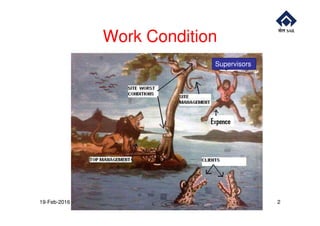
Work Condition
Supervisors
19-Feb-2016 2
19-Feb-2016 3
19-Feb-2016 4
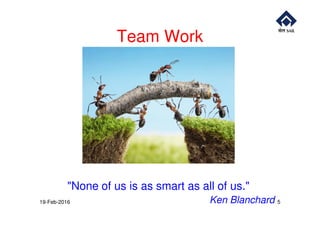
Team Work
"None of us is as smart as all of us."
Ken Blanchard19-Feb-2016 5
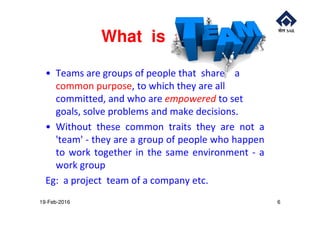
What is a
• Teams are groups of people that share a
common purpose, to which they are all
committed, and who are empowered to set
goals, solve problems and make decisions.goals, solve problems and make decisions.
• Without these common traits they are not a
'team' - they are a group of people who happen
to work together in the same environment - a
work group
Eg: a project team of a company etc.
19-Feb-2016 6
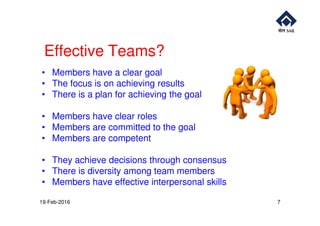
Effective Teams?
• Members have a clear goal
• The focus is on achieving results
• There is a plan for achieving the goal
• Members have clear roles• Members have clear roles
• Members are committed to the goal
• Members are competent
• They achieve decisions through consensus
• There is diversity among team members
• Members have effective interpersonal skills
19-Feb-2016 7
• There must be frequent and prolonged
contact
• Team members come together around a
Effective Team-Building
• Team members come together around a
specific goal or project
• Effective teams go through four stages of
team development
19-Feb-2016 8
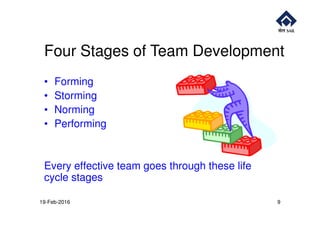
• Forming
• Storming
• Norming
Four Stages of Team Development
• Norming
• Performing
Every effective team goes through these life
cycle stages
19-Feb-2016 9
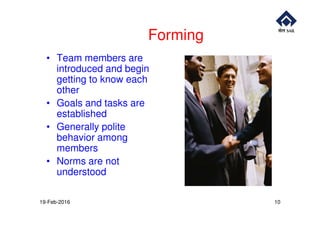
Forming
• Team members are
introduced and begin
getting to know each
other
• Goals and tasks are
establishedestablished
• Generally polite
behavior among
members
• Norms are not
understood
19-Feb-2016 10
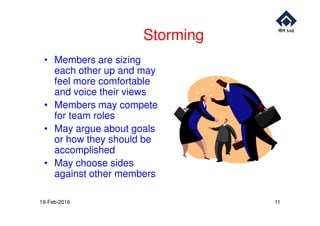
Storming
• Members are sizing
each other up and may
feel more comfortable
and voice their views
• Members may compete
for team rolesfor team roles
• May argue about goals
or how they should be
accomplished
• May choose sides
against other members
19-Feb-2016 11
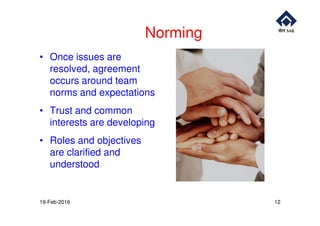
Norming
• Once issues are
resolved, agreement
occurs around team
norms and expectations
• Trust and common• Trust and common
interests are developing
• Roles and objectives
are clarified and
understood
19-Feb-2016 12
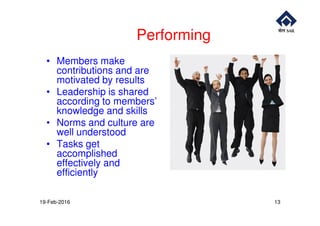
Performing
• Members make
contributions and are
motivated by results
• Leadership is shared
according to members’
knowledge and skillsknowledge and skills
• Norms and culture are
well understood
• Tasks get
accomplished
effectively and
efficiently
19-Feb-2016 13
19-Feb-2016 14

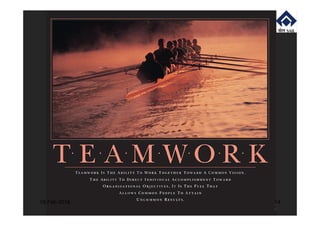
Teamwork

  • 1.
    Team Work R Biswas DeputyManager (Mining) Kiriburu Iron Ore Mine RMD, SAIL
  • 2.
  • 3.
  • 4.
  • 5.
    Team Work "None ofus is as smart as all of us." Ken Blanchard19-Feb-2016 5
  • 6.
    What is a •Teams are groups of people that share a common purpose, to which they are all committed, and who are empowered to set goals, solve problems and make decisions.goals, solve problems and make decisions. • Without these common traits they are not a 'team' - they are a group of people who happen to work together in the same environment - a work group Eg: a project team of a company etc. 19-Feb-2016 6
  • 7.
    Effective Teams? • Membershave a clear goal • The focus is on achieving results • There is a plan for achieving the goal • Members have clear roles• Members have clear roles • Members are committed to the goal • Members are competent • They achieve decisions through consensus • There is diversity among team members • Members have effective interpersonal skills 19-Feb-2016 7
  • 8.
    • There mustbe frequent and prolonged contact • Team members come together around a Effective Team-Building • Team members come together around a specific goal or project • Effective teams go through four stages of team development 19-Feb-2016 8
  • 9.
    • Forming • Storming •Norming Four Stages of Team Development • Norming • Performing Every effective team goes through these life cycle stages 19-Feb-2016 9
  • 10.
    Forming • Team membersare introduced and begin getting to know each other • Goals and tasks are establishedestablished • Generally polite behavior among members • Norms are not understood 19-Feb-2016 10
  • 11.
    Storming • Members aresizing each other up and may feel more comfortable and voice their views • Members may compete for team rolesfor team roles • May argue about goals or how they should be accomplished • May choose sides against other members 19-Feb-2016 11
  • 12.
    Norming • Once issuesare resolved, agreement occurs around team norms and expectations • Trust and common• Trust and common interests are developing • Roles and objectives are clarified and understood 19-Feb-2016 12
  • 13.
    Performing • Members make contributionsand are motivated by results • Leadership is shared according to members’ knowledge and skillsknowledge and skills • Norms and culture are well understood • Tasks get accomplished effectively and efficiently 19-Feb-2016 13
  • 14.