RTC Kiriburu -Welcome
All the participants
For the training Programme
“Explosives & Safety”
10 March, 2018
About the Programme
• The Aim and Objectives of the
Programme
• Program Structure
Aim
• To enable training of the persons
engage with Blasting Crew in
Explosive Handling including
Explosives and Accessories
Transportation, Loading of
Explosives and other Activities
related to Blasting.
Objectives
• On completion of the training program, the participants will be able to Understand his
own role for :-
• Explosive Handling including Explosives and Accessories Transportation,
• Loading of Explosives and
• other Activities related to Blasting.
Sl No Session Faculty
1 Legislation and Training Requirement for
Blasting Crew
R Biswas
2 Blasting Awareness R Biswas
3 History of Explosives R Biswas
4 Explosives & its properties PKB Sahu
5 Explosive Transportation - your Role PKB Sahu
6 Pre-Blast Inspection – your Role R Biswas
7 Blasting Operation- your Role R Biswas
8 Post-Blast Inspection- your Role R Biswas
PROGRAMME STRUCTURE
The Programme Folder
• Programme Effectiveness Sheet (Feed Back
Sheet )
• Learning Sheet
Thank You and Happy Learning
Training of persons in handling of
explosives
Rathin Biswas
Manager (Mining)
Kiriburu Iron Ore Mine
RMD, SAIL
LEGISLATION AND TRAINING
REQUIREMENT FOR BLASTING CREW
Section-1
Legislation Frame Work
Mines Act, 1952
MMR, 1961/
CMR,2017/
OMR, 1984
Mines Rules,
1955
Mines Vocational
Training Rules,
1966
3/17/2018 3
Mines Vocational Training Rules, 1966
• Chapter I-Preliminary
– Rule 1. Short title, application and
commencement
– Rule 2. Definition
• CHAPTER II- PERSONS TO BE TRAINED
– Rule 3. Application of Rules
– Rule 4. Disputes regarding training to be decided
by the Chief Inspector
– Rule 5. Standard of training
3/17/2018 4
Mines Vocational Training Rules, 1966
• CHAPTER III- General Vocational Training
– Rule 6. Scope and Standard
– Rule 7. Training of persons previously employed
• CHAPTER IV- REFRESHER TRAINING
– Rule 8. Scope and standard
– Rule 9. Training of persons already employed
– Rule 10. Training of persons employed belowground
in gassy mines
– Rule 11. Arrangement for refresher training
3/17/2018 5
Mines Vocational Training Rules, 1966
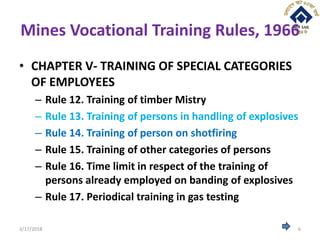
• CHAPTER V- TRAINING OF SPECIAL CATEGORIES
OF EMPLOYEES
– Rule 12. Training of timber Mistry
– Rule 13. Training of persons in handling of explosives
– Rule 14. Training of person on shotfiring
– Rule 15. Training of other categories of persons
– Rule 16. Time limit in respect of the training of
persons already employed on banding of explosives
– Rule 17. Periodical training in gas testing
3/17/2018 6
Mines Vocational Training Rules, 1966
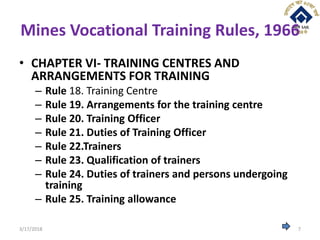
• CHAPTER VI- TRAINING CENTRES AND
ARRANGEMENTS FOR TRAINING
– Rule 18. Training Centre
– Rule 19. Arrangements for the training centre
– Rule 20. Training Officer
– Rule 21. Duties of Training Officer
– Rule 22.Trainers
– Rule 23. Qualification of trainers
– Rule 24. Duties of trainers and persons undergoing
training
– Rule 25. Training allowance
3/17/2018 7
Mines Vocational Training Rules, 1966
• CHAPTER VII- ALLOWANCE OF TRAINEES AND
ISSUE OF CERTIFICATES
– Rule 26. Trainees
– Rule 27. Stipend to trainees
– Rule 28. Certificate of trainees
– Rule 29. Duplicate Certificate
– Rule 30. Certificate to be delivered to the
Management
• CHAPTER VIII- MISCELLANEOUS
– Rule 31. Inspection
– Rule 32. Power to relax
3/17/2018 8
Mines Vocational Training Rules, 1966
• Rue: 13. Training of persons in handling of explosives - (1) Every person
other than a qualified shortfirer or blaster who is likely to be employed on
a job which involves handling of explosives shall , before he is so
employed, in addition to the course of training specified, under Chapter III
or Chapter IV as the case may be , undergo a course of training in the
handling and use of explosives, as detailed in the Sixth Schedule. Every
person who has undergone the said training shall undergo the training
again before re-employment if he has not worked in handling explosives
for a continuous period of six months or more before such re-
employment. The training under this rule shall be arranged that the
persons concerned can attend the same conveniently either before or
after their normal working hours.
• (2) Notwithstanding anything contained in sub rule (I), in the case of
metalliferous mines having opencast working only, the course of training
may be confined to not less than four lectures and demonstration covering
only such items of the Sixth Schedule as refer to opencast working and
general principals of shotfiring.
3/17/2018 9
Mines Vocational Training Rules, 1966
SIXTH SCHEDULE
(See Rule 13)
Course of Training in the handling and use of explosives.
1st Day
Talk: What is an explosive? General composition of explosives. Difference between low and high
explosives. Low explosives an their firing. Safety and its burning speed.
2nd Day
Talk: High explosive, their detonation. Electric shotfiring.
3rd Day
Talk: Dangers from explosive. Charging and firing of shots clearing of fumes produced during shotfiring.
4th Day
Talk: Dangers from blasting in gassy mines. Cracks in shot holes. Permitted explosives.
5th Day
Talk: Dangerous nature explosives. Care in handling explosives. Taking shelter. Storage of explosives on
surface and belowground. Issue of explosives Return of unused explosives.
6th Day
Talk: General revision and discussion.
3/17/2018 10
Mines Vocational Training Rules, 1966
• Rule 14. Training of person on shotfiring - (1) Every person eligible to appear at the
Shotfirer‘s Certificate of Competency Examination and who intends to appear at the said
examination within the succeeding three months, shall,, before he appears for the
examination and in addition to the training specified in Rule 13 undergo a course of training
as detailed in the Seventh Schedule. The training under the rule shall be so arranged that the
persons concerned can attend same conveniently either before or after their normal working
hours.
• (2) Notwithstanding anything contained in Rule 3, the training specified in the Seventh
Schedule shall also be undergone within one month of employment, or re-employment, as
the case may be, by-
– (i) every shotfirer or blaster on employment in an another mine except in case where he has already
undergone such training and
– (ii) every person who though qualified to fire shots has not worked as a shortfirer for a continuous
period of six months or more, on re-employment as a shotfirer :
• (3) Notwithstanding anything contained in sub-rules (1) and (2) in the case of persons,
working in metalliferous mines having opencast workings only, or holding blaster, restricted
certificate, it shall be sufficient if the course of training is confined to not less than eight
lecture and demonstrations and covering only such items of Seventh Schedule as refer to
opencast workings and general principles of shotfiring.
3/17/2018 11
Mines Vocational Training Rules, 1966
SEVENTH SCHEDULE
{See Rule (14)}
Course of Training on short firing
1st Day: High and low explosive. Difference between them. Their constituents.
2ndDay: Shot-firing accessories. Safety fuse and its burning speed. Detonators.
3rd Day: Provision of regulations etc. relating to transport handling and use of explosives.
4th Day: Storage of explosives, both above and belowground. Issue of explosives, Return of unused explosives.
5th Day: Correct drilling and placing of shot holes, Charging and firing of shots. Blown out shots. Taking shelter.
6th Day: Danger from explosives in gassy mines, permitted explosives, precautions during shot firing in gassy
mines. Dangers from cracks in shot holes.
7th Day: Dealing with misfire. Provisions of relating to duties of shot-fires.
8th Day: Examination of working places and roadway after shot firing. Clearing roadways of dust and fumes
after shot firing.
9th Day: Firing of shots singly and in rounds. Use of delay action detonators. Testing of circuits.
10th Day: Blasting with Ammonium Nitrate- Fuel Oil Explosive. Precautions.
11th Day: Heavy blasting in opencast mines. Blasting with liquid Oxygen. Precautions.
12th Day: General revision and discussion. Writing of reports.
3/17/2018 12
?
OPEN SESSION
Thank You
Training of persons in handling of
explosives
Rathin Biswas
Manager (Mining)
Kiriburu Iron Ore Mine
RMD, SAIL
BLASTING AWARENESS
Section-2
• Blasting & Flyrock
Awareness
• Recognizing the Hazards
Prevent injury to people
Prevent damage to property
Blasting activities are carefully regulated by
several governmental agencies.
Blasting Crew- Requirement
 Knowledge and Experience
 Training
 Physical Ability
 Evidence of Competency
Basic Blasting
Terminology
 Blasting Plan
 Blast Area
 Flyrock
 Blast-Warning
Signal
 All-Clear Signal
• Rock blasting is
the controlled use
of explosives to
excavate or
remove rock.
• It is a technique
used most often
in mining and civil
engineering.
• ensuring that all personnel have evacuated the blast area
during shot firing;
• using adequate blasting shelters for employees whose
presence is required in the blast area
• controlling and monitoring all entrances to the blast area;
ensuring that the blast is properly designed,drilled, and
loaded; and
• emphasizing education and training to enhance skill
levels for implementation of engineering control techniques.
Best Practices
Weather Conditions
Conduct Pre-Blast Meeting
• Review of weather conditions
• Communicate number of holes
• Calculate Explosives (SMS/ Cartridge/ Booster) per hole
• Discuss reasons to turn off electronic devices
• Review personnel location
• Discuss stemming process
• Discuss gas and fume releases
• Remind those working alone to stay in communication
with supervisor
Stemming
Blasting Shelter
Drilling Blast Holes
Storage of Explosives
Transport of Explosives
An example of a firing pattern which provides separate
delay time for the blastholes and gives good fragmentation
as well as good breakage.
Blast Area
Understanding
Warning
Signals & Signs
Two warnings are
common…
HOWEVER, some sites
use only one signal!
Blast-Warning Signal
 ___ minutes before shot is fired.
 Warns holes have been loaded
with explosives and prepared.
 Means blast area is clear, guards
have stopped traffic into area.
 Blast crew inspects grounds to
make sure no people or
equipment is in the blast area
 Radio silence is necessary.
 Guards will halt blast if they sight
anyone in area.
All-Clear Signal
 Blaster can't order the all-clear signal just
yet.
 The blaster must inspect the area to see if
there are any misfires.
 It may take minutes, hours or days to
determine if there is a misfire.
 Stay out until the All-Clear signal sounds.
Warning Signals
 Be alert and share information
 Know the blasting time, blast area
and clearing procedure; and
 Do not enter the blast area
• until an “all-clear” signal is
sounded.
Rock blasting in northern Ontario to make way for new highway upgrades.
The six exposures were taken over a span of 3 seconds.
This animation is displayed over 6 seconds.
Excavation crews working on sites involving blasting
operations may be exposed to the hazards of undetonated
charges during removal of blasted rock.
Flyrock is caused by a mismatch of the distribution
of the explosive energy, geomechanical strength
of rock mass, and confinement.
A B C D E
Optimum Depth
Protect Yourself!
• July 2002 - West Virginia
• A truck driver and his supervisor
were watching a blast from 1/2 mile
away - waiting for the "all clear"
signal.
• A rock slammed into the front
windshield and exited the rear. It
somehow missed both people. No
one was hurt.
PPE
• Hard hat
• Safety-toed shoes
• Reflective vest
• Safety glasses
• Gloves
• Hearing protection
• Explosives Security Reminder
• Inspect, verify each magazine is properly secured
• according to all applicable regulations, company
• policy, as well as manufacturers recommendations
• Explosives Security Reminder
• Report missing explosives
immediately
• Explosives Security Reminder
• Ensure that any vehicle used to
transport explosives is properly
secured and attended.
• Explosives Security Reminder
 Verify that inventories of explosives
are correct
 Copy is maintained in magazine with
duplicate at mine office
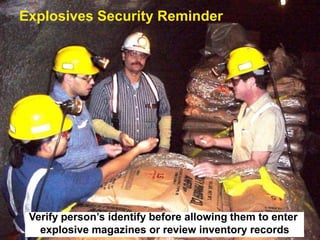
Explosives Security Reminder
Verify person’s identify before allowing them to enter
explosive magazines or review inventory records
Explosives
Misfires found during the post-blast
inspection
Exclude all employees from danger zone.
No other work except that required to clear the
misfire.
Only the Blaster-in-Charge handles all the
sequence of events following a misfire.
Extra care must be taken, as the designed pattern
HAS changed.
• Review facility’s security measures
• Are further measures necessary to protect explosives from theft?
Explosives Security Reminder
• Explosives Security Reminder
• Post proper authorities phone
• numbers in conspicous locations
• Explosives Security Reminder
• Periodically inspect magazines for
evidence of tampering or theft
• Explosives Security Reminder
• Immediately report shortages, loss or
theft of any explosive material
?
OPEN SESSION
Thank You
Training of persons in handling of
explosives
Rathin Biswas
Manager (Mining)
Kiriburu Iron Ore Mine
RMD, SAIL
HISTORY OF EXPLOSIVES
Section-3
Disclaimer
The information presented in this presentation has been compiled from
sources believed to be reliable and is intended to be a tool to assist and
guide you in building your own presentation. This program may not
address all the hazardous conditions or unsafe acts that may exist. For
that reason, users to confirm accuracy and compliance with the latest
standards and best practices. Local, State/Central regulations take
precedence over this material. Implementation of any practices
suggested by this program is at your sole discretion, and author will
have no liability to any party for any damages including, but not
limited to, direct, indirect, special or consequential damages, arising
out of or in connection with the information provided or its use.
Black Powder
• Saltpeter or “Nitre”
• Chinese as early
as the 10th
Century
• Roger Bacon
published formula
in 1242
• Berthold Schwartz
invented Gun ~
1300
Black Powder
• First Powder Mill in Massachusetts in
1675
• Americans first blasted with powder
around 1773
• American Revolution hastened
manufacture of black powder
• New frontiers required blasting to build
roads and canals for transporting goods
and people (early 1800s)
How Important was Black Powder?
Guard House Location 10’ WallStorage
• Discovered by
Ascanio Sobrero in
1846
• Nobel built factory in
1861
• Nobel Patented
Dynamite in 1867
• Problems included
fumes, freezing, &
headaches
• 750 million pounds
manufactured in 1955
Nitroglycerin and Dynamite
Dynamite -
from Dynamis, meaning power
Ammonium Nitrate
• Synthesized in 1659 by J. R.
Glauber
• Used for fertilizer and
explosives products
• Texas City explosion
• ANFO
• Pros: Easier to load,
cheaper, and safer than
dynamite
• Cons: desensitized by water
• Over 2.2 Billion pounds
Water Gels
• Developed in
1940s to solve
the water
problem
• Non-
Nitroglycerin
• Use increased
with
development of
equipment for
drilling large
diameter holesPros: economics, loading density, low
sensitivity, water resistance, no nitro
Cons: needs sensitizer, not for small holes
Binary/Two Component Explosives
• Usually consist of Ammonium Nitrate
(sensitizer) and Nitromethane (fuel)
• Advantages include:
– not a Class A explosive until mixed
– no danger of fire while in storage
– available in correct type and size
– can deactivate after mixing
– will detonate at minus 140F
• Disadvantages include:
– cost
– time required to mix
Initiation Devices
• Safety Fuse
• Fuse Caps
• Electric Blasting Caps
• Delay Caps
• Vented Caps
• Composition Caps
• Detonating Cord
• Nonelectric Delay
Caps
• Shock Tube
History of Explosives
50 B.C. Early form of seismoscope used by Chang Heng in China.
668 A.D. "Greek-fire" used in battle.
1200 A.D. Arabian author Abd Allah records use of saltpeter as main
ingredient of black powder.
1242 English Friar Roger Bacon publishes gunpowder formula.
1380 German Franciscan Monk, Berthold Schwarts developed gunpowder
and its use in guns.
1627 First recorded use of black powder for rock blasting (Hungary)
1670 Black powder use spreads to tin mines of Cornwall England by
German miners.
1696 First recorded use of black powder for road construction in
Switzerland.
1745 Doctor Watson of British Royal Society explodes black powder with
an electric spark.
1750 American inventor Benjamin Franklin encases and compresses
powder in cartridges.
1773 Black powder first used in U.S. at Copper Mine in Connecticut.
1831 William Bickford of Cornwall, England invents Safety Fuse.
1832 Dr. Robert Hare of University of Pennsylvania demonstrates bridge
wire electric blasting cap.
1846 Italian chemist Ascanio Sobrero discovers nitroglycerine.
1863 Wilbrand invents Trinitrotoluene (TNT)
History of Explosives...
1864 Swedish inventor Alfred Nobel develops first detonating blasting cap
1866 Swedish chemist Alfred Nobel invents dynamite by mixing
kieselguhr with nitroglycerine.
1866 First U.S. plant to make nitroglycerine, Little Ferry, NJ.
1870 First U.S. dynamite plant, Giant Powder Co., San Francisco,
California.
1875 Nobel patents blasting gelatine
1878 Rack bar electric blasting machine developed by H. Julius Smith
1884 Ammonium Nitrate (AN) becomes widely used in dynamite
formulations.
1885 Two component explosives used in New York Harbor.
1885 Permitted explosives officially recognized in Europe.
1888 Nobel invents ballistite, a dense smokeless powder
1902 Detonating cord introduced in Europe.
1908 U.S. Geological Survey assigned task of testing explosives for use
in underground coal mines.
1913 Insitute of Makers of Explosives (IME) formed in Chicago
Mid 1920’s Liquid Oxygen based explosives commercialized in U.S.
1935 duPont introduces first commercially successful non-nitroglycerin
ammonium nitrate (AN) blasting agent
1938 Modern PETN-filled fabric-covered detonating cord introduced in
U.S.
1946 Short interval millisecond delay electric blasting caps introduced.
History of Explosives...
1950’s High-speed photography for blast analysis introduced.
Late 1950’s Prilled AN fuel mixture begins to replace dynamite.
Bulk trucks and loaders developed.
1960’s Tunnel boring machines begin to seriously impact the use of
explosives in large tunnel jobs.
1967 Shock tube-type non-electric delay detonators introduced in
Sweden.
1969 Emulsion explosives introduced.
1971 Emulsion ANFO blends introduced
1972 Lang & Favreau introduce Computer Modeling of Blast Design.
1980 Bulk Blends introduced.
1988 Laser profiling for blast design and analysis, developed in Britain,
introduced in the United States.
Late-1980’s Electronic delay detonators (EDD’s) introduced.
1991 Industry works with USDOT to adopt HM 181, UN classifications for
explosives packaging.
?
OPEN SESSION
Thank You
Training of persons in handling of
explosives
Pawan Kumar Sahu
Deputy Manager (Mining)
Kiriburu Iron Ore Mine
RMD, SAIL
EXPLOSIVES & ITS PROPERTIES
Section-4
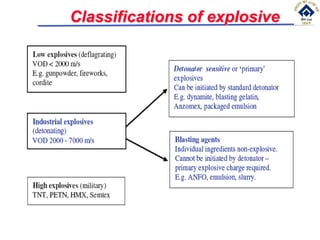
Definition of explosives
• An explosive is a substance which,
when properly initiated, is very
rapidly converted to gases at high
temperature and pressure. This
process is called detonation.
Classifications of explosive
Explosive properties
• Effective energy
• Velocity of detonation
• Density
• Detonation pressure
• Sensitivity
• Water resistance
• Physical characteristics
• Fume characteristics
• Storage life
Effective energy
• Effective energy is defined as the total energy released by
the explosive gases as they expand and do useful work
from the initial detonation down to a cut-off pressure of 100
MPa.
• Relative weight effective energy (RWEE). RWEE is defined
as the effective energy of an explosive compared to the
effective energy of an equal weight of standard ANFO (i.e.
94% AN, 6% FO, density = 0.8 g/cm3). RWEE is expressed
as a percentage, with hat of ANFO being 100%.
• Shock and heave energy- Energy is delivered by an
explosive in two main forms, shock energy and heave
energy. The gases continue to expand, forcing their way
into fractures created by the shock wave, and displace the
fractured rock outwards. This latter effect of the expanding
gases is termed heave.
Velocity of Detonation
• The velocity of detonation (VOD) is
the rate at which the detonation wave
travels along an explosive column.
The greater the VOD the greater the
power or ‘shattering’ effect of an
explosive.
Density
• The density of an explosive
determines the charge weight per
meter of hole
Detonation pressure
• Detonation pressure is the pressure
in the reaction zone as an explosive
detonates. It is a significant indicator
of the ability of an explosive to
produce good fragmentation. A high
detonation pressure is one of the
desirable characteristics in a primer.
Sensitivity
• Sensitivity is a measure of the ease
with which an explosive can be
detonated by heat, friction or shock
and of its ability to propagate that
detonation. Modern commercial
explosives can be grouped into two
main categories according to their
sensitivity, detonator sensitive
explosives and blasting agents.
Fume characteristics
• The gases produced by the
detonation of an explosive consist
mostly of non-toxic carbon dioxide,
nitrogen and steam.
• Small amounts of toxic gases are
also produced, the main ones being
carbon monoxide and oxides of
nitrogen
Storage properties
• Explosives deteriorate and shelf life
is particularly affected by both
climate and magazine conditions.
• The maintenance of explosives
magazines is also subject to
Statutory Regulations.
Water resistance
• Blasting often takes place in wet
conditions, even underwater for
special tasks. In these cases, the
water resistance of an explosive is a
very important consideration.
Physical characteristics
• The physical characteristics of an
explosive can be important with
respect to handling and loading into
blastholes.
Blasting agents
• A blasting agent is an explosive that:
– Comprises ingredients that by themselves are non-explosive
– Can only be detonated by a high explosive charge placed within it and not by a
detonator.
All blasting agents contain the following essential components:
• Oxidiser- A chemical that provides oxygen for the reaction.
Typical oxidisers are ammonium nitrate and calcium nitrate.
• Fuel- A chemical that reacts with oxygen to produce heat.
Common fuels include fuel oil and aluminium.
• Sensitiser - Provides the heat source (‘hot spot’) to drive the
chemical reaction of oxidiser and fuel. Sensitisers are generally
small air bubbles or pockets within the explosive.
• The composition of explosives is balanced chemically to produce
the desired effects in blasting.
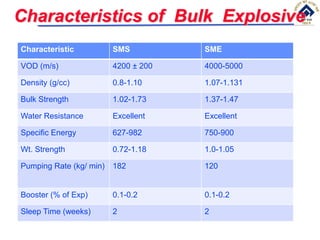
Characteristics of Bulk Explosive
Characteristic SMS SME
VOD (m/s) 4200 ± 200 4000-5000
Density (g/cc) 0.8-1.10 1.07-1.131
Bulk Strength 1.02-1.73 1.37-1.47
Water Resistance Excellent Excellent
Specific Energy 627-982 750-900
Wt. Strength 0.72-1.18 1.0-1.05
Pumping Rate (kg/ min) 182 120
Booster (% of Exp) 0.1-0.2 0.1-0.2
Sleep Time (weeks) 2 2
Flow sheet- Bulk Explosive
Bulk explosive trucks
Bulk V/s Cartridge
Feature Advantage with Bulk
Safety Non explosive ingredients are stored at all stages
Inventory No inventory to be maintained and hence no investment in
magazines.
Explosive vans Large number of vans are not required
Manpower Manpower saving is obtained by less deployment of
Van/drivers/helpers blasting crew and magazine staff
Speed of
operation
Swift charging rate 250/300 kg /Mt
Explosive product Tailor made product wrt density and energy can be
delivered down the hole
Blasting
efficiency
Full bore hole coupling can be achieved enabling
expanded burden and spacing.
Other features No explosive pilferage.
Initiating explosives
• Initiating explosives can be broadly classified
into electric and non-electric types.
• In electric systems, a device that can generate or
store electrical energy transmits that energy to
the initiating explosives via a circuit of insulated
conductors. Blast sequences can be controlled
by means of electric timing systems but delay
timing is usually achieved through pyrotechnic
delay elements incorporated inside detonators.
• Non-electric initiating systems use reactive
chemicals to store and transmit energy by
controlled burning, detonation, or shock waves.
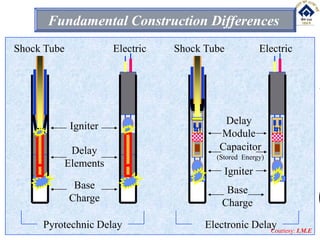
Fundamental Construction Differences
Shock Tube Electric
Igniter
Delay
Module
Base
Charge
Electronic Delay
Capacitor
(Stored Energy)
Shock Tube Electric
Igniter
Delay
Elements
Base
Charge
Pyrotechnic Delay Courtesy: I.M.E
Field Programmed
(Variable) Delay Periods
•Two Wire or Multi-Wired
•Digital / Coded Security
•One Millisecond Interval Delays
•Several Seconds (Maximum)
•Blast Machine Programming
•Hand-Held Programmers
•Blast Design Software Options
Factory Programmed
(Fixed) Delay Periods
•Typically Two Wire
•Electric Tie -in Principles
•Coded Security
•Multiple Delay Periods
•Blast Machine
•Sequential Capability
Factory Programmed
(Fixed) Delay Periods
•Typically Two Wire
•Electric Tie -in Principles
•Coded Security
•Multiple Delay Periods
•Blast Machine
•Sequential Capability
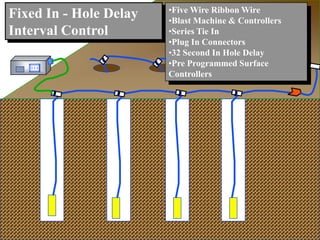
Fixed In - Hole Delay
Interval Control
•Five Wire Ribbon Wire
•Blast Machine & Controllers
•Series Tie In
•Plug In Connectors
•32 Second In Hole Delay
•Pre Programmed Surface
Controllers
Field Programmed
Passive Programmed
•Two Wire
•Blast Machine, Computer,Scanners
•Network Tie In
•Plug In Connectors
•Bar Code Reader Sequenced/Programmed
•Shock Tube Leads
•Energy Transition
•Electronic Delay
•Standard Tie In
Shock Tube Initiated
Factory Programmed
17ms 17ms 17ms
• Added Blast Control
• Education of Blasters
• Understand Dynamics
– Better Blast Control
• Improved Flexibility
• Information
• Improved Economics
• Communication
• Information/Control
Challenges / Opportunities
 Added Complexity
 Training Requirements
 Environmental Limits
– Temp/Pressure/Shock
 Multiple User Interfaces
 Dumb Intelligence
 System Costs
 Communication
 Equipment
?
OPEN SESSION
Thank You
Training of persons in handling of
explosives
Pawan Kumar Sahu
Deputy Manager (Mining)
Kiriburu Iron Ore Mine
RMD, SAIL
EXPLOSIVE TRANSPORTATION -
AND YOUR ROLE
Section-5
Explosives and
Blasting Agents
Transportation
Regulations and laws
• Applicable traffic regulations
• Applicable state laws
1a
Basic safety guidelines
• Smoking is prohibited near vehicles
carrying explosives or blasting
agents
2a
• Use of intoxicants,
narcotics, dangerous
drugs prohibited when:
– Driving or riding in a
vehicle
– Loading or unloading a
vehicle
Basic safety guidelines
2b
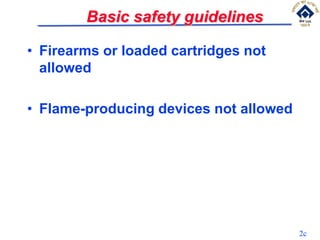
Basic safety guidelines
• Firearms or loaded cartridges not
allowed
• Flame-producing devices not allowed
2c
Safe driving procedures
• Driver safety
• Defensive driving
3a
Attended vehicles
• An attended vehicle is one where:
– the driver or attendant is physically on
or in the vehicle; or
– the driver or attendant has the vehicle
within his/her field of vision and can
reach it quickly
4a
Attended vehicles
• Vehicles
transporting
Class A or B
explosives must
be attended
4b
Attended vehicles
• Driver must be awake, alert, not
occupied with other duties, except
for communication with:
– public officers
– consignees
– representatives
of the carrier
shipper
4c
Attended vehicles
• Vehicle may be left unattended when
it is:
– parked in a secured, fenced, or walled
area with gates and entrances locked;
or
– at a magazine site that is constructed
for the storage of explosives
4d
Proper use of fire extinguishers
• Fire extinguishers must be located
near the
driver’s seat
• Must be full and
ready for
immediate use
5a
Proper use of fire extinguishers
• Must have at least
two extinguishers
present
5b
Types of explosives and
blasting agents transported
• Explosive classifications:
– Class A
– Class B
– Class C
• Hazards of explosives and/or
blasting agents
6a
Delivery and unloading
• Delivery can only be made to:
– authorized persons
– authorized magazines
– authorized temporary storage areas
– authorized handling areas
• Transfer not allowed between sunset
and sunrise
7a
Vehicle inspection
• Fire extinguishers
• Electrical wiring
• Chassis, motor, and body clean and
free of grease and oil
8a
Vehicle inspection
• Fuel tanks and lines secured and free
of leaks
• Brakes, lights, horn, windshield
wipers, steering
• Tires
8b
Explosives/blasting agents -
transporting
• Avoid congested areas and heavy
traffic unless the route is designated
by local authorities
• Never park vehicle on public streets
adjacent to where people are working
10a
Emergency procedures
• Notify fire and police departments of
breakdowns/collisions
• Transferring explosives from a
disabled vehicle
• Supervision during the transfer
11a
Summary of key points
• Types of explosives and blasting
agents
• Traffic regulations
• State and local
laws
12a
Summary of key points
• Delivery of
explosives
• General safety
guidelines
12b
Summary of key points
• Driver safety
• Attended vehicles
• Use of fire
extinguishers
12c
Summary of key points
• Vehicle inspection
• Transporting explosives/blasting
agents
• Emergency
procedures
12d
Storage of explosives
• 154. Storage of explosives. – (1) No owner,
agent or manager shall store, or knowingly
allow any other person to store, within the
premises of a mine any explosives
otherwise than in accordance with the
provisions of rules made under the Indian
Explosives Act, 1884.
• (2) Explosives shall not be taken into or
kept in any building except a magazine duly
approved by the Licencing Authority under
the Indian Explosives Act, 1884 :
•
Storage of explosives
• Provided that the Regional Inspector may, by an order in
writing and subject to such conditions as he may specify
therein, permit the use of any store or premises specially
constructed at or near the entrance to a mine for the
temporary storage of explosives intended for use in the
mine or of surplus explosives brought out of the mine at the
end of a shift.
• (3) Explosives shall not be stored below ground in amine
except with the approval in writing of the Chief Inspector
and subject to such conditions as he may specify therein.
Such storage shall be done only in a magazine or
magazines duly licenced in accordance with the provisions
of rules made under the Indian Explosives Act, 1884.
• (4) Every licence granted by the Licencing Authority under
the Indian Explosives Act, 1884 for the storage of
explosives, or a true copy thereof, shall be kept at the office
of the mine.
• 155. Cartridges. (1) Unless otherwise permitted
by the Chief Inspector by an order in writing
and subject to such conditions as he may
specify therein, no explosive, other than a fuse
or a detonator, shall be issued for use in mine,
or taken into or used in any part of a mine,
unless it is in the form of a cartridge. Cartridges
shall be used only in the form in which they are
received.
• (2) The preparation of cartridges from loose
gunpowder, the drying of gunpowder an the
reconstruction of damp cartridges shall be
carried out by a competent person and only in a
place approved by the Licencing Authority an
in accordance with the rules made under the
Indian Explosives Act, 1884.
Storage of explosives
• 156. Magazines, stores and premises to
store explosives. – (1) Every magazine,
or store or premises, where explosives
are stored shall be in charge of a
competent person who shall be
responsible for the proper receipt,
storage an issue of explosives.
• (2) Explosives shall not be issued from
the magazine unless they are required
for immediate use. If any explosives are
returned to the magazine or store or
premises, they shall be reissue before
fresh stock is used.
Storage of explosives
• (3) Explosives shall be issued only to
competent persons upon written requisition
signed by the blaster or by a official
authorised for the purpose, and only
against their signature or thumb
impression. Such requisition shall be
preserved by the person in charge of the
magazine or store or premises.
• (4) The person in charge of the magazine or
store or premises shall maintain, in a bound
paged book kept for the purpose, a clear
and accurate record of explosives issued to
each competent person and a similar record
of explosives returned tot he magazine or
store or premises.
Storage of explosives
• 157. Cases and containers for carrying
explosives. (1) No explosive shall be
issued from the magazine or taken into
any mine except in a case or container of
substantial construction and securely
locked. Cases or containers made of iron
or steel shall be heavily galvanised; and
no case or container provided for carrying
detonators shall be constructed of metal
or other conductive material.
Storage of explosives
• (2) No detonator shall be kept in a
case of container which contains
other explosives, materials or tools;
and two or more types of detonators
shall not be kept in the same case of
container .
Storage of explosives
• (3) No detonator shall be taken out
from a case or container unless it is
required for immediate use.
• (4) No case or container shall
contain more than five kilogrammes
or explosives, and no person shall
have in his possession at one time in
any place more than one such case
or container :
Storage of explosives
• Provided further that the Chief
Inspector may, by an order in writing
and subject to such conditions as he
may specify therein, permit the
carrying of a larger quantity of
explosives in a single case of
container, or the use, at one time in
one place, of more than one such
case or container.
Storage of explosives
• (5)Every case or container shall be
numbered; and as far as practicable,
the same case or container shall be
issue to the same blaster or
competent person, as the case may
be, every day.
• (6) The key of every case or
container shall be retained by the
blaster in his own possession
throughout his shift.
?
OPEN SESSION
Thank You
Training of persons in handling of
explosives
Rathin Biswas
Manager (Mining)
Kiriburu Iron Ore Mine
RMD, SAIL
PRE-BLAST INSPECTION –
YOUR ROLE
Section-6
Blast Site Edge Protection
Information on the use of edge protection systems in the blasting
area
Any person likely to be working in the blasting area
and those supervising such operations.
Introduction
• Lives have been lost in the past through falls
from quarry faces.
• Thankfully this is now very rare mainly due to
control measures introduced to prevent it.
• In deciding what are the most suitable control
measures for any particular circumstance,
account needs to be taken.
Managing the Risk
• The Operator is responsible for Health and Safety on site
including all drilling and blasting activities
– This includes the design, construction and provision of blast site
edge protection
• Blast site activities include
– Surveying, marking out, drilling, loading and firing
• It is therefore very important to carry out a site specific
risk assessment including all the personnel likely to be
involved in the blasting operation
– For Example
• Driller, Shotfirer, Explosives Supervisor, Quarry Manager
• Bulk explosive supplier, Geotechnical Consultant
Managing the Risk
The following topics should be considered
as a minimum in a risk assessment
1. Prevention of personnel and equipment from
falling over the edge
2. The site geology and stability of the face.
3. Access to the blast site for drill rig, delivery of
stemming, explosives delivery vehicles, bulk
explosive trucks and emergency vehicles.
4. Blast design parameters
Such as spacing, burden, etc
6. Profiling and surveying operations
7. Weather conditions
Managing the Risk
• The Work at Height hierarchy should be followed
in selecting the method used:-
– Collective measures should be given priority over
personal protective measures. Physical barriers such
as the safety bund and post and strap should be
considered first
– Where the use of physical barriers creates an
unacceptable risk then other measures such as
delineation of the danger zone or harnesses should be
considered
– The Quarry operator should be able to show that they
have considered how a fall from an open edge will be
prevented for that particular shot.
Protection Methods
• Safety Bund
– Advantages
• Provides protection for people
• Does not need removing before blast
– Disadvantages
• Can cover up bad edge conditions
– A safe system of work needs to be
established detailing how such bunds
put in place
• Requires the movement of mobile plant
close to the crest
Protection Methods
• Safety Bund
– How high do the bunds need to be ?
– People only on the blast area
• Not less than 1m
• In this case a second bund will be
required behind the blast to prevent
vehicles from encroaching
– Vehicles operating on the blast area
• A minimum of 1.5m or the radius
of the largest vehicle wheel
Protection Methods
• Post and Strap
– Designed to prevent personnel from
accidentally approaching the edge
– Advantages
• Acts as a physical barrier to prevent
personnel from falling over face
– Disadvantages
• Barrier will not prevent machinery from
falling over face
• Requires a drill rig to approach the edge to
drill post holes
• Placing and removal of system requires
personnel to approach the edge
Protection Methods
• Post and Strap – Bad Practice
Only a single strap
has been used
Worse than useless as
the protection has been
placed such that the
face edge comes inside
the protection
!
!
Protection Methods
• Post and Strap – Good Practice
Two straps have been used
Straps are tensioned
Line of protection is
positioned just in front of
the first row of holes
Protection Methods
• Stand-off Distance
– In this case workers may not approach within a
specified distance to an unprotected edge
– The distance needs to be well delineated with
some form of barrier
• Good example is when used with cones and rope
– This system needs to be well supervised
– Advantages
• No need for the drill rig to approach the bench edge
• Can easily be removed before the blast
– Disadvantages
• Does not prevent either people or equipment from
falling over face
• Example of Stand-off Distance
– In the photograph this system is used on a site that employs
a stand-off distance of 3m.
Protection Methods
A cone and rope system has been used
to indicate the stand-off distance from
the edge of the face
Note also that in this case
a bund has been positioned
to prevent equipment such
as bulk explosive trucks
from coming on the blast
area
Protection Methods
• Fall Prevention Systems
– Should only be used as a last
resort
– Should be installed so as to
prevent personnel reaching the
crest and falling over the face
– Requires that personnel are
also trained in emergency
recovery procedures.
– Many sites require the use of such
system when removing the post
and
strap system previously described
Key Points
• Edge protection is required for all blast areas
• Each blast should be separately assessed to
determine suitable protection measures for that
location
• A single edge protection system may not be
universally appropriate
• If you think the edge protection is inadequate
STOP WORK and inform your supervisor
?
OPEN SESSION
Thank You
Training of persons in handling of
explosives
Rathin Biswas
Manager (Mining)
Kiriburu Iron Ore Mine
RMD, SAIL
BLASTING OPERATION-
YOUR ROLE
Section-7
Blasting Operation
• The Blasting operation can be
subdivided into three major
groups, viz.
• (i) Blast Planning, which
includes Geo-Mining Study of
the ore Body, Explosive
selection and Blast Design;
• (ii) Blast Operation including
selection of initiation system
selection and firing with proper
sequencing and
• (iii) Blast Monitoring, that
includes Fragmentation
Analysis, Blast economy study
and Socio-Environmental
Aspect study of Blast operation
Blast Planning
Blast designing is not a science, but knowledge, experience, studying
and analyzing past practices in relation to rock strata & geology etc.,
makes blaster to achieve perfection.
Thus, for a blaster, valuable tool is the file of blast reports that he builds
as he gains experience. Not only do these provide evidence of the
quality of his work, but they also provide a wealth of information
upon which he can draw as future blasting situations develop.
Blast Planning, includes-
• GeoMining Study
• Explosive selection and
• Blast Design
Geo-
Mining
Study
Explosive
Selection
Blast
Design
Blasting Operation
Selection
of Initiation
System
Firing
Sequence
Blasting Operation
Selection
of Initiation
System
Firing
Sequence
Blast Monitoring
Blast Monitoring includes
• Fragmentation Analysis & Seismic Analysis
• Blast Economy study and
• Socio-Environmental Aspect study of Blast operation
Fragmentation
& Seismic
Analysis
Blast
Economy
Socio-
Environmental
Aspect
?
OPEN SESSION
Thank You
Training of persons in handling of
explosives
Rathin Biswas
Manager (Mining)
Kiriburu Iron Ore Mine
RMD, SAIL
POST-BLAST INSPECTION-
YOUR ROLE
Section-8
Introduction
• The Shotfirer has a responsibility to carry out a post-
blast inspection
– The purpose of the inspection is to confirm that conditions are
safe for work in the area to recommence
– In particular the shotfirer is looking for evidence of misfires and
unsafe ground conditions
• Most safety professionals consider the post-blast
inspection to be the most hazardous part of the
shotfiring job
What are the hazards
• Fumes and dust
– All blasts will
produce fumes
and this is often
accompanied by
dust
– Both fumes and
dust - in
excessive
quantities - can be
harmful to health
and exposure to
them should be
avoided
WAIT UNTIL THE DUST AND
FUMES HAVE CLEARED
What are the hazards
• Falls of ground
– The blasting process inevitably results in some
movement of the rock mass for some considerable
distance from the blast area
– This can lead to falls of ground
from both the benches above
and below the blast
– These falls of ground can
happen some considerable time
after the blast has been fired and
pose a serious threat to the
safety of the shotfirer and
any other personnel in
the area
What are the hazards
• Falls of ground
– The area of ground immediately
surrounding the blast area can
be especially unstable
– It is not unusual for overhangs
to be left behind on the newly
formed crest
– There will be no edge protection
– The face will not have been ‘dressed’
What are the hazards
• Misfires or burning explosives
– If the shotfirer discovers explosives that have either
misfired or are burning then there is a clear danger of
additional detonations with the associated risks of blast
damage and flyrock
– In such cases the shotfirer should
• Return to the shotfiring shelter
• Ensure that the all-clear is not sounded
• Ensure that all sentries stay in-place
• Inform the Explosives Supervisor of the situation
– The Shotfiring Rules for each quarry should include a
section dealing with misfires and it is these procedures
that should be followed in this event
Minimising the risks
• Fumes and dust
– Make sure the shotfiring shelter is not
positioned downwind of the blast area
• Positioning a Shotfiring Shelter
– Wait for the fumes and dust to clear
• Falls of ground
– Keep away from the toe of the face above and
crest of the face below
– If possible inspect the blast muck-pile from the
bench below
– Inspect the blast muck-pile from the side
Key points
• The post-blast inspection is potentially the most risky part
of the shotfiring process
• After firing wait until the dust and fumes have cleared
• Approach the blast area with care avoiding the toes and
crest of faces
• Inspect the blast area from below or from the side of the
blast
• Do not rush the inspection process
• Do not sound the all-clear until the inspection process is
complete
?
OPEN SESSION
Thank You

Explosives & safety

  • 1.
    RTC Kiriburu -Welcome Allthe participants For the training Programme “Explosives & Safety” 10 March, 2018
  • 2.
    About the Programme •The Aim and Objectives of the Programme • Program Structure
  • 3.
    Aim • To enabletraining of the persons engage with Blasting Crew in Explosive Handling including Explosives and Accessories Transportation, Loading of Explosives and other Activities related to Blasting.
  • 4.
    Objectives • On completionof the training program, the participants will be able to Understand his own role for :- • Explosive Handling including Explosives and Accessories Transportation, • Loading of Explosives and • other Activities related to Blasting.
  • 5.
    Sl No SessionFaculty 1 Legislation and Training Requirement for Blasting Crew R Biswas 2 Blasting Awareness R Biswas 3 History of Explosives R Biswas 4 Explosives & its properties PKB Sahu 5 Explosive Transportation - your Role PKB Sahu 6 Pre-Blast Inspection – your Role R Biswas 7 Blasting Operation- your Role R Biswas 8 Post-Blast Inspection- your Role R Biswas PROGRAMME STRUCTURE
  • 6.
    The Programme Folder •Programme Effectiveness Sheet (Feed Back Sheet ) • Learning Sheet
  • 7.
    Thank You andHappy Learning
  • 8.
    Training of personsin handling of explosives Rathin Biswas Manager (Mining) Kiriburu Iron Ore Mine RMD, SAIL
  • 9.
    LEGISLATION AND TRAINING REQUIREMENTFOR BLASTING CREW Section-1
  • 10.
    Legislation Frame Work MinesAct, 1952 MMR, 1961/ CMR,2017/ OMR, 1984 Mines Rules, 1955 Mines Vocational Training Rules, 1966 3/17/2018 3
  • 11.
    Mines Vocational TrainingRules, 1966 • Chapter I-Preliminary – Rule 1. Short title, application and commencement – Rule 2. Definition • CHAPTER II- PERSONS TO BE TRAINED – Rule 3. Application of Rules – Rule 4. Disputes regarding training to be decided by the Chief Inspector – Rule 5. Standard of training 3/17/2018 4
  • 12.
    Mines Vocational TrainingRules, 1966 • CHAPTER III- General Vocational Training – Rule 6. Scope and Standard – Rule 7. Training of persons previously employed • CHAPTER IV- REFRESHER TRAINING – Rule 8. Scope and standard – Rule 9. Training of persons already employed – Rule 10. Training of persons employed belowground in gassy mines – Rule 11. Arrangement for refresher training 3/17/2018 5
  • 13.
    Mines Vocational TrainingRules, 1966 • CHAPTER V- TRAINING OF SPECIAL CATEGORIES OF EMPLOYEES – Rule 12. Training of timber Mistry – Rule 13. Training of persons in handling of explosives – Rule 14. Training of person on shotfiring – Rule 15. Training of other categories of persons – Rule 16. Time limit in respect of the training of persons already employed on banding of explosives – Rule 17. Periodical training in gas testing 3/17/2018 6
  • 14.
    Mines Vocational TrainingRules, 1966 • CHAPTER VI- TRAINING CENTRES AND ARRANGEMENTS FOR TRAINING – Rule 18. Training Centre – Rule 19. Arrangements for the training centre – Rule 20. Training Officer – Rule 21. Duties of Training Officer – Rule 22.Trainers – Rule 23. Qualification of trainers – Rule 24. Duties of trainers and persons undergoing training – Rule 25. Training allowance 3/17/2018 7
  • 15.
    Mines Vocational TrainingRules, 1966 • CHAPTER VII- ALLOWANCE OF TRAINEES AND ISSUE OF CERTIFICATES – Rule 26. Trainees – Rule 27. Stipend to trainees – Rule 28. Certificate of trainees – Rule 29. Duplicate Certificate – Rule 30. Certificate to be delivered to the Management • CHAPTER VIII- MISCELLANEOUS – Rule 31. Inspection – Rule 32. Power to relax 3/17/2018 8
  • 16.
    Mines Vocational TrainingRules, 1966 • Rue: 13. Training of persons in handling of explosives - (1) Every person other than a qualified shortfirer or blaster who is likely to be employed on a job which involves handling of explosives shall , before he is so employed, in addition to the course of training specified, under Chapter III or Chapter IV as the case may be , undergo a course of training in the handling and use of explosives, as detailed in the Sixth Schedule. Every person who has undergone the said training shall undergo the training again before re-employment if he has not worked in handling explosives for a continuous period of six months or more before such re- employment. The training under this rule shall be arranged that the persons concerned can attend the same conveniently either before or after their normal working hours. • (2) Notwithstanding anything contained in sub rule (I), in the case of metalliferous mines having opencast working only, the course of training may be confined to not less than four lectures and demonstration covering only such items of the Sixth Schedule as refer to opencast working and general principals of shotfiring. 3/17/2018 9
  • 17.
    Mines Vocational TrainingRules, 1966 SIXTH SCHEDULE (See Rule 13) Course of Training in the handling and use of explosives. 1st Day Talk: What is an explosive? General composition of explosives. Difference between low and high explosives. Low explosives an their firing. Safety and its burning speed. 2nd Day Talk: High explosive, their detonation. Electric shotfiring. 3rd Day Talk: Dangers from explosive. Charging and firing of shots clearing of fumes produced during shotfiring. 4th Day Talk: Dangers from blasting in gassy mines. Cracks in shot holes. Permitted explosives. 5th Day Talk: Dangerous nature explosives. Care in handling explosives. Taking shelter. Storage of explosives on surface and belowground. Issue of explosives Return of unused explosives. 6th Day Talk: General revision and discussion. 3/17/2018 10
  • 18.
    Mines Vocational TrainingRules, 1966 • Rule 14. Training of person on shotfiring - (1) Every person eligible to appear at the Shotfirer‘s Certificate of Competency Examination and who intends to appear at the said examination within the succeeding three months, shall,, before he appears for the examination and in addition to the training specified in Rule 13 undergo a course of training as detailed in the Seventh Schedule. The training under the rule shall be so arranged that the persons concerned can attend same conveniently either before or after their normal working hours. • (2) Notwithstanding anything contained in Rule 3, the training specified in the Seventh Schedule shall also be undergone within one month of employment, or re-employment, as the case may be, by- – (i) every shotfirer or blaster on employment in an another mine except in case where he has already undergone such training and – (ii) every person who though qualified to fire shots has not worked as a shortfirer for a continuous period of six months or more, on re-employment as a shotfirer : • (3) Notwithstanding anything contained in sub-rules (1) and (2) in the case of persons, working in metalliferous mines having opencast workings only, or holding blaster, restricted certificate, it shall be sufficient if the course of training is confined to not less than eight lecture and demonstrations and covering only such items of Seventh Schedule as refer to opencast workings and general principles of shotfiring. 3/17/2018 11
  • 19.
    Mines Vocational TrainingRules, 1966 SEVENTH SCHEDULE {See Rule (14)} Course of Training on short firing 1st Day: High and low explosive. Difference between them. Their constituents. 2ndDay: Shot-firing accessories. Safety fuse and its burning speed. Detonators. 3rd Day: Provision of regulations etc. relating to transport handling and use of explosives. 4th Day: Storage of explosives, both above and belowground. Issue of explosives, Return of unused explosives. 5th Day: Correct drilling and placing of shot holes, Charging and firing of shots. Blown out shots. Taking shelter. 6th Day: Danger from explosives in gassy mines, permitted explosives, precautions during shot firing in gassy mines. Dangers from cracks in shot holes. 7th Day: Dealing with misfire. Provisions of relating to duties of shot-fires. 8th Day: Examination of working places and roadway after shot firing. Clearing roadways of dust and fumes after shot firing. 9th Day: Firing of shots singly and in rounds. Use of delay action detonators. Testing of circuits. 10th Day: Blasting with Ammonium Nitrate- Fuel Oil Explosive. Precautions. 11th Day: Heavy blasting in opencast mines. Blasting with liquid Oxygen. Precautions. 12th Day: General revision and discussion. Writing of reports. 3/17/2018 12
  • 20.
  • 21.
  • 22.
    Training of personsin handling of explosives Rathin Biswas Manager (Mining) Kiriburu Iron Ore Mine RMD, SAIL
  • 23.
  • 24.
    • Blasting &Flyrock Awareness • Recognizing the Hazards Prevent injury to people Prevent damage to property
  • 25.
    Blasting activities arecarefully regulated by several governmental agencies.
  • 26.
    Blasting Crew- Requirement Knowledge and Experience  Training  Physical Ability  Evidence of Competency
  • 27.
    Basic Blasting Terminology  BlastingPlan  Blast Area  Flyrock  Blast-Warning Signal  All-Clear Signal
  • 28.
    • Rock blastingis the controlled use of explosives to excavate or remove rock. • It is a technique used most often in mining and civil engineering.
  • 30.
    • ensuring thatall personnel have evacuated the blast area during shot firing; • using adequate blasting shelters for employees whose presence is required in the blast area • controlling and monitoring all entrances to the blast area; ensuring that the blast is properly designed,drilled, and loaded; and • emphasizing education and training to enhance skill levels for implementation of engineering control techniques. Best Practices
  • 31.
  • 32.
    Conduct Pre-Blast Meeting •Review of weather conditions • Communicate number of holes • Calculate Explosives (SMS/ Cartridge/ Booster) per hole • Discuss reasons to turn off electronic devices • Review personnel location • Discuss stemming process • Discuss gas and fume releases • Remind those working alone to stay in communication with supervisor
  • 33.
  • 34.
  • 35.
  • 37.
  • 38.
  • 46.
    An example ofa firing pattern which provides separate delay time for the blastholes and gives good fragmentation as well as good breakage.
  • 48.
  • 50.
  • 51.
    Two warnings are common… HOWEVER,some sites use only one signal!
  • 56.
    Blast-Warning Signal  ___minutes before shot is fired.  Warns holes have been loaded with explosives and prepared.  Means blast area is clear, guards have stopped traffic into area.  Blast crew inspects grounds to make sure no people or equipment is in the blast area  Radio silence is necessary.  Guards will halt blast if they sight anyone in area.
  • 57.
    All-Clear Signal  Blastercan't order the all-clear signal just yet.  The blaster must inspect the area to see if there are any misfires.  It may take minutes, hours or days to determine if there is a misfire.  Stay out until the All-Clear signal sounds.
  • 58.
    Warning Signals  Bealert and share information  Know the blasting time, blast area and clearing procedure; and  Do not enter the blast area • until an “all-clear” signal is sounded.
  • 60.
    Rock blasting innorthern Ontario to make way for new highway upgrades. The six exposures were taken over a span of 3 seconds. This animation is displayed over 6 seconds.
  • 61.
    Excavation crews workingon sites involving blasting operations may be exposed to the hazards of undetonated charges during removal of blasted rock.
  • 64.
    Flyrock is causedby a mismatch of the distribution of the explosive energy, geomechanical strength of rock mass, and confinement. A B C D E Optimum Depth
  • 71.
    Protect Yourself! • July2002 - West Virginia • A truck driver and his supervisor were watching a blast from 1/2 mile away - waiting for the "all clear" signal. • A rock slammed into the front windshield and exited the rear. It somehow missed both people. No one was hurt.
  • 72.
    PPE • Hard hat •Safety-toed shoes • Reflective vest • Safety glasses • Gloves • Hearing protection
  • 73.
    • Explosives SecurityReminder • Inspect, verify each magazine is properly secured • according to all applicable regulations, company • policy, as well as manufacturers recommendations
  • 74.
    • Explosives SecurityReminder • Report missing explosives immediately
  • 75.
    • Explosives SecurityReminder • Ensure that any vehicle used to transport explosives is properly secured and attended.
  • 76.
    • Explosives SecurityReminder  Verify that inventories of explosives are correct  Copy is maintained in magazine with duplicate at mine office
  • 77.
    Explosives Security Reminder Verifyperson’s identify before allowing them to enter explosive magazines or review inventory records
  • 78.
  • 79.
    Misfires found duringthe post-blast inspection Exclude all employees from danger zone. No other work except that required to clear the misfire. Only the Blaster-in-Charge handles all the sequence of events following a misfire. Extra care must be taken, as the designed pattern HAS changed.
  • 81.
    • Review facility’ssecurity measures • Are further measures necessary to protect explosives from theft? Explosives Security Reminder
  • 82.
    • Explosives SecurityReminder • Post proper authorities phone • numbers in conspicous locations
  • 83.
    • Explosives SecurityReminder • Periodically inspect magazines for evidence of tampering or theft
  • 84.
    • Explosives SecurityReminder • Immediately report shortages, loss or theft of any explosive material
  • 85.
  • 86.
  • 87.
    Training of personsin handling of explosives Rathin Biswas Manager (Mining) Kiriburu Iron Ore Mine RMD, SAIL
  • 88.
  • 89.
    Disclaimer The information presentedin this presentation has been compiled from sources believed to be reliable and is intended to be a tool to assist and guide you in building your own presentation. This program may not address all the hazardous conditions or unsafe acts that may exist. For that reason, users to confirm accuracy and compliance with the latest standards and best practices. Local, State/Central regulations take precedence over this material. Implementation of any practices suggested by this program is at your sole discretion, and author will have no liability to any party for any damages including, but not limited to, direct, indirect, special or consequential damages, arising out of or in connection with the information provided or its use.
  • 90.
    Black Powder • Saltpeteror “Nitre” • Chinese as early as the 10th Century • Roger Bacon published formula in 1242 • Berthold Schwartz invented Gun ~ 1300
  • 91.
    Black Powder • FirstPowder Mill in Massachusetts in 1675 • Americans first blasted with powder around 1773 • American Revolution hastened manufacture of black powder • New frontiers required blasting to build roads and canals for transporting goods and people (early 1800s)
  • 92.
    How Important wasBlack Powder? Guard House Location 10’ WallStorage
  • 93.
    • Discovered by AscanioSobrero in 1846 • Nobel built factory in 1861 • Nobel Patented Dynamite in 1867 • Problems included fumes, freezing, & headaches • 750 million pounds manufactured in 1955 Nitroglycerin and Dynamite Dynamite - from Dynamis, meaning power
  • 94.
    Ammonium Nitrate • Synthesizedin 1659 by J. R. Glauber • Used for fertilizer and explosives products • Texas City explosion • ANFO • Pros: Easier to load, cheaper, and safer than dynamite • Cons: desensitized by water • Over 2.2 Billion pounds
  • 95.
    Water Gels • Developedin 1940s to solve the water problem • Non- Nitroglycerin • Use increased with development of equipment for drilling large diameter holesPros: economics, loading density, low sensitivity, water resistance, no nitro Cons: needs sensitizer, not for small holes
  • 96.
    Binary/Two Component Explosives •Usually consist of Ammonium Nitrate (sensitizer) and Nitromethane (fuel) • Advantages include: – not a Class A explosive until mixed – no danger of fire while in storage – available in correct type and size – can deactivate after mixing – will detonate at minus 140F • Disadvantages include: – cost – time required to mix
  • 97.
    Initiation Devices • SafetyFuse • Fuse Caps • Electric Blasting Caps • Delay Caps • Vented Caps • Composition Caps • Detonating Cord • Nonelectric Delay Caps • Shock Tube
  • 98.
    History of Explosives 50B.C. Early form of seismoscope used by Chang Heng in China. 668 A.D. "Greek-fire" used in battle. 1200 A.D. Arabian author Abd Allah records use of saltpeter as main ingredient of black powder. 1242 English Friar Roger Bacon publishes gunpowder formula. 1380 German Franciscan Monk, Berthold Schwarts developed gunpowder and its use in guns. 1627 First recorded use of black powder for rock blasting (Hungary) 1670 Black powder use spreads to tin mines of Cornwall England by German miners. 1696 First recorded use of black powder for road construction in Switzerland. 1745 Doctor Watson of British Royal Society explodes black powder with an electric spark. 1750 American inventor Benjamin Franklin encases and compresses powder in cartridges. 1773 Black powder first used in U.S. at Copper Mine in Connecticut. 1831 William Bickford of Cornwall, England invents Safety Fuse. 1832 Dr. Robert Hare of University of Pennsylvania demonstrates bridge wire electric blasting cap. 1846 Italian chemist Ascanio Sobrero discovers nitroglycerine. 1863 Wilbrand invents Trinitrotoluene (TNT)
  • 99.
    History of Explosives... 1864Swedish inventor Alfred Nobel develops first detonating blasting cap 1866 Swedish chemist Alfred Nobel invents dynamite by mixing kieselguhr with nitroglycerine. 1866 First U.S. plant to make nitroglycerine, Little Ferry, NJ. 1870 First U.S. dynamite plant, Giant Powder Co., San Francisco, California. 1875 Nobel patents blasting gelatine 1878 Rack bar electric blasting machine developed by H. Julius Smith 1884 Ammonium Nitrate (AN) becomes widely used in dynamite formulations. 1885 Two component explosives used in New York Harbor. 1885 Permitted explosives officially recognized in Europe. 1888 Nobel invents ballistite, a dense smokeless powder 1902 Detonating cord introduced in Europe. 1908 U.S. Geological Survey assigned task of testing explosives for use in underground coal mines. 1913 Insitute of Makers of Explosives (IME) formed in Chicago Mid 1920’s Liquid Oxygen based explosives commercialized in U.S. 1935 duPont introduces first commercially successful non-nitroglycerin ammonium nitrate (AN) blasting agent 1938 Modern PETN-filled fabric-covered detonating cord introduced in U.S. 1946 Short interval millisecond delay electric blasting caps introduced.
  • 100.
    History of Explosives... 1950’sHigh-speed photography for blast analysis introduced. Late 1950’s Prilled AN fuel mixture begins to replace dynamite. Bulk trucks and loaders developed. 1960’s Tunnel boring machines begin to seriously impact the use of explosives in large tunnel jobs. 1967 Shock tube-type non-electric delay detonators introduced in Sweden. 1969 Emulsion explosives introduced. 1971 Emulsion ANFO blends introduced 1972 Lang & Favreau introduce Computer Modeling of Blast Design. 1980 Bulk Blends introduced. 1988 Laser profiling for blast design and analysis, developed in Britain, introduced in the United States. Late-1980’s Electronic delay detonators (EDD’s) introduced. 1991 Industry works with USDOT to adopt HM 181, UN classifications for explosives packaging.
  • 101.
  • 102.
  • 103.
    Training of personsin handling of explosives Pawan Kumar Sahu Deputy Manager (Mining) Kiriburu Iron Ore Mine RMD, SAIL
  • 104.
    EXPLOSIVES & ITSPROPERTIES Section-4
  • 105.
    Definition of explosives •An explosive is a substance which, when properly initiated, is very rapidly converted to gases at high temperature and pressure. This process is called detonation.
  • 106.
  • 107.
    Explosive properties • Effectiveenergy • Velocity of detonation • Density • Detonation pressure • Sensitivity • Water resistance • Physical characteristics • Fume characteristics • Storage life
  • 108.
    Effective energy • Effectiveenergy is defined as the total energy released by the explosive gases as they expand and do useful work from the initial detonation down to a cut-off pressure of 100 MPa. • Relative weight effective energy (RWEE). RWEE is defined as the effective energy of an explosive compared to the effective energy of an equal weight of standard ANFO (i.e. 94% AN, 6% FO, density = 0.8 g/cm3). RWEE is expressed as a percentage, with hat of ANFO being 100%. • Shock and heave energy- Energy is delivered by an explosive in two main forms, shock energy and heave energy. The gases continue to expand, forcing their way into fractures created by the shock wave, and displace the fractured rock outwards. This latter effect of the expanding gases is termed heave.
  • 109.
    Velocity of Detonation •The velocity of detonation (VOD) is the rate at which the detonation wave travels along an explosive column. The greater the VOD the greater the power or ‘shattering’ effect of an explosive.
  • 110.
    Density • The densityof an explosive determines the charge weight per meter of hole
  • 111.
    Detonation pressure • Detonationpressure is the pressure in the reaction zone as an explosive detonates. It is a significant indicator of the ability of an explosive to produce good fragmentation. A high detonation pressure is one of the desirable characteristics in a primer.
  • 112.
    Sensitivity • Sensitivity isa measure of the ease with which an explosive can be detonated by heat, friction or shock and of its ability to propagate that detonation. Modern commercial explosives can be grouped into two main categories according to their sensitivity, detonator sensitive explosives and blasting agents.
  • 113.
    Fume characteristics • Thegases produced by the detonation of an explosive consist mostly of non-toxic carbon dioxide, nitrogen and steam. • Small amounts of toxic gases are also produced, the main ones being carbon monoxide and oxides of nitrogen
  • 114.
    Storage properties • Explosivesdeteriorate and shelf life is particularly affected by both climate and magazine conditions. • The maintenance of explosives magazines is also subject to Statutory Regulations.
  • 115.
    Water resistance • Blastingoften takes place in wet conditions, even underwater for special tasks. In these cases, the water resistance of an explosive is a very important consideration.
  • 116.
    Physical characteristics • Thephysical characteristics of an explosive can be important with respect to handling and loading into blastholes.
  • 117.
    Blasting agents • Ablasting agent is an explosive that: – Comprises ingredients that by themselves are non-explosive – Can only be detonated by a high explosive charge placed within it and not by a detonator. All blasting agents contain the following essential components: • Oxidiser- A chemical that provides oxygen for the reaction. Typical oxidisers are ammonium nitrate and calcium nitrate. • Fuel- A chemical that reacts with oxygen to produce heat. Common fuels include fuel oil and aluminium. • Sensitiser - Provides the heat source (‘hot spot’) to drive the chemical reaction of oxidiser and fuel. Sensitisers are generally small air bubbles or pockets within the explosive. • The composition of explosives is balanced chemically to produce the desired effects in blasting.
  • 118.
    Characteristics of BulkExplosive Characteristic SMS SME VOD (m/s) 4200 ± 200 4000-5000 Density (g/cc) 0.8-1.10 1.07-1.131 Bulk Strength 1.02-1.73 1.37-1.47 Water Resistance Excellent Excellent Specific Energy 627-982 750-900 Wt. Strength 0.72-1.18 1.0-1.05 Pumping Rate (kg/ min) 182 120 Booster (% of Exp) 0.1-0.2 0.1-0.2 Sleep Time (weeks) 2 2
  • 119.
  • 120.
  • 121.
    Bulk V/s Cartridge FeatureAdvantage with Bulk Safety Non explosive ingredients are stored at all stages Inventory No inventory to be maintained and hence no investment in magazines. Explosive vans Large number of vans are not required Manpower Manpower saving is obtained by less deployment of Van/drivers/helpers blasting crew and magazine staff Speed of operation Swift charging rate 250/300 kg /Mt Explosive product Tailor made product wrt density and energy can be delivered down the hole Blasting efficiency Full bore hole coupling can be achieved enabling expanded burden and spacing. Other features No explosive pilferage.
  • 122.
    Initiating explosives • Initiatingexplosives can be broadly classified into electric and non-electric types. • In electric systems, a device that can generate or store electrical energy transmits that energy to the initiating explosives via a circuit of insulated conductors. Blast sequences can be controlled by means of electric timing systems but delay timing is usually achieved through pyrotechnic delay elements incorporated inside detonators. • Non-electric initiating systems use reactive chemicals to store and transmit energy by controlled burning, detonation, or shock waves.
  • 124.
    Fundamental Construction Differences ShockTube Electric Igniter Delay Module Base Charge Electronic Delay Capacitor (Stored Energy) Shock Tube Electric Igniter Delay Elements Base Charge Pyrotechnic Delay Courtesy: I.M.E
  • 125.
    Field Programmed (Variable) DelayPeriods •Two Wire or Multi-Wired •Digital / Coded Security •One Millisecond Interval Delays •Several Seconds (Maximum) •Blast Machine Programming •Hand-Held Programmers •Blast Design Software Options
  • 126.
    Factory Programmed (Fixed) DelayPeriods •Typically Two Wire •Electric Tie -in Principles •Coded Security •Multiple Delay Periods •Blast Machine •Sequential Capability
  • 127.
    Factory Programmed (Fixed) DelayPeriods •Typically Two Wire •Electric Tie -in Principles •Coded Security •Multiple Delay Periods •Blast Machine •Sequential Capability
  • 128.
    Fixed In -Hole Delay Interval Control •Five Wire Ribbon Wire •Blast Machine & Controllers •Series Tie In •Plug In Connectors •32 Second In Hole Delay •Pre Programmed Surface Controllers
  • 129.
    Field Programmed Passive Programmed •TwoWire •Blast Machine, Computer,Scanners •Network Tie In •Plug In Connectors •Bar Code Reader Sequenced/Programmed
  • 130.
    •Shock Tube Leads •EnergyTransition •Electronic Delay •Standard Tie In Shock Tube Initiated Factory Programmed 17ms 17ms 17ms
  • 131.
    • Added BlastControl • Education of Blasters • Understand Dynamics – Better Blast Control • Improved Flexibility • Information • Improved Economics • Communication • Information/Control Challenges / Opportunities  Added Complexity  Training Requirements  Environmental Limits – Temp/Pressure/Shock  Multiple User Interfaces  Dumb Intelligence  System Costs  Communication  Equipment
  • 132.
  • 133.
  • 134.
    Training of personsin handling of explosives Pawan Kumar Sahu Deputy Manager (Mining) Kiriburu Iron Ore Mine RMD, SAIL
  • 135.
    EXPLOSIVE TRANSPORTATION - ANDYOUR ROLE Section-5
  • 136.
  • 137.
    Regulations and laws •Applicable traffic regulations • Applicable state laws 1a
  • 138.
    Basic safety guidelines •Smoking is prohibited near vehicles carrying explosives or blasting agents 2a
  • 139.
    • Use ofintoxicants, narcotics, dangerous drugs prohibited when: – Driving or riding in a vehicle – Loading or unloading a vehicle Basic safety guidelines 2b
  • 140.
    Basic safety guidelines •Firearms or loaded cartridges not allowed • Flame-producing devices not allowed 2c
  • 141.
    Safe driving procedures •Driver safety • Defensive driving 3a
  • 142.
    Attended vehicles • Anattended vehicle is one where: – the driver or attendant is physically on or in the vehicle; or – the driver or attendant has the vehicle within his/her field of vision and can reach it quickly 4a
  • 143.
    Attended vehicles • Vehicles transporting ClassA or B explosives must be attended 4b
  • 144.
    Attended vehicles • Drivermust be awake, alert, not occupied with other duties, except for communication with: – public officers – consignees – representatives of the carrier shipper 4c
  • 145.
    Attended vehicles • Vehiclemay be left unattended when it is: – parked in a secured, fenced, or walled area with gates and entrances locked; or – at a magazine site that is constructed for the storage of explosives 4d
  • 146.
    Proper use offire extinguishers • Fire extinguishers must be located near the driver’s seat • Must be full and ready for immediate use 5a
  • 147.
    Proper use offire extinguishers • Must have at least two extinguishers present 5b
  • 148.
    Types of explosivesand blasting agents transported • Explosive classifications: – Class A – Class B – Class C • Hazards of explosives and/or blasting agents 6a
  • 149.
    Delivery and unloading •Delivery can only be made to: – authorized persons – authorized magazines – authorized temporary storage areas – authorized handling areas • Transfer not allowed between sunset and sunrise 7a
  • 150.
    Vehicle inspection • Fireextinguishers • Electrical wiring • Chassis, motor, and body clean and free of grease and oil 8a
  • 151.
    Vehicle inspection • Fueltanks and lines secured and free of leaks • Brakes, lights, horn, windshield wipers, steering • Tires 8b
  • 152.
    Explosives/blasting agents - transporting •Avoid congested areas and heavy traffic unless the route is designated by local authorities • Never park vehicle on public streets adjacent to where people are working 10a
  • 153.
    Emergency procedures • Notifyfire and police departments of breakdowns/collisions • Transferring explosives from a disabled vehicle • Supervision during the transfer 11a
  • 154.
    Summary of keypoints • Types of explosives and blasting agents • Traffic regulations • State and local laws 12a
  • 155.
    Summary of keypoints • Delivery of explosives • General safety guidelines 12b
  • 156.
    Summary of keypoints • Driver safety • Attended vehicles • Use of fire extinguishers 12c
  • 157.
    Summary of keypoints • Vehicle inspection • Transporting explosives/blasting agents • Emergency procedures 12d
  • 158.
    Storage of explosives •154. Storage of explosives. – (1) No owner, agent or manager shall store, or knowingly allow any other person to store, within the premises of a mine any explosives otherwise than in accordance with the provisions of rules made under the Indian Explosives Act, 1884. • (2) Explosives shall not be taken into or kept in any building except a magazine duly approved by the Licencing Authority under the Indian Explosives Act, 1884 : •
  • 159.
    Storage of explosives •Provided that the Regional Inspector may, by an order in writing and subject to such conditions as he may specify therein, permit the use of any store or premises specially constructed at or near the entrance to a mine for the temporary storage of explosives intended for use in the mine or of surplus explosives brought out of the mine at the end of a shift. • (3) Explosives shall not be stored below ground in amine except with the approval in writing of the Chief Inspector and subject to such conditions as he may specify therein. Such storage shall be done only in a magazine or magazines duly licenced in accordance with the provisions of rules made under the Indian Explosives Act, 1884. • (4) Every licence granted by the Licencing Authority under the Indian Explosives Act, 1884 for the storage of explosives, or a true copy thereof, shall be kept at the office of the mine.
  • 160.
    • 155. Cartridges.(1) Unless otherwise permitted by the Chief Inspector by an order in writing and subject to such conditions as he may specify therein, no explosive, other than a fuse or a detonator, shall be issued for use in mine, or taken into or used in any part of a mine, unless it is in the form of a cartridge. Cartridges shall be used only in the form in which they are received. • (2) The preparation of cartridges from loose gunpowder, the drying of gunpowder an the reconstruction of damp cartridges shall be carried out by a competent person and only in a place approved by the Licencing Authority an in accordance with the rules made under the Indian Explosives Act, 1884. Storage of explosives
  • 161.
    Storage of explosives •156. Magazines, stores and premises to store explosives. – (1) Every magazine, or store or premises, where explosives are stored shall be in charge of a competent person who shall be responsible for the proper receipt, storage an issue of explosives. • (2) Explosives shall not be issued from the magazine unless they are required for immediate use. If any explosives are returned to the magazine or store or premises, they shall be reissue before fresh stock is used.
  • 162.
    Storage of explosives •(3) Explosives shall be issued only to competent persons upon written requisition signed by the blaster or by a official authorised for the purpose, and only against their signature or thumb impression. Such requisition shall be preserved by the person in charge of the magazine or store or premises. • (4) The person in charge of the magazine or store or premises shall maintain, in a bound paged book kept for the purpose, a clear and accurate record of explosives issued to each competent person and a similar record of explosives returned tot he magazine or store or premises.
  • 163.
    Storage of explosives •157. Cases and containers for carrying explosives. (1) No explosive shall be issued from the magazine or taken into any mine except in a case or container of substantial construction and securely locked. Cases or containers made of iron or steel shall be heavily galvanised; and no case or container provided for carrying detonators shall be constructed of metal or other conductive material.
  • 164.
    Storage of explosives •(2) No detonator shall be kept in a case of container which contains other explosives, materials or tools; and two or more types of detonators shall not be kept in the same case of container .
  • 165.
    Storage of explosives •(3) No detonator shall be taken out from a case or container unless it is required for immediate use. • (4) No case or container shall contain more than five kilogrammes or explosives, and no person shall have in his possession at one time in any place more than one such case or container :
  • 166.
    Storage of explosives •Provided further that the Chief Inspector may, by an order in writing and subject to such conditions as he may specify therein, permit the carrying of a larger quantity of explosives in a single case of container, or the use, at one time in one place, of more than one such case or container.
  • 167.
    Storage of explosives •(5)Every case or container shall be numbered; and as far as practicable, the same case or container shall be issue to the same blaster or competent person, as the case may be, every day. • (6) The key of every case or container shall be retained by the blaster in his own possession throughout his shift.
  • 168.
  • 169.
  • 170.
    Training of personsin handling of explosives Rathin Biswas Manager (Mining) Kiriburu Iron Ore Mine RMD, SAIL
  • 171.
  • 172.
    Blast Site EdgeProtection Information on the use of edge protection systems in the blasting area Any person likely to be working in the blasting area and those supervising such operations.
  • 173.
    Introduction • Lives havebeen lost in the past through falls from quarry faces. • Thankfully this is now very rare mainly due to control measures introduced to prevent it. • In deciding what are the most suitable control measures for any particular circumstance, account needs to be taken.
  • 174.
    Managing the Risk •The Operator is responsible for Health and Safety on site including all drilling and blasting activities – This includes the design, construction and provision of blast site edge protection • Blast site activities include – Surveying, marking out, drilling, loading and firing • It is therefore very important to carry out a site specific risk assessment including all the personnel likely to be involved in the blasting operation – For Example • Driller, Shotfirer, Explosives Supervisor, Quarry Manager • Bulk explosive supplier, Geotechnical Consultant
  • 175.
    Managing the Risk Thefollowing topics should be considered as a minimum in a risk assessment 1. Prevention of personnel and equipment from falling over the edge 2. The site geology and stability of the face. 3. Access to the blast site for drill rig, delivery of stemming, explosives delivery vehicles, bulk explosive trucks and emergency vehicles. 4. Blast design parameters Such as spacing, burden, etc 6. Profiling and surveying operations 7. Weather conditions
  • 176.
    Managing the Risk •The Work at Height hierarchy should be followed in selecting the method used:- – Collective measures should be given priority over personal protective measures. Physical barriers such as the safety bund and post and strap should be considered first – Where the use of physical barriers creates an unacceptable risk then other measures such as delineation of the danger zone or harnesses should be considered – The Quarry operator should be able to show that they have considered how a fall from an open edge will be prevented for that particular shot.
  • 177.
    Protection Methods • SafetyBund – Advantages • Provides protection for people • Does not need removing before blast – Disadvantages • Can cover up bad edge conditions – A safe system of work needs to be established detailing how such bunds put in place • Requires the movement of mobile plant close to the crest
  • 178.
    Protection Methods • SafetyBund – How high do the bunds need to be ? – People only on the blast area • Not less than 1m • In this case a second bund will be required behind the blast to prevent vehicles from encroaching – Vehicles operating on the blast area • A minimum of 1.5m or the radius of the largest vehicle wheel
  • 179.
    Protection Methods • Postand Strap – Designed to prevent personnel from accidentally approaching the edge – Advantages • Acts as a physical barrier to prevent personnel from falling over face – Disadvantages • Barrier will not prevent machinery from falling over face • Requires a drill rig to approach the edge to drill post holes • Placing and removal of system requires personnel to approach the edge
  • 180.
    Protection Methods • Postand Strap – Bad Practice Only a single strap has been used Worse than useless as the protection has been placed such that the face edge comes inside the protection ! !
  • 181.
    Protection Methods • Postand Strap – Good Practice Two straps have been used Straps are tensioned Line of protection is positioned just in front of the first row of holes
  • 182.
    Protection Methods • Stand-offDistance – In this case workers may not approach within a specified distance to an unprotected edge – The distance needs to be well delineated with some form of barrier • Good example is when used with cones and rope – This system needs to be well supervised – Advantages • No need for the drill rig to approach the bench edge • Can easily be removed before the blast – Disadvantages • Does not prevent either people or equipment from falling over face
  • 183.
    • Example ofStand-off Distance – In the photograph this system is used on a site that employs a stand-off distance of 3m. Protection Methods A cone and rope system has been used to indicate the stand-off distance from the edge of the face Note also that in this case a bund has been positioned to prevent equipment such as bulk explosive trucks from coming on the blast area
  • 184.
    Protection Methods • FallPrevention Systems – Should only be used as a last resort – Should be installed so as to prevent personnel reaching the crest and falling over the face – Requires that personnel are also trained in emergency recovery procedures. – Many sites require the use of such system when removing the post and strap system previously described
  • 185.
    Key Points • Edgeprotection is required for all blast areas • Each blast should be separately assessed to determine suitable protection measures for that location • A single edge protection system may not be universally appropriate • If you think the edge protection is inadequate STOP WORK and inform your supervisor
  • 186.
  • 187.
  • 188.
    Training of personsin handling of explosives Rathin Biswas Manager (Mining) Kiriburu Iron Ore Mine RMD, SAIL
  • 189.
  • 190.
    Blasting Operation • TheBlasting operation can be subdivided into three major groups, viz. • (i) Blast Planning, which includes Geo-Mining Study of the ore Body, Explosive selection and Blast Design; • (ii) Blast Operation including selection of initiation system selection and firing with proper sequencing and • (iii) Blast Monitoring, that includes Fragmentation Analysis, Blast economy study and Socio-Environmental Aspect study of Blast operation
  • 191.
    Blast Planning Blast designingis not a science, but knowledge, experience, studying and analyzing past practices in relation to rock strata & geology etc., makes blaster to achieve perfection. Thus, for a blaster, valuable tool is the file of blast reports that he builds as he gains experience. Not only do these provide evidence of the quality of his work, but they also provide a wealth of information upon which he can draw as future blasting situations develop. Blast Planning, includes- • GeoMining Study • Explosive selection and • Blast Design Geo- Mining Study Explosive Selection Blast Design
  • 192.
  • 193.
  • 194.
    Blast Monitoring Blast Monitoringincludes • Fragmentation Analysis & Seismic Analysis • Blast Economy study and • Socio-Environmental Aspect study of Blast operation Fragmentation & Seismic Analysis Blast Economy Socio- Environmental Aspect
  • 195.
  • 196.
  • 197.
    Training of personsin handling of explosives Rathin Biswas Manager (Mining) Kiriburu Iron Ore Mine RMD, SAIL
  • 198.
  • 199.
    Introduction • The Shotfirerhas a responsibility to carry out a post- blast inspection – The purpose of the inspection is to confirm that conditions are safe for work in the area to recommence – In particular the shotfirer is looking for evidence of misfires and unsafe ground conditions • Most safety professionals consider the post-blast inspection to be the most hazardous part of the shotfiring job
  • 200.
    What are thehazards • Fumes and dust – All blasts will produce fumes and this is often accompanied by dust – Both fumes and dust - in excessive quantities - can be harmful to health and exposure to them should be avoided WAIT UNTIL THE DUST AND FUMES HAVE CLEARED
  • 201.
    What are thehazards • Falls of ground – The blasting process inevitably results in some movement of the rock mass for some considerable distance from the blast area – This can lead to falls of ground from both the benches above and below the blast – These falls of ground can happen some considerable time after the blast has been fired and pose a serious threat to the safety of the shotfirer and any other personnel in the area
  • 202.
    What are thehazards • Falls of ground – The area of ground immediately surrounding the blast area can be especially unstable – It is not unusual for overhangs to be left behind on the newly formed crest – There will be no edge protection – The face will not have been ‘dressed’
  • 203.
    What are thehazards • Misfires or burning explosives – If the shotfirer discovers explosives that have either misfired or are burning then there is a clear danger of additional detonations with the associated risks of blast damage and flyrock – In such cases the shotfirer should • Return to the shotfiring shelter • Ensure that the all-clear is not sounded • Ensure that all sentries stay in-place • Inform the Explosives Supervisor of the situation – The Shotfiring Rules for each quarry should include a section dealing with misfires and it is these procedures that should be followed in this event
  • 204.
    Minimising the risks •Fumes and dust – Make sure the shotfiring shelter is not positioned downwind of the blast area • Positioning a Shotfiring Shelter – Wait for the fumes and dust to clear • Falls of ground – Keep away from the toe of the face above and crest of the face below – If possible inspect the blast muck-pile from the bench below – Inspect the blast muck-pile from the side
  • 205.
    Key points • Thepost-blast inspection is potentially the most risky part of the shotfiring process • After firing wait until the dust and fumes have cleared • Approach the blast area with care avoiding the toes and crest of faces • Inspect the blast area from below or from the side of the blast • Do not rush the inspection process • Do not sound the all-clear until the inspection process is complete
  • 206.
  • 207.