SEMINAR ON
DRILLING & BLASTING EQUIPMENTS
                    (2008-09)

                   By
             YOGESH S. GHULE


  VEERMATA JIJABAI TECHNOLOGICAL INSTITUTE
    CIVIL AND ENVIRONMENTAL ENGINEERING DEPARTMENT
PRESENTED BY-
YOGESH S. GHULE        061010018


   UNDER THE GUIDENCE OF-
                    PROF.S.Y.MHASKE
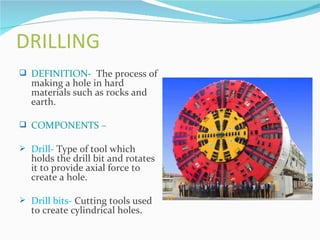
DRILLING
 DEFINITION- The process of
  making a hole in hard
  materials such as rocks and
  earth.

 COMPONENTS –

 Drill- Type of tool which
  holds the drill bit and rotates
  it to provide axial force to
  create a hole.

 Drill bits- Cutting tools used
  to create cylindrical holes.
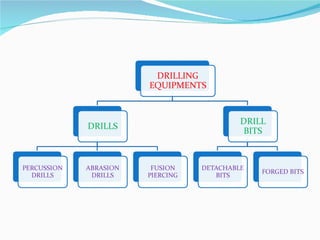
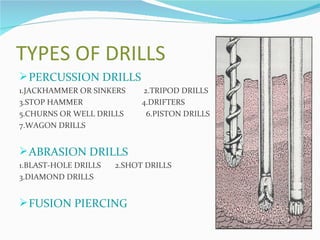
TYPES OF DRILLS
 PERCUSSION DRILLS
1.JACKHAMMER OR SINKERS     2.TRIPOD DRILLS
3.STOP HAMMER               4.DRIFTERS
5.CHURNS OR WELL DRILLS      6.PISTON DRILLS
7.WAGON DRILLS


 ABRASION DRILLS
1.BLAST-HOLE DRILLS   2.SHOT DRILLS
3.DIAMOND DRILLS


 FUSION PIERCING
PERCUSSION DRILLS
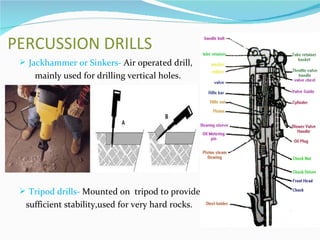
  Jackhammer or Sinkers- Air operated drill,
    mainly used for drilling vertical holes.


  Tripod drills- Mounted on tripod to provide
  sufficient stability,used for very hard rocks.
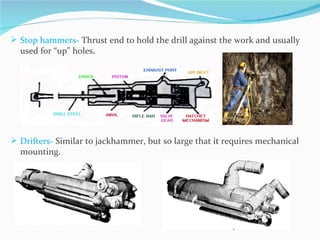
 Stop hammers- Thrust end to hold the drill against the work and usually
  used for “up” holes.


 Drifters- Similar to jackhammer, but so large that it requires mechanical
  mounting.
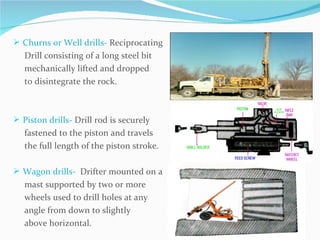
 Churns or Well drills- Reciprocating
   Drill consisting of a long steel bit
   mechanically lifted and dropped
   to disintegrate the rock.


 Piston drills- Drill rod is securely
   fastened to the piston and travels
   the full length of the piston stroke.

 Wagon drills- Drifter mounted on a
   mast supported by two or more
   wheels used to drill holes at any
   angle from down to slightly
   above horizontal.
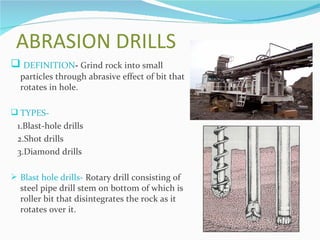
ABRASION DRILLS
 DEFINITION- Grind rock into small
  particles through abrasive effect of bit that
  rotates in hole.

 TYPES-
 1.Blast-hole drills
 2.Shot drills
 3.Diamond drills

 Blast hole drills- Rotary drill consisting of
  steel pipe drill stem on bottom of which is
  roller bit that disintegrates the rock as it
  rotates over it.
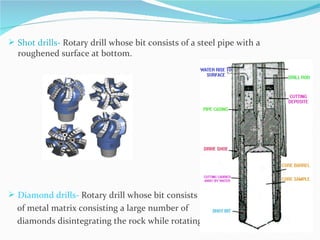
 Shot drills- Rotary drill whose bit consists of a steel pipe with a
  roughened surface at bottom.


 Diamond drills- Rotary drill whose bit consists
  of metal matrix consisting a large number of
  diamonds disintegrating the rock while rotating.
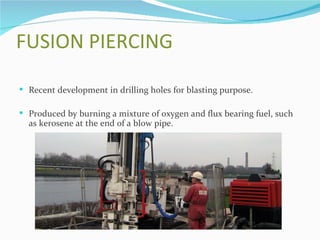
FUSION PIERCING

 Recent development in drilling holes for blasting purpose.

 Produced by burning a mixture of oxygen and flux bearing fuel, such
  as kerosene at the end of a blow pipe.
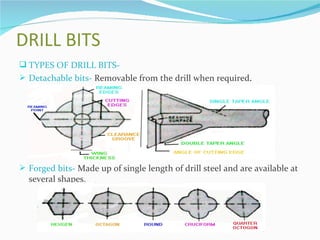
DRILL BITS
 TYPES OF DRILL BITS-
 Detachable bits- Removable from the drill when required.


 Forged bits- Made up of single length of drill steel and are available at
  several shapes.
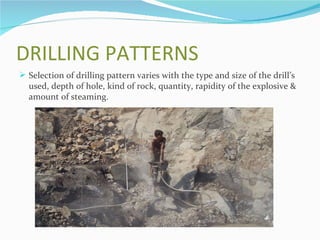
DRILLING PATTERNS
 Selection of drilling pattern varies with the type and size of the drill’s
  used, depth of hole, kind of rock, quantity, rapidity of the explosive &
  amount of steaming.
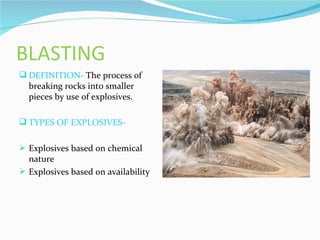
BLASTING
 DEFINITION- The process of
  breaking rocks into smaller
  pieces by use of explosives.

 TYPES OF EXPLOSIVES-


 Explosives based on chemical
  nature
 Explosives based on availability
EXPLOSIVES BASED ON CHEMICAL NATURE

 High or detonating explosives-
  Process is extremely rapid, almost
  instantaneous.

 Low or deflagrating Explosives- Low
  velocity of burning and produce
  pressure by progressive burning.
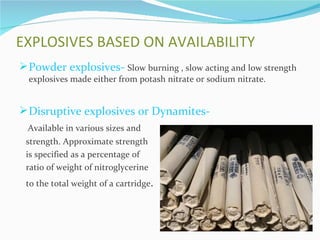
EXPLOSIVES BASED ON AVAILABILITY
 Powder explosives- Slow burning , slow acting and low strength
  explosives made either from potash nitrate or sodium nitrate.


 Disruptive explosives or Dynamites-
 Available in various sizes and
 strength. Approximate strength
 is specified as a percentage of
 ratio of weight of nitroglycerine
 to the total weight of a cartridge.
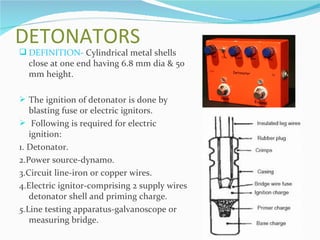
DETONATORS
 DEFINITION- Cylindrical metal shells
  close at one end having 6.8 mm dia & 50
  mm height.

 The ignition of detonator is done by
   blasting fuse or electric ignitors.
 Following is required for electric
   ignition:
1. Detonator.
2.Power source-dynamo.
3.Circuit line-iron or copper wires.
4.Electric ignitor-comprising 2 supply wires
   detonator shell and priming charge.
5.Line testing apparatus-galvanoscope or
   measuring bridge.
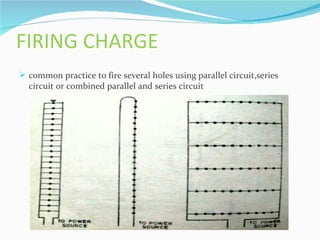
FIRING CHARGE
 common practice to fire several holes using parallel circuit,series
  circuit or combined parallel and series circuit
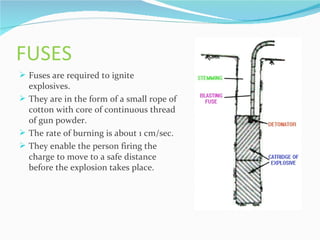
FUSES
 Fuses are required to ignite
  explosives.
 They are in the form of a small rope of
  cotton with core of continuous thread
  of gun powder.
 The rate of burning is about 1 cm/sec.
 They enable the person firing the
  charge to move to a safe distance
  before the explosion takes place.
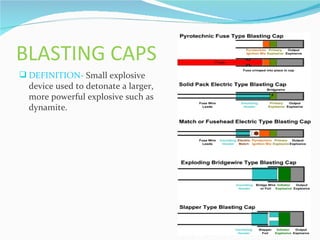
BLASTING CAPS
 DEFINITION- Small explosive
  device used to detonate a larger,
  more powerful explosive such as
  dynamite.
TOOLS FOR BLASTING
1.Dipper         2.Jumper
3.Priming needle 4.Scraping spoon
5.Tamping bar

 Dipper- Used to drill hole to the required depth.


 Jumper- Used to make blast hole & more effective in boring a nearly
  vertical hole.

 Priming needle- Used to maintain the hole while tamping is done & is
  in the form of a thin copper rod with a loop at one end.
 Scraping spoon- Used to remove dust of crushed stone from blast hole.


 Tamping bar- Used to tamp the material while refilling a blast hole.
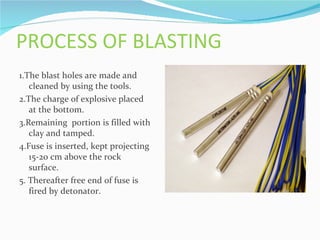
PROCESS OF BLASTING
1.The blast holes are made and
   cleaned by using the tools.
2.The charge of explosive placed
   at the bottom.
3.Remaining portion is filled with
   clay and tamped.
4.Fuse is inserted, kept projecting
   15-20 cm above the rock
   surface.
5. Thereafter free end of fuse is
   fired by detonator.
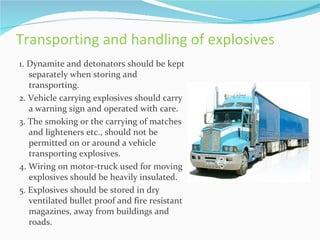
Transporting and handling of explosives
1. Dynamite and detonators should be kept
   separately when storing and
   transporting.
2. Vehicle carrying explosives should carry
   a warning sign and operated with care.
3. The smoking or the carrying of matches
   and lighteners etc., should not be
   permitted on or around a vehicle
   transporting explosives.
4. Wiring on motor-truck used for moving
   explosives should be heavily insulated.
5. Explosives should be stored in dry
   ventilated bullet proof and fire resistant
   magazines, away from buildings and
   roads.
QUESTIONS
1)   List various types of drills & explain any
     two.
2)   What are precautions should be taken
     while transporting & handling of
     explosive?
3)   Write short note on fuses.
4)   Define and state the relationship between
     drill and drill bits.
5)   Explain procedure of drilling and blasting.

Drilling and blasting powerpoint 2003

  • 1.
    SEMINAR ON DRILLING &BLASTING EQUIPMENTS (2008-09) By YOGESH S. GHULE VEERMATA JIJABAI TECHNOLOGICAL INSTITUTE CIVIL AND ENVIRONMENTAL ENGINEERING DEPARTMENT
  • 2.
    PRESENTED BY- YOGESH S.GHULE 061010018 UNDER THE GUIDENCE OF- PROF.S.Y.MHASKE
  • 4.
    DRILLING  DEFINITION- Theprocess of making a hole in hard materials such as rocks and earth.  COMPONENTS –  Drill- Type of tool which holds the drill bit and rotates it to provide axial force to create a hole.  Drill bits- Cutting tools used to create cylindrical holes.
  • 5.
    TYPES OF DRILLS PERCUSSION DRILLS 1.JACKHAMMER OR SINKERS 2.TRIPOD DRILLS 3.STOP HAMMER 4.DRIFTERS 5.CHURNS OR WELL DRILLS 6.PISTON DRILLS 7.WAGON DRILLS  ABRASION DRILLS 1.BLAST-HOLE DRILLS 2.SHOT DRILLS 3.DIAMOND DRILLS  FUSION PIERCING
  • 6.
    PERCUSSION DRILLS Jackhammer or Sinkers- Air operated drill, mainly used for drilling vertical holes.  Tripod drills- Mounted on tripod to provide sufficient stability,used for very hard rocks.
  • 7.
     Stop hammers-Thrust end to hold the drill against the work and usually used for “up” holes.  Drifters- Similar to jackhammer, but so large that it requires mechanical mounting.
  • 8.
     Churns orWell drills- Reciprocating Drill consisting of a long steel bit mechanically lifted and dropped to disintegrate the rock.  Piston drills- Drill rod is securely fastened to the piston and travels the full length of the piston stroke.  Wagon drills- Drifter mounted on a mast supported by two or more wheels used to drill holes at any angle from down to slightly above horizontal.
  • 9.
    ABRASION DRILLS  DEFINITION-Grind rock into small particles through abrasive effect of bit that rotates in hole.  TYPES- 1.Blast-hole drills 2.Shot drills 3.Diamond drills  Blast hole drills- Rotary drill consisting of steel pipe drill stem on bottom of which is roller bit that disintegrates the rock as it rotates over it.
  • 10.
     Shot drills-Rotary drill whose bit consists of a steel pipe with a roughened surface at bottom.  Diamond drills- Rotary drill whose bit consists of metal matrix consisting a large number of diamonds disintegrating the rock while rotating.
  • 11.
    FUSION PIERCING  Recentdevelopment in drilling holes for blasting purpose.  Produced by burning a mixture of oxygen and flux bearing fuel, such as kerosene at the end of a blow pipe.
  • 12.
    DRILL BITS  TYPESOF DRILL BITS-  Detachable bits- Removable from the drill when required.  Forged bits- Made up of single length of drill steel and are available at several shapes.
  • 13.
    DRILLING PATTERNS  Selectionof drilling pattern varies with the type and size of the drill’s used, depth of hole, kind of rock, quantity, rapidity of the explosive & amount of steaming.
  • 14.
    BLASTING  DEFINITION- Theprocess of breaking rocks into smaller pieces by use of explosives.  TYPES OF EXPLOSIVES-  Explosives based on chemical nature  Explosives based on availability
  • 15.
    EXPLOSIVES BASED ONCHEMICAL NATURE  High or detonating explosives- Process is extremely rapid, almost instantaneous.  Low or deflagrating Explosives- Low velocity of burning and produce pressure by progressive burning.
  • 16.
    EXPLOSIVES BASED ONAVAILABILITY  Powder explosives- Slow burning , slow acting and low strength explosives made either from potash nitrate or sodium nitrate.  Disruptive explosives or Dynamites- Available in various sizes and strength. Approximate strength is specified as a percentage of ratio of weight of nitroglycerine to the total weight of a cartridge.
  • 17.
    DETONATORS  DEFINITION- Cylindricalmetal shells close at one end having 6.8 mm dia & 50 mm height.  The ignition of detonator is done by blasting fuse or electric ignitors.  Following is required for electric ignition: 1. Detonator. 2.Power source-dynamo. 3.Circuit line-iron or copper wires. 4.Electric ignitor-comprising 2 supply wires detonator shell and priming charge. 5.Line testing apparatus-galvanoscope or measuring bridge.
  • 18.
    FIRING CHARGE  commonpractice to fire several holes using parallel circuit,series circuit or combined parallel and series circuit
  • 19.
    FUSES  Fuses arerequired to ignite explosives.  They are in the form of a small rope of cotton with core of continuous thread of gun powder.  The rate of burning is about 1 cm/sec.  They enable the person firing the charge to move to a safe distance before the explosion takes place.
  • 20.
    BLASTING CAPS  DEFINITION-Small explosive device used to detonate a larger, more powerful explosive such as dynamite.
  • 21.
    TOOLS FOR BLASTING 1.Dipper 2.Jumper 3.Priming needle 4.Scraping spoon 5.Tamping bar  Dipper- Used to drill hole to the required depth.  Jumper- Used to make blast hole & more effective in boring a nearly vertical hole.  Priming needle- Used to maintain the hole while tamping is done & is in the form of a thin copper rod with a loop at one end.  Scraping spoon- Used to remove dust of crushed stone from blast hole.  Tamping bar- Used to tamp the material while refilling a blast hole.
  • 22.
    PROCESS OF BLASTING 1.Theblast holes are made and cleaned by using the tools. 2.The charge of explosive placed at the bottom. 3.Remaining portion is filled with clay and tamped. 4.Fuse is inserted, kept projecting 15-20 cm above the rock surface. 5. Thereafter free end of fuse is fired by detonator.
  • 23.
    Transporting and handlingof explosives 1. Dynamite and detonators should be kept separately when storing and transporting. 2. Vehicle carrying explosives should carry a warning sign and operated with care. 3. The smoking or the carrying of matches and lighteners etc., should not be permitted on or around a vehicle transporting explosives. 4. Wiring on motor-truck used for moving explosives should be heavily insulated. 5. Explosives should be stored in dry ventilated bullet proof and fire resistant magazines, away from buildings and roads.
  • 24.
    QUESTIONS 1) List various types of drills & explain any two. 2) What are precautions should be taken while transporting & handling of explosive? 3) Write short note on fuses. 4) Define and state the relationship between drill and drill bits. 5) Explain procedure of drilling and blasting.