Team Building
By
Attar Nazmin
Deshmukh Namira
Khan Alisha
Khan Shifa Naaz
Content
o What is team ?
o DifferenCe betWeen team anD goals
o CharaCteristiCs of gooD team
o roles of team members
o CharaCteristiCs of gooD team members
o types of team
team
Team is special type of group whose members have complementary
skills and are committed to a common purpose or set goals for what
they hold themselves mutually responsible.
A group in which members work together intensively to achieve a
common group goal .
Individual talent Wins the games , but teamwork wins Championship.
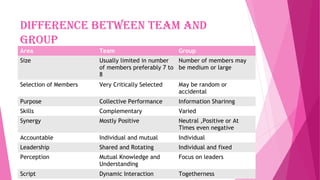
DifferenCe betWeen team anD
group
Area Team Group
Size Usually limited in number
of members preferably 7 to
8
Number of members may
be medium or large
Selection of Members Very Critically Selected May be random or
accidental
Purpose Collective Performance Information Sharinng
Skills Complementary Varied
Synergy Mostly Positive Neutral ,Positive or At
Times even negative
Accountable Individual and mutual Individual
Leadership Shared and Rotating Individual and fixed
Perception Mutual Knowledge and
Understanding
Focus on leaders
Script Dynamic Interaction Togetherness
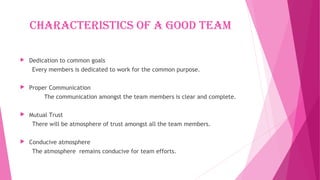
CharaCteristiCs Of a gOOd team
 Dedication to common goals
Every members is dedicated to work for the common purpose.
 Proper Communication
The communication amongst the team members is clear and complete.
 Mutual Trust
There will be atmosphere of trust amongst all the team members.
 Conducive atmosphere
The atmosphere remains conducive for team efforts.
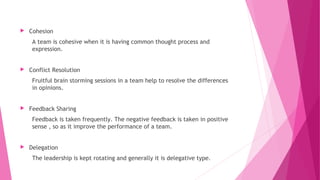
 Cohesion
A team is cohesive when it is having common thought process and
expression.
 Conflict Resolution
Fruitful brain storming sessions in a team help to resolve the differences
in opinions.
 Feedback Sharing
Feedback is taken frequently. The negative feedback is taken in positive
sense , so as it improve the performance of a team.
 Delegation
The leadership is kept rotating and generally it is delegative type.
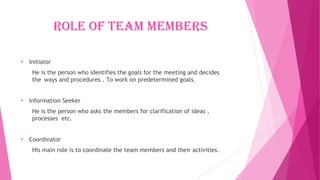
rOle Of team members
 Initiator
He is the person who identifies the goals for the meeting and decides
the ways and procedures . To work on predetermined goals.
 Information Seeker
He is the person who asks the members for clarification of ideas ,
processes etc.
 Coordinator
His main role is to coordinate the team members and their activities.
 Evaluator
His main role is to evaluate the team’s performances with some
standards.
 Encourager
He praises and supports ideas of team mambers.
Characteristics of Good Team Member
 Proactive
In organizational behavior proactivity refers to anticipatory , Change
oriented and self-Initiated behavior in situation .
 Identify Yourself with the common purpose
An effective team has common objectives which are shared by the team
members . So be enthusiastic about achieving these goals and
communicate this enthusiasm to other members of your team .
 State Your views but be prepared to listen to other people
Put forth your ideas , but give the chance to other team members to …
Present Their ideas also.
Use Your Strength and Managed your Weakness
Critically Identify your Strong Points and Weak points.
Trust your other team members
The trust amongst team members increases cooperation.
Forget your Status and your position in the hierarchy
Remember that to achieve the common goal is the ultimate aim for any
team. The conflicts arising due to ego clashes and authority clashes
always produce harm to the common objectives.
Types of Team
 Work Team
This type of team is relatively permanent in nature and found to be
engaged in the daily work . e.g. : a team of STAFF MEMBERs.
 Management Team
This team coordinate the activities of work team formed from a number
of work areas. e.g. : a team of HEADS OF DEPARTMENTs.
 Cross-functional Team
This is drawn from the same hierarchical level but from different
functional areas within an organization to accomplish a particular task.
Quality Circle
This team is dedicated to check quality.
e.g. : In all the Industries the quality circle are formed to improve
processes.
Self-Managed Team
This team has total autonomy during it’s work , Planning and
Scheduling.
e.g. : a team of students or artists entering for the Indian folk dance
competition will have to select Indian folk , practice schedules ,
suitable choreographer etc.
Team building

Team building

  • 1.
    Team Building By Attar Nazmin DeshmukhNamira Khan Alisha Khan Shifa Naaz
  • 2.
    Content o What isteam ? o DifferenCe betWeen team anD goals o CharaCteristiCs of gooD team o roles of team members o CharaCteristiCs of gooD team members o types of team
  • 3.
    team Team is specialtype of group whose members have complementary skills and are committed to a common purpose or set goals for what they hold themselves mutually responsible. A group in which members work together intensively to achieve a common group goal . Individual talent Wins the games , but teamwork wins Championship.
  • 4.
    DifferenCe betWeen teamanD group Area Team Group Size Usually limited in number of members preferably 7 to 8 Number of members may be medium or large Selection of Members Very Critically Selected May be random or accidental Purpose Collective Performance Information Sharinng Skills Complementary Varied Synergy Mostly Positive Neutral ,Positive or At Times even negative Accountable Individual and mutual Individual Leadership Shared and Rotating Individual and fixed Perception Mutual Knowledge and Understanding Focus on leaders Script Dynamic Interaction Togetherness
  • 5.
    CharaCteristiCs Of agOOd team  Dedication to common goals Every members is dedicated to work for the common purpose.  Proper Communication The communication amongst the team members is clear and complete.  Mutual Trust There will be atmosphere of trust amongst all the team members.  Conducive atmosphere The atmosphere remains conducive for team efforts.
  • 6.
     Cohesion A teamis cohesive when it is having common thought process and expression.  Conflict Resolution Fruitful brain storming sessions in a team help to resolve the differences in opinions.  Feedback Sharing Feedback is taken frequently. The negative feedback is taken in positive sense , so as it improve the performance of a team.  Delegation The leadership is kept rotating and generally it is delegative type.
  • 7.
    rOle Of teammembers  Initiator He is the person who identifies the goals for the meeting and decides the ways and procedures . To work on predetermined goals.  Information Seeker He is the person who asks the members for clarification of ideas , processes etc.  Coordinator His main role is to coordinate the team members and their activities.
  • 8.
     Evaluator His mainrole is to evaluate the team’s performances with some standards.  Encourager He praises and supports ideas of team mambers.
  • 9.
    Characteristics of GoodTeam Member  Proactive In organizational behavior proactivity refers to anticipatory , Change oriented and self-Initiated behavior in situation .  Identify Yourself with the common purpose An effective team has common objectives which are shared by the team members . So be enthusiastic about achieving these goals and communicate this enthusiasm to other members of your team .  State Your views but be prepared to listen to other people Put forth your ideas , but give the chance to other team members to …
  • 10.
    Present Their ideasalso. Use Your Strength and Managed your Weakness Critically Identify your Strong Points and Weak points. Trust your other team members The trust amongst team members increases cooperation. Forget your Status and your position in the hierarchy Remember that to achieve the common goal is the ultimate aim for any team. The conflicts arising due to ego clashes and authority clashes always produce harm to the common objectives.
  • 11.
    Types of Team Work Team This type of team is relatively permanent in nature and found to be engaged in the daily work . e.g. : a team of STAFF MEMBERs.  Management Team This team coordinate the activities of work team formed from a number of work areas. e.g. : a team of HEADS OF DEPARTMENTs.  Cross-functional Team This is drawn from the same hierarchical level but from different functional areas within an organization to accomplish a particular task.
  • 12.
    Quality Circle This teamis dedicated to check quality. e.g. : In all the Industries the quality circle are formed to improve processes. Self-Managed Team This team has total autonomy during it’s work , Planning and Scheduling. e.g. : a team of students or artists entering for the Indian folk dance competition will have to select Indian folk , practice schedules , suitable choreographer etc.