2011 Program Management
            Challenge


            Developing High
           Performance Teams

Presenters:
Bobby Watkins NASA Marshall Spaceflight Center
Izella M. Dornell U.S. Department of Commerce

                                                 1
Agenda
Overview
Program/Project Problem Resolution
Anatomy of a High Performance Team
  – The Importance of Teams
  – Team Building Components
  – Team Leadership
  – Team Membership
  – Obtaining Balance
10 Reasons to Use Teams              2
High Performance Teams
           Overview
• Developing strong teams and relationships
  within the team are major components that
  enable mission success
• Optimizing team performance should be a
  high priority for an organization’s
  leadership
• A team’s functionality can mean the
  difference between having the appropriate
  resources made available or landing on a
  “high risk” cancellation list             3
Six Step Problem Solving Process

 Act                            Plan
               1. Identify/
               Select
               Problem
  6. Evaluate              2. Analyze
  the Solution             the Problem

  5. Implement           3. Generate
  the Solution           Potential
                         Solutions
             4. Select &
             Plan Solution

Check                           Do       4
Blue Print Tools
• Team Building
  – Fostering collaboration through “team
    building” is the key component for
    effective execution of the organization’s
    mission, programs and projects

  – Must realize that people are the
    foundation for building and nurturing
    high performing teams
                                                5
Team Building Components


•   Purpose
•   Structure
•   Motivation
•   Dynamics
•   Communication
•   Respect for members
•   Feedback
•   Closure


                           6
High Performance Teams
            Leadership
• Effective leaders first gain an
  understanding of the context of their
  organization
     • Mission
     • Stakeholders
     • Constraints
     • Political environment
     • Culture
                                          7
High Performance Teams
              Leadership
• Characteristics
  –   Use different leadership styles
  –   Define and focus on goals and objectives
  –   Articulate a strategy for moving forward
  –   Engage employees/team members
  –   Put customers first
  –   Involve key stakeholders
  –   Seize the moment
  –   Communicate, communicate and communicate
  –   Create alignment
  –   Expect the unexpected
  –   Stick with it
                                                 8
Who Touches the Process?
•   Process Owner
•   Professional staff who do the work
•   Technical staff who do the work
•   IT representative
•   HR representative
•   Finance representative
•   Customers & other stakeholders
•   Suppliers
•   Benchmarking partner
•   Somebody with facilitation skills
•   Somebody who has done a process improvement
                                                  10
For Team
Effectiveness…….
A Team Facilitator Who:
–   Consults (Knows when to shut up)
–   Focuses the Team
–   Encourages Initiative
–   Shares Tasks & Leadership
–   Trains & Develops
–   Cultivates Honesty
–   Cultivates Respect
–   Coordinates Activities
–   Motivates the Team
–   Measures, Measures, Measures
–   Cultivates Creativity
–   Runs Interference
                                       12
Team Members Who:
•   Care
•   Take Responsibility
•   Freely Offer Ideas & Talents
•   Encourage the Ideas & Talents of Others
•   Focus
•   Think (till it hurts)
•   Are Positive
•   Appreciate & Utilize Diversity
•   Helps the Leader
                                              13
Meeting Ground Rules
•   1.   Respect Each Other
•   2.   Share Responsibility
•   3.   Criticize Ideas Not People
•   4.   Keep An Open Mind
•   5.   Question & Participate
•   6.   Attend All Meetings
•   7.   Listen Constructively & Carefully
•   8.   Be On Time
•   9.   Make All Points At Meetings
     – (Not In Parking Lot)
• 10. Be Candid & Diplomatic                 14
High Performance Teams
       Balanced Results

   Processes implemented to
  maximize program and project
    efficiency with the “active
cooperation” and “buy-in” from the
              TEAM

                                 15
Obtaining Team Balance


• What do you need to be able to do?

  –   Create a Blue Print
  –   Know the Environment
  –   Determine the Leadership
  –   Establish organizational goals/mission focus
  –   Build a functional team
       • Build relationships
       • Establish alliances and coalitions
       • Beware of organizational “land mines” i.e. politics/culture

                                                                       16
Ten Reasons to Use Teams

(Besides getting the boss
  off the hook on tough
        decisions)
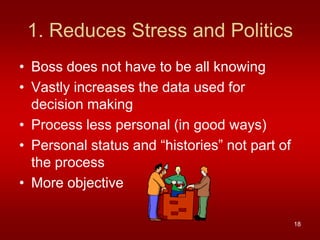
1. Reduces Stress and Politics
• Boss does not have to be all knowing
• Vastly increases the data used for
  decision making
• Process less personal (in good ways)
• Personal status and “histories” not part of
  the process
• More objective

                                                18
2. Reduces Bureaucracy
• Communication among units immediate
• Assignments made and completed outside
  of “chain of command”
• No need for sequential “clearance” for
  permission to take next steps


                                       19
3. Creates Fun and Energy
• Group commitment to each other pushes
  things forward
• People bond when on a well defined
  mission
• Brainstorming, creativity and innovation
  are invigorating
• Learning is invigorating
• A good facilitator will make sure there is
  fun
                                               20
4. Consensus Can Happen
• Solutions moves forward without sabotage
  – Majority rule causes sabotage
  – Unilateral decisions cause insurrection
  – Consensus causes the group to “dig deeper”


                                                 21
5. Makes Your Diversity A
            Resource
• Produces tangible experience of the
  advantage of differences
• Infects the organizations culture


                                        22
6. Creates Continuously Improving
            Systems
• Systematic approaches used by teams
  produced systems
  – Systems have monitoring devises
  – Systems have means of calibrating to
    changing customer requirements
  – Systems have input, in-process and output
    measures
  – Systems are deployed to standards
  – Systems can be compared and benchmarked
                                            23
7. Not Constrained by the
            Organization Chart
•   Include Suppliers
•   Include Partners
•   Include Customers
•   Include the Customer you want


                                    24
8. Learning Happens
• Transfer of skills, knowledge and point of
  view
• Innovation results when concepts from
  unrelated fields meet
• There are development opportunities even
  in a “flat” organization
• Hidden talents emerge
• Personal growth inevitable
                                           25
9. Puts the “We” in Your
               Organization

•   Builds relationships across silos
•   Communication channels outlive project
•   Credit and pride goes far and wide
•   Supports empowerment
•   Encourages matrix management


                                             26
10. Produces Better Solutions That
     Actually Get Implemented

•   All the right egos invested
•   Every “gift” can be in the room
•   All bases have been touched
•   Everyone pulling for success
•   Everyone adapting for success
•   Lots of folks get credit for success
•   No put downs
                                           27
Discussion

Dornell.izella

  • 1.
    2011 Program Management Challenge Developing High Performance Teams Presenters: Bobby Watkins NASA Marshall Spaceflight Center Izella M. Dornell U.S. Department of Commerce 1
  • 2.
    Agenda Overview Program/Project Problem Resolution Anatomyof a High Performance Team – The Importance of Teams – Team Building Components – Team Leadership – Team Membership – Obtaining Balance 10 Reasons to Use Teams 2
  • 3.
    High Performance Teams Overview • Developing strong teams and relationships within the team are major components that enable mission success • Optimizing team performance should be a high priority for an organization’s leadership • A team’s functionality can mean the difference between having the appropriate resources made available or landing on a “high risk” cancellation list 3
  • 4.
    Six Step ProblemSolving Process Act Plan 1. Identify/ Select Problem 6. Evaluate 2. Analyze the Solution the Problem 5. Implement 3. Generate the Solution Potential Solutions 4. Select & Plan Solution Check Do 4
  • 5.
    Blue Print Tools •Team Building – Fostering collaboration through “team building” is the key component for effective execution of the organization’s mission, programs and projects – Must realize that people are the foundation for building and nurturing high performing teams 5
  • 6.
    Team Building Components • Purpose • Structure • Motivation • Dynamics • Communication • Respect for members • Feedback • Closure 6
  • 7.
    High Performance Teams Leadership • Effective leaders first gain an understanding of the context of their organization • Mission • Stakeholders • Constraints • Political environment • Culture 7
  • 8.
    High Performance Teams Leadership • Characteristics – Use different leadership styles – Define and focus on goals and objectives – Articulate a strategy for moving forward – Engage employees/team members – Put customers first – Involve key stakeholders – Seize the moment – Communicate, communicate and communicate – Create alignment – Expect the unexpected – Stick with it 8
  • 10.
    Who Touches theProcess? • Process Owner • Professional staff who do the work • Technical staff who do the work • IT representative • HR representative • Finance representative • Customers & other stakeholders • Suppliers • Benchmarking partner • Somebody with facilitation skills • Somebody who has done a process improvement 10
  • 11.
  • 12.
    A Team FacilitatorWho: – Consults (Knows when to shut up) – Focuses the Team – Encourages Initiative – Shares Tasks & Leadership – Trains & Develops – Cultivates Honesty – Cultivates Respect – Coordinates Activities – Motivates the Team – Measures, Measures, Measures – Cultivates Creativity – Runs Interference 12
  • 13.
    Team Members Who: • Care • Take Responsibility • Freely Offer Ideas & Talents • Encourage the Ideas & Talents of Others • Focus • Think (till it hurts) • Are Positive • Appreciate & Utilize Diversity • Helps the Leader 13
  • 14.
    Meeting Ground Rules • 1. Respect Each Other • 2. Share Responsibility • 3. Criticize Ideas Not People • 4. Keep An Open Mind • 5. Question & Participate • 6. Attend All Meetings • 7. Listen Constructively & Carefully • 8. Be On Time • 9. Make All Points At Meetings – (Not In Parking Lot) • 10. Be Candid & Diplomatic 14
  • 15.
    High Performance Teams Balanced Results Processes implemented to maximize program and project efficiency with the “active cooperation” and “buy-in” from the TEAM 15
  • 16.
    Obtaining Team Balance •What do you need to be able to do? – Create a Blue Print – Know the Environment – Determine the Leadership – Establish organizational goals/mission focus – Build a functional team • Build relationships • Establish alliances and coalitions • Beware of organizational “land mines” i.e. politics/culture 16
  • 17.
    Ten Reasons toUse Teams (Besides getting the boss off the hook on tough decisions)
  • 18.
    1. Reduces Stressand Politics • Boss does not have to be all knowing • Vastly increases the data used for decision making • Process less personal (in good ways) • Personal status and “histories” not part of the process • More objective 18
  • 19.
    2. Reduces Bureaucracy •Communication among units immediate • Assignments made and completed outside of “chain of command” • No need for sequential “clearance” for permission to take next steps 19
  • 20.
    3. Creates Funand Energy • Group commitment to each other pushes things forward • People bond when on a well defined mission • Brainstorming, creativity and innovation are invigorating • Learning is invigorating • A good facilitator will make sure there is fun 20
  • 21.
    4. Consensus CanHappen • Solutions moves forward without sabotage – Majority rule causes sabotage – Unilateral decisions cause insurrection – Consensus causes the group to “dig deeper” 21
  • 22.
    5. Makes YourDiversity A Resource • Produces tangible experience of the advantage of differences • Infects the organizations culture 22
  • 23.
    6. Creates ContinuouslyImproving Systems • Systematic approaches used by teams produced systems – Systems have monitoring devises – Systems have means of calibrating to changing customer requirements – Systems have input, in-process and output measures – Systems are deployed to standards – Systems can be compared and benchmarked 23
  • 24.
    7. Not Constrainedby the Organization Chart • Include Suppliers • Include Partners • Include Customers • Include the Customer you want 24
  • 25.
    8. Learning Happens •Transfer of skills, knowledge and point of view • Innovation results when concepts from unrelated fields meet • There are development opportunities even in a “flat” organization • Hidden talents emerge • Personal growth inevitable 25
  • 26.
    9. Puts the“We” in Your Organization • Builds relationships across silos • Communication channels outlive project • Credit and pride goes far and wide • Supports empowerment • Encourages matrix management 26
  • 27.
    10. Produces BetterSolutions That Actually Get Implemented • All the right egos invested • Every “gift” can be in the room • All bases have been touched • Everyone pulling for success • Everyone adapting for success • Lots of folks get credit for success • No put downs 27
  • 29.