TopicTopic
Team Building
1
Team MembersTeam Members
Shubhangini
Shreesh
Shravan
Shubham Sharma
Shubham Nigam
2
ContentsContents
 Meaning – Team
 Features of Team
 Why should be a Team
 Objectives
 Tangible Benefits
 Intangible Benefits
 Team Morale
 Team Skills
 Stages in Team Building
 Conclusion
3
4
A group organized to work
together.
What is Teamwork & Team BuildingWhat is Teamwork & Team Building
Teamwork
 Concept of people working together as a team.
Team player
 A team player is someone who is able to get along
with their colleagues and work together in a
cohesive group.
Team Building
 Process of establishing and developing a greater
sense of collaboration and trust between
members.
5
What is a
Team ?
6
A
A team is a group of
individuals working together
to solve a problem,meet an
objective, or tackle an issue.
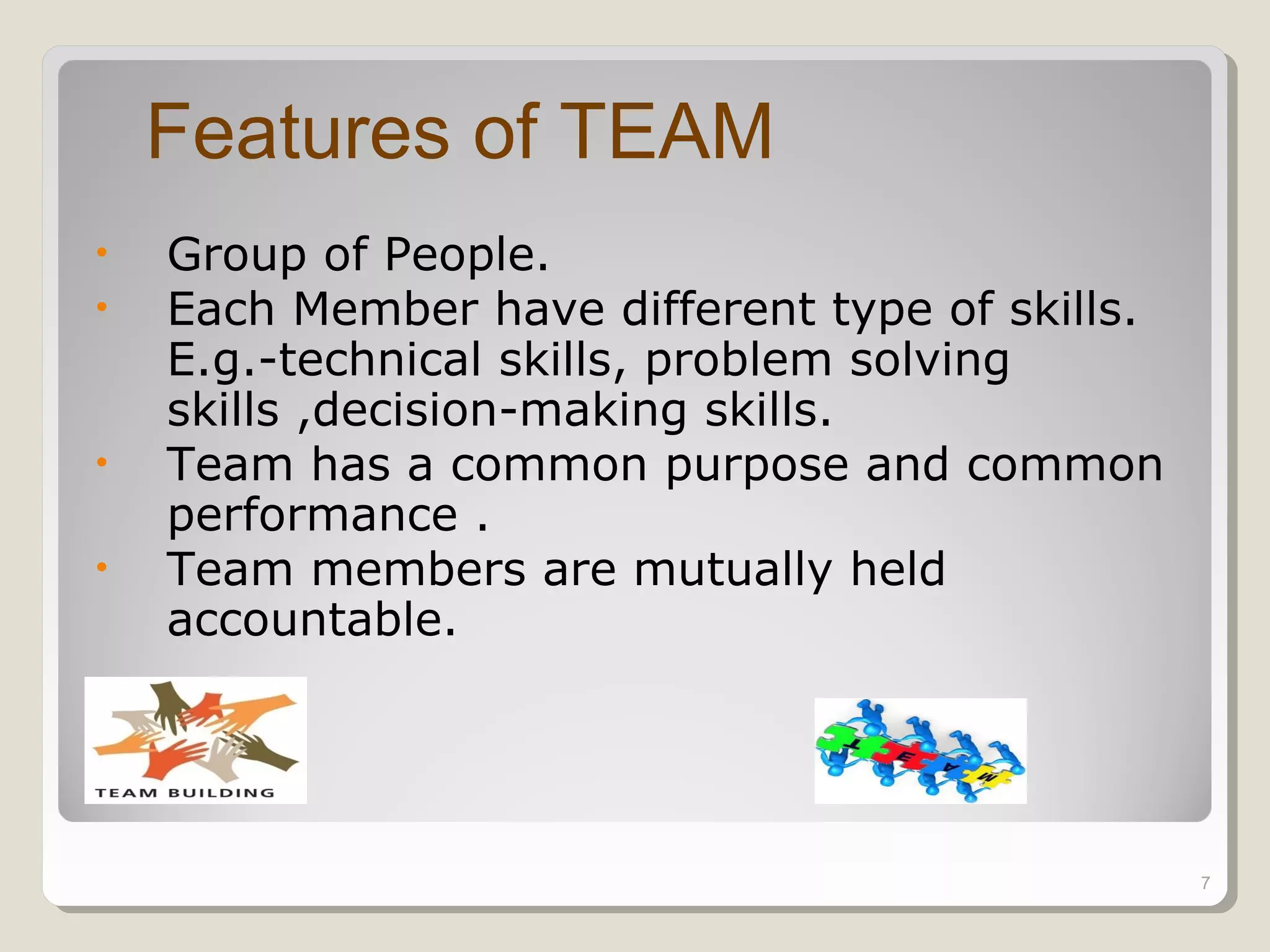
Features of TEAM
• Group of People.
• Each Member have different type of skills.
E.g.-technical skills, problem solving
skills ,decision-making skills.
• Team has a common purpose and common
performance .
• Team members are mutually held
accountable.
7
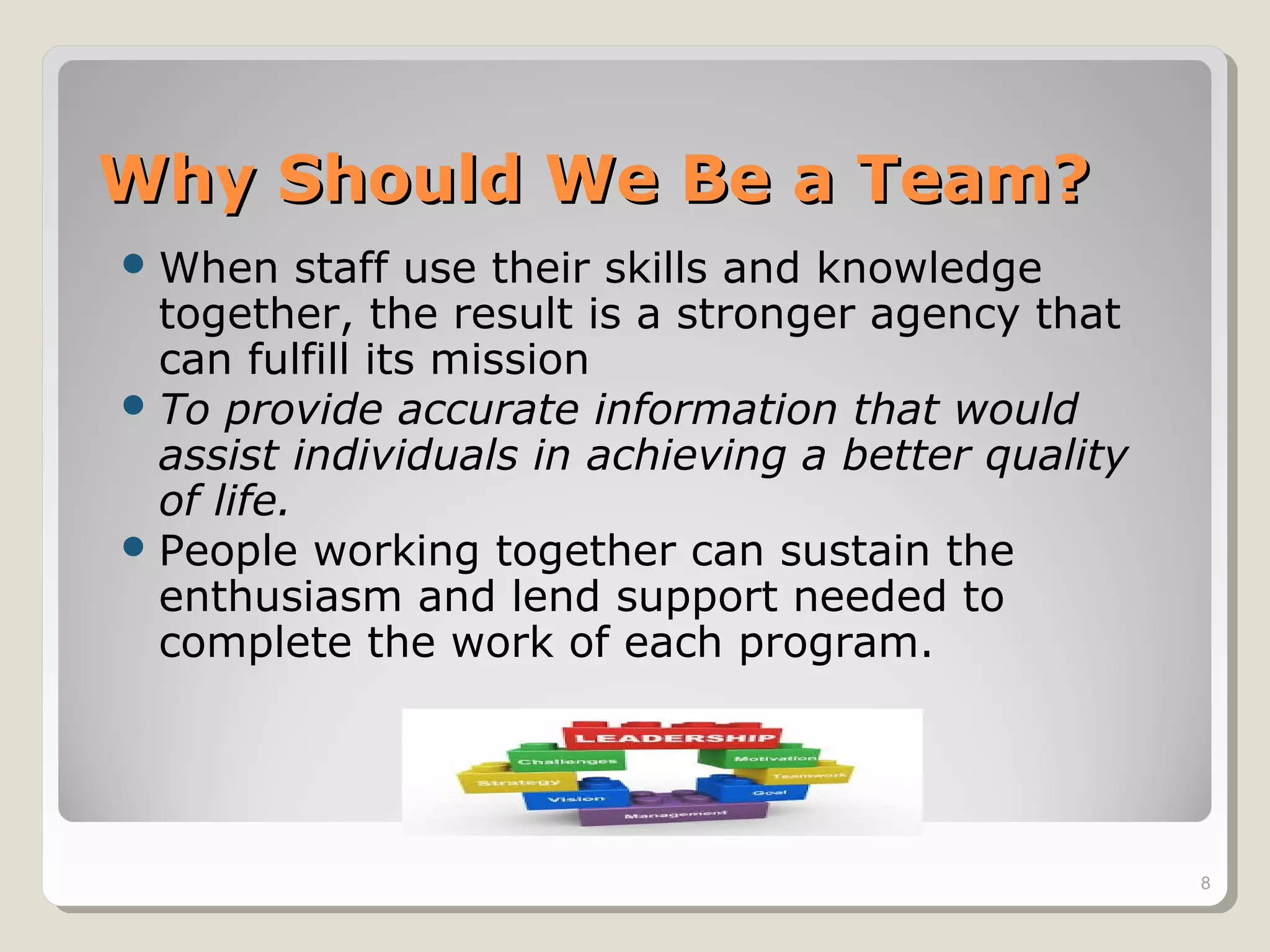
Why Should We Be a Team?Why Should We Be a Team?
When staff use their skills and knowledge
together, the result is a stronger agency that
can fulfill its mission
To provide accurate information that would
assist individuals in achieving a better quality
of life.
People working together can sustain the
enthusiasm and lend support needed to
complete the work of each program.
8
OBJECTIVE OF TEAM BUILDNGOBJECTIVE OF TEAM BUILDNG
To Keep the morale of team
high.
To achieve the common goal.
Improve the performance.
Avoid the dispute and problem.
Optimum utilization of
resources.
9
Team BenefitsTeam Benefits
10
Together
Everyone
Achieves
More
Team means ‘we’ is
stronger than ‘me
Esprit de corps.Esprit de corps.
More participation inMore participation in
activities.activities.
Enhance club/OIEnhance club/OI
reputation.reputation.
Sense of accomplishment.Sense of accomplishment.
11
INTANGIBLE BENEFITS
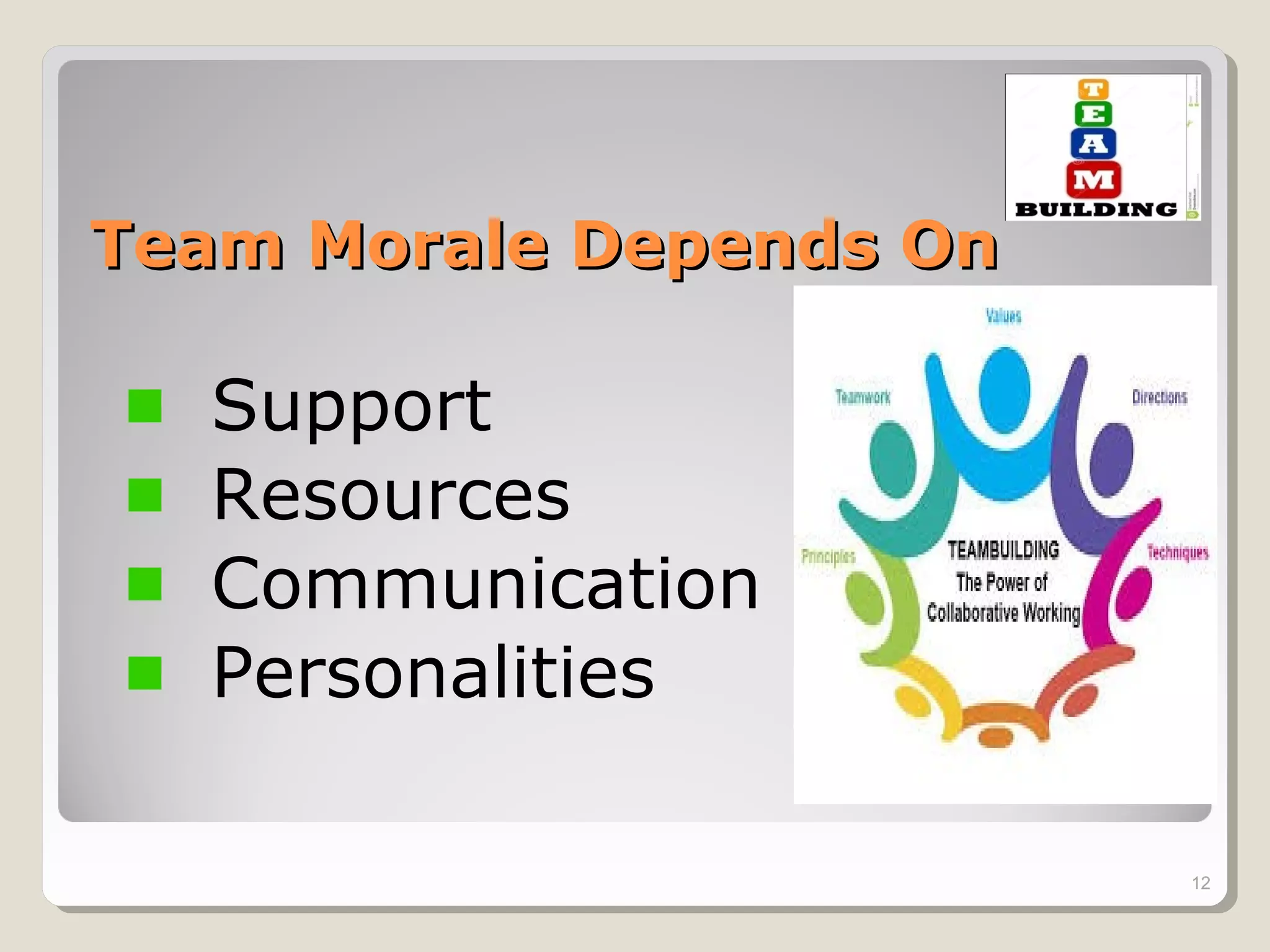
Team Morale Depends OnTeam Morale Depends On
Support
Resources
Communication
Personalities
12
Teamwork SkillsTeamwork Skills
 Listen
 Question
 Persuade
 Respect
 Help
 Share
 Participate
13
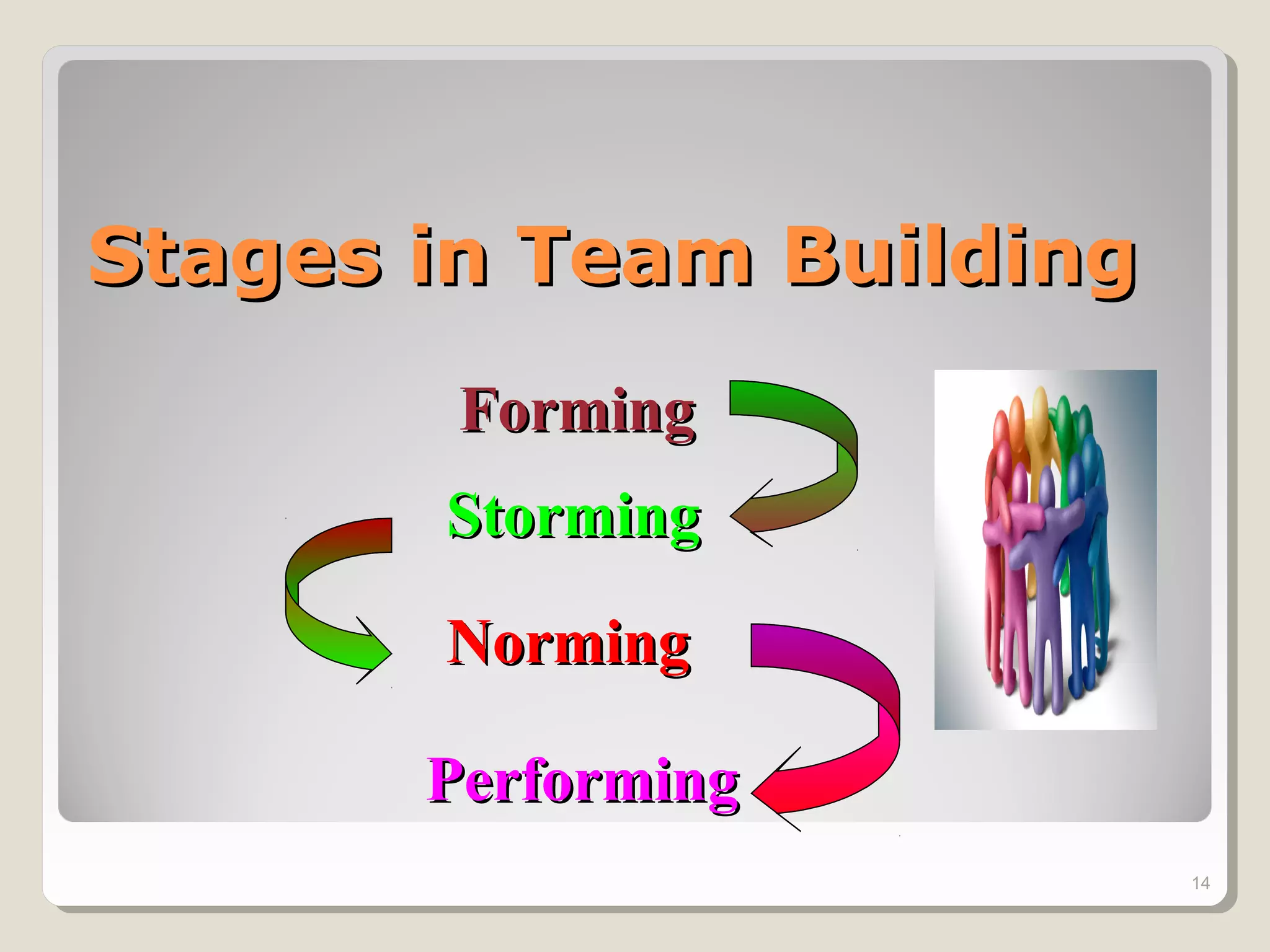
Stages in Team BuildingStages in Team Building
14
FormingForming
StormingStorming
NormingNorming
PerformingPerforming
Stage 1 : FORMINGStage 1 : FORMING
Members are polite and positive.
Few are anxious and others simply
excited.
Desire to be accepted.
Exchange some personal
information.
Leaders play a dominant role.
Stage last for few time.
15
Stage 2: STORMINGStage 2: STORMING
Members start to push against the
boundaries.
Conflict between team members.
People work in different ways
Different ways causes problems
16
Stage 3: NORMINGStage 3: NORMING
Differences are resolved.
Members socialize together.
Commitment towards the team
goal.
There is prolonged time gap
between Storming and norming .
17
Stage 4: PERFORMINGStage 4: PERFORMING
Members are competent and autonomous.
Formerly established structures and
process helps.
Leaders can delegate work.
Team performance is not influenced by
others
18
Stage – 5 AdjourningStage – 5 Adjourning
Added in the year 1977.
Also known as mourning and unforming
the group.
Difficult for team members.
19
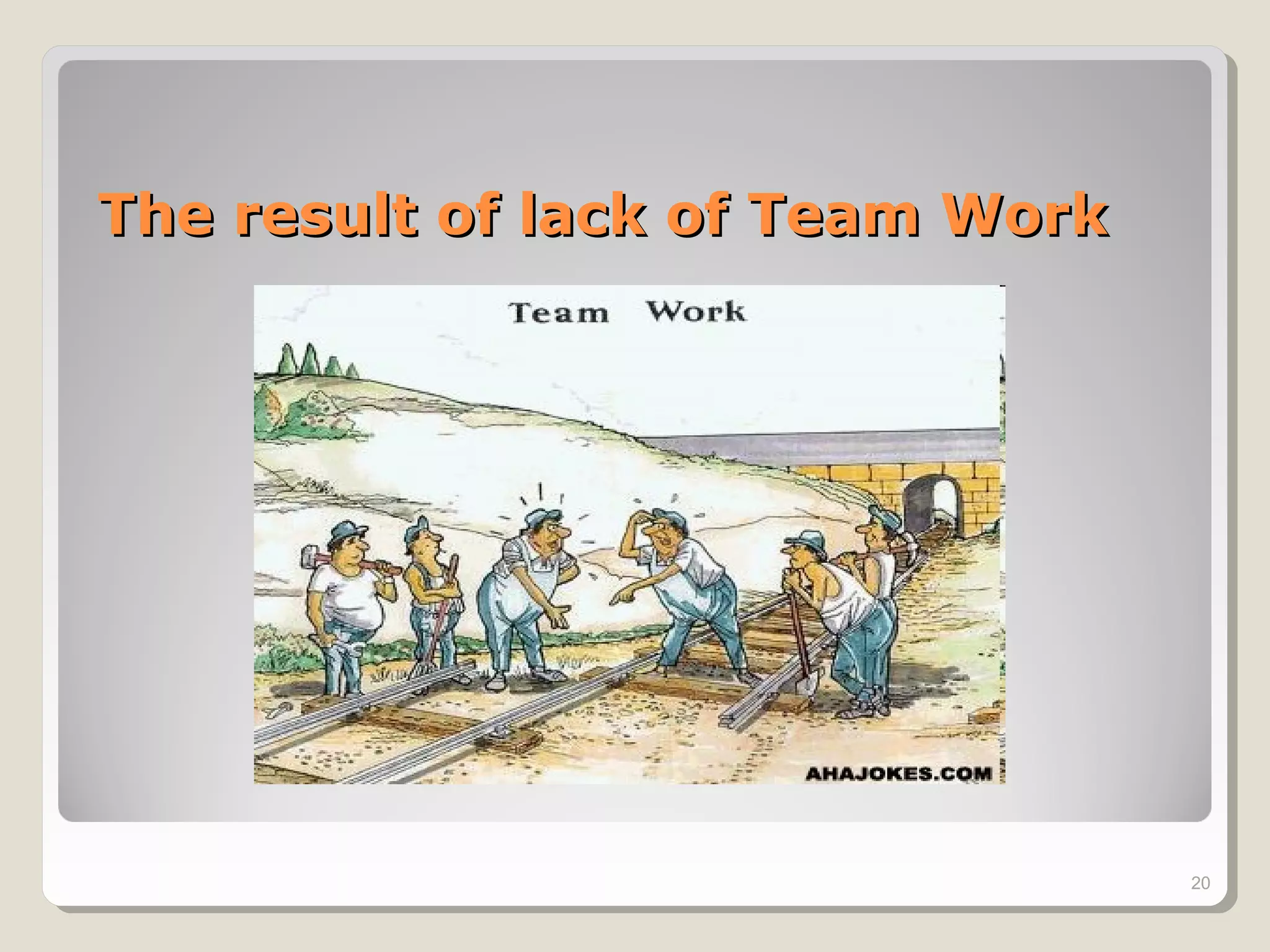
The result of lack of Team WorkThe result of lack of Team Work
20
Every Team Member Can Help!Every Team Member Can Help!
21
22
24
ReferencesReferences
Tuckman, B.W. (1965) 'Developmental
Sequence in Small Groups,' Psychological
Bulletin, Volume 63, June 1965.
Tuckman, B.W. and Jensen, M.A.C.
(1977) 'Stages of Small-Group
Development Revisited,' Group
Organization Management, Volume 2,
Number 4, December 1977
25
Prepared By – Shravan
Edited By - Shubham Nigam
Research By - Shubhangini
Shreesh
Shubham Sharma
26
27

Team building

  • 1.
  • 2.
  • 3.
    ContentsContents  Meaning –Team  Features of Team  Why should be a Team  Objectives  Tangible Benefits  Intangible Benefits  Team Morale  Team Skills  Stages in Team Building  Conclusion 3
  • 4.
    4 A group organizedto work together.
  • 5.
    What is Teamwork& Team BuildingWhat is Teamwork & Team Building Teamwork  Concept of people working together as a team. Team player  A team player is someone who is able to get along with their colleagues and work together in a cohesive group. Team Building  Process of establishing and developing a greater sense of collaboration and trust between members. 5
  • 6.
    What is a Team? 6 A A team is a group of individuals working together to solve a problem,meet an objective, or tackle an issue.
  • 7.
    Features of TEAM •Group of People. • Each Member have different type of skills. E.g.-technical skills, problem solving skills ,decision-making skills. • Team has a common purpose and common performance . • Team members are mutually held accountable. 7
  • 8.
    Why Should WeBe a Team?Why Should We Be a Team? When staff use their skills and knowledge together, the result is a stronger agency that can fulfill its mission To provide accurate information that would assist individuals in achieving a better quality of life. People working together can sustain the enthusiasm and lend support needed to complete the work of each program. 8
  • 9.
    OBJECTIVE OF TEAMBUILDNGOBJECTIVE OF TEAM BUILDNG To Keep the morale of team high. To achieve the common goal. Improve the performance. Avoid the dispute and problem. Optimum utilization of resources. 9
  • 10.
  • 11.
    Esprit de corps.Espritde corps. More participation inMore participation in activities.activities. Enhance club/OIEnhance club/OI reputation.reputation. Sense of accomplishment.Sense of accomplishment. 11 INTANGIBLE BENEFITS
  • 12.
    Team Morale DependsOnTeam Morale Depends On Support Resources Communication Personalities 12
  • 13.
    Teamwork SkillsTeamwork Skills Listen  Question  Persuade  Respect  Help  Share  Participate 13
  • 14.
    Stages in TeamBuildingStages in Team Building 14 FormingForming StormingStorming NormingNorming PerformingPerforming
  • 15.
    Stage 1 :FORMINGStage 1 : FORMING Members are polite and positive. Few are anxious and others simply excited. Desire to be accepted. Exchange some personal information. Leaders play a dominant role. Stage last for few time. 15
  • 16.
    Stage 2: STORMINGStage2: STORMING Members start to push against the boundaries. Conflict between team members. People work in different ways Different ways causes problems 16
  • 17.
    Stage 3: NORMINGStage3: NORMING Differences are resolved. Members socialize together. Commitment towards the team goal. There is prolonged time gap between Storming and norming . 17
  • 18.
    Stage 4: PERFORMINGStage4: PERFORMING Members are competent and autonomous. Formerly established structures and process helps. Leaders can delegate work. Team performance is not influenced by others 18
  • 19.
    Stage – 5AdjourningStage – 5 Adjourning Added in the year 1977. Also known as mourning and unforming the group. Difficult for team members. 19
  • 20.
    The result oflack of Team WorkThe result of lack of Team Work 20
  • 21.
    Every Team MemberCan Help!Every Team Member Can Help! 21
  • 22.
  • 23.
  • 24.
    ReferencesReferences Tuckman, B.W. (1965)'Developmental Sequence in Small Groups,' Psychological Bulletin, Volume 63, June 1965. Tuckman, B.W. and Jensen, M.A.C. (1977) 'Stages of Small-Group Development Revisited,' Group Organization Management, Volume 2, Number 4, December 1977 25
  • 25.
    Prepared By –Shravan Edited By - Shubham Nigam Research By - Shubhangini Shreesh Shubham Sharma 26
  • 26.