WELCOME TO MY
PRESENTATION
MY TOPIC ON
CONVERSATIONAL
ANALYSIS
CONVERSATIONAL ANALYSIS
It is a method that explores systematically how
people talk, verbally and nonverbally.
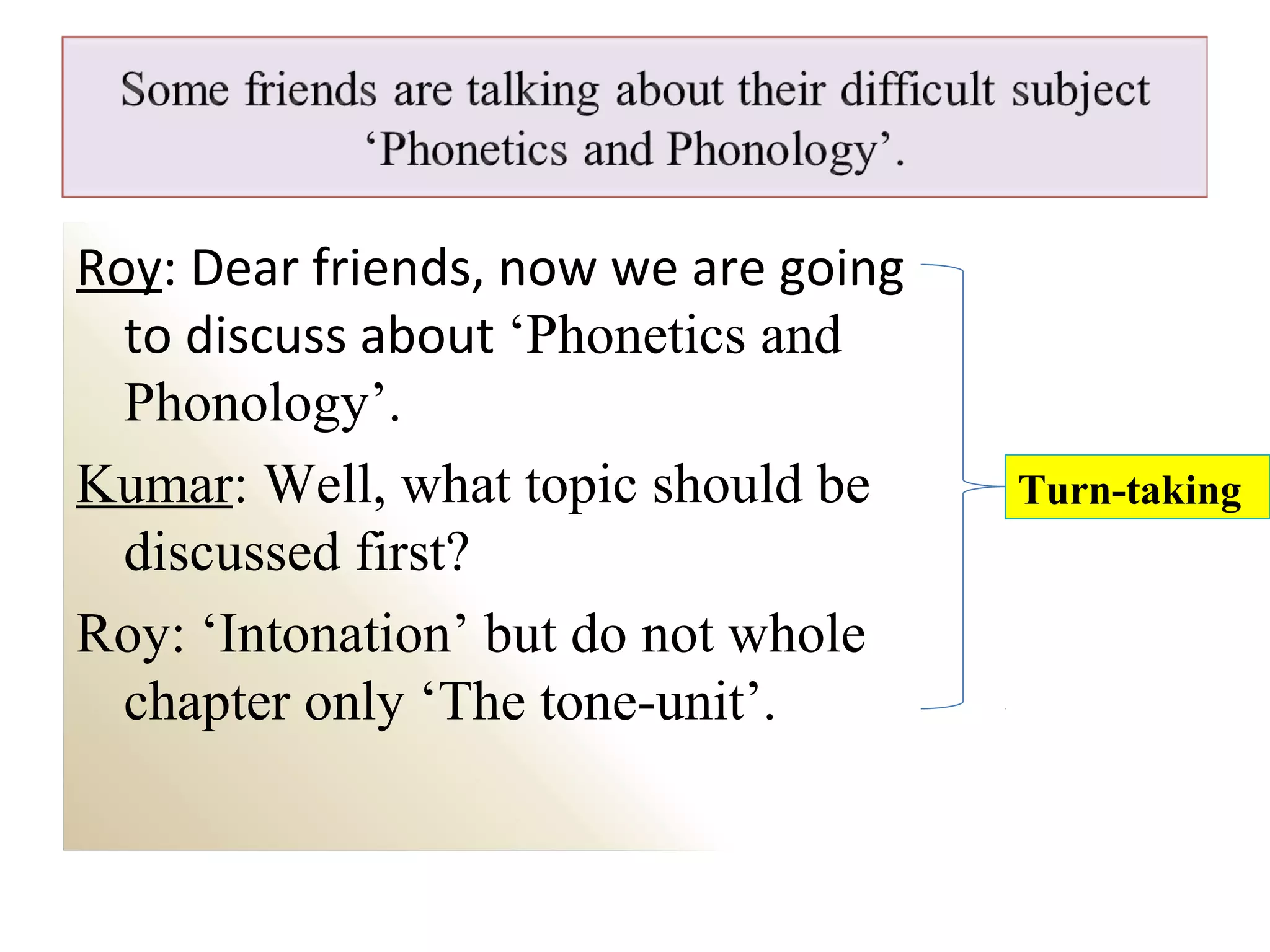
Roy: Dear friends, now we are going
to discuss about ‘Phonetics and
Phonology’.
Kumar: Well, what topic should be
discussed first?
Roy: ‘Intonation’ but do not whole
chapter only ‘The tone-unit’.
Turn-taking
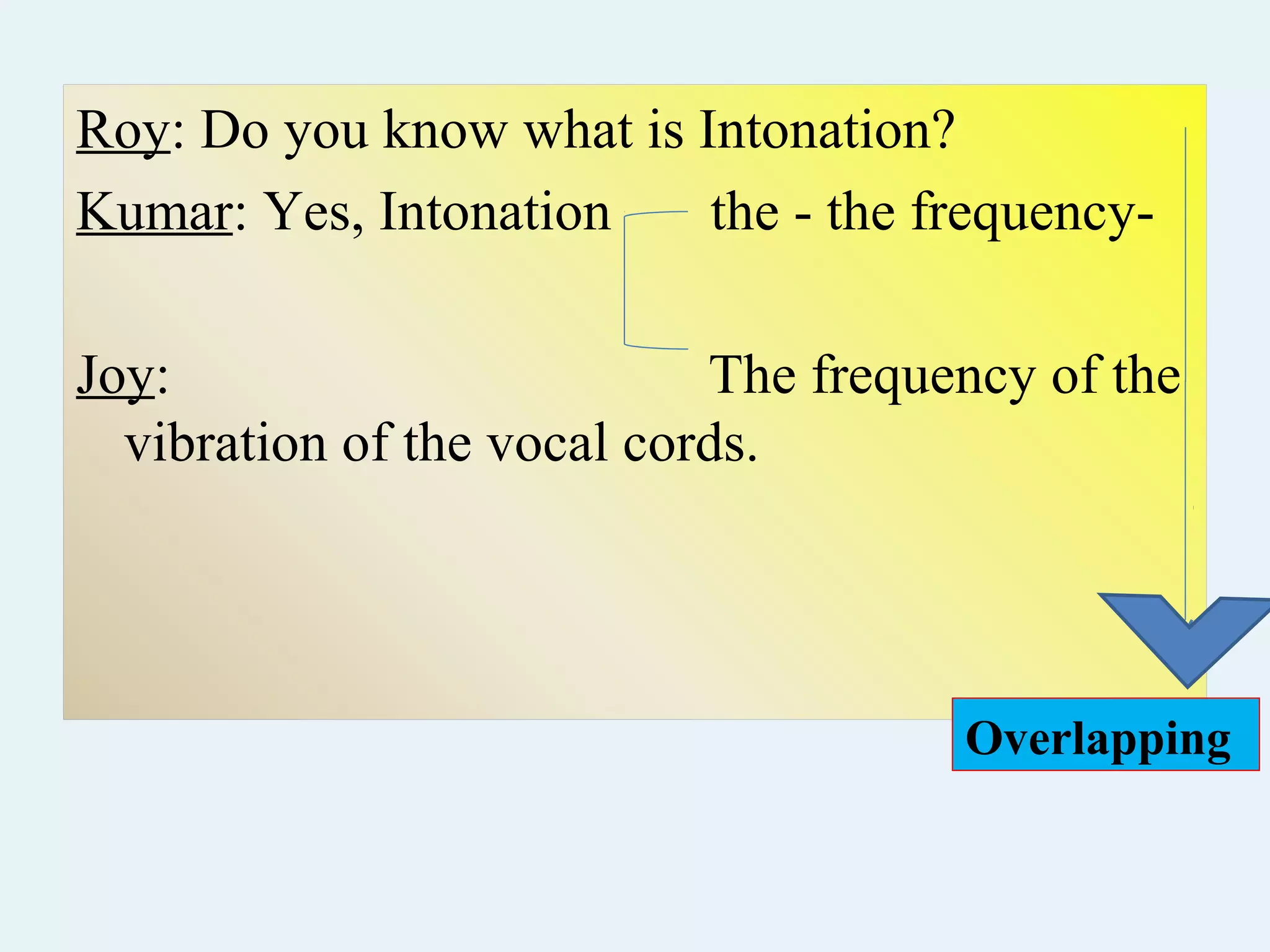
Roy: Do you know what is Intonation?
Kumar: Yes, Intonation the - the frequency-
Joy: The frequency of the
vibration of the vocal cords.
Overlapping
Meanwhile, Kamal and Jamal enter into the room.
Kamal: Hello everybody
Roy: Hello Kamal
Jamal: Hello everybody
Roy: Hello Jamal
Adjacency Pair
Roy: Kamal, Sit here, Sit here.
Kamal: Thank you. Recurs
Roy: Can we start our discussion?
Kamal: Yes, hurry up.
Self Selection
Roy: Let’s start about ‘The tone-unit’. ‘The tone-unit’
is a stretch of speech uttered under a single coherent
intonation contour.
Complete Utterance
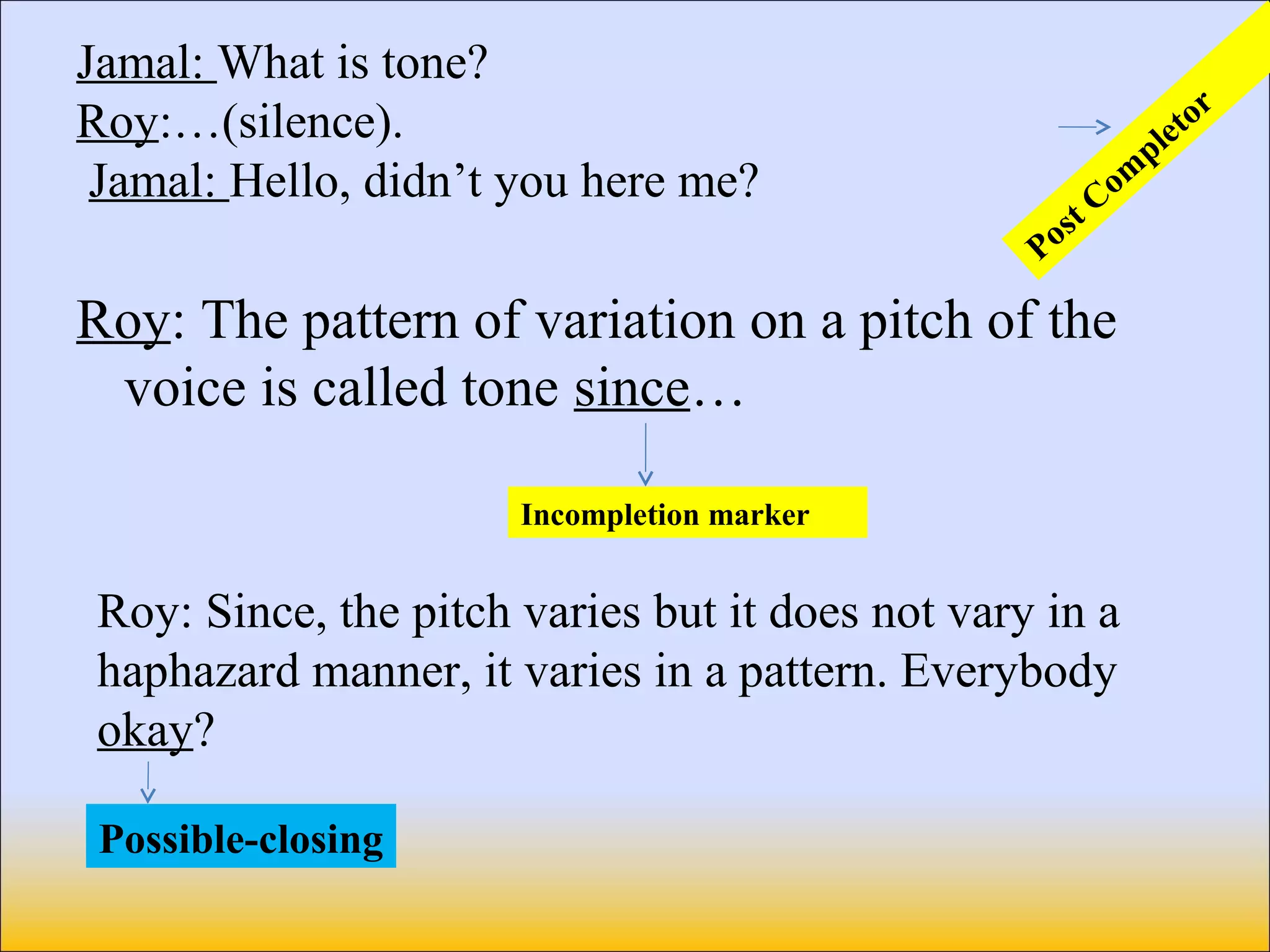
Jamal: What is tone?
Roy:…(silence).
Jamal: Hello, didn’t you here me?
Roy: The pattern of variation on a pitch of the
voice is called tone since…
Post Com
pletor
Incompletion marker
Roy: Since, the pitch varies but it does not vary in a
haphazard manner, it varies in a pattern. Everybody
okay?
Possible-closing
Roy: Five types of tone-unit.
#Rising tone
#falling tone
#Rising-falling tone
#Falling-rising tone
#Level tone
Kamal: How can we understand rise tone or fall
tone?
Roy: The rising tone may be used incomplete
utterances, yes/no Q. It is used friendly way,
polite request. And falling tone may be used
ordinary statement, commands, do not use
incomplete utterances or yes/no Q.
Repair initiator
Roy: How are you felling now?
All: Quite well.
Roy: Can we start about ‘rising-
falling tone’ and ‘falling-rising
tone’?
All: Okay.
Pre-invitation
Jamal: can I stop you for sometime?
Roy: Yes, what’s your problem?
Jamal: Can you tell about intonation
again?
Roy: You can see the book.
Pre-request
and
Request
Roy: The rising-falling tone is a
combination of a rising and falling tone.
Jamal: What was the falling- rising tone?
[Q]
Roy: Well, do you understand rising-falling
tone ? [Q1]
Jamal: Yes. [A1]
Roy: The falling- rising tone normally
indicates that something implied- through
this tone can express other attitudes as
well. [A]
Insertionsequence
Kamal: But. How can I identify
falling tone?
Roy: When you find statement,
command or Yes/No Q.
Jamal: Yes/No Q.?
Roy: Yes.
Kumar: Are you sure?
Roy: oh! No, It is WH-Q.
Side sequence
Roy: You should call it falling tone when you
find commands.[statement]
Kamal: Is it request? [Misapprehension]
Roy: No, this rule should be applied only
commands. [Clarification]
Kamal: Oh, yeah, thank you.[Terminator]
The sequence misapprehension-clarification
Roy: Hello friends, we will continue our
discussion after the class. Thank you
everybody.
All. Thank you Roy.
BY KAJAL CHANDRA ROY

Conversational Analysis

  • 1.
    WELCOME TO MY PRESENTATION MYTOPIC ON CONVERSATIONAL ANALYSIS
  • 2.
    CONVERSATIONAL ANALYSIS It isa method that explores systematically how people talk, verbally and nonverbally.
  • 3.
    Roy: Dear friends,now we are going to discuss about ‘Phonetics and Phonology’. Kumar: Well, what topic should be discussed first? Roy: ‘Intonation’ but do not whole chapter only ‘The tone-unit’. Turn-taking
  • 4.
    Roy: Do youknow what is Intonation? Kumar: Yes, Intonation the - the frequency- Joy: The frequency of the vibration of the vocal cords. Overlapping
  • 5.
    Meanwhile, Kamal andJamal enter into the room. Kamal: Hello everybody Roy: Hello Kamal Jamal: Hello everybody Roy: Hello Jamal Adjacency Pair Roy: Kamal, Sit here, Sit here. Kamal: Thank you. Recurs
  • 6.
    Roy: Can westart our discussion? Kamal: Yes, hurry up. Self Selection Roy: Let’s start about ‘The tone-unit’. ‘The tone-unit’ is a stretch of speech uttered under a single coherent intonation contour. Complete Utterance
  • 7.
    Jamal: What istone? Roy:…(silence). Jamal: Hello, didn’t you here me? Roy: The pattern of variation on a pitch of the voice is called tone since… Post Com pletor Incompletion marker Roy: Since, the pitch varies but it does not vary in a haphazard manner, it varies in a pattern. Everybody okay? Possible-closing
  • 8.
    Roy: Five typesof tone-unit. #Rising tone #falling tone #Rising-falling tone #Falling-rising tone #Level tone Kamal: How can we understand rise tone or fall tone? Roy: The rising tone may be used incomplete utterances, yes/no Q. It is used friendly way, polite request. And falling tone may be used ordinary statement, commands, do not use incomplete utterances or yes/no Q. Repair initiator
  • 9.
    Roy: How areyou felling now? All: Quite well. Roy: Can we start about ‘rising- falling tone’ and ‘falling-rising tone’? All: Okay. Pre-invitation Jamal: can I stop you for sometime? Roy: Yes, what’s your problem? Jamal: Can you tell about intonation again? Roy: You can see the book. Pre-request and Request
  • 10.
    Roy: The rising-fallingtone is a combination of a rising and falling tone. Jamal: What was the falling- rising tone? [Q] Roy: Well, do you understand rising-falling tone ? [Q1] Jamal: Yes. [A1] Roy: The falling- rising tone normally indicates that something implied- through this tone can express other attitudes as well. [A] Insertionsequence
  • 11.
    Kamal: But. Howcan I identify falling tone? Roy: When you find statement, command or Yes/No Q. Jamal: Yes/No Q.? Roy: Yes. Kumar: Are you sure? Roy: oh! No, It is WH-Q. Side sequence
  • 12.
    Roy: You shouldcall it falling tone when you find commands.[statement] Kamal: Is it request? [Misapprehension] Roy: No, this rule should be applied only commands. [Clarification] Kamal: Oh, yeah, thank you.[Terminator] The sequence misapprehension-clarification
  • 13.
    Roy: Hello friends,we will continue our discussion after the class. Thank you everybody. All. Thank you Roy.
  • 14.