THE WRITING PROCESS
WHAT WRITING IS?
Writing is one of the skills that help learners gain independence,
creativity, fluency and express their feelings through the power of
written words. To write any paper, it is necessary to follow a plan. It is
called Writing Process, which is a sequence of steps to follow to help
any writer or students develop and shape their ideas to the point that
they can write about them clearly and in a structure that will help you to
show them well. Also, in this process there are some important clue
points that teachers and students must consider. Such as, students
must be encouraged to think about audience. Who is the writing for?
What does the reader need to know? It is also important for students
realize that what they put on their papers can be changed at any time,
but it is with the purpose to improve the writing. Now, it is important to
know learning to write is like learning to read; it involves a series of
steps. There are five distinct stages a writer must follow to record
research, observations, experiences, thoughts and so on.
PRE-WRITING
It is a phase where students come up with ideas; it is according to a
specific topic, so it can be conducted through brainstorming. Students
have opportunity to write everything coming to their mind related to a
given topic, but at the same time; teachers can also elicit ideas,
vocabulary, phrases using different strategies. Also, it is possible to
comprise this phase making use of free writing. It means students can
write a lot of ideas, don’t stop writing, just let the ideas flow without
worrying about mistakes, and then sort their ideas and choose which
one they will use to write their story.
WRITING THE FIRST DRAFT
Students are ready to move to their first drafting stage. It is to put the
ideas previously gathered into sentences and paragraphs. It is a stage
where writers start connecting everything they have. Provide feedback
in this stage is very important. First, it allows teachers to see where
students are having problems. Also, it immediately communicates to
students that writing involves progressive refinement.
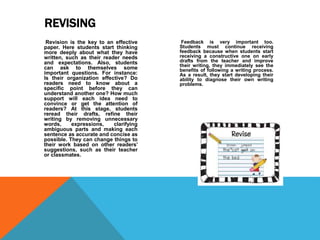
Revision is the key to an effective
paper. Here students start thinking
more deeply about what they have
written, such as their reader needs
and expectations. Also, students
can ask to themselves some
important questions. For instance:
Is their organization effective? Do
readers need to know about a
specific point before they can
understand another one? How much
support will each idea need to
convince or get the attention of
readers? At this stage, students
reread their drafts, refine their
writing by removing unnecessary
words, expressions, clarifying
ambiguous parts and making each
sentence as accurate and concise as
possible. They can change things to
their work based on other readers’
suggestions, such as their teacher
or classmates.
Feedback is very important too.
Students must continue receiving
feedback because when students start
receiving a constructive one on early
drafts from the teacher and improve
their writing, they immediately see the
benefits of following a writing process.
As a result, they start developing their
ability to diagnose their own writing
problems.
REVISING
EDITING
The editing stage is distinct from the revision stage. It must be done
after revising stage. Here, students must go through their writing line by
line. Some things to check in this stage are: Have I used the same word
too many times? If so, I must change it, looking for another alternative.
Are any of my sentences so hard to understand? If so, I can rewrite
them to make my idea clear. Are my sentences grammatically correct?
Revise present, past and future tense. Is everything spelled correctly?
Proofread as many times as necessary. Have I used punctuation marks
correctly? It often causes difficulties; check it carefully.
Publish can mean different things. It
depends on the type of writing
produced and the reason. For
instance, publishing for students can
mean to prepare a neatly handwritten,
to hand a final copy of the writing or
publishing it in a blog spot. It also,
can extend to a public performance,
such as a speech or debate. It is a
complex process and if teachers do
not give the appropriate tool, it can
lead to students’ frustration. As with
the speaking skill, it is necessary to
provide a supportive environment for
the learners, keep calm and be patient
with them because it is clear, it
requires time to complete each one of
the stages. As a result, finally your
students will be able to reach the final
phase handing a great and successful
paper.
PUBLISHING
Finally, it’s clear; we are connected to one
another in every moment. We get that
connection in a lot of ways. So, if we realize
writing is one of the ways we more get
interaction with others in our everyday lives. As
a result, it is very important, we as teachers to
help our students to improve this skill, which
will help them not only in their school
experience, but also in their daily life.

The writing process

  • 1.
  • 2.
    WHAT WRITING IS? Writingis one of the skills that help learners gain independence, creativity, fluency and express their feelings through the power of written words. To write any paper, it is necessary to follow a plan. It is called Writing Process, which is a sequence of steps to follow to help any writer or students develop and shape their ideas to the point that they can write about them clearly and in a structure that will help you to show them well. Also, in this process there are some important clue points that teachers and students must consider. Such as, students must be encouraged to think about audience. Who is the writing for? What does the reader need to know? It is also important for students realize that what they put on their papers can be changed at any time, but it is with the purpose to improve the writing. Now, it is important to know learning to write is like learning to read; it involves a series of steps. There are five distinct stages a writer must follow to record research, observations, experiences, thoughts and so on.
  • 3.
    PRE-WRITING It is aphase where students come up with ideas; it is according to a specific topic, so it can be conducted through brainstorming. Students have opportunity to write everything coming to their mind related to a given topic, but at the same time; teachers can also elicit ideas, vocabulary, phrases using different strategies. Also, it is possible to comprise this phase making use of free writing. It means students can write a lot of ideas, don’t stop writing, just let the ideas flow without worrying about mistakes, and then sort their ideas and choose which one they will use to write their story.
  • 4.
    WRITING THE FIRSTDRAFT Students are ready to move to their first drafting stage. It is to put the ideas previously gathered into sentences and paragraphs. It is a stage where writers start connecting everything they have. Provide feedback in this stage is very important. First, it allows teachers to see where students are having problems. Also, it immediately communicates to students that writing involves progressive refinement.
  • 5.
    Revision is thekey to an effective paper. Here students start thinking more deeply about what they have written, such as their reader needs and expectations. Also, students can ask to themselves some important questions. For instance: Is their organization effective? Do readers need to know about a specific point before they can understand another one? How much support will each idea need to convince or get the attention of readers? At this stage, students reread their drafts, refine their writing by removing unnecessary words, expressions, clarifying ambiguous parts and making each sentence as accurate and concise as possible. They can change things to their work based on other readers’ suggestions, such as their teacher or classmates. Feedback is very important too. Students must continue receiving feedback because when students start receiving a constructive one on early drafts from the teacher and improve their writing, they immediately see the benefits of following a writing process. As a result, they start developing their ability to diagnose their own writing problems. REVISING
  • 6.
    EDITING The editing stageis distinct from the revision stage. It must be done after revising stage. Here, students must go through their writing line by line. Some things to check in this stage are: Have I used the same word too many times? If so, I must change it, looking for another alternative. Are any of my sentences so hard to understand? If so, I can rewrite them to make my idea clear. Are my sentences grammatically correct? Revise present, past and future tense. Is everything spelled correctly? Proofread as many times as necessary. Have I used punctuation marks correctly? It often causes difficulties; check it carefully.
  • 7.
    Publish can meandifferent things. It depends on the type of writing produced and the reason. For instance, publishing for students can mean to prepare a neatly handwritten, to hand a final copy of the writing or publishing it in a blog spot. It also, can extend to a public performance, such as a speech or debate. It is a complex process and if teachers do not give the appropriate tool, it can lead to students’ frustration. As with the speaking skill, it is necessary to provide a supportive environment for the learners, keep calm and be patient with them because it is clear, it requires time to complete each one of the stages. As a result, finally your students will be able to reach the final phase handing a great and successful paper. PUBLISHING
  • 8.
    Finally, it’s clear;we are connected to one another in every moment. We get that connection in a lot of ways. So, if we realize writing is one of the ways we more get interaction with others in our everyday lives. As a result, it is very important, we as teachers to help our students to improve this skill, which will help them not only in their school experience, but also in their daily life.