COLLABORATIVE
LEARNING
Email: janki.somani@iitms.co.in Mobile: 08448010216 Website: https://www.iitms.co.in/
Shortcomings
of Traditional
Learning
Methods
Students lack critical thinking
abilities
Students learn for degrees
and grades
Students use memorization
techniques for learning
Lacks development of creativity
and cognitive abilities
What is
Collaborative
Learning?
Collaborative learning is an educational
approach in which students study in
groups to enhance their learning
outcomes
They come together to perform tasks,
work on projects and understand new
concepts
Helps students to defend their places,
reframe ideas, understand other person’s
points of view
Aids in better understanding of a subject
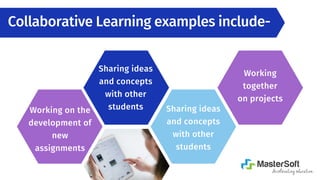
Sharing ideas
and concepts
with other
students
Working on the
development of
new
assignments
Sharing ideas
and concepts
with other
students
Working
together
on projects
Collaborative Learning examples include-
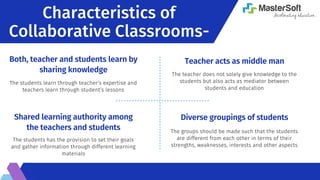
The students learn through teacher’s expertise and
teachers learn through student’s lessons
Both, teacher and students learn by
sharing knowledge
The students has the provision to set their goals
and gather information through different learning
materials
Shared learning authority among
the teachers and students
The teacher does not solely give knowledge to the
students but also acts as mediator between
students and education
Teacher acts as middle man
The groups should be made such that the students
are different from each other in terms of their
strengths, weaknesses, interests and other aspects
Diverse groupings of students
Characteristics of
Collaborative Classrooms-
Benefits of Collaborative
Learning
Submit our
application for a
collaboration feature
license.
Work on the
foundations of our
offline product.
Set up teams in the
top 10 locales to start
localizing our
product.
01 02 03
04 05
Submit our
application for a
collaboration feature
license.
Submit our
application for a
collaboration feature
license.
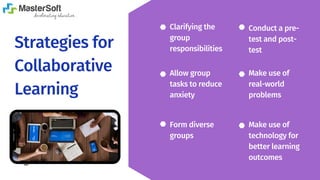
Strategies for
Collaborative
Learning
Clarifying the
group
responsibilities
Allow group
tasks to reduce
anxiety
Form diverse
groups
Conduct a pre-
test and post-
test
Make use of
real-world
problems
Make use of
technology for
better learning
outcomes
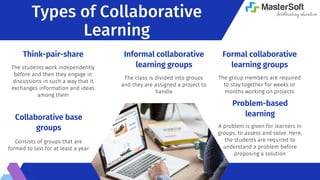
The students work independently
before and then they engage in
discussions in such a way that it
exchanges information and ideas
among them
Think-pair-share
A problem is given for learners in
groups, to assess and solve. Here,
the students are required to
understand a problem before
proposing a solution
Problem-based
learning
The group members are required
to stay together for weeks or
months working on projects
Formal collaborative
learning groups
Consists of groups that are
formed to last for at least a year
Collaborative base
groups
Types of Collaborative
Learning
The class is divided into groups
and they are assigned a project to
handle
Informal collaborative
learning groups
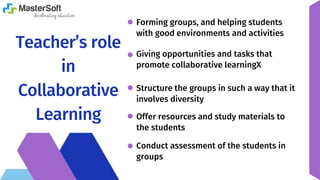
Teacher’s role
in
Collaborative
Learning
Forming groups, and helping students
with good environments and activities
Giving opportunities and tasks that
promote collaborative learningX
Structure the groups in such a way that it
involves diversity
Offer resources and study materials to
the students
Conduct assessment of the students in
groups
How can MasterSoft help in Collaborative
learning?
MasterSoft can help
the students to form
groups and work
remotely with the help
of software
It can help the
teachers to assess the
students and get
access to their work
The teachers has
access to various
groups and their
information stored
separately
The distribution of
responsibilities and
solutions can be
recorded in the
portals
Email- janki.somani@iitms.co.in
Visit www.iitms.co.in
Contact Us
08448010216
WE ARE HERE!
https://www.iitms.co.in/blog/what-is-collaborative-learning.html
Thank you for your time !
https://www.iitms.co.in/blog/what-is-collaborative-learning.html

Collaborative learning ppt

  • 1.
    COLLABORATIVE LEARNING Email: janki.somani@iitms.co.in Mobile:08448010216 Website: https://www.iitms.co.in/
  • 2.
    Shortcomings of Traditional Learning Methods Students lackcritical thinking abilities Students learn for degrees and grades Students use memorization techniques for learning Lacks development of creativity and cognitive abilities
  • 3.
    What is Collaborative Learning? Collaborative learningis an educational approach in which students study in groups to enhance their learning outcomes They come together to perform tasks, work on projects and understand new concepts Helps students to defend their places, reframe ideas, understand other person’s points of view Aids in better understanding of a subject
  • 4.
    Sharing ideas and concepts withother students Working on the development of new assignments Sharing ideas and concepts with other students Working together on projects Collaborative Learning examples include-
  • 5.
    The students learnthrough teacher’s expertise and teachers learn through student’s lessons Both, teacher and students learn by sharing knowledge The students has the provision to set their goals and gather information through different learning materials Shared learning authority among the teachers and students The teacher does not solely give knowledge to the students but also acts as mediator between students and education Teacher acts as middle man The groups should be made such that the students are different from each other in terms of their strengths, weaknesses, interests and other aspects Diverse groupings of students Characteristics of Collaborative Classrooms-
  • 6.
    Benefits of Collaborative Learning Submitour application for a collaboration feature license. Work on the foundations of our offline product. Set up teams in the top 10 locales to start localizing our product. 01 02 03 04 05 Submit our application for a collaboration feature license. Submit our application for a collaboration feature license.
  • 7.
    Strategies for Collaborative Learning Clarifying the group responsibilities Allowgroup tasks to reduce anxiety Form diverse groups Conduct a pre- test and post- test Make use of real-world problems Make use of technology for better learning outcomes
  • 8.
    The students workindependently before and then they engage in discussions in such a way that it exchanges information and ideas among them Think-pair-share A problem is given for learners in groups, to assess and solve. Here, the students are required to understand a problem before proposing a solution Problem-based learning The group members are required to stay together for weeks or months working on projects Formal collaborative learning groups Consists of groups that are formed to last for at least a year Collaborative base groups Types of Collaborative Learning The class is divided into groups and they are assigned a project to handle Informal collaborative learning groups
  • 9.
    Teacher’s role in Collaborative Learning Forming groups,and helping students with good environments and activities Giving opportunities and tasks that promote collaborative learningX Structure the groups in such a way that it involves diversity Offer resources and study materials to the students Conduct assessment of the students in groups
  • 10.
    How can MasterSofthelp in Collaborative learning? MasterSoft can help the students to form groups and work remotely with the help of software It can help the teachers to assess the students and get access to their work The teachers has access to various groups and their information stored separately The distribution of responsibilities and solutions can be recorded in the portals
  • 11.
    Email- janki.somani@iitms.co.in Visit www.iitms.co.in ContactUs 08448010216 WE ARE HERE! https://www.iitms.co.in/blog/what-is-collaborative-learning.html
  • 12.
    Thank you foryour time ! https://www.iitms.co.in/blog/what-is-collaborative-learning.html