1. What is the world'shortest play?
2. What is the world'd shortest poetry form?
3. It is a book of observations and musings recorded by Sei Shonagon
during her time as court lady. (Japanese Lit)
4. It is a popular novel by Kamala Markandaya (India)
WHO WROTE EACH LITERARY WORK?
A. Hills Like White Elephants
B. The Bet
C. A Rose for Emily
D. Age of Innocence
E. A Doll's House
F. Essays in Idleness
G. The Road Not Taken
H. Sherlock Holmes
Why teach Literature? (Duff and Maley, 1990)
1. LINGUISTIC
In terms of language acquisition and learning, literary
texts offer samples of a very wide range of styles,
registers and text types at many levels of difficulty.
2. METHODOLOGICAL
-SInce literary texts are open to multiple interpretations,
readers can have different opinions and ideas about a
variety of topics. This provides learners an opportunity
to engage in genuine interaction. The learners can even
be taught to develop critical thinking.
3. MOTIVATIONAL
Literary texts are non-trivial since they deal with
matters which concerned the writer enough to make
him or her write about them. In this they are unlike
many other forms of language teaching inputs, which
frequently trivialize experience in the service of
pedagogy. Literary texts touch on themes to which
learners can bring a personal response from their own
experience.
How do readers respond to literature? How can we
make our students respond to literature?
DESCRIPTION
Students can talk or write about what they read in their
own words
DISCRIMINATION
Students can discriminate among the different literary
texts. They can identify them by type, author or theme.
How do readers respond to literature? How can we
make our students respond to literature?
RELATION
Students can relate several elements of a litetary text to
each other or to other texts
INTERPRETATION
Students can figure out what they think the author is
saying and defend their style
How do readers respond to literature? How can we
make our students respond to literature?
GENERALIZATION
Students can draw out the main idea of a piece of
literary work or an author's style
EVALUATING
Students can evaluate the worth of a piece of literature
using a set of criteria
How do readers respond to literature? How can we
make our students respond to literature?
VALUING
Students can indicate the importance of literature to
their own lives or to the world outside of the text
CREATION
Students can respond creatively by making art projects,
composing a musical medley, producing an MTV, writing
another stanza for a poem or another chapter or novel
etc
FICTION
-fiction is any imaginative recreation and reconstruction
of life
-It includes short stories and novels.
THE ELEMENTS OF FICTION:
A. Setting - time and place
B. Characters
C. Plot -
Parts of the Plot - exposition, complication, crisis
climax, denouement
D. Point of View
E. Theme
POETRY
ESSAY
DRAMA
D. Point of View
E. Theme
POETRY
ESSAY
DRAMA
A. Achilles' heel
-the weakest point of one's personality or something
that marks the weakes point of a person
B. Herculean task
-a great or impossible task; something that is almost
impossible to do
C. Apple of discord
-the object of conflict
A. Achilles' heel
-the weakest point of one's personality or something
that marks the weakes point of a person
B. Herculean task
-a great or impossible task; something that is almost
impossible to do
C. Apple of discord
-the object of conflict
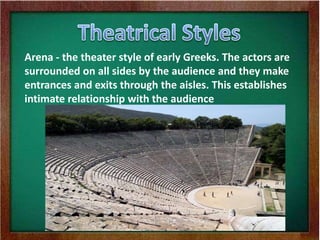
Arena - the theater style of early Greeks. The actors are
surrounded on all sides by the audience and they make
entrances and exits through the aisles. This establishes
intimate relationship with the audience
Medieval Theater - this used staging areas called
mansions inside the churches and portable wagons
wheeled about outside the churches
Elizabethan theater - this used staging areas called
mansions inside the churches and portable wagons
wheeled about outside the churches.
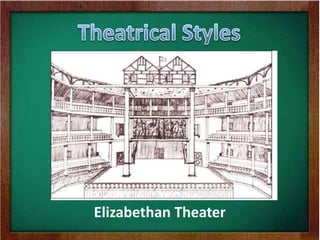
Elizabethan Theater
Genres of Drama
Tragedy - a type of drama that shows the
downfall and destruction of a noble or
outstanding person, traditionally one who
possesses a character weakness called a
tragic flaw. The tragic hero, through choice
or circumstance, is caught up in a sequence
of events that inevitably results in disaster.
Genres of Drama
Comedy - a type of drama intended to
interest and amuse the audience rather
than make them deeply concerned about
events that happen. The characters
overcome some difficulties, but they always
overcome their ill fortune and find
happiness in the end.
Genres of Drama
Tragicomedy - a play that does not adhere
strictly to the structure of tragedy. This is usually
a serious play that also has some of the qualities
of a comedy. It arouses thought even with
laughter.
Farce - has very swift movements, has ridiculous
situations, and does not stimulate thought.
Example: Comedy of Errors, The Taming of the
Shrew
Genres of Drama
Tragicomedy - a play that does not adhere
strictly to the structure of tragedy. This is usually
a serious play that also has some of the qualities
of a comedy. It arouses thought even with
laughter.
Farce - has very swift movements, has ridiculous
situations, and does not stimulate thought.
Example: Comedy of Errors, The Taming of the
Shrew
Genres of Drama
Farce - has very swift movements, has ridiculous
situations, and does not stimulate thought.
Example: Comedy of Errors, The Taming of the
Shrew

Teaching literature

  • 1.
    1. What isthe world'shortest play? 2. What is the world'd shortest poetry form? 3. It is a book of observations and musings recorded by Sei Shonagon during her time as court lady. (Japanese Lit) 4. It is a popular novel by Kamala Markandaya (India) WHO WROTE EACH LITERARY WORK? A. Hills Like White Elephants B. The Bet C. A Rose for Emily D. Age of Innocence E. A Doll's House F. Essays in Idleness G. The Road Not Taken H. Sherlock Holmes
  • 2.
    Why teach Literature?(Duff and Maley, 1990) 1. LINGUISTIC In terms of language acquisition and learning, literary texts offer samples of a very wide range of styles, registers and text types at many levels of difficulty. 2. METHODOLOGICAL -SInce literary texts are open to multiple interpretations, readers can have different opinions and ideas about a variety of topics. This provides learners an opportunity to engage in genuine interaction. The learners can even be taught to develop critical thinking.
  • 3.
    3. MOTIVATIONAL Literary textsare non-trivial since they deal with matters which concerned the writer enough to make him or her write about them. In this they are unlike many other forms of language teaching inputs, which frequently trivialize experience in the service of pedagogy. Literary texts touch on themes to which learners can bring a personal response from their own experience.
  • 4.
    How do readersrespond to literature? How can we make our students respond to literature? DESCRIPTION Students can talk or write about what they read in their own words DISCRIMINATION Students can discriminate among the different literary texts. They can identify them by type, author or theme.
  • 5.
    How do readersrespond to literature? How can we make our students respond to literature? RELATION Students can relate several elements of a litetary text to each other or to other texts INTERPRETATION Students can figure out what they think the author is saying and defend their style
  • 6.
    How do readersrespond to literature? How can we make our students respond to literature? GENERALIZATION Students can draw out the main idea of a piece of literary work or an author's style EVALUATING Students can evaluate the worth of a piece of literature using a set of criteria
  • 7.
    How do readersrespond to literature? How can we make our students respond to literature? VALUING Students can indicate the importance of literature to their own lives or to the world outside of the text CREATION Students can respond creatively by making art projects, composing a musical medley, producing an MTV, writing another stanza for a poem or another chapter or novel etc
  • 8.
    FICTION -fiction is anyimaginative recreation and reconstruction of life -It includes short stories and novels. THE ELEMENTS OF FICTION: A. Setting - time and place B. Characters C. Plot - Parts of the Plot - exposition, complication, crisis climax, denouement
  • 9.
    D. Point ofView E. Theme POETRY ESSAY DRAMA
  • 10.
    D. Point ofView E. Theme POETRY ESSAY DRAMA
  • 11.
    A. Achilles' heel -theweakest point of one's personality or something that marks the weakes point of a person B. Herculean task -a great or impossible task; something that is almost impossible to do C. Apple of discord -the object of conflict
  • 12.
    A. Achilles' heel -theweakest point of one's personality or something that marks the weakes point of a person B. Herculean task -a great or impossible task; something that is almost impossible to do C. Apple of discord -the object of conflict
  • 13.
    Arena - thetheater style of early Greeks. The actors are surrounded on all sides by the audience and they make entrances and exits through the aisles. This establishes intimate relationship with the audience
  • 14.
    Medieval Theater -this used staging areas called mansions inside the churches and portable wagons wheeled about outside the churches Elizabethan theater - this used staging areas called mansions inside the churches and portable wagons wheeled about outside the churches.
  • 15.
  • 16.
    Genres of Drama Tragedy- a type of drama that shows the downfall and destruction of a noble or outstanding person, traditionally one who possesses a character weakness called a tragic flaw. The tragic hero, through choice or circumstance, is caught up in a sequence of events that inevitably results in disaster.
  • 17.
    Genres of Drama Comedy- a type of drama intended to interest and amuse the audience rather than make them deeply concerned about events that happen. The characters overcome some difficulties, but they always overcome their ill fortune and find happiness in the end.
  • 18.
    Genres of Drama Tragicomedy- a play that does not adhere strictly to the structure of tragedy. This is usually a serious play that also has some of the qualities of a comedy. It arouses thought even with laughter. Farce - has very swift movements, has ridiculous situations, and does not stimulate thought. Example: Comedy of Errors, The Taming of the Shrew
  • 19.
    Genres of Drama Tragicomedy- a play that does not adhere strictly to the structure of tragedy. This is usually a serious play that also has some of the qualities of a comedy. It arouses thought even with laughter. Farce - has very swift movements, has ridiculous situations, and does not stimulate thought. Example: Comedy of Errors, The Taming of the Shrew
  • 20.
    Genres of Drama Farce- has very swift movements, has ridiculous situations, and does not stimulate thought. Example: Comedy of Errors, The Taming of the Shrew