
Feedback
Dr. Hironmoy Roy
What is it?
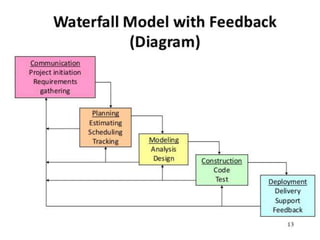
• Process in which the effect of the “output” of a
system, is returned back (fed back) to modify the
next “output”.
• It is a dialogue between two persons, which reflects
back “how another person sees other’s behaviour.”
Why is it?
• ‘Continuous Quality Assurance’ of the entire
system
• It basically tells (a) the strength (b) the
weakness (c) the areas of improvement
When to give?
• When asked to do so
• Whenever your offer is accepted
• Give feedback as soon as possible
• Needs to be given privately, maintaining the self
esteem of the recipient
• To focus on the areas to be improved
• Not to overload, just to focus of two-three areas at
a given time
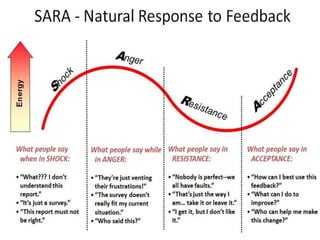
While to accept feedback....
• Breathe.......
• Listen carefully
• Assume it in constructive sense
• Pause and think before reply
• Ask for the suggestions
• Respect and to provide thanks
Types of feedback
• Positive feedback & Negative feedback
• Verbal feedback & Non verbal feedback
• Written feedback & Oral feedback
• Qualitative feedback & Quantitative feedback
When it becomes “effective”?
• Goal is to get the student internalise & materialise
the feedback to use the suggested strategies
independently in future work
• Criteria-based phrases are used to describe the
strength & weakness of learners’ work
• Limit feedback to maximum two traits
• Students shall have opportunity to “re-do” their
work upon the feedback
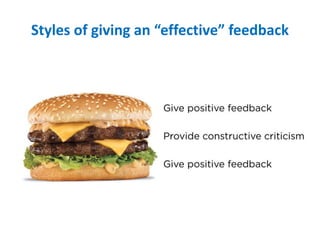
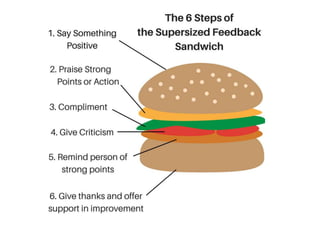
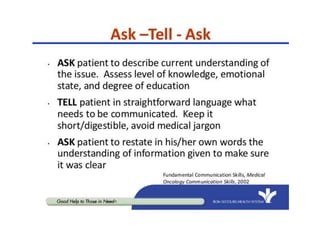
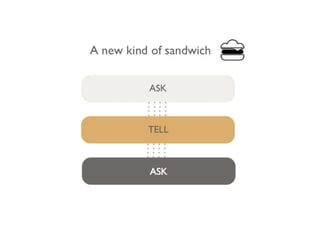
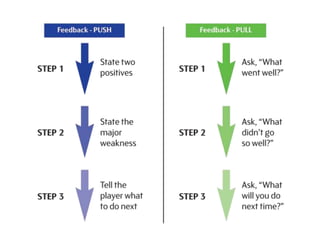
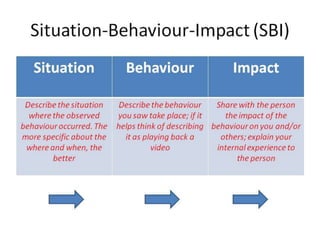
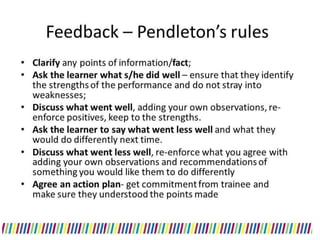
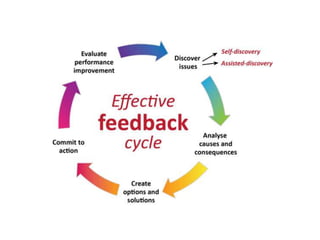
Styles of giving an “effective” feedback
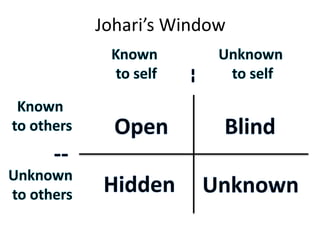
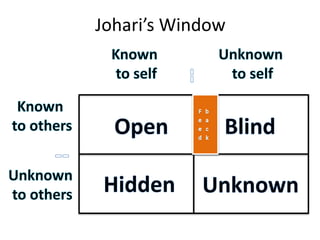
Johari’s Window
Johari’s Window
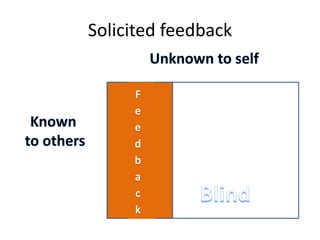
Solicited feedback
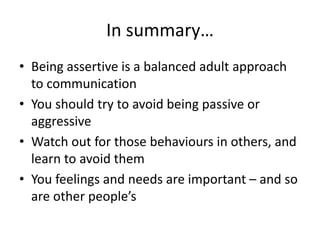
In summary…
• Being assertive is a balanced adult approach
to communication
• You should try to avoid being passive or
aggressive
• Watch out for those behaviours in others, and
learn to avoid them
• You feelings and needs are important – and so
are other people’s
Thank you

FEEDBACK

  • 1.
  • 2.
    What is it? •Process in which the effect of the “output” of a system, is returned back (fed back) to modify the next “output”. • It is a dialogue between two persons, which reflects back “how another person sees other’s behaviour.”
  • 3.
    Why is it? •‘Continuous Quality Assurance’ of the entire system • It basically tells (a) the strength (b) the weakness (c) the areas of improvement
  • 4.
    When to give? •When asked to do so • Whenever your offer is accepted • Give feedback as soon as possible • Needs to be given privately, maintaining the self esteem of the recipient • To focus on the areas to be improved • Not to overload, just to focus of two-three areas at a given time
  • 5.
    While to acceptfeedback.... • Breathe....... • Listen carefully • Assume it in constructive sense • Pause and think before reply • Ask for the suggestions • Respect and to provide thanks
  • 6.
    Types of feedback •Positive feedback & Negative feedback • Verbal feedback & Non verbal feedback • Written feedback & Oral feedback • Qualitative feedback & Quantitative feedback
  • 7.
    When it becomes“effective”? • Goal is to get the student internalise & materialise the feedback to use the suggested strategies independently in future work • Criteria-based phrases are used to describe the strength & weakness of learners’ work • Limit feedback to maximum two traits • Students shall have opportunity to “re-do” their work upon the feedback
  • 8.
    Styles of givingan “effective” feedback
  • 17.
  • 18.
  • 19.
  • 22.
    In summary… • Beingassertive is a balanced adult approach to communication • You should try to avoid being passive or aggressive • Watch out for those behaviours in others, and learn to avoid them • You feelings and needs are important – and so are other people’s
  • 23.