I N G L Ê S E E N S I N O
TEACHING
GRAMMAR
Discentes: Júlia Gonçalves
Manoela Couto
Raul de Castro
8° período
Letras (Português e Inglês)
A ) I N T R O D U C I N G G R A M M A R
Teaching grammar plays a fundamental role in language acquisition, as it
helps students understand how linguistic structure works and communicate
improving their communication.
However, teaching grammar in isolation, without being linked to context or
practical use, can become demotivating and disconnected from students' real
communication needs.
This is why, in communicative and more modern approaches, grammar often
emerges naturally in reading, listening, writing or speaking activities, with the
focus on the use of the language and not just its structure.
A ) I N T R O D U C I N G G R A M M A R
The form-focus approach is an example of how grammar teaching can be
integrated more fluidly and in context.
This happens when the teacher identifies a grammatical error or gap during a
communicative activity (such as a conversation or reading) and, Instead of
interrupting fluency, it makes a small adjustment to the form, explaining the
grammatical point.
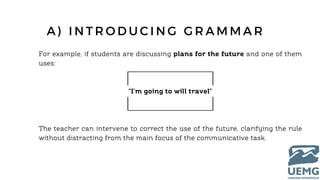
For example, if students are discussing plans for the future and one of them
uses:
"I'm going to will travel"
The teacher can intervene to correct the use of the future, clarifying the rule
without distracting from the main focus of the communicative task.
A ) I N T R O D U C I N G G R A M M A R
Practical activities
A ) I N T R O D U C I N G G R A M M A R
There are many creative and engaging ways to present and practice
grammar. A simple example of introducing grammar would be to introduce a
new grammatical structure, such as Present Continuous, using images and
questions such as:
"What is he doing?"
"He is running".
Through this controlled practice, students can absorb grammatical form in a
meaningful context.
B ) D I S C O V E R I N G G R A M M A R
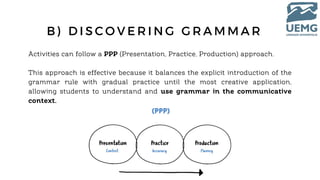
Activities can follow a PPP (Presentation, Practice, Production) approach.
This approach is effective because it balances the explicit introduction of the
grammar rule with gradual practice until the most creative application,
allowing students to understand and use grammar in the communicative
context.
B ) D I S C O V E R I N G G R A M M A R
EXAMPLE
B ) D I S C O V E R I N G G R A M M A R
EXAMPLE
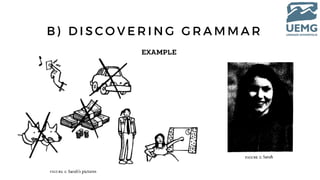
1- The students see Sarah's image and the teacher asks about her work,
without confirming or denying their answers.
The teacher then says sentences about what Sarah does every day, and the
students must choose which card or image corresponds to the sentence said,
such as:
"She doesn't like dogs" and "She gets up early"
B ) D I S C O V E R I N G G R A M M A R
EXAMPLE
2- After confirming that Sarah is a postwoman, the teacher speaks
sentences about each image, getting the students to individually repeat each
word.
3- After practicing the sentences confidently, students invent or choose a
real person and create three affirmative and three negative sentences about
what that person does or does'nt do on a daily basis.
4- They share the sentences with the class, who try to guess the profession
described.
C ) P R A C T I S I N G G R A M M A R
Controlled Practice
What It Is: Controlled practice focuses on accuracy, where learners work with
grammar in a highly structured manner. This could involve activities like gap-
fills, sentence transformation exercises, or substitution drills, where learners
manipulate grammatical forms but don’t need to think deeply about meaning.
Purpose: The goal is to help learners become familiar with the form and
structure of grammatical points, ensuring that they can correctly produce
these forms.
EXAMPLE:
If teaching the past simple tense, learners might be given
sentences with verbs in parentheses (e.g., "Yesterday, I ____ (go) to
the market.") and have to convert them to the correct form ("went").
C ) P R A C T I S I N G G R A M M A R
Meaningful Practice
What It Is: In this stage, the practice is still controlled to an extent, but
the focus shifts toward ensuring that learners are using the grammar in
contexts where meaning is more important. The tasks still contain clear
prompts, but students have to start thinking about meaning as well as
form.
Purpose: This helps learners begin to link grammatical structures with
real-world communication. It's a bridge between controlled practice and
free communication.
EXAMPLE:
Students might be given prompts or pictures and asked to
describe what they did yesterday, but with the requirement that
they use the past simple tense.
C ) P R A C T I S I N G G R A M M A R
Communicative Practice
What It Is: Communicative practice moves towards fluency, where
learners focus more on meaning and less on form. The activities here are
designed to simulate real-world communication, where students use the
target grammar naturally in conversation or writing.
Purpose: The aim is for students to use the grammar they've learned in
spontaneous and realistic ways, enabling them to internalize the rules
and apply them in actual communication.
EXAMPLE:
Students might be asked to role-play a conversation about past
experiences (e.g., "Tell your partner about a trip you took recently").
Here, the past simple is required, but the task is communicative,
with the emphasis on sharing information, not on being
grammatically perfect.
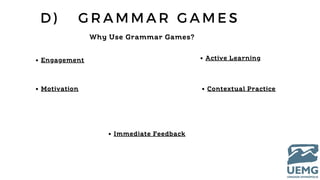
D ) G R A M M A R G A M E S
Why Use Grammar Games?
Engagement
Motivation
Active Learning
Contextual Practice
Immediate Feedback
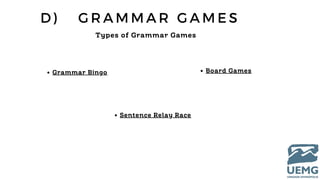
D ) G R A M M A R G A M E S
Types of Grammar Games
Grammar Bingo Board Games
Sentence Relay Race
D ) G R A M M A R G A M E S
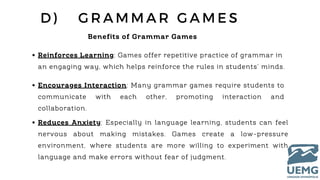
Benefits of Grammar Games
Reinforces Learning: Games offer repetitive practice of grammar in
an engaging way, which helps reinforce the rules in students’ minds.
Encourages Interaction: Many grammar games require students to
communicate with each other, promoting interaction and
collaboration.
Reduces Anxiety: Especially in language learning, students can feel
nervous about making mistakes. Games create a low-pressure
environment, where students are more willing to experiment with
language and make errors without fear of judgment.
E ) G R A M M A R B O O K S
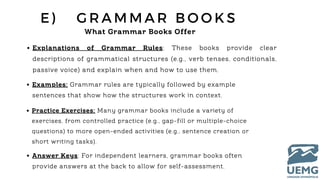
What Grammar Books Offer
Explanations of Grammar Rules: These books provide clear
descriptions of grammatical structures (e.g., verb tenses, conditionals,
passive voice) and explain when and how to use them.
Examples: Grammar rules are typically followed by example
sentences that show how the structures work in context.
Practice Exercises: Many grammar books include a variety of
exercises, from controlled practice (e.g., gap-fill or multiple-choice
questions) to more open-ended activities (e.g., sentence creation or
short writing tasks).
Answer Keys: For independent learners, grammar books often
provide answers at the back to allow for self-assessment.
E ) G R A M M A R B O O K S
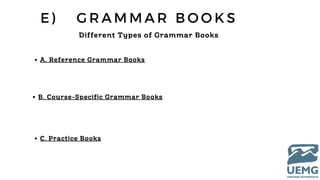
Different Types of Grammar Books
A. Reference Grammar Books
B. Course-Specific Grammar Books
C. Practice Books
E ) G R A M M A R B O O K S
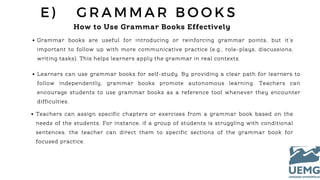
How to Use Grammar Books Effectively
Grammar books are useful for introducing or reinforcing grammar points, but it’s
important to follow up with more communicative practice (e.g., role-plays, discussions,
writing tasks). This helps learners apply the grammar in real contexts.
Learners can use grammar books for self-study. By providing a clear path for learners to
follow independently, grammar books promote autonomous learning. Teachers can
encourage students to use grammar books as a reference tool whenever they encounter
difficulties.
Teachers can assign specific chapters or exercises from a grammar book based on the
needs of the students. For instance, if a group of students is struggling with conditional
sentences, the teacher can direct them to specific sections of the grammar book for
focused practice.
E ) G R A M M A R B O O K S
Limitations of Grammar Books
Over-reliance on Exercises: Simply completing exercises from a
grammar book doesn’t always lead to communicative competence.
Learners may understand grammar rules in theory but still struggle
to use them in real-life conversations.
Lack of Context: Grammar books sometimes present grammar points in
isolation, without enough real-world context. Teachers need to bridge
this gap by providing tasks where learners can apply grammar in
meaningful situations.
G R A M M A R A C T I V I T Y
https://kahoot.it/
C O N C L U S I O N
The Chapter focuses on effective approaches to teaching grammar, advocating for a
balanced methodology that fosters both accuracy and fluency. It highlights the
importance of combining traditional grammar instruction, such as explanations and
controlled practice from grammar books, with more interactive and communicative
techniques. These include games, task-based activities, and real-life scenarios that
help learners apply grammar in meaningful contexts. Harmer emphasizes that
grammar should not be taught in isolation but integrated into a broader
communicative framework, allowing students to not only understand grammatical
rules but also use them naturally and effectively in communication. This blend of
structured learning and real-world practice ensures a deeper, more practical mastery
of grammar.
R E F E R Ê N C I A S
HARMER, Jeremy. The Practice of English Language Teaching. 4. ed. Harlow: Pearson
Longman, 2008.

TEACHING GRAMMAR; Ensinando Gramática; Gramática da Língua Inglesa

  • 1.
    I N GL Ê S E E N S I N O TEACHING GRAMMAR Discentes: Júlia Gonçalves Manoela Couto Raul de Castro 8° período Letras (Português e Inglês)
  • 2.
    A ) IN T R O D U C I N G G R A M M A R Teaching grammar plays a fundamental role in language acquisition, as it helps students understand how linguistic structure works and communicate improving their communication. However, teaching grammar in isolation, without being linked to context or practical use, can become demotivating and disconnected from students' real communication needs. This is why, in communicative and more modern approaches, grammar often emerges naturally in reading, listening, writing or speaking activities, with the focus on the use of the language and not just its structure.
  • 3.
    A ) IN T R O D U C I N G G R A M M A R The form-focus approach is an example of how grammar teaching can be integrated more fluidly and in context. This happens when the teacher identifies a grammatical error or gap during a communicative activity (such as a conversation or reading) and, Instead of interrupting fluency, it makes a small adjustment to the form, explaining the grammatical point.
  • 4.
    For example, ifstudents are discussing plans for the future and one of them uses: "I'm going to will travel" The teacher can intervene to correct the use of the future, clarifying the rule without distracting from the main focus of the communicative task. A ) I N T R O D U C I N G G R A M M A R
  • 5.
    Practical activities A )I N T R O D U C I N G G R A M M A R There are many creative and engaging ways to present and practice grammar. A simple example of introducing grammar would be to introduce a new grammatical structure, such as Present Continuous, using images and questions such as: "What is he doing?" "He is running". Through this controlled practice, students can absorb grammatical form in a meaningful context.
  • 6.
    B ) DI S C O V E R I N G G R A M M A R Activities can follow a PPP (Presentation, Practice, Production) approach. This approach is effective because it balances the explicit introduction of the grammar rule with gradual practice until the most creative application, allowing students to understand and use grammar in the communicative context.
  • 7.
    B ) DI S C O V E R I N G G R A M M A R EXAMPLE
  • 8.
    B ) DI S C O V E R I N G G R A M M A R EXAMPLE 1- The students see Sarah's image and the teacher asks about her work, without confirming or denying their answers. The teacher then says sentences about what Sarah does every day, and the students must choose which card or image corresponds to the sentence said, such as: "She doesn't like dogs" and "She gets up early"
  • 9.
    B ) DI S C O V E R I N G G R A M M A R EXAMPLE 2- After confirming that Sarah is a postwoman, the teacher speaks sentences about each image, getting the students to individually repeat each word. 3- After practicing the sentences confidently, students invent or choose a real person and create three affirmative and three negative sentences about what that person does or does'nt do on a daily basis. 4- They share the sentences with the class, who try to guess the profession described.
  • 10.
    C ) PR A C T I S I N G G R A M M A R Controlled Practice What It Is: Controlled practice focuses on accuracy, where learners work with grammar in a highly structured manner. This could involve activities like gap- fills, sentence transformation exercises, or substitution drills, where learners manipulate grammatical forms but don’t need to think deeply about meaning. Purpose: The goal is to help learners become familiar with the form and structure of grammatical points, ensuring that they can correctly produce these forms. EXAMPLE: If teaching the past simple tense, learners might be given sentences with verbs in parentheses (e.g., "Yesterday, I ____ (go) to the market.") and have to convert them to the correct form ("went").
  • 11.
    C ) PR A C T I S I N G G R A M M A R Meaningful Practice What It Is: In this stage, the practice is still controlled to an extent, but the focus shifts toward ensuring that learners are using the grammar in contexts where meaning is more important. The tasks still contain clear prompts, but students have to start thinking about meaning as well as form. Purpose: This helps learners begin to link grammatical structures with real-world communication. It's a bridge between controlled practice and free communication. EXAMPLE: Students might be given prompts or pictures and asked to describe what they did yesterday, but with the requirement that they use the past simple tense.
  • 12.
    C ) PR A C T I S I N G G R A M M A R Communicative Practice What It Is: Communicative practice moves towards fluency, where learners focus more on meaning and less on form. The activities here are designed to simulate real-world communication, where students use the target grammar naturally in conversation or writing. Purpose: The aim is for students to use the grammar they've learned in spontaneous and realistic ways, enabling them to internalize the rules and apply them in actual communication. EXAMPLE: Students might be asked to role-play a conversation about past experiences (e.g., "Tell your partner about a trip you took recently"). Here, the past simple is required, but the task is communicative, with the emphasis on sharing information, not on being grammatically perfect.
  • 13.
    D ) GR A M M A R G A M E S Why Use Grammar Games? Engagement Motivation Active Learning Contextual Practice Immediate Feedback
  • 14.
    D ) GR A M M A R G A M E S Types of Grammar Games Grammar Bingo Board Games Sentence Relay Race
  • 15.
    D ) GR A M M A R G A M E S Benefits of Grammar Games Reinforces Learning: Games offer repetitive practice of grammar in an engaging way, which helps reinforce the rules in students’ minds. Encourages Interaction: Many grammar games require students to communicate with each other, promoting interaction and collaboration. Reduces Anxiety: Especially in language learning, students can feel nervous about making mistakes. Games create a low-pressure environment, where students are more willing to experiment with language and make errors without fear of judgment.
  • 16.
    E ) GR A M M A R B O O K S What Grammar Books Offer Explanations of Grammar Rules: These books provide clear descriptions of grammatical structures (e.g., verb tenses, conditionals, passive voice) and explain when and how to use them. Examples: Grammar rules are typically followed by example sentences that show how the structures work in context. Practice Exercises: Many grammar books include a variety of exercises, from controlled practice (e.g., gap-fill or multiple-choice questions) to more open-ended activities (e.g., sentence creation or short writing tasks). Answer Keys: For independent learners, grammar books often provide answers at the back to allow for self-assessment.
  • 17.
    E ) GR A M M A R B O O K S Different Types of Grammar Books A. Reference Grammar Books B. Course-Specific Grammar Books C. Practice Books
  • 18.
    E ) GR A M M A R B O O K S How to Use Grammar Books Effectively Grammar books are useful for introducing or reinforcing grammar points, but it’s important to follow up with more communicative practice (e.g., role-plays, discussions, writing tasks). This helps learners apply the grammar in real contexts. Learners can use grammar books for self-study. By providing a clear path for learners to follow independently, grammar books promote autonomous learning. Teachers can encourage students to use grammar books as a reference tool whenever they encounter difficulties. Teachers can assign specific chapters or exercises from a grammar book based on the needs of the students. For instance, if a group of students is struggling with conditional sentences, the teacher can direct them to specific sections of the grammar book for focused practice.
  • 19.
    E ) GR A M M A R B O O K S Limitations of Grammar Books Over-reliance on Exercises: Simply completing exercises from a grammar book doesn’t always lead to communicative competence. Learners may understand grammar rules in theory but still struggle to use them in real-life conversations. Lack of Context: Grammar books sometimes present grammar points in isolation, without enough real-world context. Teachers need to bridge this gap by providing tasks where learners can apply grammar in meaningful situations.
  • 20.
    G R AM M A R A C T I V I T Y https://kahoot.it/
  • 21.
    C O NC L U S I O N The Chapter focuses on effective approaches to teaching grammar, advocating for a balanced methodology that fosters both accuracy and fluency. It highlights the importance of combining traditional grammar instruction, such as explanations and controlled practice from grammar books, with more interactive and communicative techniques. These include games, task-based activities, and real-life scenarios that help learners apply grammar in meaningful contexts. Harmer emphasizes that grammar should not be taught in isolation but integrated into a broader communicative framework, allowing students to not only understand grammatical rules but also use them naturally and effectively in communication. This blend of structured learning and real-world practice ensures a deeper, more practical mastery of grammar.
  • 22.
    R E FE R Ê N C I A S HARMER, Jeremy. The Practice of English Language Teaching. 4. ed. Harlow: Pearson Longman, 2008.