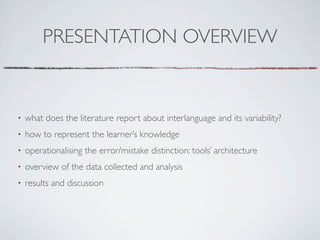
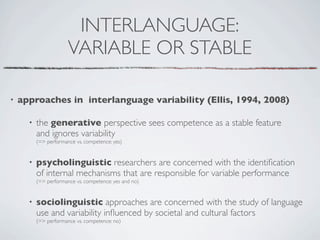
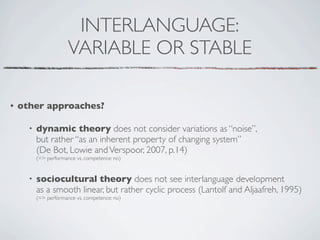
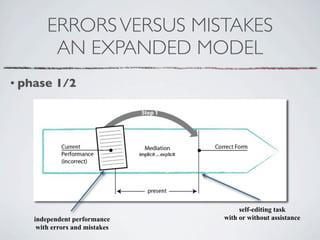
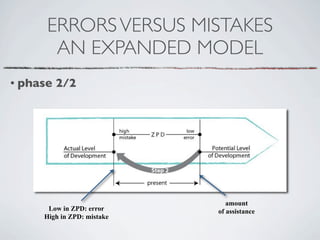
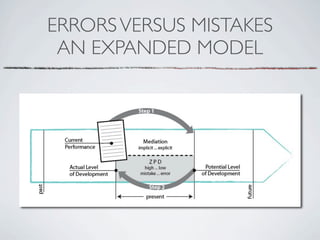
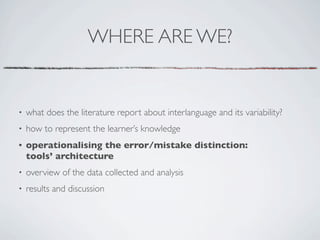
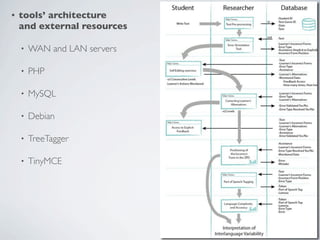
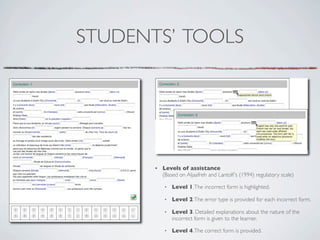
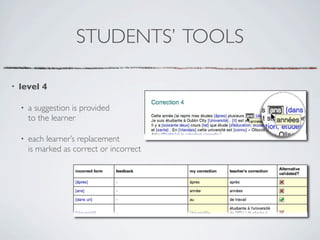
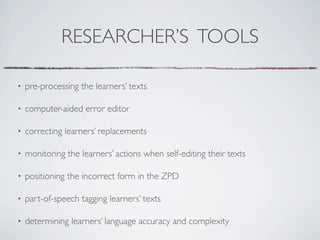
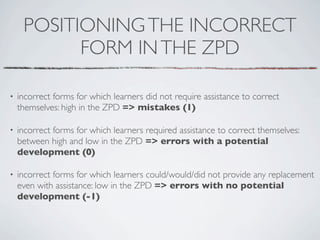
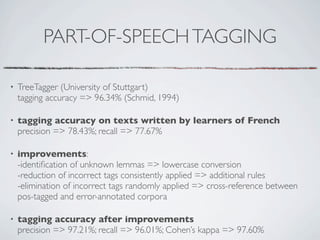
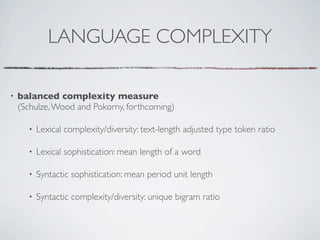
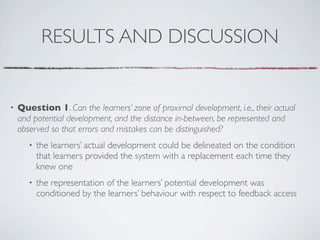
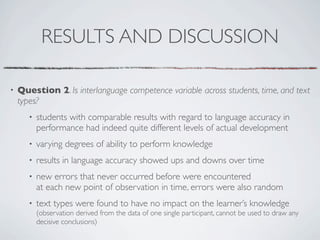
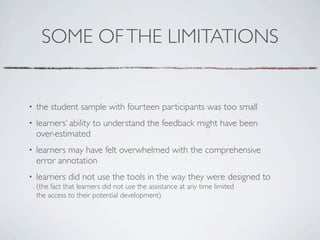
This document discusses modeling second language learners' interlanguage and its variability using a dynamic assessment approach. It provides an overview of relevant literature on interlanguage and its variability, approaches to representing learners' knowledge, and operationalizing the distinction between errors and mistakes. The document then describes the tools and data collection methods used in the study, including tools for learners, researchers, and data analysis. Preliminary results suggest the study was able to represent learners' zones of proximal development to some degree in order to distinguish errors from mistakes. Interlanguage competence appeared variable across learners, time periods, and text types based on initial analyses. The modeling of learners' zones of proximal development provided insight into their interlanguage development.
![INTERLANGUAGE:
COMPETENCE OR PERFORMANCE
• some definitions
• “a separate linguistic system” (Selinker, 1974, p.35)
• “a grammar, which underlies the use of language” (White, 2003, p.1)
• “the language produced by a nonnative speaker of a language
(i.e., a learner’s output)” (Gass and Selinker, 2001, p.455)
• linguistic competence is “what researchers are talking about when
[referring] to ‘interlanguage’” (Ellis, 2008, p.17)](https://image.slidesharecdn.com/tuebingen-111016181229-phpapp01/85/MODELING-SECOND-LANGUAGE-LEARNERS-INTERLANGUAGE-AND-ITS-VARIABILITY-3-320.jpg)
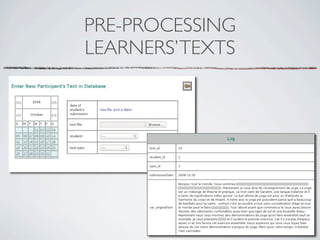
![COMPUTER-AIDED ERROR EDITOR
• process to correct learners’ texts:
• (1) highlighting the incorrect word or
groups of words;
• (2) applying the corresponding error
type;
• (3) writing a personalised feedback or
(5) choosing a meta-linguistic feedback
in the drop down list;
• (4) entering an appropriate replacement
to the learner’s incorrect form.
• error encoding
• *incorrect form*[errorType]
{index@meta-linguistic feedback@correct
form}](https://image.slidesharecdn.com/tuebingen-111016181229-phpapp01/85/MODELING-SECOND-LANGUAGE-LEARNERS-INTERLANGUAGE-AND-ITS-VARIABILITY-23-320.jpg)
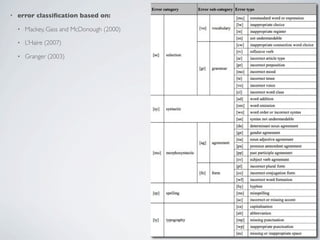
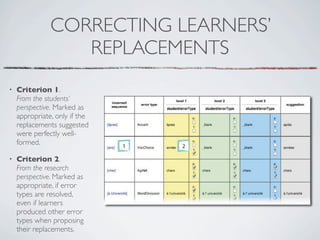
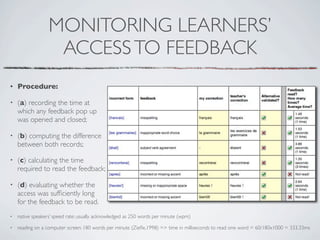
![LANGUAGE ACCURACY
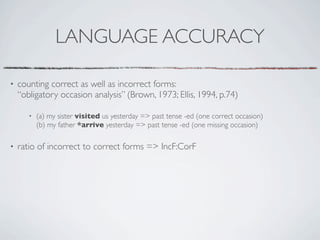
• counting correct as well as incorrect forms:
“obligatory occasion analysis” (Brown, 1973; Ellis, 1994, p.74)
• (a) my sister visited us yesterday => past tense -ed (one correct occasion)
(b) my father *arrive yesterday => past tense -ed (one missing occasion)
• ratio of incorrect to correct forms => IncF:CorF
• Example:
4 noun-adjective agreement error types [...] Il y n’a pas beaucoup des parlent, mais ce n’est pas
necessaire parce-que les choses malheureux qui
6 ADJ pos-tags => (2 correct - 4 incorrect) passer est drole et les plus important.
J’aime cet film parce-que il est surréaliste. Il n’est pas
IncF:CorF => 4:2 trop longue mais il y a beacoups des choses passer. J’aime
aussi le fin de le film, parce-que on n’attendre pas le fin,
quand le homme as coincé dans le four. [...]
percentage of success in noun adjective
agreement =>(2/2+4)X100=33.33%](https://image.slidesharecdn.com/tuebingen-111016181229-phpapp01/85/MODELING-SECOND-LANGUAGE-LEARNERS-INTERLANGUAGE-AND-ITS-VARIABILITY-31-320.jpg)
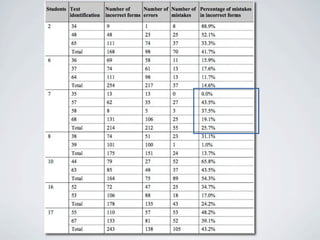
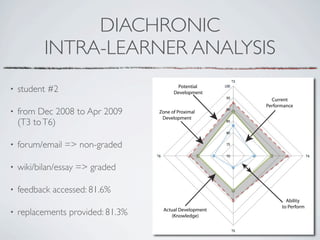
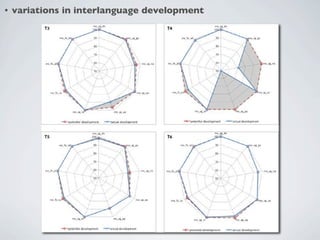

![• Aljaafreh, A. and Lantolf, J.P. 1994. Negative feedback as regulation and second language learning in the zone of Proximal development. Modern Language
Journal. 78 (4), pp465-483.
• Amaral, L.A. and Meurers, D. 2008. From recording linguistic competence to supporting inferences about language acquisition in context. Computer Assisted
Language Learning. 21 (4), pp323-338.
• Brown, R. 1973. A first language: the early stages. Cambridge, MA: Harward University Press.
• Cohen, J. 1960. A Coefficient of Agreement for Nominal Scales. Educational and Psychological Measurement. 20 (1), pp37-46.
• Corder, S.P. 1981. Error Analysis and Interlanguage. Oxford: Oxford University Press.
• De Bot, K., Lowie, W. and Verspoor, M. 2007. A Dynamic Systems Theory approach to second language acquisition. Bilingualism: Language and Cognition. 10
(1), pp7-21.
• Ellis, R. 1985. Understanding second language acquisition. Oxford: Oxford University Press.
• Ellis, R. 1994. The study of second language acquisition. Oxford: Oxford University Press.
• Ellis, R. 2008. Investigating grammatical difficulty in second language learning: implications for second language acquisition research and language testing.
International Journal of Applied Linguistics. 18 (1), pp4-22.
• Ellis, R. 2009. Corrective Feedback and Teacher Development. L2 Journal. 1 (1), pp3-18.
• Gass, S.M. and Selinker, L. 2001. Second language acquisition: an introductory course. 2nd ed. Mahwah, NJ: Lawrence Erlbaum Associates.
• Granger, S. 2003. Error-tagged learner corpora and CALL: a promising synergy. CALICO Journal. 20 (3), pp465-480.
• Gregg, K.R. 1990. The Variable Competence Model of Second Language Acquisition, and Why It Isn’t. Applied Linguistics. 11 (4), pp364-383.
• Heift, T. and Schulze, M. 2007. Errors and intelligence in computer-assisted language learning; parsers and pedagogues. New York: Routledge.
• James, C. 1998. Errors in language learning and use: exploring error analysis. Edinburgh: Pearson Education Limited.
• L’Haire, S. 2007. FipsOrtho: a spell checker for learners of French. ReCALL. 19 (2), pp137-161.
• Lantolf, J.P. and Aljaafreh, A. 1995. Second language learning in the zone of proximal development: A revolutionary experience. International Journal of
Educational Research. 23 (7), pp619-632.
• Lantolf, J.P. and Poehner, M.E. 2004. Dynamic assessment of L2 development: Bringing the past into the future. Journal of Applied Linguistics. 1 (1), p49.
• Lantolf, J.P. and Poehner, M.E. 2009. The artificial development of second language ability: a sociocultural approach IN: Ritchie, W.C. and Bhatia, T.K. (eds.) The
new handbook of second language acquisition. 2nd ed. Bingley, UK: Emerald Group Publishing Limited.
• Mackey, A., Gass, S. and McDonough, K. 2000. How do learners perceive interactional feedback? Studies in Second Language Acquisition. 22 (4), pp471-497.
• Schmid, H. 1994. Probabilistic part-of-speech tagging using decision trees. IN: Proceedings of International Conference on New Methods in Language
Processing. September 1994. Manchester, UK.
• Schulze, M., Wood, P. and Pokorny, B. forthcoming. Measuring balanced complexity. [Online]. Available from: <http://wcgs.ca/~mschulze/papers/complexity.pdf>
• Selinker, L. 1974. Interlanguage (reprinted from IRAL, Vol 10/3, 1972) IN: Richards, J.C. (ed.) Error analysis: perspectives on second language acquisition. Essex:
Longman Group Limited.
• Taylor, G. 1986. Errors and Explanations. Applied Linguistics. 7 (2), pp144-166.
• Valsiner, J. 2001. Process Structure of Semiotic Mediation in Human Development. Human Development. 44 (2/3), pp84-97.
• Vygotsky, L.S. 1978. Mind in Society: The Development of Higher Psychological Processes. Cambridge, MA: Harvard University Press.
• White, L. 2003. Second language acquisition and universal grammar. West Sussex, UK: Cambridge University Press.
• Ziefle, M. 1998. Effects of display resolution on visual performance. Human Factors. 40 (4), pp554-568](https://image.slidesharecdn.com/tuebingen-111016181229-phpapp01/85/MODELING-SECOND-LANGUAGE-LEARNERS-INTERLANGUAGE-AND-ITS-VARIABILITY-44-320.jpg)


![6.[35 40]toward an integrated framework for language testing and intervention](https://cdn.slidesharecdn.com/ss_thumbnails/6-35-40towardanintegratedframeworkforlanguagetestingandintervention-111118182207-phpapp01-thumbnail.jpg?width=640&height=640&fit=bounds)


