








Becoming a
Friends Teacher
Session 1
Teachers and Learners
What makes a good teacher?
A good teacher

Ability to give interesting classes
Use (the full range of) their personality
Desire to empathize with students
Treat all students equally
Correct without offending
Know students’ names
Teacher-Student relationship
Care about students’ learning
How should teachers
 talk to students?
Teacher Talk

Interaction  crucial skill
‘Rough-tune’ the language
Empathy
Physical movement
Comprehensible language
How should teachers
 give instructions?
Giving instructions

Rules:
  As simple as possible
  Logical
Check students have understood
  a student explains the activity
  someone shows how it works
  a student translates
Clear and well staged
Who should talk in class?
TTT and STT

Maximize STT and minimize TTT
Good TTT – comprehensible input
Language acquisition – TTT works!
Common sense and experience
Get the balance right!
What are the best
 kinds of lesson?
Best lessons

Predictable classes  Student boredom
Teachers need to violate their behavior patterns
Starting point for student involvement
Different tasks during a lesson
Variety Anarchy
Balance predictability and surprise
How important is it to follow
  a pre-arranged plan?
Pre-arranged plan

Variety with flexibility
‘Abandon the plan’
React quickly to unplanned events
Plans are only prototypes
Good teachers are flexible!
Why is it difficult to describe
      a good learner?
Good learners

Students bring unique personalities
‘Practice makes perfect’ – Does it?
Doing homework – best student?
Encourage habits in students
How important is the
students’ motivation?
Students’ motivation

World War II – successful language learning experience
  They were highly motivated
  They really wanted to learn
  They had powerful reasons (fear of failure)
Integrative vs. Instrumental motivation
Teachers provoke interest and involvement
Real motivation comes from within
Tell me and I forget.
Teach me and I remember.
  Involve me and I learn!
Who is responsible
 for learning?
Responsibility for learning

Self-study / Self-access center
Students take responsibility for their own learning
Good learners don’t wait to be taught
Learning: teacher-student partnership
Start gradually and encourage student autonomy
Teachers should choose the right kind of task
Encourage the practice of self-study
What characteristics do good
 classroom learners share?
Good learners’ characteristics

 Willingness to listen
 Willingness to experiment
 Willingness to ask questions
 Willingness to think about how to learn
 Willingness to accept correction
Create a positive atmosphere
What’s special about
 teaching adults?
Teaching adults

Longer history of learning experience
Opinions about teaching and learning
More nervous of learning
High degree of anxiety
Can be disruptive and exhausting
Life experience
Teaching adults

View the importance of learning
Greater attention span
Few discipline problems – immediate cooperation
Learning doesn’t need to be camouflaged
Use entertaining and enjoyable activities
Balance serious and fun moments
What are the different levels?
Learning levels

Basic distinction:
  Beginner
  Intermediate
  Advanced
Learning levels


beginners     false     elementary       lower      intermediate       upper      advanced
            beginners                intermediate                  intermediate
The CEF


                        A1                A2                  B1                  B2                  C1      C2
beginners     false          elementary            lower           intermediate            upper           advanced
            beginners                          intermediate                            intermediate
Learning levels

Beginners – success and failure are easy to see
  Teacher has a part in students’ success
Intermediate – the plateau effect
  Give students more challenging tasks
Advanced – clear evidence of progress
  Encourage students to take more responsibility
How should we teach
the different levels?
Teaching levels

Appropriacy
Level of language
Teacher’s behavior
Activities depend on students’ language level
Choose language and
activities appropriately
Conclusions
 Session 1
Session 2
Classroom Management
How should teachers use their
 physical presence in class?
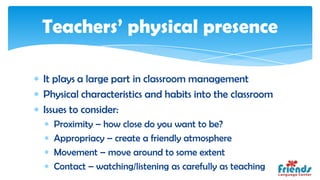
Teachers’ physical presence

It plays a large part in classroom management
Physical characteristics and habits into the classroom
Issues to consider:
  Proximity – how close do you want to be?
  Appropriacy – create a friendly atmosphere
  Movement – move around to some extent
  Contact – watching/listening as carefully as teaching
Consider your physical approach
   and personality in the class
How should teachers use their
      voices in class?
Teachers’ voice

Teacher’s most important instrument
Issues to think about:
  Audibility/Volume – everyone should hear
  Variety – vary quality and volume
  Conservation – take care of your voice
Different and varied voices

  More interesting classes
How should teachers mark
  the stages of a lesson?
Marking lesson stages

A play starts with the rise of a curtain!
Make it clear when you start and finish
Changes of direction  get the students’ attention
  clap hands / speak loudly / raise hands
Provide closure – summaries / predictions
Successful teachers promote a
    feeling of completeness
What’s the best seating
arrangement for a class?
Seating arrangement
Seating arrangement

Orderly rows
  Students and teacher can see each other
  It makes lecturing easy – eye contact
  It makes discipline easier
  The teacher can easily walk around
  It implies working with the whole class
  Keep everyone involved
Seating arrangement

Circles and horseshoes
  For smaller classes
  Teacher at the open end (horseshoe)
  Less dominating position (circle)
  The Round Table – King Arthur (equality)
  Lower the teacher-student barriers
  All students can see each other
Seating arrangement

Separate tables
  Teacher walks around monitoring and helping
  The atmosphere is less hierarchical
  Students gain more responsibility
  Consider students’ preferences
  It makes ‘whole-class’ teaching more difficult
Always consider advantages
   and disadvantages!
What different student
groupings can teachers use?
Student groupings

Whole class
  Students focus on the teacher and the task in hand
Groupwork and pairwork
  Cooperative activities / Greater independence
  Problems: students domination / disruption / use of L1
Solowork
  Students work at their own speed, as individuals
Use different class groupings for
        different activities
How can teachers evaluate
      their lessons?
Evaluating lessons

Ask students for feedback (spoken or written)
Invite a colleague into the classroom
Have a lesson recorded on film
Ask students to give suggestions periodically
Keep a record of students’ achievements
Experiment and Evaluate
Conclusions
 Session 2
Session 3
Describing Learning and Teaching
What do we know about
 language learning?
Language Learning

Children learn a language by exposure (unconsciously)
Most adults can learn a language without studying it
Children and adults share certain similarities:
  Exposure, but little production
  Motivation to communicate
  Opportunities to use the language
Natural language acquisition in the classroom (???)
What elements are necessary
  for successful language
  learning in classrooms?
Elements for successful learning

  Different kinds of exposure (classroom vs. ‘picking up’)
  Motivation, exposure and use
  Three elements (present in nearly all classes)
    ESA
      Engage
      Study
      Activate
ENGAGE

Arouse Ss’ interest, involving their emotions
Allow ‘fun’ moments that lead to better learning
Activities and materials (games, music, discussions,
stimulating pictures, dramatic stories, etc.)
Engage Ss with the topic/exercise/language
Engaged Ss learn better!
STUDY

Focus on language and how it is constructed
Different styles – Ts explain grammar, Ss discover
grammar, Ss work in groups
Examples: sound problems, 3rd person ‘s’, inviting
patterns, use of pronouns, parapraph organization,
‘make’ and ‘do’, etc.
Blend acquisition and Study activities
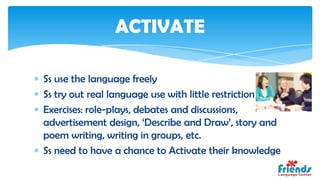
ACTIVATE

Ss use the language freely
Ss try out real language use with little restriction
Exercises: role-plays, debates and discussions,
advertisement design, ‘Describe and Draw’, story and
poem writing, writing in groups, etc.
Ss need to have a chance to Activate their knowledge
The ESA elements need to be
    present in most lessons
How do the three elements of
  ESA fit together in lesson
          sequences?
ESA Lesson Sequences

Straight Arrows:
  Engage – Modern robots. Actions. Like them? Why (not)?
  Study – Particular robot. ‘can’ / ‘can’t’. Pronunciation.
  Grammar.
  Activate – Groups design a robot. Presentation.
Straight Arrows

 ESA


 Engage                    Study   Activate
Straight Arrows Sequence
Straight Arrows

It works for certain structures
It doesn’t work for all learning styles
It works better for lower levels
It’s not appropriate for more advanced levels
ESA Lesson Sequences

Boomerang:
 Engage – Discussion on job interviews. Ss get interested.
 Activate – T describes an interview situation. Ss plan
 questions. Ss role-play the interviews. T monitors.
 Study – T works on troubles. Comparison for discovery.
 Controlled practice.
 Activate – Ss role-play another job interview.
Boomerang

  EAS(A)
                         1


 Engage                Study       Activate
Boomerang Sequence             2   3
Boomerang

Ts answer the needs of Ss
Show Ss they have a need to use language
Transparency – what Ss need/what they are taught
Ts need to find good material based on the problems
More appropriate for intermediate/advanced Ss
ESA Lesson Sequences
Patchwork:
  Engage – Picture of sunbathers. Comments.
  Activate – Ss act out a dialogue: doctor – sunburn victim.
  Activate – Text on different people and effect the sun has on their skin. Ss
  say how they feel about it.
  Study – Vocabulary and pronunciation.
  Activate – Ss describe themselves as in the text.
  Study – Relative clause (I’m the type of person who...). Ss practice.
  Engage – T discusses advertisements.
  Activate – Ss write a radio commercial for a sunscreen. Ss record.
Patchwork
EAASASEA                  1
  (etc.)
                     6           4


  Engage                 Study           Activate
                                     3              2
                                 5
Patchwork Sequence        7
Patchwork

Very common at intermediate/advanced levels
Reflection of the way we learn
Balance between Study and Activation
Balance between language and topic
Flexibility
What teaching models
have influenced current
  teaching practice?
Teaching Models

Grammar-translation – grammar analysis
Audio-lingualism – habit formation
PPP – straight arrows sequence
TBL – emphasis on the task – boomerang sequence
CLT – functions and exposure – patchwork sequence
Promote students’ success by
   using the ESA elements in
different and varied sequences
Conclusions
 Session 3
Session 4
Describing language
Sentence constructions

Subject, Object, Verb, Complement and Adverbial
Complements (be, seem, look etc.) – relates to subject:
  She seems happy. / They are Irish. / He looks tired.
Subject + Verb (+ Object):
  He laughed. (intransitive) / He read the book. (transitive)
Objects (direct and indirect)
  She sang a song. (DO) / She sang me a song. (IO)
Sentence constructions

Adverbial (phrases) – complement the verb:
  He lived in Paris. (place)
  They arrived late / at night. (time)
  She sings beautifully / like an angel. (manner)
Multi-clause sentences:
  The girl met the woman who was standing at the canal
  and they went to a café and had a meal, which they
  enjoyed very much.
Parts of speech
Parts of speech
Nouns
Verbs
Adjectives
Adverbs
Determiners
Prepositions
Pronouns
Conjunctions
Exclamations
Noun types
Countable and uncountable
  Weather, doubt, money, people, friends, coins, etc.
Plural nouns, singular verbs
  Darts is a popular game. / The news is depressing.
Collective nouns
  Familly, team, government (either singular or plural)
Compound nouns
  Walking stick, city hall, boyfriend, etc.
Noun phrases
  The man with the hat... / The girls I met last night...
Verb types

Auxiliary verbs and Modal auxiliary verbs
  be, do, have
  shall, should, will, would, can, could, may, might, must, ought
Main verbs – main meaning
Phrasal verbs – verb + adverb and/or preposition
  run over, put off, take after, get away with, put up with, etc.
Verb forms

  Present / Past / Simple / Continuous (Progressive)
                       simple                     continuous
present   Mr. D’Arcy is in the hall.   What’s happening?
          I love it here.              I’m not listening.
past      She said goodbye.            He was waiting at the gate.
          She cried.                   They were listening to the radio.
          She bought a new phone.
Verb forms

Form and meaning
 What are you doing tomorrow?
 I arrive at the house and knock on the door... (storytelling)
Verb forms

          Perfect verbs
                         simple                                 continuous
present     I have read Othello.                 I’ve been reading Othello.
            They haven’t arrived yet.            They haven’t been traveling for long.
past        He had studied English as a child.   She’d been living in Argentina for years.
            She hadn’t talked to him before.     They hadn’t been talking for more than
                                                 a minute when...
Verb forms

Participles
  Present – taking, talking, happening, going, etc.
  Past – taken, talked, happened, gone, etc.
Regular and irregular verbs
  Regular – talked, happened, laughed, etc.
  Irregular – ran, went, bought, saw, etc.
Verb forms

Active and passive
  A scene of utter chaos confronted her.
  She was confronted by a scene of utter chaos.
Verb complementation
  (to +) infinitive – I can swim. / I like to swim (2 possibilities)
  Participle – I enjoy running.
  ‘that’ – She suggested that I trained as a teacher.
Pronouns

   Personal pronouns
       subject          object        reflexive            possessive
I                me              myself           mine
you              you             yourself         yours
he               him             himself          his
she              her             herself          hers
it               it              itself           its
we               us              ourselves        ours
you              you             yourselves       yours
they             them            themselves       theirs
Pronouns

Relative pronouns (who, whose, where, which, that)
  The man who walked into my office was tall and blond.
  She gave me a pen that I still use.
  That’s the school where I taught my first class.
  That’s the woman whose courage saved her child.
  The saxophone is the instrument which makes the nicest
  sound.
Adjectives

Comparative and superlative
  -(i)er/-(i)est; more/most; irregular
          adjective       comparative             superlative
    good               better                 best
    big                bigger                 biggest
    nice               nicer                  nicest
    young              younger                youngest
    silly              sillier                silliest
    clever             cleverer/more clever   cleverest/most clever
    interesting        more interesting       most interesting
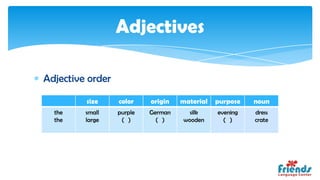
Adjectives

Adjective order

         size     color    origin   material   purpose   noun
  the    small    purple   German     silk     evening   dress
  the    large     ( )       ( )    wooden       ( )     crate
Adverbs

Time – early, late, yesterday morning
Manner – well, quickly, fiercely
Place – upstairs, in Cambridge, in hell

Adverb position – usually at the end of sentences
Modifying adverbs – a wonderfully physical performance,
an unusually large cucumber, a really fascinating film
Prepositions
At, in, on, for, of, with, etc.
Usually before nouns or at the end of a clause
  The book’s on the shelf.
  It’s not something I’m very interested in.
Particular prepositions
  anxious about, dream about/of, good at, depend on...
Prepositions and adverbs
  She climbed down the ladder. (P) / She sat down. (A)
Articles

Determiners – the, a, an, this, that, these, those, some, all of
Definite article – the
Indefinite article – a/an
Conjunctions and conditionals

 Conjunctions join two clauses (and, but, so, because...)
   Nicky said goodnight and walked out of the house.
 Conditional sentences (if)
   Present, Past and Future
   Real and hypothetical
   First, Second and Third
Conjunctions and conditionals

                            real                      hypothetical
Talking about   If you pay by cash, you get   If I had a dog, I’d take it for
the present     a discount.                   walks.
Talking about   If you work hard, you’ll      If I won the lottery, I’d
the future      pass the exam.                travel around the world.
Talking about   If it was very warm, we ate   If I’d known about the rail
the past        outside.                      strike, I would have come
                                              by car.
Forms and Meanings
Forms and meanings

One form, many meanings
  book, beat, can, I’m talking to the president
One meaning, many forms
  I’ll see you tomorrow. / I’m going to win the race. / I can get to
  you by tomorrow evening. / He arrives at home on Sunday.
  intelligent, bright, brainy, clever, smart, etc.
FORM   MEANING
Language Functions
Language Functions

Purpose you wish to achieve
  Inviting
  Apologizing
  Agreeing
  Giving advice
  Asking for information, etc.
Students need to know how to
      perform functions!
Words together: collocation
Collocation

‘How was your lesson?’ ‘A complete disaster!’
  ‘A total disaster!’ / ‘An utter disaster!’
  ‘A full disaster!’ / ‘A whole disaster!’
Common/good sense, but not bad sense
Making the bed, but not making the housework
Speaking and Writing
Pronunciation
Pronunciation

Sounds (phonemes)
Stress – different symbols
Pitch – the level at which you speak
Intonation – the music of speech
Conclusions
 Session 4
Session 5
Teaching language
What does language
 study consist of?
Language study

Students need to:
  Be exposed to the language
  Understand its meaning
  Understand its form (how it is constructed)
  Practice it
How should we expose
students to language?
Exposure

Example 1: ‘It’s a pen’ (complete beginners)
Example 2: invitations (elementary)
Example 3: comparatives (lower intermediate)
Example 4: ‘protection’ (upper intermediate)
How can we help students to
  understand meaning?
Understanding meaning

Example 1: ‘It’s a pen’ (complete beginners)
Example 2: invitations (elementary)
Example 3: comparatives (lower intermediate)
Example 4: ‘protection’ (upper intermediate)
How can we help students to
understand language form?
Understanding language form

 Example 1: ‘It’s a pen’ (complete beginners)
 Example 2: invitations (elementary)
 Example 3: comparatives (lower intermediate)
 Example 4: ‘protection’ (upper intermediate)
How should students
practice language?
Practicing language

Example 1: ‘It’s a pen’ (complete beginners)
Example 2: invitations (elementary)
Example 3: comparatives (lower intermediate)
Example 4: ‘protection’ (upper intermediate)
Why do students make
     mistakes?
Making mistakes

Part of learning
Interference from L1 – ‘false friends’ (assist, pretend, lunch)
Grammar issues (article usage, word order)
Developmental errors – ‘I have to go’ / ‘I must to go’
Mistakes – errors / slips
All students make mistakes as a
natural and useful way of learning.
How should teachers
 correct students?
Correcting students

It is a vital part of the teacher’s role
Carefulness, sensitivity and appropriacy
See if Ss can correct themselves
Ask a colleague to help
Example
Where do language study
 activities fit in teaching
        sequences?
Study activities

Example 1: ‘It’s a pen’ (complete beginners)
Example 2: invitations (elementary)
Example 3: comparatives (lower intermediate)
Example 4: ‘protection’ (upper intermediate)
Conclusions
 Session 5
Session 6
Reading and Writing
Why teach reading?
Why teach reading?

Careers, study purposes, pleasure
Good exposure to English
Good models for English writing
Opportunities to study language
What kind of reading should
       students do?
Kinds of reading

Authenticity
Balance real English and Ss’ capabilities and interests
Consider topics and types of reading
Who are the students?
What reading skills should
   students acquire?
Reading Skills

Scanning – particular information
Skimming – general idea
Reading for pleasure
Reading for detailed comprehension
What are the principles
behind the teaching of
      reading?
Principles

1. Reading is not a passive skill.
2. Ss need to be engaged with what they’re reading.
3. Ss should be encouraged to respond to the content of a
   reading text, not just to the language.
4. Prediction is a major factor in reading.
5. Match the task to the topic.
6. Good teachers exploit reading texts to the full.
What do reading sequences
        look like?
Why teach writing?
Why teach writing?

Reinforcement – visual demonstration of language
Language development – it helps us to learn
Learning style – produce language more slowly
Writing as a skill – teacher’s job!
What kind of writing should
       students do?
Kinds of writing

Consider Ss’ age, interests and level.
Make sure Ss have enough language
Common everyday styles
Consider usefulness and enjoyability for mixed groups
Motivation should ALWAYS be present!
What do writing sequences
       look like?
How should teachers
  correct writing?
Correcting writing

Red ink, underlinings and crossings-out?
Demotivating effect
Balance accuracy/truth and sensitivity/sympathy
Avoid ‘over-correction’:
  Correct specific mistakes (pronunciation, grammar, etc.)
  Use a correction code
Always write a comment at the end
Correcting writing

Two last points:
  Correcting is important, but time-consuming
  Ensure Ss understand the problem and encourage re-writing
What can be done about
    handwriting?
Handwriting

Personal matter – reflects character
Word processors – less motivation to write
Insist on neatness and legibility
How does writing fit into ESA?
Conclusions
 Session 6
Session 7
Speaking and Listening
What kind of speaking should
        students do?
What kind of speaking?

Activate exercises
Ss using any and all the language
There should be a task to complete
Ss should want to complete the task
Why encourage students to do
      speaking tasks?
Encouraging students

Rehearsal
  Ss ‘get the feel’ of what communicating really feels like
Feedback
  Ts see how well/badly their class is doing
  Ss see how easy/difficult a speaking task is
Engagement
  Activities can and should be highly motivating
What do speaking activities
        look like?
How should teachers correct
       speaking?
Correcting speaking

Correction is different during an Activate exercise.
Constant interruption ‘destroys’ the purpose of the activity.
Watch and listen, note things down
Ask for Ss’ opinions, then give feedback
Make the mistakes impersonal
What else should teachers do
during a speaking activity?
What else?

Get involved, but don’t dominate!
Intervene when necessary
Prompting is often necessary
Consider sympathy and sensitivity!
How do speaking activities fit
         into ESA ?
Why teach listening?

Hear different varieties and accents
Ts should judge the number of varieties
Treat English as a global language
Recordings expose Ss to spoken English
The more Ss do it, the better they become!
What kind of listening should
       students do?
Kinds of listening

Authentic / Realistic material
Consider engagement and motivation
Consider Ss’ age, level and interest
Different kinds of recordings
  Announcements, conversations, telephone exchanges, lectures,
  ‘plays’, news broadcasts, interviews, radio programs, stories
  read aloud etc.
What’s special about listening?
Listening

The same speed for everybody (panic!)
Encourage ‘general understanding’ first
Unique features of spoken language
  Incomplete utterances (Dinner?)
  Repetitions (I know, I know what you’re talking about.)
  Hesitations (Yes, well, uhm, yes, possibly, but, er...)
Ensure that Ss are well prepared
What are the principles behind
  the teaching of listening?
Principles

1. The CD player is just as important as the CD.
2. Preparation is vital.
3. Once will not be enough.
4. Ss should be encouraged to respond to the content of a
   listening, not just to the language.
5. Different listening stages demand different listening tasks.
6. Good teachers exploit listening texts to the full.
What do listening sequences
        look like?
Where does video fit in?
Video

Consider age, level, interest, task difficulty and motivation.
Video is richer – speakers can be seen (body language)
Watching videos is not an excuse for TV watching!
  Play the video without sound
  Play the video but cover the picture
  Freeze the picture
  Divide the class in half
Conclusions
 Session 7
Session 8
Using coursebooks
What are the different options
    for coursebook use?
Coursebook use

Consider language, content and sequencing.
Four alternatives:
  Omit – inappropriacy problems
  Replace – interest and appropriacy
  Add – extend Ss’ engagement
  Adapt – teacher’s style
So why use coursebooks at all?
How should teachers choose
      coursebooks?
Teacher Training Course

Teacher Training Course

  • 1.
  • 2.
  • 3.
    What makes agood teacher?
  • 4.
    A good teacher Abilityto give interesting classes Use (the full range of) their personality Desire to empathize with students Treat all students equally Correct without offending Know students’ names
  • 5.
  • 6.
    How should teachers talk to students?
  • 7.
    Teacher Talk Interaction crucial skill ‘Rough-tune’ the language Empathy Physical movement
  • 8.
  • 9.
    How should teachers give instructions?
  • 10.
    Giving instructions Rules: As simple as possible Logical Check students have understood a student explains the activity someone shows how it works a student translates
  • 11.
  • 12.
    Who should talkin class?
  • 13.
    TTT and STT MaximizeSTT and minimize TTT Good TTT – comprehensible input Language acquisition – TTT works! Common sense and experience
  • 14.
  • 15.
    What are thebest kinds of lesson?
  • 16.
    Best lessons Predictable classes Student boredom Teachers need to violate their behavior patterns Starting point for student involvement Different tasks during a lesson Variety Anarchy
  • 17.
  • 18.
    How important isit to follow a pre-arranged plan?
  • 19.
    Pre-arranged plan Variety withflexibility ‘Abandon the plan’ React quickly to unplanned events Plans are only prototypes
  • 20.
  • 21.
    Why is itdifficult to describe a good learner?
  • 22.
    Good learners Students bringunique personalities ‘Practice makes perfect’ – Does it? Doing homework – best student?
  • 23.
  • 24.
    How important isthe students’ motivation?
  • 25.
    Students’ motivation World WarII – successful language learning experience They were highly motivated They really wanted to learn They had powerful reasons (fear of failure) Integrative vs. Instrumental motivation Teachers provoke interest and involvement Real motivation comes from within
  • 26.
    Tell me andI forget. Teach me and I remember. Involve me and I learn!
  • 27.
    Who is responsible for learning?
  • 28.
    Responsibility for learning Self-study/ Self-access center Students take responsibility for their own learning Good learners don’t wait to be taught Learning: teacher-student partnership Start gradually and encourage student autonomy Teachers should choose the right kind of task
  • 29.
  • 30.
    What characteristics dogood classroom learners share?
  • 31.
    Good learners’ characteristics Willingness to listen Willingness to experiment Willingness to ask questions Willingness to think about how to learn Willingness to accept correction
  • 32.
  • 33.
    What’s special about teaching adults?
  • 34.
    Teaching adults Longer historyof learning experience Opinions about teaching and learning More nervous of learning High degree of anxiety Can be disruptive and exhausting Life experience
  • 35.
    Teaching adults View theimportance of learning Greater attention span Few discipline problems – immediate cooperation Learning doesn’t need to be camouflaged Use entertaining and enjoyable activities
  • 36.
  • 37.
    What are thedifferent levels?
  • 38.
    Learning levels Basic distinction: Beginner Intermediate Advanced
  • 39.
    Learning levels beginners false elementary lower intermediate upper advanced beginners intermediate intermediate
  • 40.
    The CEF A1 A2 B1 B2 C1 C2 beginners false elementary lower intermediate upper advanced beginners intermediate intermediate
  • 41.
    Learning levels Beginners –success and failure are easy to see Teacher has a part in students’ success Intermediate – the plateau effect Give students more challenging tasks Advanced – clear evidence of progress Encourage students to take more responsibility
  • 42.
    How should weteach the different levels?
  • 43.
    Teaching levels Appropriacy Level oflanguage Teacher’s behavior Activities depend on students’ language level
  • 44.
  • 45.
  • 46.
  • 47.
    How should teachersuse their physical presence in class?
  • 48.
    Teachers’ physical presence Itplays a large part in classroom management Physical characteristics and habits into the classroom Issues to consider: Proximity – how close do you want to be? Appropriacy – create a friendly atmosphere Movement – move around to some extent Contact – watching/listening as carefully as teaching
  • 49.
    Consider your physicalapproach and personality in the class
  • 50.
    How should teachersuse their voices in class?
  • 51.
    Teachers’ voice Teacher’s mostimportant instrument Issues to think about: Audibility/Volume – everyone should hear Variety – vary quality and volume Conservation – take care of your voice
  • 52.
    Different and variedvoices More interesting classes
  • 53.
    How should teachersmark the stages of a lesson?
  • 54.
    Marking lesson stages Aplay starts with the rise of a curtain! Make it clear when you start and finish Changes of direction  get the students’ attention clap hands / speak loudly / raise hands Provide closure – summaries / predictions
  • 55.
    Successful teachers promotea feeling of completeness
  • 56.
    What’s the bestseating arrangement for a class?
  • 57.
  • 58.
    Seating arrangement Orderly rows Students and teacher can see each other It makes lecturing easy – eye contact It makes discipline easier The teacher can easily walk around It implies working with the whole class Keep everyone involved
  • 59.
    Seating arrangement Circles andhorseshoes For smaller classes Teacher at the open end (horseshoe) Less dominating position (circle) The Round Table – King Arthur (equality) Lower the teacher-student barriers All students can see each other
  • 60.
    Seating arrangement Separate tables Teacher walks around monitoring and helping The atmosphere is less hierarchical Students gain more responsibility Consider students’ preferences It makes ‘whole-class’ teaching more difficult
  • 61.
    Always consider advantages and disadvantages!
  • 62.
  • 63.
    Student groupings Whole class Students focus on the teacher and the task in hand Groupwork and pairwork Cooperative activities / Greater independence Problems: students domination / disruption / use of L1 Solowork Students work at their own speed, as individuals
  • 64.
    Use different classgroupings for different activities
  • 65.
    How can teachersevaluate their lessons?
  • 66.
    Evaluating lessons Ask studentsfor feedback (spoken or written) Invite a colleague into the classroom Have a lesson recorded on film Ask students to give suggestions periodically Keep a record of students’ achievements
  • 67.
  • 68.
  • 69.
  • 70.
    What do weknow about language learning?
  • 71.
    Language Learning Children learna language by exposure (unconsciously) Most adults can learn a language without studying it Children and adults share certain similarities: Exposure, but little production Motivation to communicate Opportunities to use the language Natural language acquisition in the classroom (???)
  • 72.
    What elements arenecessary for successful language learning in classrooms?
  • 73.
    Elements for successfullearning Different kinds of exposure (classroom vs. ‘picking up’) Motivation, exposure and use Three elements (present in nearly all classes) ESA Engage Study Activate
  • 74.
    ENGAGE Arouse Ss’ interest,involving their emotions Allow ‘fun’ moments that lead to better learning Activities and materials (games, music, discussions, stimulating pictures, dramatic stories, etc.) Engage Ss with the topic/exercise/language Engaged Ss learn better!
  • 75.
    STUDY Focus on languageand how it is constructed Different styles – Ts explain grammar, Ss discover grammar, Ss work in groups Examples: sound problems, 3rd person ‘s’, inviting patterns, use of pronouns, parapraph organization, ‘make’ and ‘do’, etc. Blend acquisition and Study activities
  • 76.
    ACTIVATE Ss use thelanguage freely Ss try out real language use with little restriction Exercises: role-plays, debates and discussions, advertisement design, ‘Describe and Draw’, story and poem writing, writing in groups, etc. Ss need to have a chance to Activate their knowledge
  • 77.
    The ESA elementsneed to be present in most lessons
  • 78.
    How do thethree elements of ESA fit together in lesson sequences?
  • 79.
    ESA Lesson Sequences StraightArrows: Engage – Modern robots. Actions. Like them? Why (not)? Study – Particular robot. ‘can’ / ‘can’t’. Pronunciation. Grammar. Activate – Groups design a robot. Presentation.
  • 80.
    Straight Arrows ESA Engage Study Activate Straight Arrows Sequence
  • 81.
    Straight Arrows It worksfor certain structures It doesn’t work for all learning styles It works better for lower levels It’s not appropriate for more advanced levels
  • 82.
    ESA Lesson Sequences Boomerang: Engage – Discussion on job interviews. Ss get interested. Activate – T describes an interview situation. Ss plan questions. Ss role-play the interviews. T monitors. Study – T works on troubles. Comparison for discovery. Controlled practice. Activate – Ss role-play another job interview.
  • 83.
    Boomerang EAS(A) 1 Engage Study Activate Boomerang Sequence 2 3
  • 84.
    Boomerang Ts answer theneeds of Ss Show Ss they have a need to use language Transparency – what Ss need/what they are taught Ts need to find good material based on the problems More appropriate for intermediate/advanced Ss
  • 85.
    ESA Lesson Sequences Patchwork: Engage – Picture of sunbathers. Comments. Activate – Ss act out a dialogue: doctor – sunburn victim. Activate – Text on different people and effect the sun has on their skin. Ss say how they feel about it. Study – Vocabulary and pronunciation. Activate – Ss describe themselves as in the text. Study – Relative clause (I’m the type of person who...). Ss practice. Engage – T discusses advertisements. Activate – Ss write a radio commercial for a sunscreen. Ss record.
  • 86.
    Patchwork EAASASEA 1 (etc.) 6 4 Engage Study Activate 3 2 5 Patchwork Sequence 7
  • 87.
    Patchwork Very common atintermediate/advanced levels Reflection of the way we learn Balance between Study and Activation Balance between language and topic Flexibility
  • 88.
    What teaching models haveinfluenced current teaching practice?
  • 89.
    Teaching Models Grammar-translation –grammar analysis Audio-lingualism – habit formation PPP – straight arrows sequence TBL – emphasis on the task – boomerang sequence CLT – functions and exposure – patchwork sequence
  • 90.
    Promote students’ successby using the ESA elements in different and varied sequences
  • 91.
  • 92.
  • 93.
  • 94.
    Sentence constructions Subject, Object,Verb, Complement and Adverbial Complements (be, seem, look etc.) – relates to subject: She seems happy. / They are Irish. / He looks tired. Subject + Verb (+ Object): He laughed. (intransitive) / He read the book. (transitive) Objects (direct and indirect) She sang a song. (DO) / She sang me a song. (IO)
  • 95.
    Sentence constructions Adverbial (phrases)– complement the verb: He lived in Paris. (place) They arrived late / at night. (time) She sings beautifully / like an angel. (manner) Multi-clause sentences: The girl met the woman who was standing at the canal and they went to a café and had a meal, which they enjoyed very much.
  • 96.
  • 97.
  • 98.
    Noun types Countable anduncountable Weather, doubt, money, people, friends, coins, etc. Plural nouns, singular verbs Darts is a popular game. / The news is depressing. Collective nouns Familly, team, government (either singular or plural) Compound nouns Walking stick, city hall, boyfriend, etc. Noun phrases The man with the hat... / The girls I met last night...
  • 99.
    Verb types Auxiliary verbsand Modal auxiliary verbs be, do, have shall, should, will, would, can, could, may, might, must, ought Main verbs – main meaning Phrasal verbs – verb + adverb and/or preposition run over, put off, take after, get away with, put up with, etc.
  • 100.
    Verb forms Present / Past / Simple / Continuous (Progressive) simple continuous present Mr. D’Arcy is in the hall. What’s happening? I love it here. I’m not listening. past She said goodbye. He was waiting at the gate. She cried. They were listening to the radio. She bought a new phone.
  • 101.
    Verb forms Form andmeaning What are you doing tomorrow? I arrive at the house and knock on the door... (storytelling)
  • 102.
    Verb forms Perfect verbs simple continuous present I have read Othello. I’ve been reading Othello. They haven’t arrived yet. They haven’t been traveling for long. past He had studied English as a child. She’d been living in Argentina for years. She hadn’t talked to him before. They hadn’t been talking for more than a minute when...
  • 103.
    Verb forms Participles Present – taking, talking, happening, going, etc. Past – taken, talked, happened, gone, etc. Regular and irregular verbs Regular – talked, happened, laughed, etc. Irregular – ran, went, bought, saw, etc.
  • 104.
    Verb forms Active andpassive A scene of utter chaos confronted her. She was confronted by a scene of utter chaos. Verb complementation (to +) infinitive – I can swim. / I like to swim (2 possibilities) Participle – I enjoy running. ‘that’ – She suggested that I trained as a teacher.
  • 105.
    Pronouns Personal pronouns subject object reflexive possessive I me myself mine you you yourself yours he him himself his she her herself hers it it itself its we us ourselves ours you you yourselves yours they them themselves theirs
  • 106.
    Pronouns Relative pronouns (who,whose, where, which, that) The man who walked into my office was tall and blond. She gave me a pen that I still use. That’s the school where I taught my first class. That’s the woman whose courage saved her child. The saxophone is the instrument which makes the nicest sound.
  • 107.
    Adjectives Comparative and superlative -(i)er/-(i)est; more/most; irregular adjective comparative superlative good better best big bigger biggest nice nicer nicest young younger youngest silly sillier silliest clever cleverer/more clever cleverest/most clever interesting more interesting most interesting
  • 108.
    Adjectives Adjective order size color origin material purpose noun the small purple German silk evening dress the large ( ) ( ) wooden ( ) crate
  • 109.
    Adverbs Time – early,late, yesterday morning Manner – well, quickly, fiercely Place – upstairs, in Cambridge, in hell Adverb position – usually at the end of sentences Modifying adverbs – a wonderfully physical performance, an unusually large cucumber, a really fascinating film
  • 110.
    Prepositions At, in, on,for, of, with, etc. Usually before nouns or at the end of a clause The book’s on the shelf. It’s not something I’m very interested in. Particular prepositions anxious about, dream about/of, good at, depend on... Prepositions and adverbs She climbed down the ladder. (P) / She sat down. (A)
  • 111.
    Articles Determiners – the,a, an, this, that, these, those, some, all of Definite article – the Indefinite article – a/an
  • 112.
    Conjunctions and conditionals Conjunctions join two clauses (and, but, so, because...) Nicky said goodnight and walked out of the house. Conditional sentences (if) Present, Past and Future Real and hypothetical First, Second and Third
  • 113.
    Conjunctions and conditionals real hypothetical Talking about If you pay by cash, you get If I had a dog, I’d take it for the present a discount. walks. Talking about If you work hard, you’ll If I won the lottery, I’d the future pass the exam. travel around the world. Talking about If it was very warm, we ate If I’d known about the rail the past outside. strike, I would have come by car.
  • 114.
  • 115.
    Forms and meanings Oneform, many meanings book, beat, can, I’m talking to the president One meaning, many forms I’ll see you tomorrow. / I’m going to win the race. / I can get to you by tomorrow evening. / He arrives at home on Sunday. intelligent, bright, brainy, clever, smart, etc.
  • 116.
    FORM MEANING
  • 117.
  • 118.
    Language Functions Purpose youwish to achieve Inviting Apologizing Agreeing Giving advice Asking for information, etc.
  • 119.
    Students need toknow how to perform functions!
  • 120.
  • 121.
    Collocation ‘How was yourlesson?’ ‘A complete disaster!’ ‘A total disaster!’ / ‘An utter disaster!’ ‘A full disaster!’ / ‘A whole disaster!’ Common/good sense, but not bad sense Making the bed, but not making the housework
  • 122.
  • 123.
  • 124.
    Pronunciation Sounds (phonemes) Stress –different symbols Pitch – the level at which you speak Intonation – the music of speech
  • 125.
  • 126.
  • 127.
    What does language study consist of?
  • 128.
    Language study Students needto: Be exposed to the language Understand its meaning Understand its form (how it is constructed) Practice it
  • 129.
    How should weexpose students to language?
  • 130.
    Exposure Example 1: ‘It’sa pen’ (complete beginners) Example 2: invitations (elementary) Example 3: comparatives (lower intermediate) Example 4: ‘protection’ (upper intermediate)
  • 131.
    How can wehelp students to understand meaning?
  • 132.
    Understanding meaning Example 1:‘It’s a pen’ (complete beginners) Example 2: invitations (elementary) Example 3: comparatives (lower intermediate) Example 4: ‘protection’ (upper intermediate)
  • 133.
    How can wehelp students to understand language form?
  • 134.
    Understanding language form Example 1: ‘It’s a pen’ (complete beginners) Example 2: invitations (elementary) Example 3: comparatives (lower intermediate) Example 4: ‘protection’ (upper intermediate)
  • 135.
  • 136.
    Practicing language Example 1:‘It’s a pen’ (complete beginners) Example 2: invitations (elementary) Example 3: comparatives (lower intermediate) Example 4: ‘protection’ (upper intermediate)
  • 137.
    Why do studentsmake mistakes?
  • 138.
    Making mistakes Part oflearning Interference from L1 – ‘false friends’ (assist, pretend, lunch) Grammar issues (article usage, word order) Developmental errors – ‘I have to go’ / ‘I must to go’ Mistakes – errors / slips
  • 139.
    All students makemistakes as a natural and useful way of learning.
  • 140.
    How should teachers correct students?
  • 141.
    Correcting students It isa vital part of the teacher’s role Carefulness, sensitivity and appropriacy See if Ss can correct themselves Ask a colleague to help Example
  • 142.
    Where do languagestudy activities fit in teaching sequences?
  • 143.
    Study activities Example 1:‘It’s a pen’ (complete beginners) Example 2: invitations (elementary) Example 3: comparatives (lower intermediate) Example 4: ‘protection’ (upper intermediate)
  • 144.
  • 145.
  • 146.
  • 147.
    Why teach reading? Careers,study purposes, pleasure Good exposure to English Good models for English writing Opportunities to study language
  • 148.
    What kind ofreading should students do?
  • 149.
    Kinds of reading Authenticity Balancereal English and Ss’ capabilities and interests Consider topics and types of reading Who are the students?
  • 150.
    What reading skillsshould students acquire?
  • 151.
    Reading Skills Scanning –particular information Skimming – general idea Reading for pleasure Reading for detailed comprehension
  • 152.
    What are theprinciples behind the teaching of reading?
  • 153.
    Principles 1. Reading isnot a passive skill. 2. Ss need to be engaged with what they’re reading. 3. Ss should be encouraged to respond to the content of a reading text, not just to the language. 4. Prediction is a major factor in reading. 5. Match the task to the topic. 6. Good teachers exploit reading texts to the full.
  • 154.
    What do readingsequences look like?
  • 155.
  • 156.
    Why teach writing? Reinforcement– visual demonstration of language Language development – it helps us to learn Learning style – produce language more slowly Writing as a skill – teacher’s job!
  • 157.
    What kind ofwriting should students do?
  • 158.
    Kinds of writing ConsiderSs’ age, interests and level. Make sure Ss have enough language Common everyday styles Consider usefulness and enjoyability for mixed groups Motivation should ALWAYS be present!
  • 159.
    What do writingsequences look like?
  • 160.
    How should teachers correct writing?
  • 161.
    Correcting writing Red ink,underlinings and crossings-out? Demotivating effect Balance accuracy/truth and sensitivity/sympathy Avoid ‘over-correction’: Correct specific mistakes (pronunciation, grammar, etc.) Use a correction code Always write a comment at the end
  • 162.
    Correcting writing Two lastpoints: Correcting is important, but time-consuming Ensure Ss understand the problem and encourage re-writing
  • 163.
    What can bedone about handwriting?
  • 164.
    Handwriting Personal matter –reflects character Word processors – less motivation to write Insist on neatness and legibility
  • 165.
    How does writingfit into ESA?
  • 166.
  • 167.
  • 168.
    What kind ofspeaking should students do?
  • 169.
    What kind ofspeaking? Activate exercises Ss using any and all the language There should be a task to complete Ss should want to complete the task
  • 170.
    Why encourage studentsto do speaking tasks?
  • 171.
    Encouraging students Rehearsal Ss ‘get the feel’ of what communicating really feels like Feedback Ts see how well/badly their class is doing Ss see how easy/difficult a speaking task is Engagement Activities can and should be highly motivating
  • 172.
    What do speakingactivities look like?
  • 173.
    How should teacherscorrect speaking?
  • 174.
    Correcting speaking Correction isdifferent during an Activate exercise. Constant interruption ‘destroys’ the purpose of the activity. Watch and listen, note things down Ask for Ss’ opinions, then give feedback Make the mistakes impersonal
  • 175.
    What else shouldteachers do during a speaking activity?
  • 176.
    What else? Get involved,but don’t dominate! Intervene when necessary Prompting is often necessary Consider sympathy and sensitivity!
  • 177.
    How do speakingactivities fit into ESA ?
  • 178.
  • 179.
    Why teach listening? Heardifferent varieties and accents Ts should judge the number of varieties Treat English as a global language Recordings expose Ss to spoken English The more Ss do it, the better they become!
  • 180.
    What kind oflistening should students do?
  • 181.
    Kinds of listening Authentic/ Realistic material Consider engagement and motivation Consider Ss’ age, level and interest Different kinds of recordings Announcements, conversations, telephone exchanges, lectures, ‘plays’, news broadcasts, interviews, radio programs, stories read aloud etc.
  • 182.
  • 183.
    Listening The same speedfor everybody (panic!) Encourage ‘general understanding’ first Unique features of spoken language Incomplete utterances (Dinner?) Repetitions (I know, I know what you’re talking about.) Hesitations (Yes, well, uhm, yes, possibly, but, er...) Ensure that Ss are well prepared
  • 184.
    What are theprinciples behind the teaching of listening?
  • 185.
    Principles 1. The CDplayer is just as important as the CD. 2. Preparation is vital. 3. Once will not be enough. 4. Ss should be encouraged to respond to the content of a listening, not just to the language. 5. Different listening stages demand different listening tasks. 6. Good teachers exploit listening texts to the full.
  • 186.
    What do listeningsequences look like?
  • 187.
  • 188.
    Video Consider age, level,interest, task difficulty and motivation. Video is richer – speakers can be seen (body language) Watching videos is not an excuse for TV watching! Play the video without sound Play the video but cover the picture Freeze the picture Divide the class in half
  • 189.
  • 190.
  • 191.
    What are thedifferent options for coursebook use?
  • 192.
    Coursebook use Consider language,content and sequencing. Four alternatives: Omit – inappropriacy problems Replace – interest and appropriacy Add – extend Ss’ engagement Adapt – teacher’s style
  • 193.
    So why usecoursebooks at all?
  • 194.
    How should teacherschoose coursebooks?