CLASS MANAGEMENTUNIT   ILEARNERS
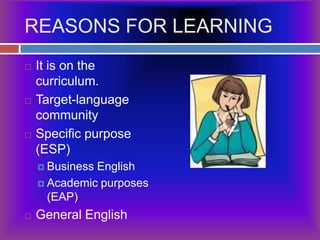
REASONS FOR LEARNINGIt is on the curriculum.Target-language communitySpecific purpose (ESP)Business EnglishAcademic purposes (EAP)General English
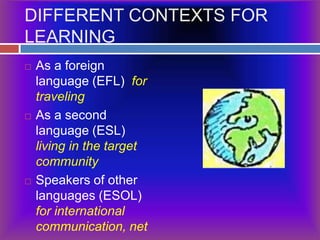
DIFFERENT CONTEXTS FOR LEARNINGAs a foreign language (EFL)  for travelingAs a second language (ESL) living in the target communitySpeakers of other languages (ESOL)  for international communication, net
…schools and language schoolsSchools as part of the curriculum. Equipment and information technology (IT).Private language schools.  Better equipped, smaller groups, student’s choice (motivation).
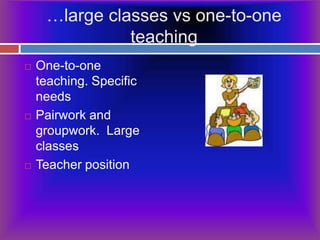
…large classes vs one-to-one teachingOne-to-one teaching. Specific needsPairwork and groupwork.  Large classesTeacher position
…in school and in companySchool policy, syllabus and curriculum decisions by responsible administrators.Expert teachers going to companies. Teacher negotiate class content.
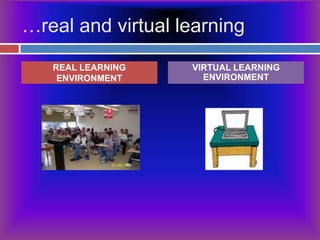
…real and virtual learningREAL LEARNING ENVIRONMENTVIRTUAL LEARNING ENVIRONMENT
LEARNER DIFFERENCESAgeChildren 2 to 14Very young  2 to 5Young learners 5 to 9Adolescents 12 to 17Young adults 16 to 20
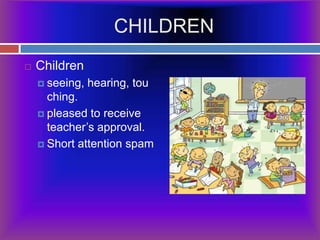
CHILDRENChildrenseeing, hearing, touching.  pleased to receive teacher’s approval.Short attention spam
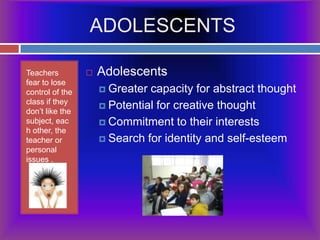
ADOLESCENTSTeachers  fear to lose control of the class if they don’t like the subject, each other, the teacher or personal issues .AdolescentsGreater capacity for abstract thoughtPotential for creative thought Commitment to their interestsSearch for identity and self-esteem
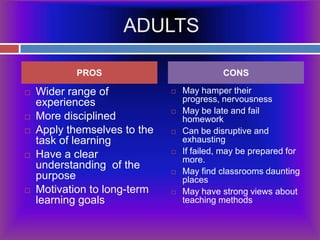
ADULTSWider range of experiencesMore disciplinedApply themselves to the task of learningHave a clear understanding  of the purpose Motivation to long-term learning goalsMay hamper their progress, nervousnessMay be late and fail homeworkCan be disruptive and exhaustingIf failed, may be prepared for more.May find classrooms daunting placesMay have strong views about teaching methodsPROSCONS
WAYS TO TEACH STUDENTSChildren: offer a greater variety of games, songs and puzzles.  Changing activities constantly.Adolescents: keep in mind the importance of a student’s place within peers.  Special care when correcting or assigning roles within an activity.  Choice of topics reflecting their interests.Adults: Focus attention on the topic, prevent problem behavior and respond appropriately if it occurs.
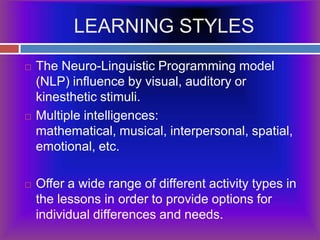
LEARNING STYLESThe Neuro-Linguistic Programming model (NLP) influence by visual, auditory or kinesthetic stimuli.Multiple intelligences: mathematical, musical, interpersonal, spatial, emotional, etc. Offer a wide range of different activity types in the lessons in order to provide options for individual differences and needs.
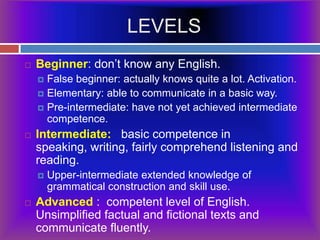
LEVELSBeginner: don’t know any English.False beginner: actually knows quite a lot. Activation.Elementary: able to communicate in a basic way.Pre-intermediate: have not yet achieved intermediate competence.Intermediate:   basic competence in speaking, writing, fairly comprehend listening and reading.Upper-intermediate extended knowledge of grammatical construction and skill use.Advanced :  competent level of English.  Unsimplified factual and fictional texts and communicate fluently.
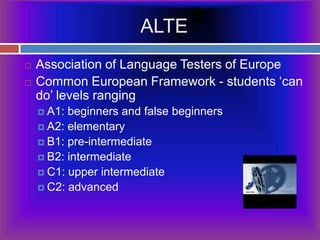
ALTEAssociation of Language Testers of EuropeCommon European Framework -students ‘can do’ levels ranging A1: beginners and false beginnersA2: elementaryB1: pre-intermediateB2: intermediateC1: upper intermediateC2: advanced
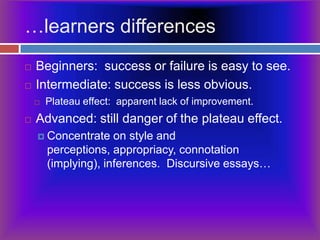
…learners differencesBeginners:  success or failure is easy to see.Intermediate: success is less obvious.Plateau effect:  apparent lack of improvement.Advanced: still danger of the plateau effect.Concentrate on style and perceptions, appropriacy, connotation (implying), inferences.  Discursive essays…
EDUCATIONAL AND CULTURAL BACKGROUNDEducational: family supportCulturalLearning by roteLearning by doingMother tongueMultilingual classesTeachers need to be sensitive and explain what and why things are done in class.  Offer a variety of techniques.
MOTIVATIONExtrinsicIntrinsicSustaining – challengeAppropriate level of challengeConsider the affect – show caringAgency – delegate responsibility
RESPONSIBILITY FOR LEARNINGLearner autonomyUsing dictionaryMonolingual learner’s dictionarSelf access centreResources comprising books, videos, listening, etc.

Class man. unit 1

  • 1.
  • 2.
    REASONS FOR LEARNINGItis on the curriculum.Target-language communitySpecific purpose (ESP)Business EnglishAcademic purposes (EAP)General English
  • 3.
    DIFFERENT CONTEXTS FORLEARNINGAs a foreign language (EFL) for travelingAs a second language (ESL) living in the target communitySpeakers of other languages (ESOL) for international communication, net
  • 4.
    …schools and languageschoolsSchools as part of the curriculum. Equipment and information technology (IT).Private language schools. Better equipped, smaller groups, student’s choice (motivation).
  • 5.
    …large classes vsone-to-one teachingOne-to-one teaching. Specific needsPairwork and groupwork. Large classesTeacher position
  • 6.
    …in school andin companySchool policy, syllabus and curriculum decisions by responsible administrators.Expert teachers going to companies. Teacher negotiate class content.
  • 7.
    …real and virtuallearningREAL LEARNING ENVIRONMENTVIRTUAL LEARNING ENVIRONMENT
  • 8.
    LEARNER DIFFERENCESAgeChildren 2to 14Very young 2 to 5Young learners 5 to 9Adolescents 12 to 17Young adults 16 to 20
  • 9.
    CHILDRENChildrenseeing, hearing, touching. pleased to receive teacher’s approval.Short attention spam
  • 10.
    ADOLESCENTSTeachers fearto lose control of the class if they don’t like the subject, each other, the teacher or personal issues .AdolescentsGreater capacity for abstract thoughtPotential for creative thought Commitment to their interestsSearch for identity and self-esteem
  • 11.
    ADULTSWider range ofexperiencesMore disciplinedApply themselves to the task of learningHave a clear understanding of the purpose Motivation to long-term learning goalsMay hamper their progress, nervousnessMay be late and fail homeworkCan be disruptive and exhaustingIf failed, may be prepared for more.May find classrooms daunting placesMay have strong views about teaching methodsPROSCONS
  • 12.
    WAYS TO TEACHSTUDENTSChildren: offer a greater variety of games, songs and puzzles. Changing activities constantly.Adolescents: keep in mind the importance of a student’s place within peers. Special care when correcting or assigning roles within an activity. Choice of topics reflecting their interests.Adults: Focus attention on the topic, prevent problem behavior and respond appropriately if it occurs.
  • 13.
    LEARNING STYLESThe Neuro-LinguisticProgramming model (NLP) influence by visual, auditory or kinesthetic stimuli.Multiple intelligences: mathematical, musical, interpersonal, spatial, emotional, etc. Offer a wide range of different activity types in the lessons in order to provide options for individual differences and needs.
  • 14.
    LEVELSBeginner: don’t knowany English.False beginner: actually knows quite a lot. Activation.Elementary: able to communicate in a basic way.Pre-intermediate: have not yet achieved intermediate competence.Intermediate: basic competence in speaking, writing, fairly comprehend listening and reading.Upper-intermediate extended knowledge of grammatical construction and skill use.Advanced : competent level of English. Unsimplified factual and fictional texts and communicate fluently.
  • 15.
    ALTEAssociation of LanguageTesters of EuropeCommon European Framework -students ‘can do’ levels ranging A1: beginners and false beginnersA2: elementaryB1: pre-intermediateB2: intermediateC1: upper intermediateC2: advanced
  • 16.
    …learners differencesBeginners: success or failure is easy to see.Intermediate: success is less obvious.Plateau effect: apparent lack of improvement.Advanced: still danger of the plateau effect.Concentrate on style and perceptions, appropriacy, connotation (implying), inferences. Discursive essays…
  • 17.
    EDUCATIONAL AND CULTURALBACKGROUNDEducational: family supportCulturalLearning by roteLearning by doingMother tongueMultilingual classesTeachers need to be sensitive and explain what and why things are done in class. Offer a variety of techniques.
  • 18.
    MOTIVATIONExtrinsicIntrinsicSustaining – challengeAppropriatelevel of challengeConsider the affect – show caringAgency – delegate responsibility
  • 19.
    RESPONSIBILITY FOR LEARNINGLearnerautonomyUsing dictionaryMonolingual learner’s dictionarSelf access centreResources comprising books, videos, listening, etc.