THE GOOD
LANGUAGE
TEACHER HUARTE AIME,
PÉREZ FLORENCIA,
YORGOVAN RAMIRO
Students’ needs
This article reports the results of
a survey designed to discover
students’ views of good and bad
language teaching
Survey
40 students of intermediate and advanced
level
Context: large mixed-ability class
Little access to expensive equipment
Examination fever is predominant
Survey
The survey took the form of:
 Interviews
 Written assignments
Students were asked to :
 recall their favourite and least favourite teachers
 say why they thought some teachers were more
successful tan others
Students’ answers
The Good Language Teacher
 Friendly
 Gave good notes
 She got close to students
 Played games
 She was forceful but not strict
 She made sure everyone
understood
 She told jokes
 She was very experienced
The Bad Language Teacher
 Very strict and rigid
 She was fixed in a chair
 Gave a lot of tests
 Distant
 Sarcastic and ironic
 Shouted when we made
mistakes
 Started the lesson immediately
 Didn’t smile
Survey’s result:
There is no formula
for
good teaching
General principles of good teachers
“Incentive value” theory in ELT
• We, as future teachers, have the responsibility of representing teaching as
a challenging intellectual enterprise
 Adherence to a formulae = enemy of incentive
 Teaching without a link to the theory = self – defeating apprentices
• No recipe for success. We have to create our own magic trick but avoid
overusing them
Possibility to generate new techniques and ideas
Teacher development
Some ways of improving one’s knowledge of ELT and thereby
increasing one’s confidence as a teacher include:
 Subscribing to ELT magazines and journals.
 Joining professional organizations and attending conferences.
 Forming local teachers’ groups to meet and discuss common
problems.
 Inviting fellow teachers to contribute lectures and workshops.
 Publishing an ELT newsletter on a local or national scale.
 Joining a special-interest group
 Arranging ELT book exhibitions
Authority, errormania and testomania
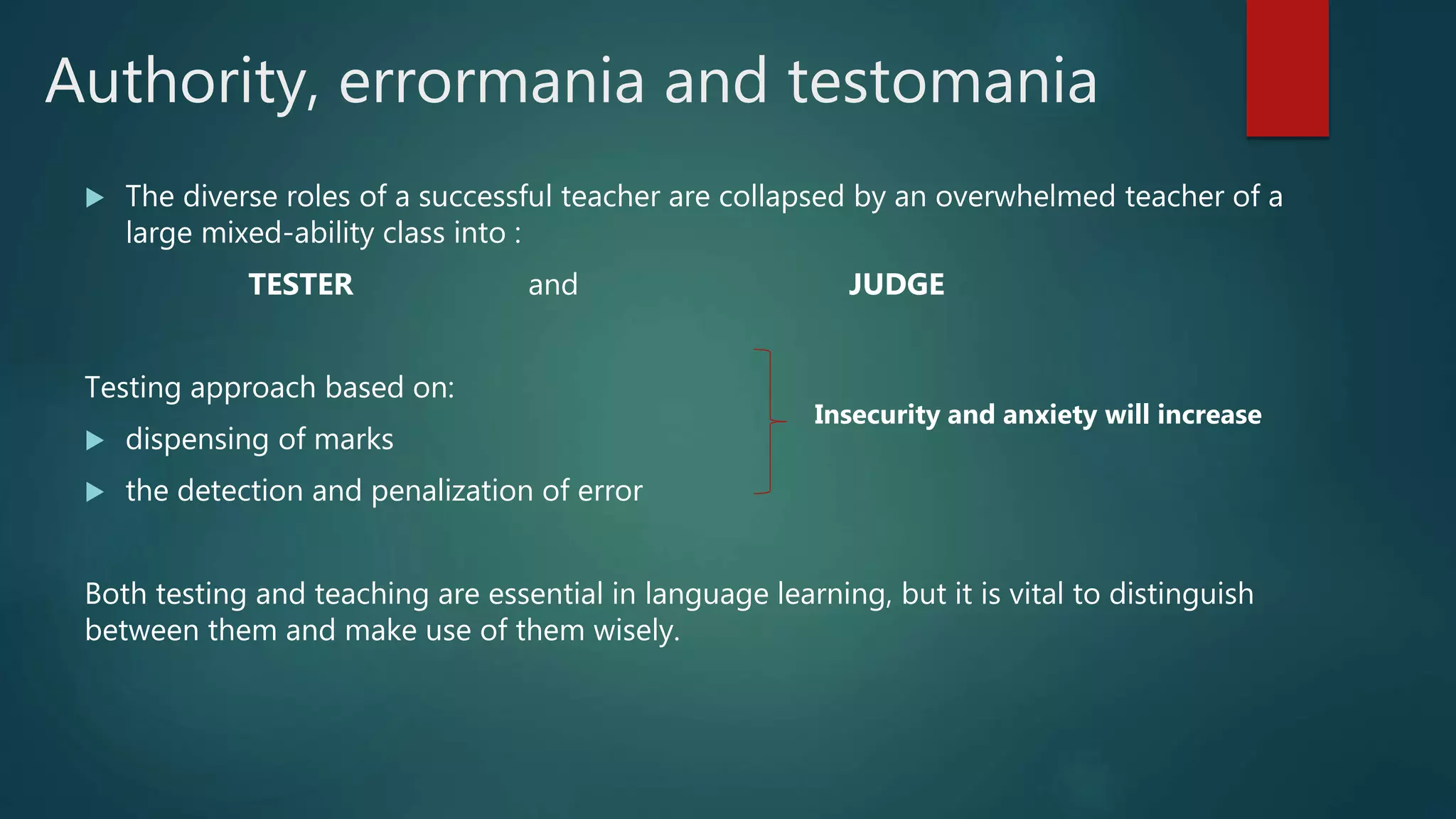
 The diverse roles of a successful teacher are collapsed by an overwhelmed teacher of a
large mixed-ability class into :
TESTER and JUDGE
Testing approach based on:
 dispensing of marks
 the detection and penalization of error
Both testing and teaching are essential in language learning, but it is vital to distinguish
between them and make use of them wisely.
Insecurity and anxiety will increase
Outer circle = roles of the teacher
 Teachers fulfill many other roles outside the professional and
pedagogic circle :
*Model for the students
*Manager
*Facilitator of learning
* Social worker, among others.
Importance of the teaching
adapting a variety of roles inside
the classroom
Not the ones found in a traditional
classroom
• Controller of activities
• Presenter of information
• Assessor of correctness or error
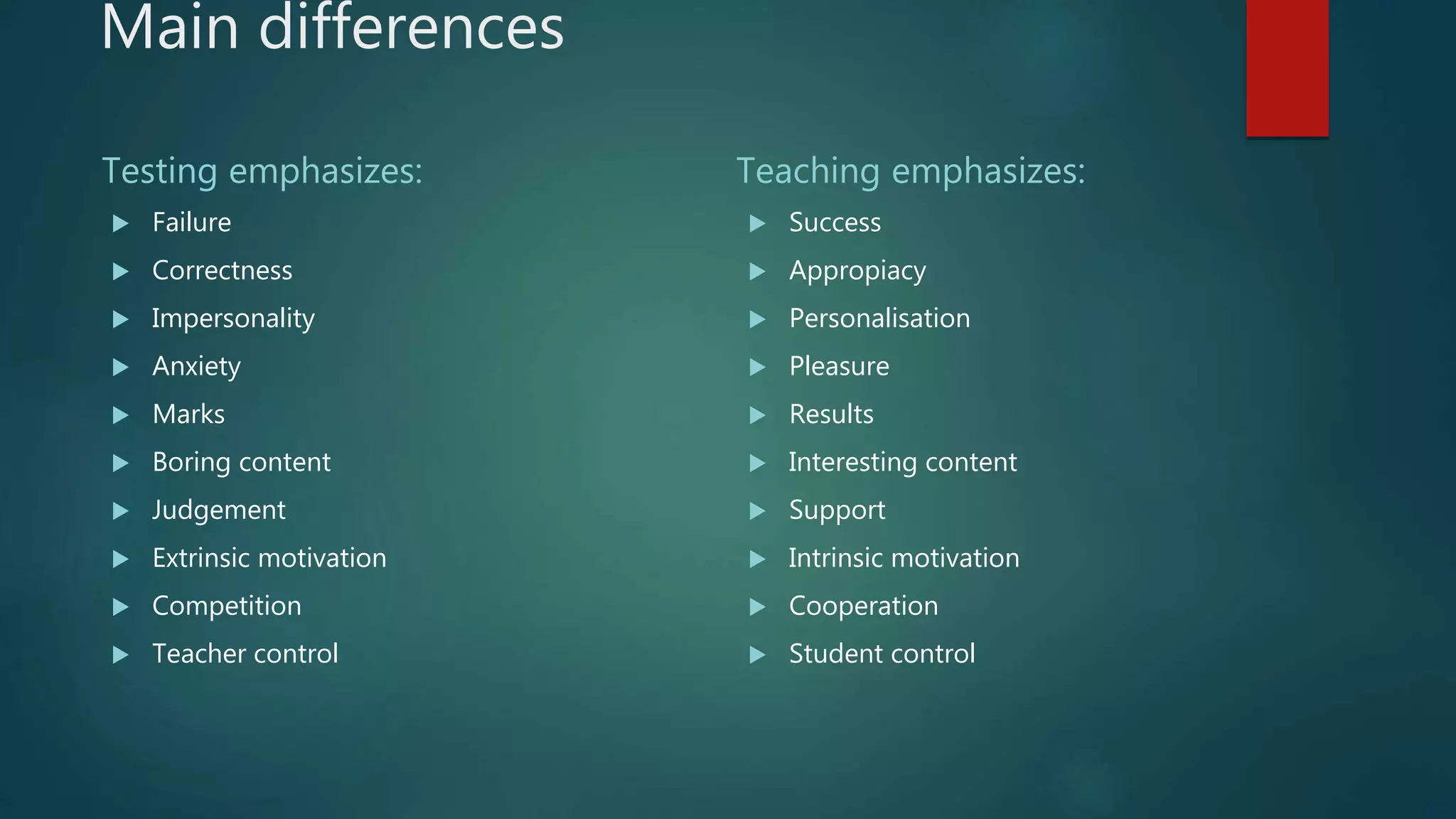
Main differences
Testing emphasizes:
 Failure
 Correctness
 Impersonality
 Anxiety
 Marks
 Boring content
 Judgement
 Extrinsic motivation
 Competition
 Teacher control
Teaching emphasizes:
 Success
 Appropiacy
 Personalisation
 Pleasure
 Results
 Interesting content
 Support
 Intrinsic motivation
 Cooperation
 Student control
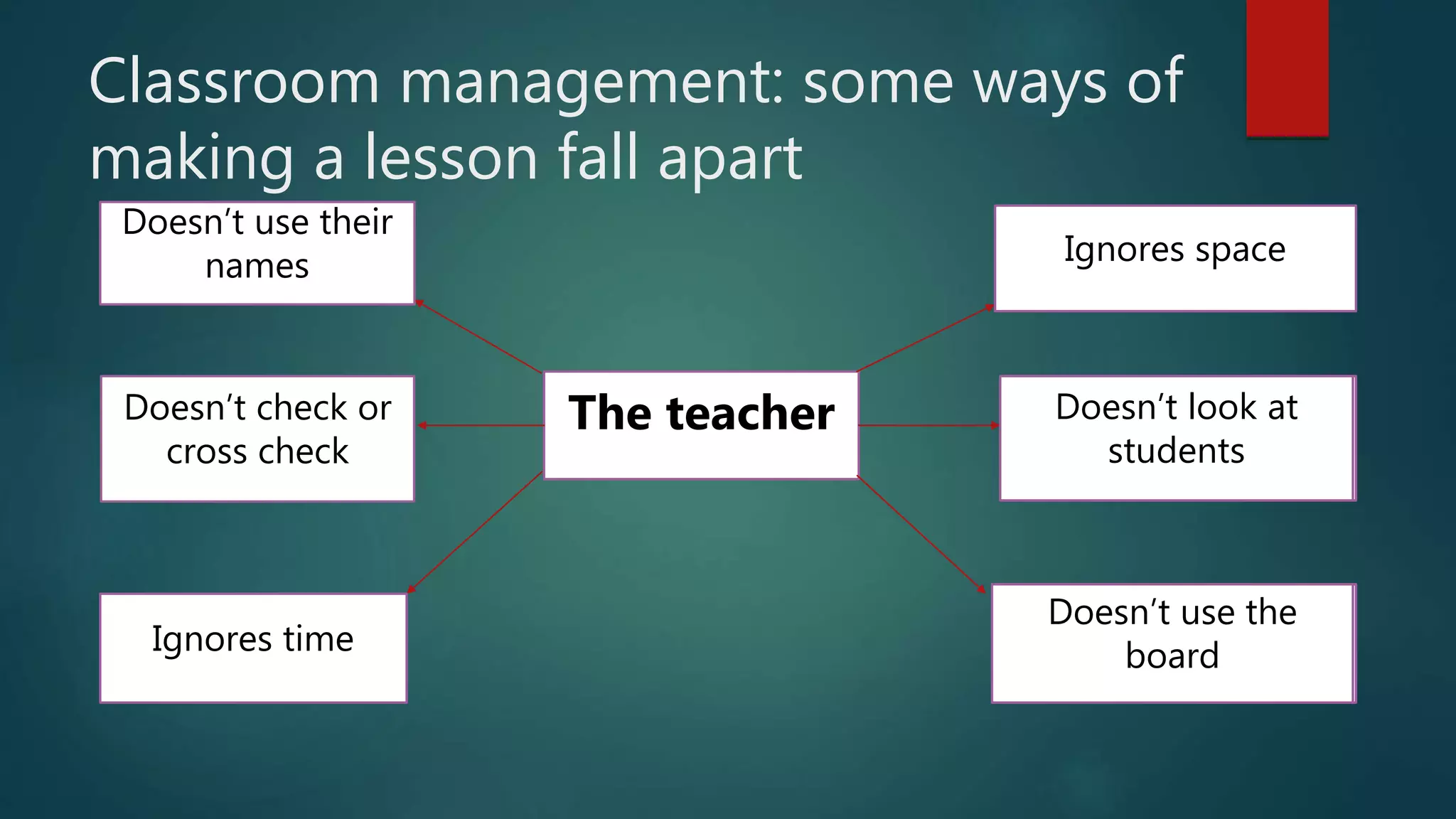
Classroom management: some ways of
making a lesson fall apart
The teacher
Doesn’t use their
names
Doesn’t check or
cross check
Ignores time
Ignores space
Doesn’t look at students
Doesn’t use the board
Doesn’t look at students
Doesn’t use the board
Doesn’t look at
students
Doesn’t use the
board
The Names. Why are they important?
Use students’ names when eliciting
and checking.
Using names makes for better
rapport with students, and involves
them directly and rapidly.
Time, friend or enemy?
 Time is very important and it can become
catastrophic if we ignore it.
 In a mixed-ability class time is particularly
significant because good learners sometimes
differ not so much in knowledge but in the pace
at which they apply that knowledge.
 Time has an important cohesive role.
Ten ways of taking time into account!
1: Don’t plan to do too much in
a lesson. Have an extra like a
joke or an anecdote before
cramming the lesson with
elaborate activities.
2:Tell students at the start of
the lesson roughly what you
intend to do and how long
it’s going to take
3:Tell students how long they
have for a particular activity
4: Warn the class one or two
minutes before an activity is
due to finish
5: Use the last few minutes to
check that learning has taken
place and to summarize what
the lesson has been all about.
6.Allow students time to copy
important information from the
board before you rub it all off,
particularly at the end of the
lesson.
7.Give ‘slower’ students time to
answer your questions or present
the results of a task before
moving on to another student.
8. Don’t wait too long for a
student to answer, as this slows
the lesson down, and it may be
difficult to pick up momentum
again.
9: If you forget your watch,
borrow one from the
students.
10: Vary the timing of relaxed
and intensive activity to build up
a sense of rhythm in the lesson,
to give it shape.
Cross-checking
 This involves checking a response given by one
student with that of other students in different
part of the classroom
 This is useful where a ‘good’ student stops
listening when a ‘less able’ student is speaking.
 Points in the lesson when this is likely to happen:
*Answering comprehension questions.
*Suggesting words to fill blanks in a text
*Reporting results of pair or group work
*Asking the teacher to explain a point of grammar or
vocabulary
*Asking the teacher to clarify instructions in a task
*Discussing a topic arising from a reading text.
Checking: The power of the Written Word
 This has a number of advantages in the mixed-ability class:
 It encourages reluctant learners to complete the task (the end-product is a
record of work done or not done)
 It discourages them from using only the mother tong as they learn to
expect a feedback phase in English.
 It gives the teacher something to discuss with early finishers if their
answers have been written down.
 When answers are written checking and cross-checking
Eye contact or Star gazing?
 Eye contact is one such detail of teacher style that
may have surprisingly significant effects.
 Try looking at the class as you are speaking, allowing
your gaze to travel gently round the class, without
staring inhibitingly at any one student.
 Look at the student who is speaking, occasionally
letting your eyes rest on another student before
coming back to the speaking student.
The Magic Board
 Use the board to record gramar, vocabulary, and content and point
students’ attention to this information when the lesson seems to be going
off the rails.
 Use the board as one way of ensuring that instructins are clear.
 Write example sentences of the target structure on the board and remind
students before the task and during it that they should be using these
structures.
 Use the board to write points made by all students as a discreet way of
emphasising the value of their contribution.
 At the end of the lesson, make sure students have copied into their
notebooks any useful information from the board.

A good language teacher Presentation

  • 1.
    THE GOOD LANGUAGE TEACHER HUARTEAIME, PÉREZ FLORENCIA, YORGOVAN RAMIRO
  • 2.
    Students’ needs This articlereports the results of a survey designed to discover students’ views of good and bad language teaching
  • 3.
    Survey 40 students ofintermediate and advanced level Context: large mixed-ability class Little access to expensive equipment Examination fever is predominant
  • 4.
    Survey The survey tookthe form of:  Interviews  Written assignments Students were asked to :  recall their favourite and least favourite teachers  say why they thought some teachers were more successful tan others
  • 5.
    Students’ answers The GoodLanguage Teacher  Friendly  Gave good notes  She got close to students  Played games  She was forceful but not strict  She made sure everyone understood  She told jokes  She was very experienced The Bad Language Teacher  Very strict and rigid  She was fixed in a chair  Gave a lot of tests  Distant  Sarcastic and ironic  Shouted when we made mistakes  Started the lesson immediately  Didn’t smile
  • 6.
    Survey’s result: There isno formula for good teaching
  • 7.
    General principles ofgood teachers
  • 8.
    “Incentive value” theoryin ELT • We, as future teachers, have the responsibility of representing teaching as a challenging intellectual enterprise  Adherence to a formulae = enemy of incentive  Teaching without a link to the theory = self – defeating apprentices • No recipe for success. We have to create our own magic trick but avoid overusing them Possibility to generate new techniques and ideas
  • 9.
    Teacher development Some waysof improving one’s knowledge of ELT and thereby increasing one’s confidence as a teacher include:  Subscribing to ELT magazines and journals.  Joining professional organizations and attending conferences.  Forming local teachers’ groups to meet and discuss common problems.  Inviting fellow teachers to contribute lectures and workshops.  Publishing an ELT newsletter on a local or national scale.  Joining a special-interest group  Arranging ELT book exhibitions
  • 10.
    Authority, errormania andtestomania  The diverse roles of a successful teacher are collapsed by an overwhelmed teacher of a large mixed-ability class into : TESTER and JUDGE Testing approach based on:  dispensing of marks  the detection and penalization of error Both testing and teaching are essential in language learning, but it is vital to distinguish between them and make use of them wisely. Insecurity and anxiety will increase
  • 11.
    Outer circle =roles of the teacher  Teachers fulfill many other roles outside the professional and pedagogic circle : *Model for the students *Manager *Facilitator of learning * Social worker, among others. Importance of the teaching adapting a variety of roles inside the classroom Not the ones found in a traditional classroom • Controller of activities • Presenter of information • Assessor of correctness or error
  • 12.
    Main differences Testing emphasizes: Failure  Correctness  Impersonality  Anxiety  Marks  Boring content  Judgement  Extrinsic motivation  Competition  Teacher control Teaching emphasizes:  Success  Appropiacy  Personalisation  Pleasure  Results  Interesting content  Support  Intrinsic motivation  Cooperation  Student control
  • 13.
    Classroom management: someways of making a lesson fall apart The teacher Doesn’t use their names Doesn’t check or cross check Ignores time Ignores space Doesn’t look at students Doesn’t use the board Doesn’t look at students Doesn’t use the board Doesn’t look at students Doesn’t use the board
  • 14.
    The Names. Whyare they important? Use students’ names when eliciting and checking. Using names makes for better rapport with students, and involves them directly and rapidly.
  • 15.
    Time, friend orenemy?  Time is very important and it can become catastrophic if we ignore it.  In a mixed-ability class time is particularly significant because good learners sometimes differ not so much in knowledge but in the pace at which they apply that knowledge.  Time has an important cohesive role.
  • 16.
    Ten ways oftaking time into account! 1: Don’t plan to do too much in a lesson. Have an extra like a joke or an anecdote before cramming the lesson with elaborate activities.
  • 17.
    2:Tell students atthe start of the lesson roughly what you intend to do and how long it’s going to take
  • 18.
    3:Tell students howlong they have for a particular activity
  • 19.
    4: Warn theclass one or two minutes before an activity is due to finish
  • 20.
    5: Use thelast few minutes to check that learning has taken place and to summarize what the lesson has been all about.
  • 21.
    6.Allow students timeto copy important information from the board before you rub it all off, particularly at the end of the lesson.
  • 22.
    7.Give ‘slower’ studentstime to answer your questions or present the results of a task before moving on to another student.
  • 23.
    8. Don’t waittoo long for a student to answer, as this slows the lesson down, and it may be difficult to pick up momentum again.
  • 24.
    9: If youforget your watch, borrow one from the students.
  • 25.
    10: Vary thetiming of relaxed and intensive activity to build up a sense of rhythm in the lesson, to give it shape.
  • 26.
    Cross-checking  This involveschecking a response given by one student with that of other students in different part of the classroom  This is useful where a ‘good’ student stops listening when a ‘less able’ student is speaking.  Points in the lesson when this is likely to happen:
  • 27.
    *Answering comprehension questions. *Suggestingwords to fill blanks in a text *Reporting results of pair or group work *Asking the teacher to explain a point of grammar or vocabulary *Asking the teacher to clarify instructions in a task *Discussing a topic arising from a reading text.
  • 28.
    Checking: The powerof the Written Word  This has a number of advantages in the mixed-ability class:  It encourages reluctant learners to complete the task (the end-product is a record of work done or not done)  It discourages them from using only the mother tong as they learn to expect a feedback phase in English.  It gives the teacher something to discuss with early finishers if their answers have been written down.  When answers are written checking and cross-checking
  • 29.
    Eye contact orStar gazing?  Eye contact is one such detail of teacher style that may have surprisingly significant effects.  Try looking at the class as you are speaking, allowing your gaze to travel gently round the class, without staring inhibitingly at any one student.  Look at the student who is speaking, occasionally letting your eyes rest on another student before coming back to the speaking student.
  • 30.
    The Magic Board Use the board to record gramar, vocabulary, and content and point students’ attention to this information when the lesson seems to be going off the rails.  Use the board as one way of ensuring that instructins are clear.  Write example sentences of the target structure on the board and remind students before the task and during it that they should be using these structures.  Use the board to write points made by all students as a discreet way of emphasising the value of their contribution.  At the end of the lesson, make sure students have copied into their notebooks any useful information from the board.