R. Raj Kumar,
Master of Education,
Department of Education,
Periyar University,
Salem - 636 011,
2013-14.
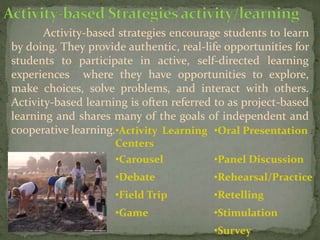
Activity-based strategies encourage students to learn
by doing. They provide authentic, real-life opportunities for
students to participate in active, self-directed learning
experiences where they have opportunities to explore,
make choices, solve problems, and interact with others.
Activity-based learning is often referred to as project-based
learning and shares many of the goals of independent and
cooperative learning.•Activity Learning
Centers
•Oral Presentation
•Carousel •Panel Discussion
•Debate •Rehearsal/Practice
•Field Trip •Retelling
•Game •Stimulation
•Survey
The study of the arts helps students to develop the
intellectual, creative, social, emotional, and physical aspects of
their lives. Arts-based strategies encourage students to
understand and appreciate a variety of the forms of music,
visual arts, drama, and dance.
Through the study of the arts and the application of arts-
based strategies to all disciplines, students learn to:
 relate their own culture to other cultures (e.g., in history and
classical studies);
 communicate using art forms (e.g., in mathematics and
science);
Cont…
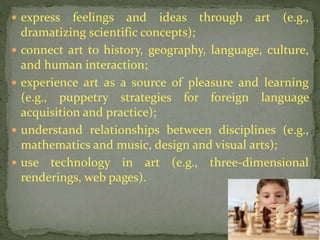
 express feelings and ideas through art (e.g.,
dramatizing scientific concepts);
 connect art to history, geography, language, culture,
and human interaction;
 experience art as a source of pleasure and learning
(e.g., puppetry strategies for foreign language
acquisition and practice);
 understand relationships between disciplines (e.g.,
mathematics and music, design and visual arts);
 use technology in art (e.g., three-dimensional
renderings, web pages).
•Ceremony •Mask Making
•Chanting •Puppetry
•Choral Reading •Reader’s Theatre
•Choreography •Role Playing
•Collage •Sketching to Learn
•Docudrama •Story Theatre
•Forum Theatre •Storyboard
•Improvisation •Tableau
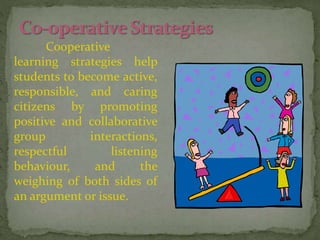
Cooperative
learning strategies help
students to become active,
responsible, and caring
citizens by promoting
positive and collaborative
group interactions,
respectful listening
behaviour, and the
weighing of both sides of
an argument or issue.
 group collaboration for positive interdependence (i.e.,
all must work together to achieve success);
 individual accountability (i.e., each individual must
contribute in order to learn);
 interpersonal skills of communication, trust, decision
making, and conflict resolution;
 face-to-face interviewing, processing, and sharing
skills;
 final reflection and debriefing to assess the
effectiveness of the process.
•Buddy System •Mentoring
•Collaborative Teaching •Number Heads
•Community Links •Peer Practice
•Conflict Resolution •Peer Teaching
•Discussion •Round Robin
•Interview •Round Table
•Jigsaw •Think/Pair/Share
•Literature Circles
Direct instruction strategies are used in a
structured environment that is directed by the
teacher/group leader. Direct instruction encompasses
a wide variety of instructional strategies that are
effective when:
 background information is required for learning;
 new knowledge and skills are introduced and/or
deled by the teacher;
 it is necessary to communicate information known
only to the teacher (for example, safety information);
 prior learning needs to be reinforced.
•Advance Organizer •Prompt
•Book Talks •Read Along
•Cloze •Read Aloud
•Conferencing •Reciprocal Teaching
•Demonstration •Review
•Directed Reading-Thinking Activities •Seminar / Tutorial
•Expository Text Frames •Socratic Dialogue
•Flash Cards •Storytelling
•Guest Speaker •Story mapping
•Guided Exploration •Task Cards
•Guided Reading •Textbooks
•Guided Writing •Visual Stimuli
•Lecture •Visualization
Independent learning strategies help students build
knowledge and skills to become self directed, motivated,
and independent learners. In order to be effective
independent learners, students must also master time-
management and self-monitoring strategies.
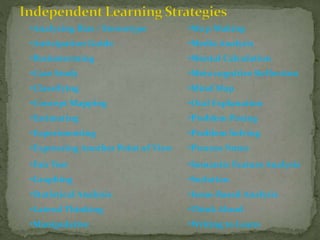
•Home Work •Note Making
•Independent Reading •Portfolio
•Independent Study •Reading Response
•Learning Contract •Reflection
•Learning Log/Journal •Report
•Memorization •Response Journal
The overall purpose of inquiry and
research for students is not just to answer a
specific question but more “to encourage high
levels of critical thinking so that processes and
resources are appropriate, conclusions are based
on supporting evidence, problems are posed and
solved, and decisions are made that will extend
learning for a lifetime” (Ontario School Library
Association, Information Studies, 2000, p. 16).
Research and inquiry models share similar stages:
 Stage 1: Preparing for Research and Inquiry
 Stage 2: Accessing Resources
 Stage 3: Processing Information
 Stage 4: Transferring Learning.
•Cognitive Skills Model •Questioning Process
•Decision – Making Models •Research Process
•Historical/Geographical Inquiry •Scientific Method
•Inquiry Process •Technical Design Process
•Mathematical Problem Solving •Writing Process
•Problem – Based Models
 Learning styles have been “…at the centre of
controversy for several decades now, and there is
still little agreement about what learning styles
really are” (Greg Gay)
 The term “learning styles” suggests that individuals
may have modalities of learning that are
distinguishable, though as Gay points out “whether
they represent learning styles or learning
differences remains to be seen.”
•Bodily-Kinesthetic
Intelligence
•Musical-Rhythmic
Intelligence
•Interpersonal
Intelligence
•Verbal-Linguistic
Intelligence
•Intrapersonal
Intelligence
•Visual-Spatial
Intelligence
•Logical-Mathematical
Intelligence
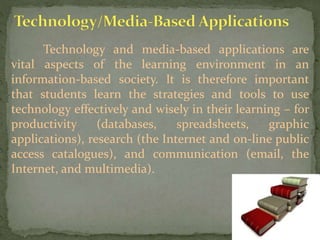
Technology and media-based applications are
vital aspects of the learning environment in an
information-based society. It is therefore important
that students learn the strategies and tools to use
technology effectively and wisely in their learning – for
productivity (databases, spreadsheets, graphic
applications), research (the Internet and on-line public
access catalogues), and communication (email, the
Internet, and multimedia).
The Ontario Curriculum: Program
Planning and Assessment, 2000, identifies the
role of technology in the curriculum as:
 assisting students to become computer literate;
 developing information literacy skills;
 assisting students to become familiar with a wide
range of software applications;
 developing the ability to critically evaluate
information;
 ensuring students use technology safely,
effectively, confidently, and ethically.
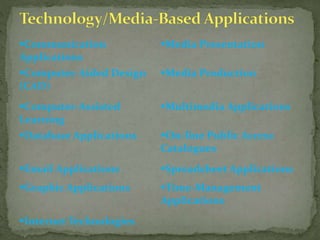
Communication
Applications
Media Presentation
Computer-Aided Design
(CAD)
Media Production
Computer-Assisted
Learning
Multimedia Applications
Database Applications On-line Public Access
Catalogues
Email Applications Spreadsheet Applications
Graphic Applications Time-Management
Applications
Internet Technologies
Thinking skill strategies develop critical thinking,
questioning skills, analytical skills, and reflective practices
in students’ approach to learning. These strategies are also
designed to foster creative and independent thinking and
learning.
Thinking skill strategies involve:
 organizational frameworks such as concept maps and
mind maps that extend the thinking processes;
 representational strategies such as graphs, maps, charts,
and visual organizers that facilitate communication and
transfer of learning to other situations;
 evaluative processes such as experimenting, fair test, and
inquiry-based research that test assumptions and
hypotheses for new learning.
•Analyzing Bias / Stereotype •Ma p Making
•Anticipation Guide •Media Analysis
•Brainstorming •Mental Calculation
•Case Study •Meta cognitive Reflection
•Classifying •Mind Map
•Concept Mapping •Oral Explanation
•Estimating •Problem Posing
•Experimenting •Problem Solving
•Expressing Another Point of View •Process Notes
•Fair Test •Semantic Feature Analysis
•Graphing •Serlation
•Statistical Analysis •Issue-Based Analysis
•Lateral Thinking •Think Aloud
•Manipulative •Writing to Learn
Teacher Learner Transaction

Teacher Learner Transaction

  • 1.
    R. Raj Kumar, Masterof Education, Department of Education, Periyar University, Salem - 636 011, 2013-14.
  • 2.
    Activity-based strategies encouragestudents to learn by doing. They provide authentic, real-life opportunities for students to participate in active, self-directed learning experiences where they have opportunities to explore, make choices, solve problems, and interact with others. Activity-based learning is often referred to as project-based learning and shares many of the goals of independent and cooperative learning.•Activity Learning Centers •Oral Presentation •Carousel •Panel Discussion •Debate •Rehearsal/Practice •Field Trip •Retelling •Game •Stimulation •Survey
  • 3.
    The study ofthe arts helps students to develop the intellectual, creative, social, emotional, and physical aspects of their lives. Arts-based strategies encourage students to understand and appreciate a variety of the forms of music, visual arts, drama, and dance. Through the study of the arts and the application of arts- based strategies to all disciplines, students learn to:  relate their own culture to other cultures (e.g., in history and classical studies);  communicate using art forms (e.g., in mathematics and science); Cont…
  • 4.
     express feelingsand ideas through art (e.g., dramatizing scientific concepts);  connect art to history, geography, language, culture, and human interaction;  experience art as a source of pleasure and learning (e.g., puppetry strategies for foreign language acquisition and practice);  understand relationships between disciplines (e.g., mathematics and music, design and visual arts);  use technology in art (e.g., three-dimensional renderings, web pages).
  • 5.
    •Ceremony •Mask Making •Chanting•Puppetry •Choral Reading •Reader’s Theatre •Choreography •Role Playing •Collage •Sketching to Learn •Docudrama •Story Theatre •Forum Theatre •Storyboard •Improvisation •Tableau
  • 6.
    Cooperative learning strategies help studentsto become active, responsible, and caring citizens by promoting positive and collaborative group interactions, respectful listening behaviour, and the weighing of both sides of an argument or issue.
  • 7.
     group collaborationfor positive interdependence (i.e., all must work together to achieve success);  individual accountability (i.e., each individual must contribute in order to learn);  interpersonal skills of communication, trust, decision making, and conflict resolution;  face-to-face interviewing, processing, and sharing skills;  final reflection and debriefing to assess the effectiveness of the process.
  • 8.
    •Buddy System •Mentoring •CollaborativeTeaching •Number Heads •Community Links •Peer Practice •Conflict Resolution •Peer Teaching •Discussion •Round Robin •Interview •Round Table •Jigsaw •Think/Pair/Share •Literature Circles
  • 9.
    Direct instruction strategiesare used in a structured environment that is directed by the teacher/group leader. Direct instruction encompasses a wide variety of instructional strategies that are effective when:  background information is required for learning;  new knowledge and skills are introduced and/or deled by the teacher;  it is necessary to communicate information known only to the teacher (for example, safety information);  prior learning needs to be reinforced.
  • 10.
    •Advance Organizer •Prompt •BookTalks •Read Along •Cloze •Read Aloud •Conferencing •Reciprocal Teaching •Demonstration •Review •Directed Reading-Thinking Activities •Seminar / Tutorial •Expository Text Frames •Socratic Dialogue •Flash Cards •Storytelling •Guest Speaker •Story mapping •Guided Exploration •Task Cards •Guided Reading •Textbooks •Guided Writing •Visual Stimuli •Lecture •Visualization
  • 11.
    Independent learning strategieshelp students build knowledge and skills to become self directed, motivated, and independent learners. In order to be effective independent learners, students must also master time- management and self-monitoring strategies. •Home Work •Note Making •Independent Reading •Portfolio •Independent Study •Reading Response •Learning Contract •Reflection •Learning Log/Journal •Report •Memorization •Response Journal
  • 12.
    The overall purposeof inquiry and research for students is not just to answer a specific question but more “to encourage high levels of critical thinking so that processes and resources are appropriate, conclusions are based on supporting evidence, problems are posed and solved, and decisions are made that will extend learning for a lifetime” (Ontario School Library Association, Information Studies, 2000, p. 16).
  • 13.
    Research and inquirymodels share similar stages:  Stage 1: Preparing for Research and Inquiry  Stage 2: Accessing Resources  Stage 3: Processing Information  Stage 4: Transferring Learning. •Cognitive Skills Model •Questioning Process •Decision – Making Models •Research Process •Historical/Geographical Inquiry •Scientific Method •Inquiry Process •Technical Design Process •Mathematical Problem Solving •Writing Process •Problem – Based Models
  • 14.
     Learning styleshave been “…at the centre of controversy for several decades now, and there is still little agreement about what learning styles really are” (Greg Gay)  The term “learning styles” suggests that individuals may have modalities of learning that are distinguishable, though as Gay points out “whether they represent learning styles or learning differences remains to be seen.”
  • 15.
  • 16.
    Technology and media-basedapplications are vital aspects of the learning environment in an information-based society. It is therefore important that students learn the strategies and tools to use technology effectively and wisely in their learning – for productivity (databases, spreadsheets, graphic applications), research (the Internet and on-line public access catalogues), and communication (email, the Internet, and multimedia).
  • 17.
    The Ontario Curriculum:Program Planning and Assessment, 2000, identifies the role of technology in the curriculum as:  assisting students to become computer literate;  developing information literacy skills;  assisting students to become familiar with a wide range of software applications;  developing the ability to critically evaluate information;  ensuring students use technology safely, effectively, confidently, and ethically.
  • 18.
    Communication Applications Media Presentation Computer-Aided Design (CAD) MediaProduction Computer-Assisted Learning Multimedia Applications Database Applications On-line Public Access Catalogues Email Applications Spreadsheet Applications Graphic Applications Time-Management Applications Internet Technologies
  • 19.
    Thinking skill strategiesdevelop critical thinking, questioning skills, analytical skills, and reflective practices in students’ approach to learning. These strategies are also designed to foster creative and independent thinking and learning. Thinking skill strategies involve:  organizational frameworks such as concept maps and mind maps that extend the thinking processes;  representational strategies such as graphs, maps, charts, and visual organizers that facilitate communication and transfer of learning to other situations;  evaluative processes such as experimenting, fair test, and inquiry-based research that test assumptions and hypotheses for new learning.
  • 20.
    •Analyzing Bias /Stereotype •Ma p Making •Anticipation Guide •Media Analysis •Brainstorming •Mental Calculation •Case Study •Meta cognitive Reflection •Classifying •Mind Map •Concept Mapping •Oral Explanation •Estimating •Problem Posing •Experimenting •Problem Solving •Expressing Another Point of View •Process Notes •Fair Test •Semantic Feature Analysis •Graphing •Serlation •Statistical Analysis •Issue-Based Analysis •Lateral Thinking •Think Aloud •Manipulative •Writing to Learn