



Teaching Strategies
Dr.. Danilo G. Baradillo
UIC
Language, Literature and
Communications Coordinator
Selecting the Appropriate Strategy
What you will need….
Curriculum Guide of the Subject
List of strategies you can use
Teaching strategies map
Selecting the Appropriate Strategy
What you will need….
Content standard
Performance standard
Learning competency
Unpacked standards
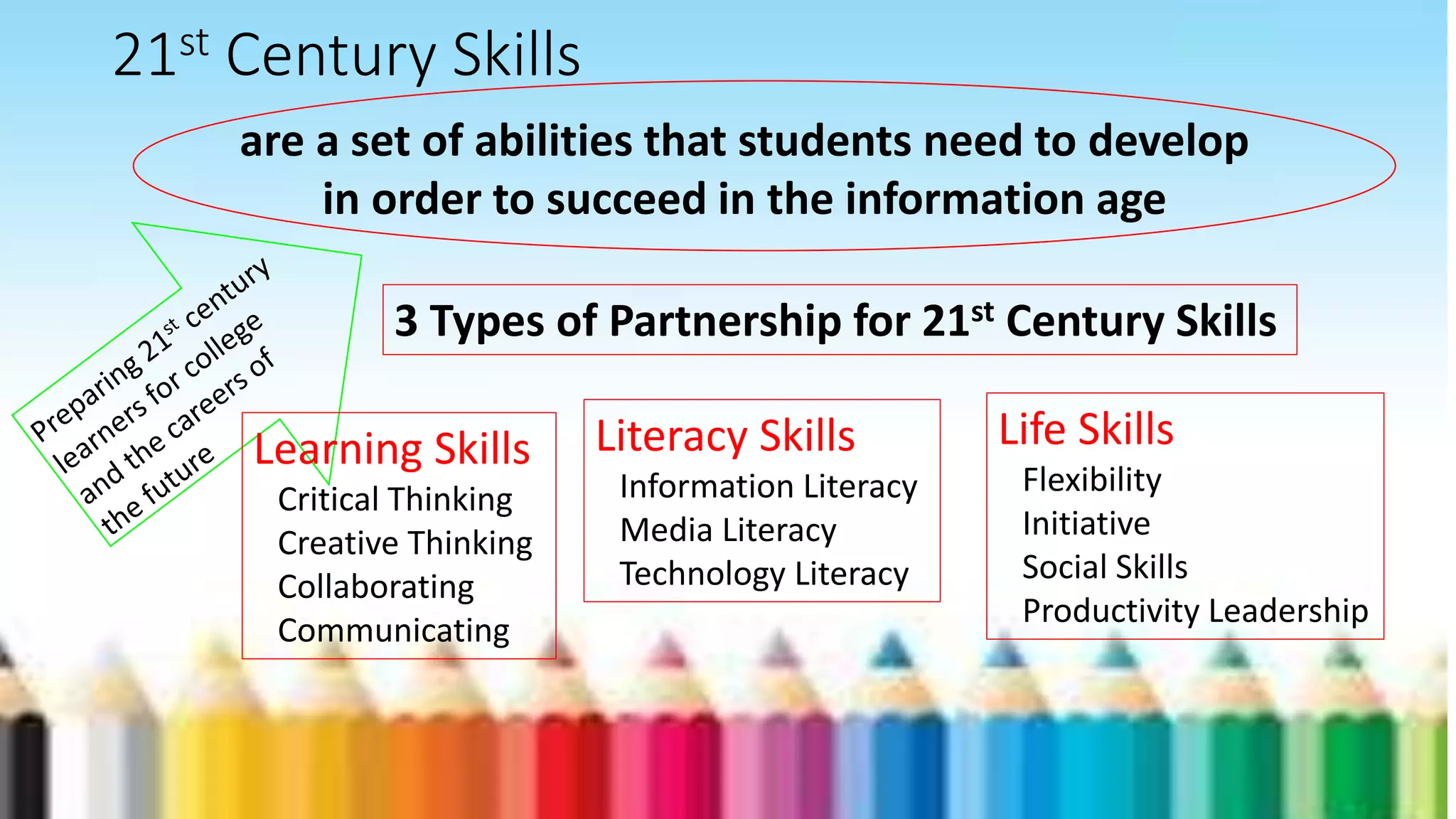
21st Century Skills
are a set of abilities that students need to develop
in order to succeed in the information age
3 Types of Partnership for 21st Century Skills
Learning Skills
Critical Thinking
Creative Thinking
Collaborating
Communicating
Literacy Skills
Information Literacy
Media Literacy
Technology Literacy
Life Skills
Flexibility
Initiative
Social Skills
Productivity Leadership
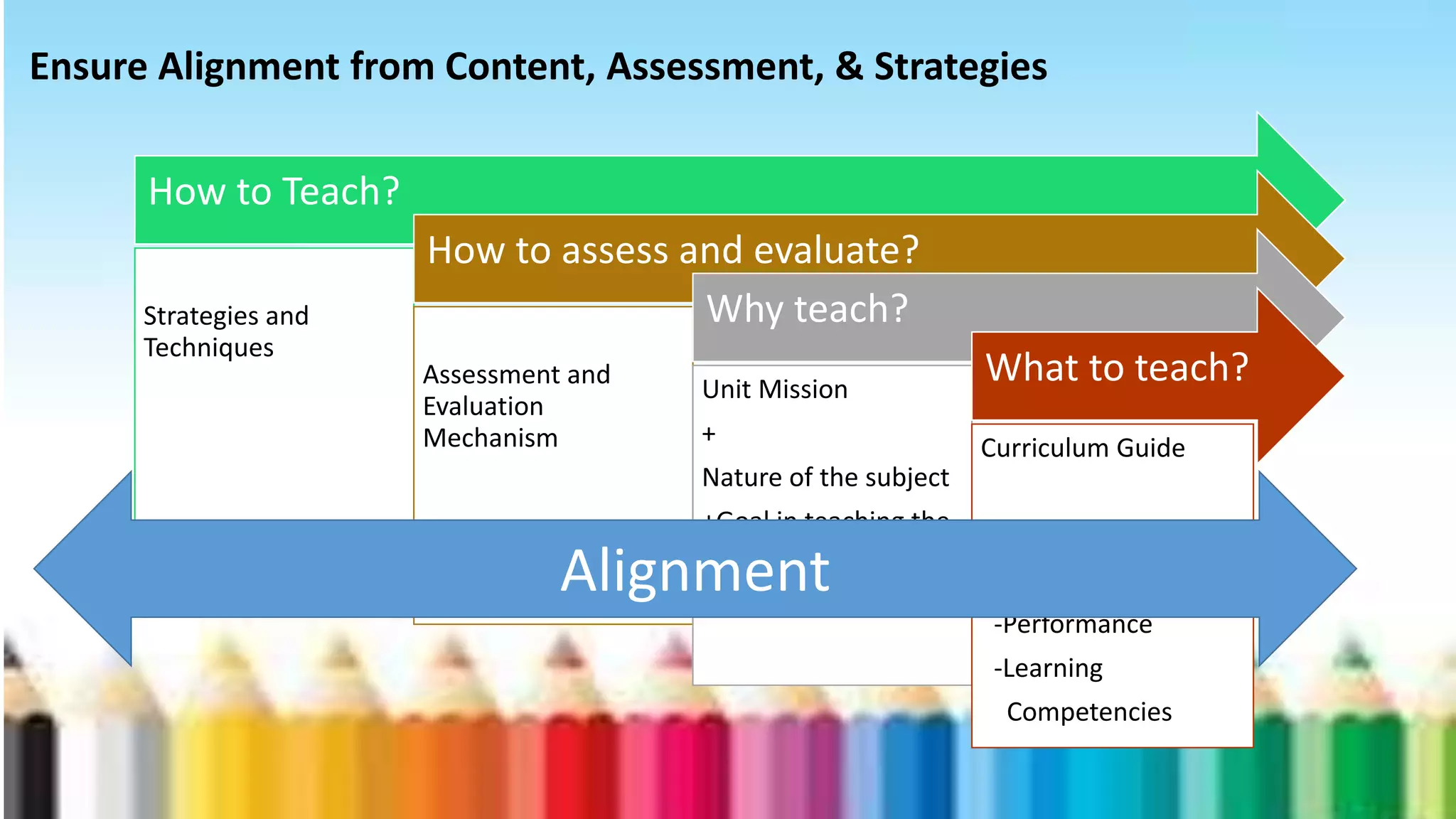
How to Teach?
Strategies and
Techniques
How to assess and evaluate?
Assessment and
Evaluation
Mechanism
Why teach?
Unit Mission
+
Nature of the subject
+Goal in teaching the
subject
What to teach?
Curriculum Guide
*Learning Standards
-Content
-Performance
-Learning
Competencies
Alignment
Ensure Alignment from Content, Assessment, & Strategies
Factors to Consider
in Choosing
a Method
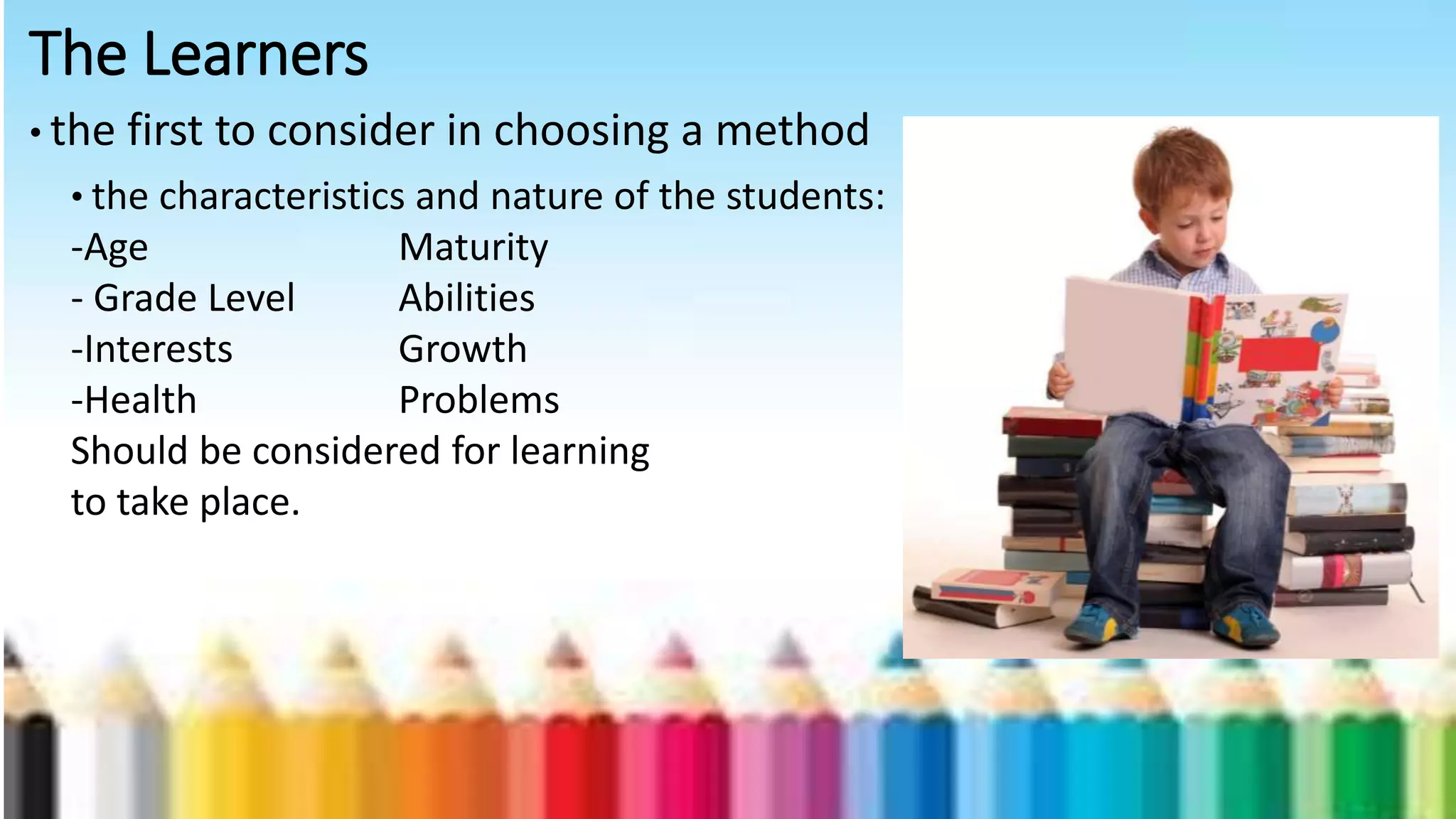
The Learners
• the first to consider in choosing a method
• the characteristics and nature of the students:
-Age Maturity
- Grade Level Abilities
-Interests Growth
-Health Problems
Should be considered for learning
to take place.
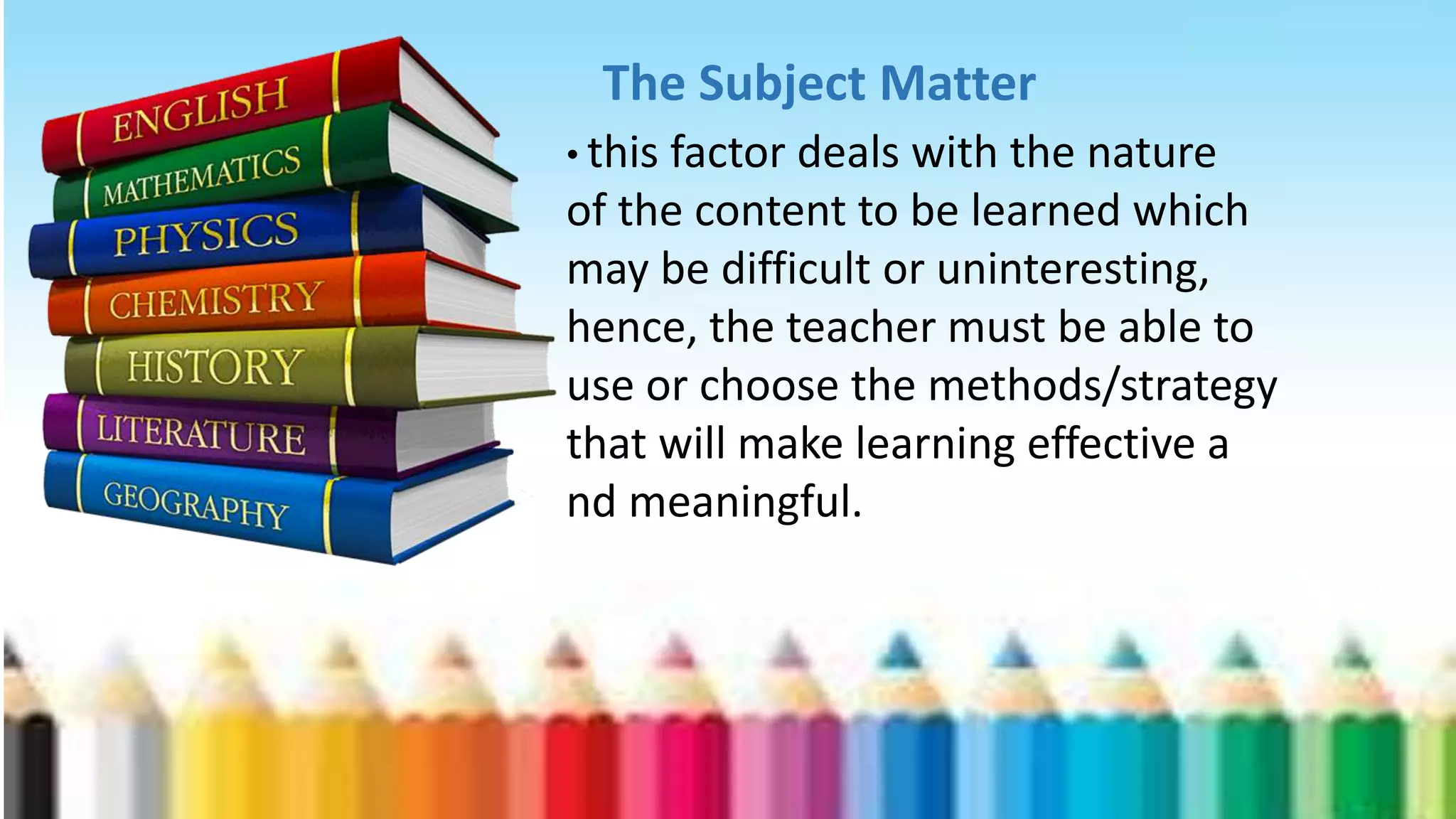
The Subject Matter
• this factor deals with the nature
of the content to be learned which
may be difficult or uninteresting,
hence, the teacher must be able to
use or choose the methods/strategy
that will make learning effective a
nd meaningful.
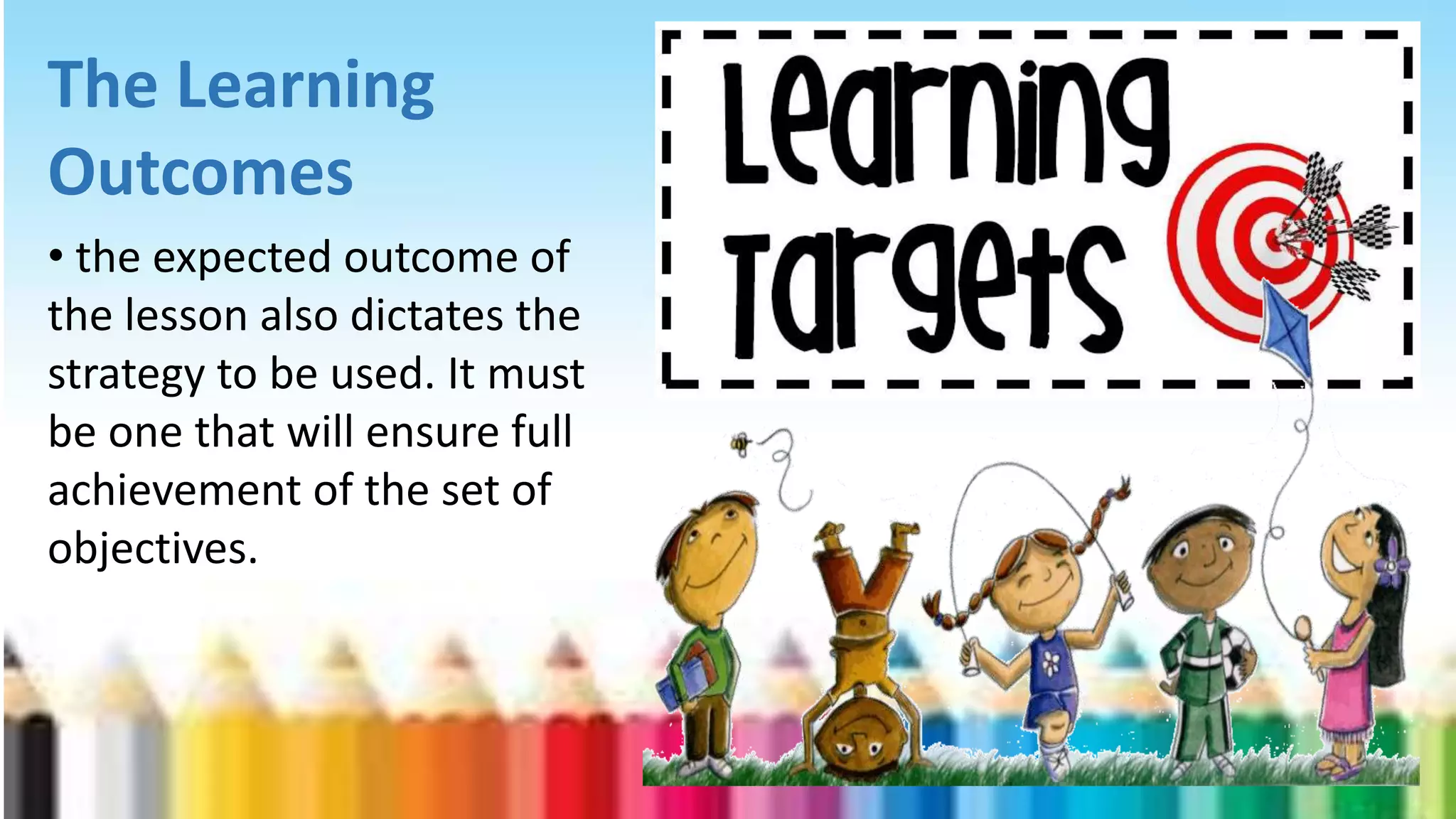
The Learning
Outcomes
• the expected outcome of
the lesson also dictates the
strategy to be used. It must
be one that will ensure full
achievement of the set of
objectives.
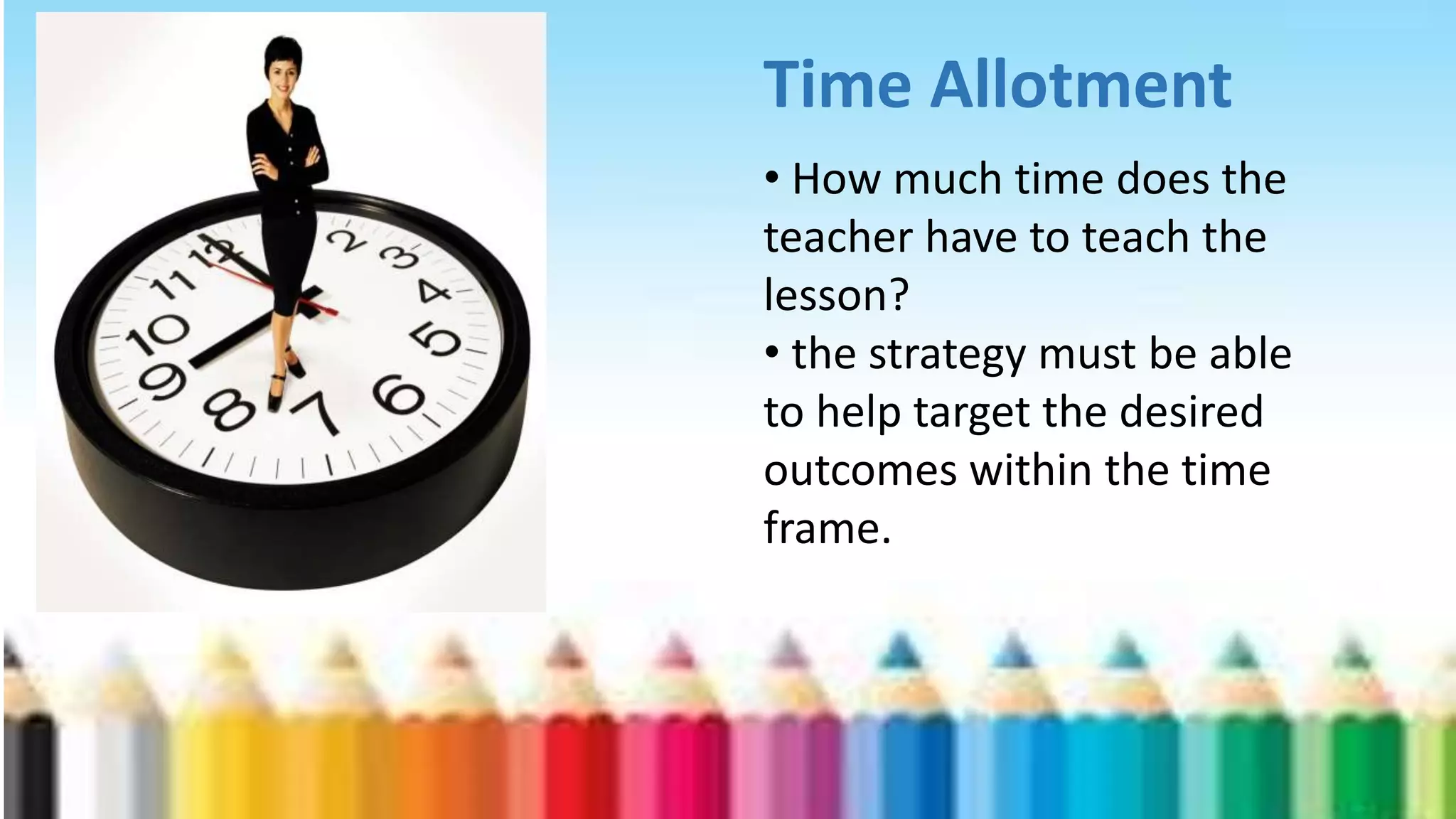
Time Allotment
• How much time does the
teacher have to teach the
lesson?
• the strategy must be able
to help target the desired
outcomes within the time
frame.
The Teacher
• the teacher’s style and academic
preparation, skills, interests, and
abilities are also points of
consideration.
• it is important that he/she could
effectively execute the method/
strategy of his/her choice to ensure
success in learning.
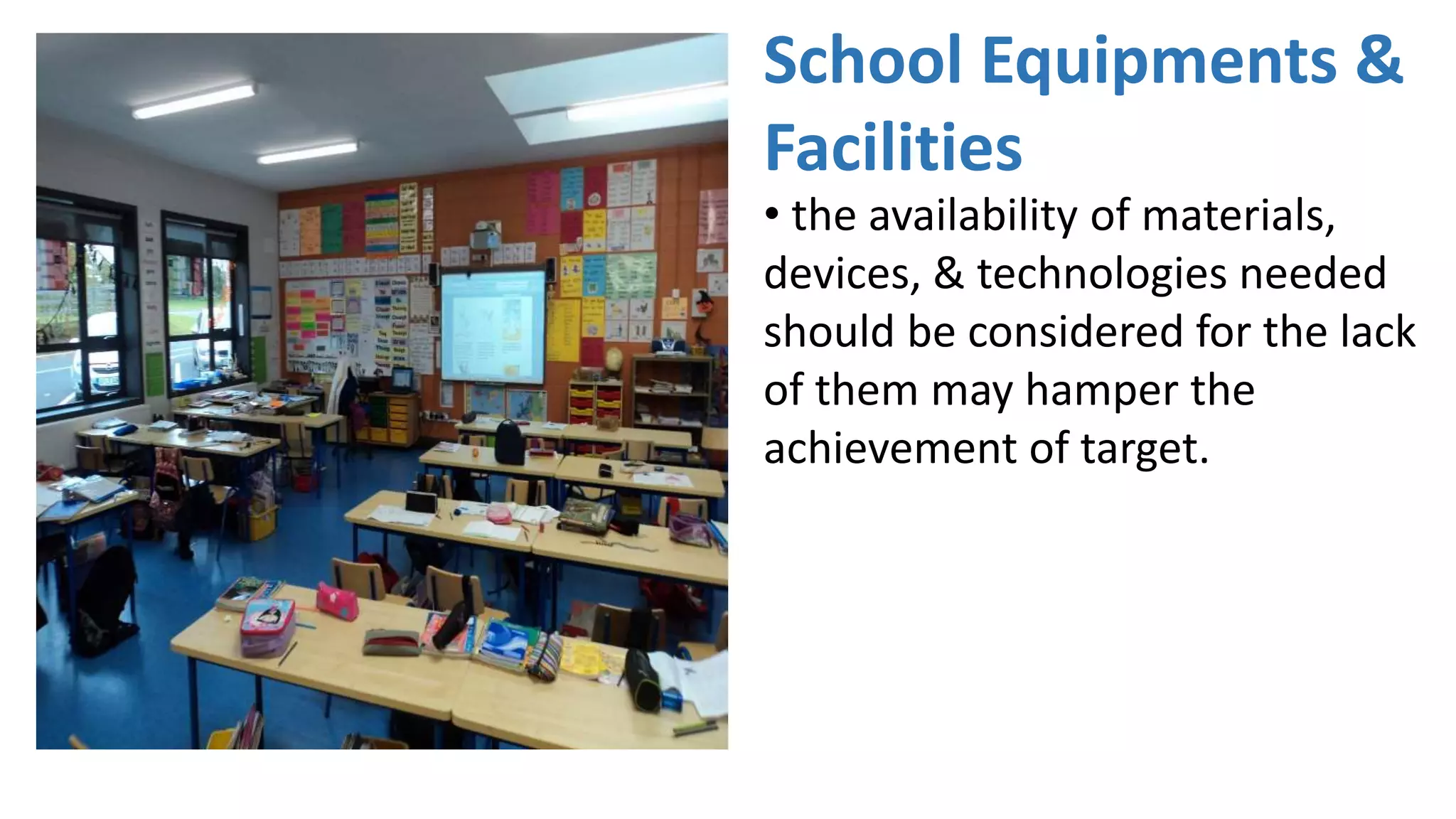
School Equipments &
Facilities
• the availability of materials,
devices, & technologies needed
should be considered for the lack
of them may hamper the
achievement of target.
What are strategies?
• How a content is being taught
• What materials to be used
• Making connections
Strategy is about….
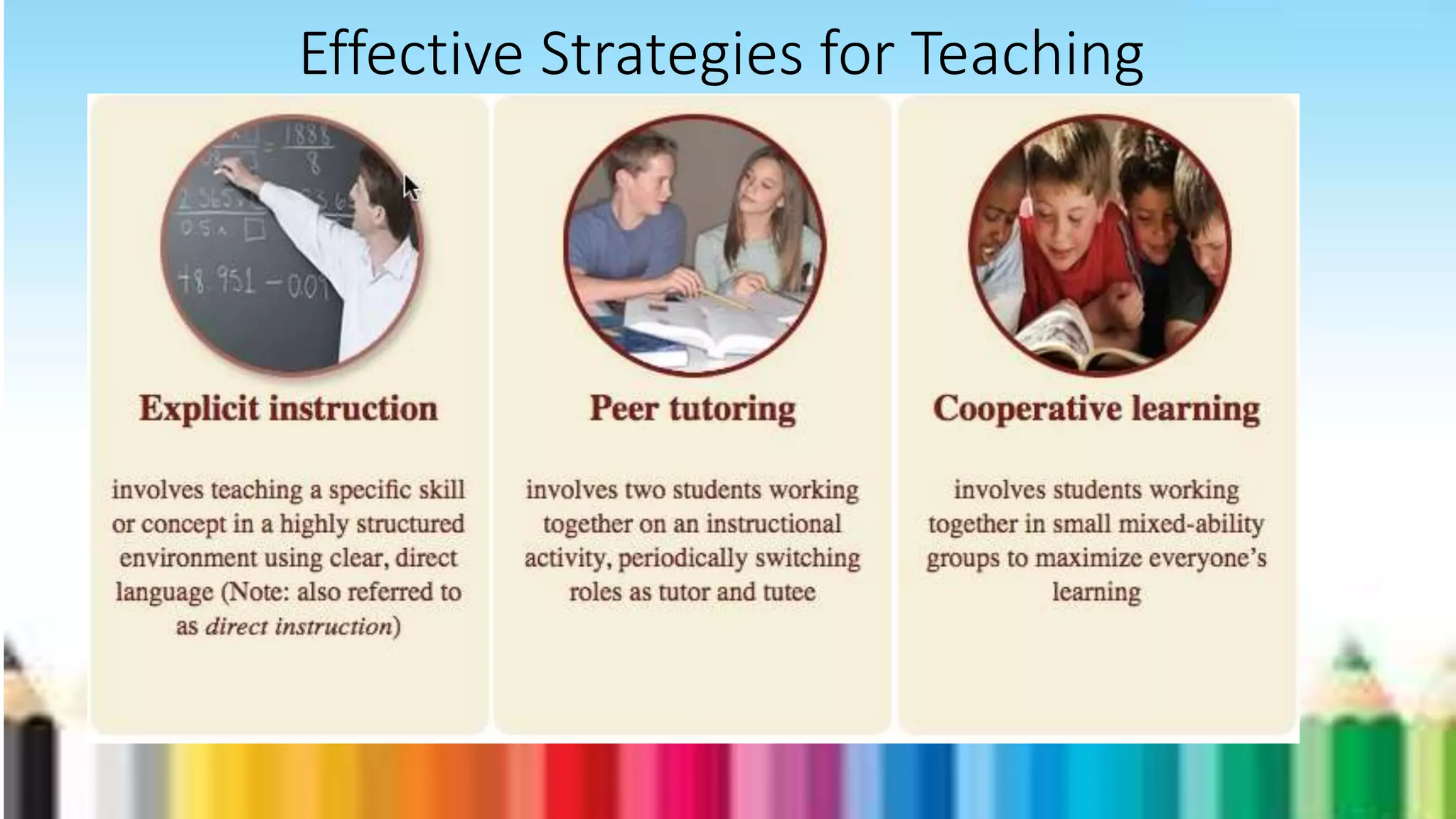
• How a content is being taught
• Lecture?
• Hands on?
• Explicit Instruction?
• Peer tutoring?
• Cooperative Learning?
Strategy is about….
Effective Strategies for Teaching
• What materials to be used
Consider the visuals
Consider manipulatives
Consider game boards
Consider technology-based
Strategy is about….
• Making connections to the real world to previous
lesson
• Begin a new lesson with a reminder of the past
lesson
• Pay attention how the students react to making
connections
Strategy is about….
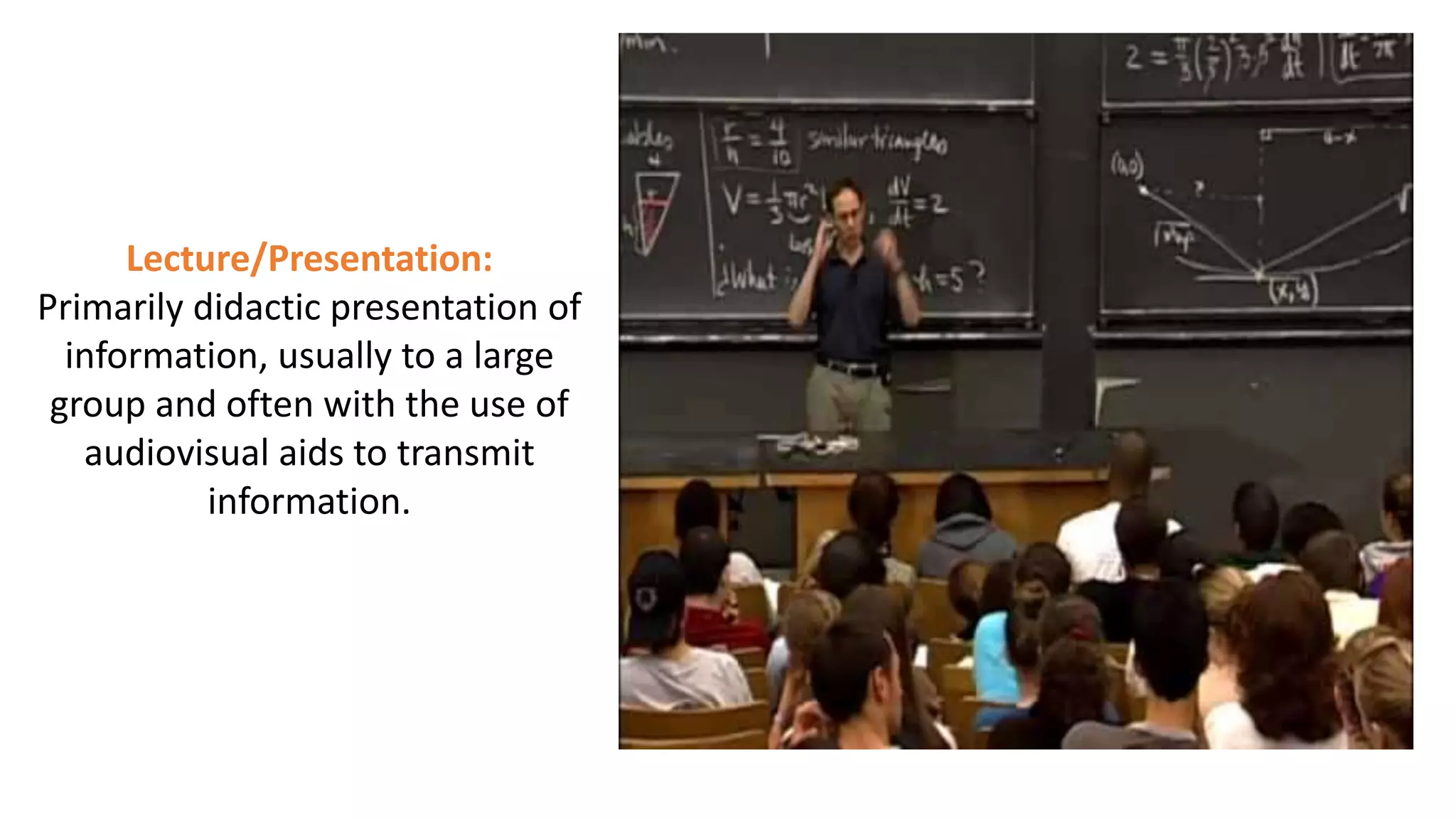
Lecture/Presentation:
Primarily didactic presentation of
information, usually to a large
group and often with the use of
audiovisual aids to transmit
information.
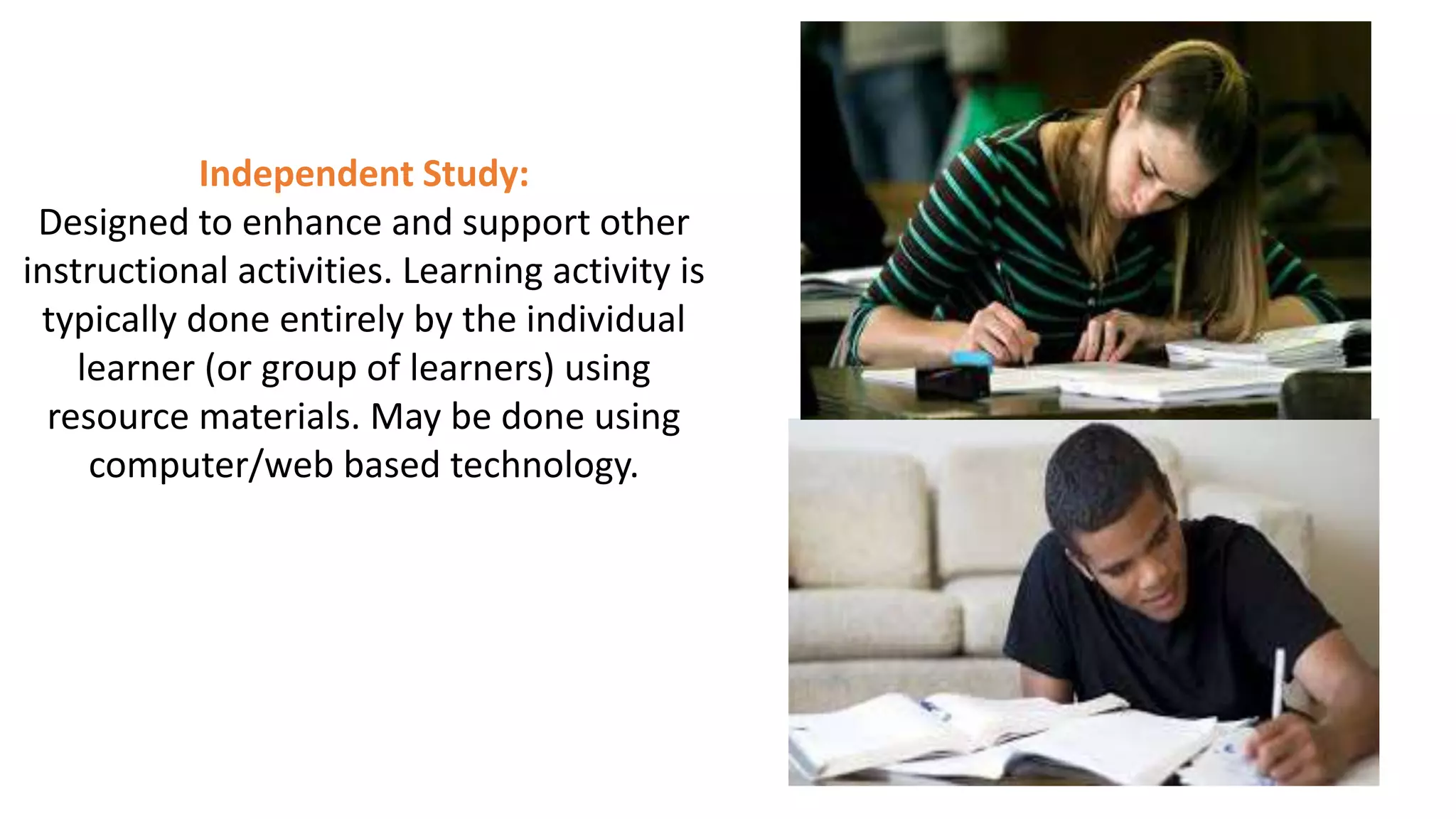
Independent Study:
Designed to enhance and support other
instructional activities. Learning activity is
typically done entirely by the individual
learner (or group of learners) using
resource materials. May be done using
computer/web based technology.
Problem-Based
Learning
The problem comes first and learners work
through the problem through progressive
disclosure by making hypotheses, exploring
mechanisms, developing and researching
learning issues, and applying new information
to the case.
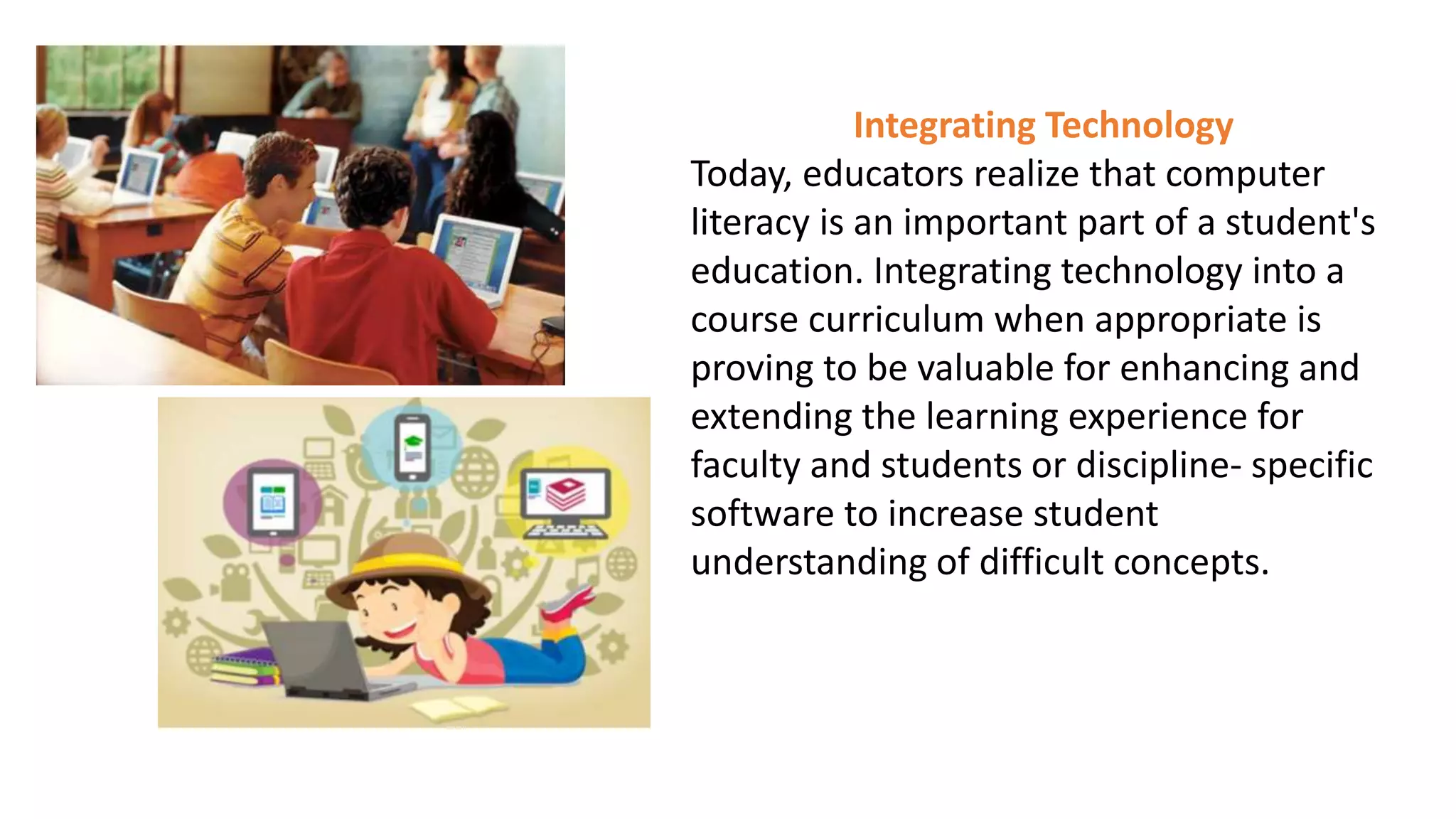
Integrating Technology
Today, educators realize that computer
literacy is an important part of a student's
education. Integrating technology into a
course curriculum when appropriate is
proving to be valuable for enhancing and
extending the learning experience for
faculty and students or discipline- specific
software to increase student
understanding of difficult concepts.
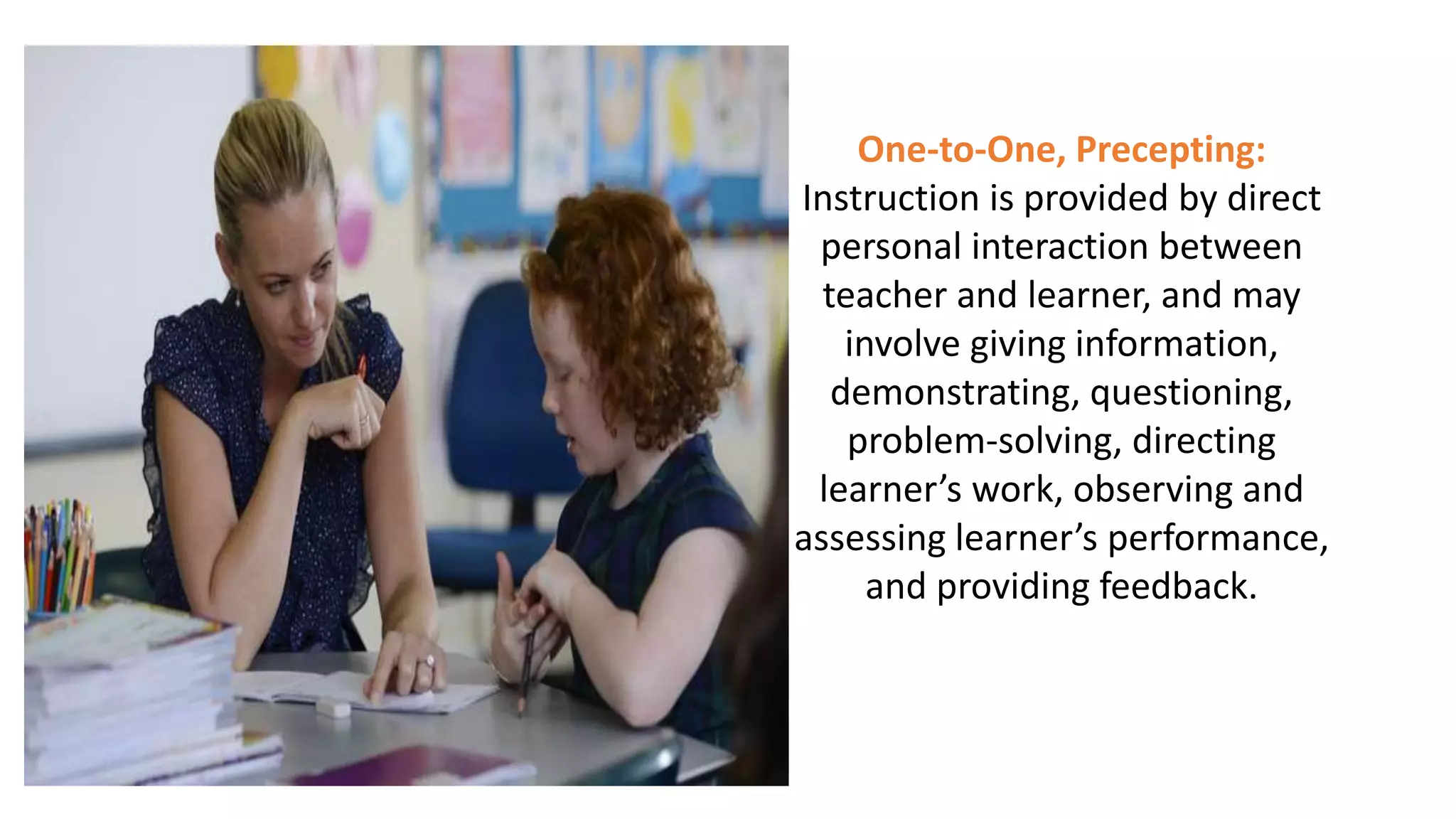
One-to-One, Precepting:
Instruction is provided by direct
personal interaction between
teacher and learner, and may
involve giving information,
demonstrating, questioning,
problem-solving, directing
learner’s work, observing and
assessing learner’s performance,
and providing feedback.
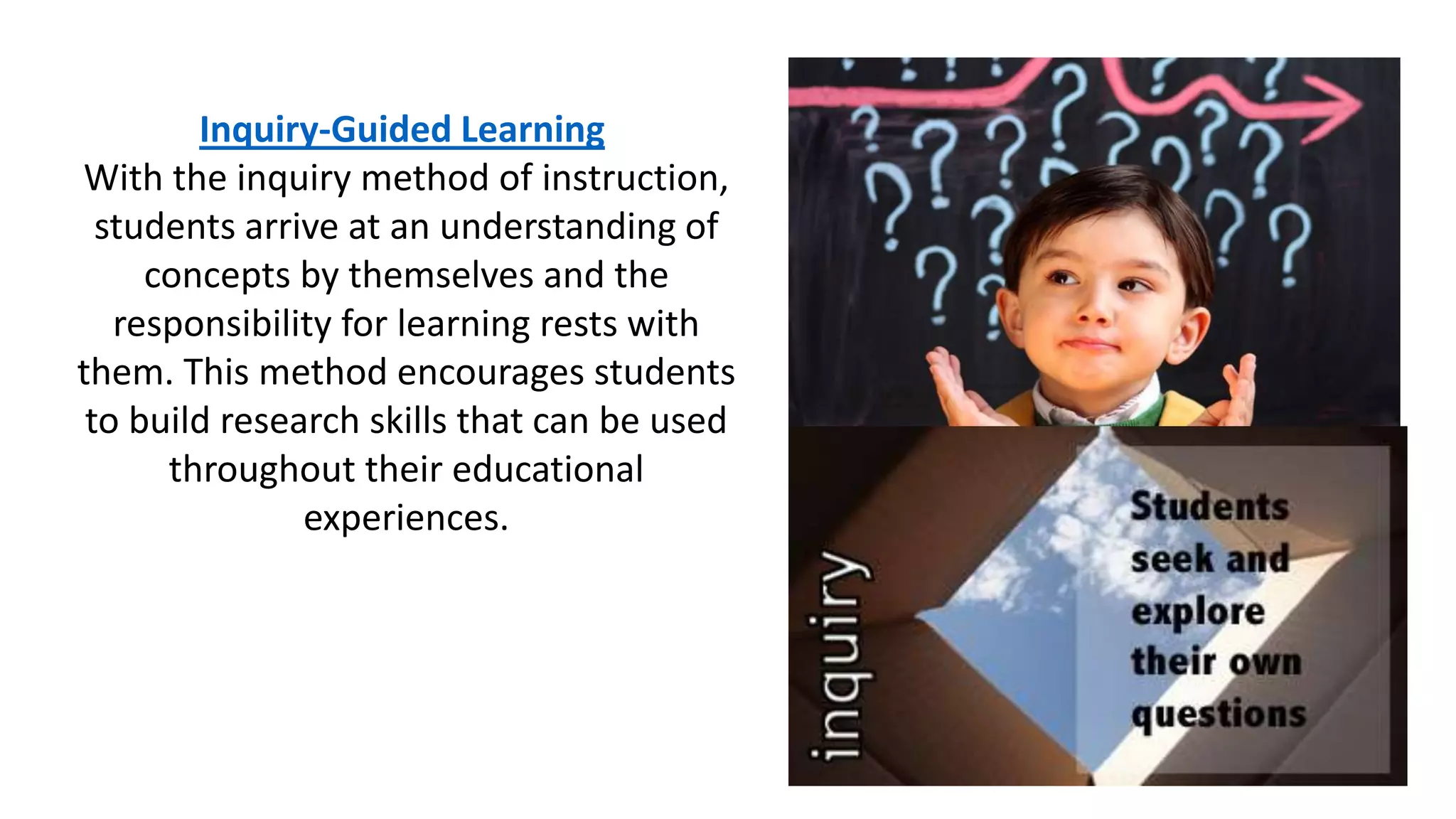
Inquiry-Guided Learning
With the inquiry method of instruction,
students arrive at an understanding of
concepts by themselves and the
responsibility for learning rests with
them. This method encourages students
to build research skills that can be used
throughout their educational
experiences.
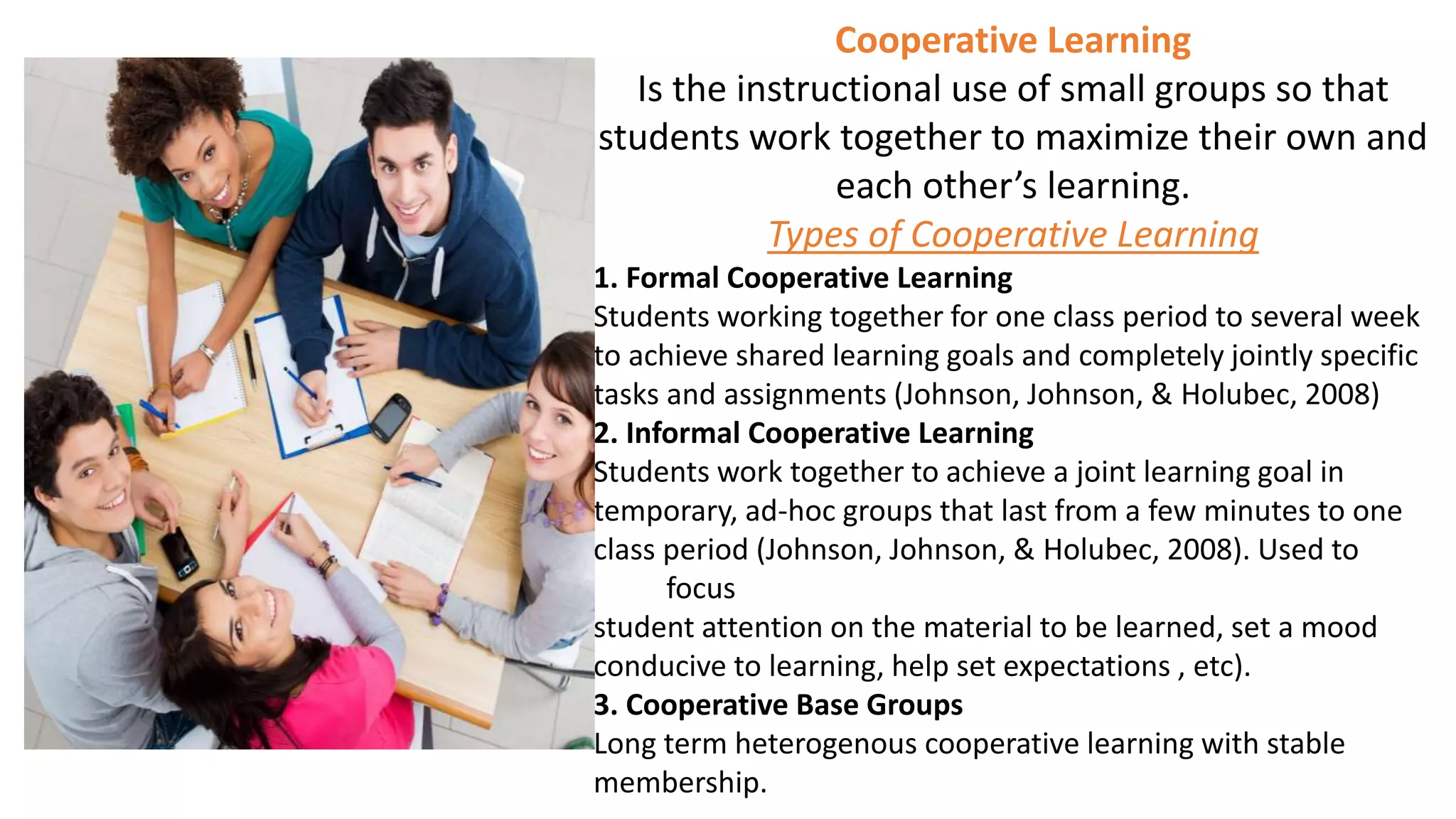
Cooperative Learning
Is the instructional use of small groups so that
students work together to maximize their own and
each other’s learning.
Types of Cooperative Learning
1. Formal Cooperative Learning
Students working together for one class period to several week
to achieve shared learning goals and completely jointly specific
tasks and assignments (Johnson, Johnson, & Holubec, 2008)
2. Informal Cooperative Learning
Students work together to achieve a joint learning goal in
temporary, ad-hoc groups that last from a few minutes to one
class period (Johnson, Johnson, & Holubec, 2008). Used to
focus
student attention on the material to be learned, set a mood
conducive to learning, help set expectations , etc).
3. Cooperative Base Groups
Long term heterogenous cooperative learning with stable
membership.
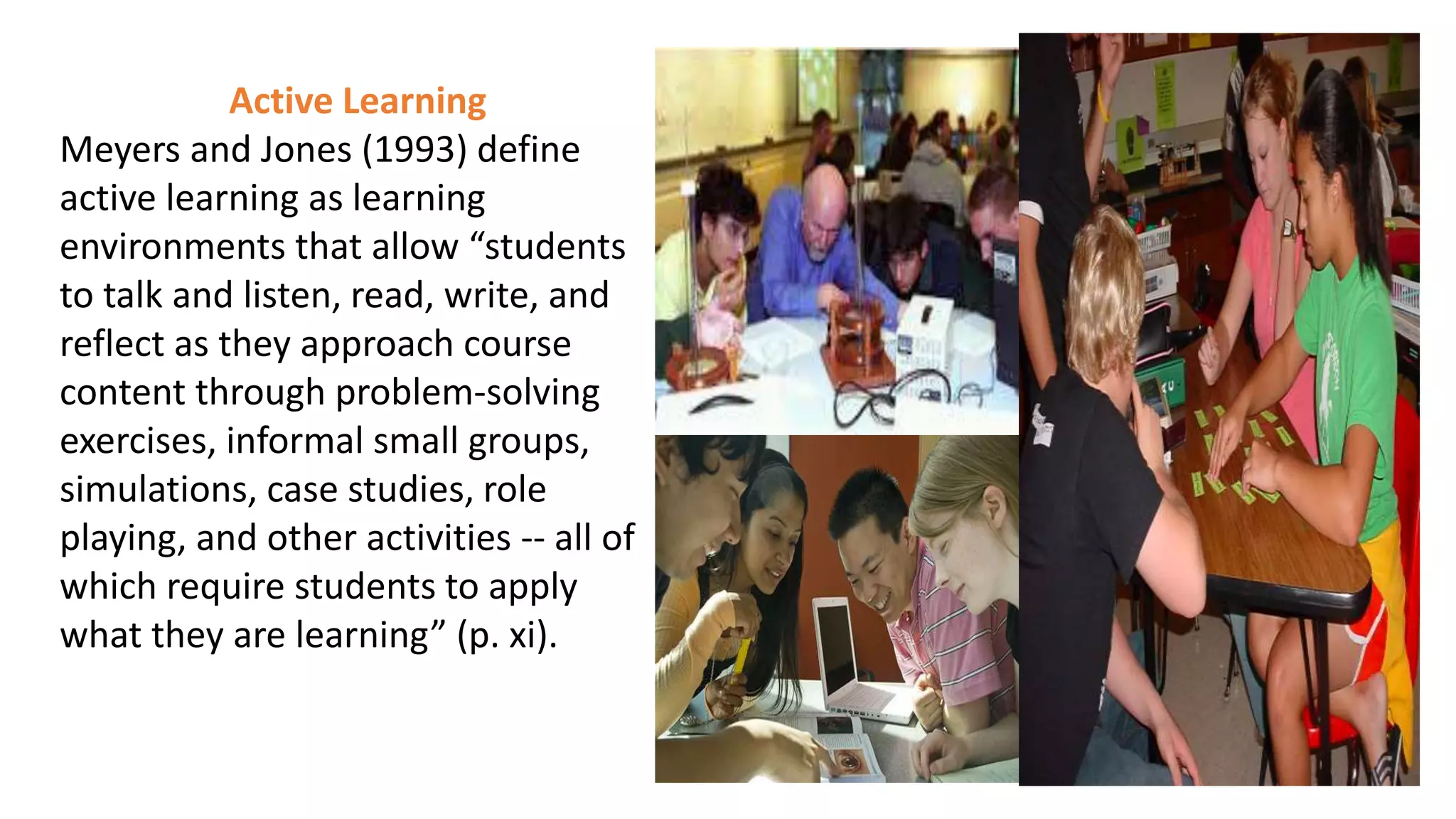
Active Learning
Meyers and Jones (1993) define
active learning as learning
environments that allow “students
to talk and listen, read, write, and
reflect as they approach course
content through problem-solving
exercises, informal small groups,
simulations, case studies, role
playing, and other activities -- all of
which require students to apply
what they are learning” (p. xi).
Games/Experiments/Simulations
Games, experiments and simulations
can be rich learning environments for
students. Students today have
grown up playing games and using
interactive tools such as the Internet,
phones, and other appliances.
Games and simulations enable
students to solve real-world
problems in a safe environment and
enjoy themselves while doing so.
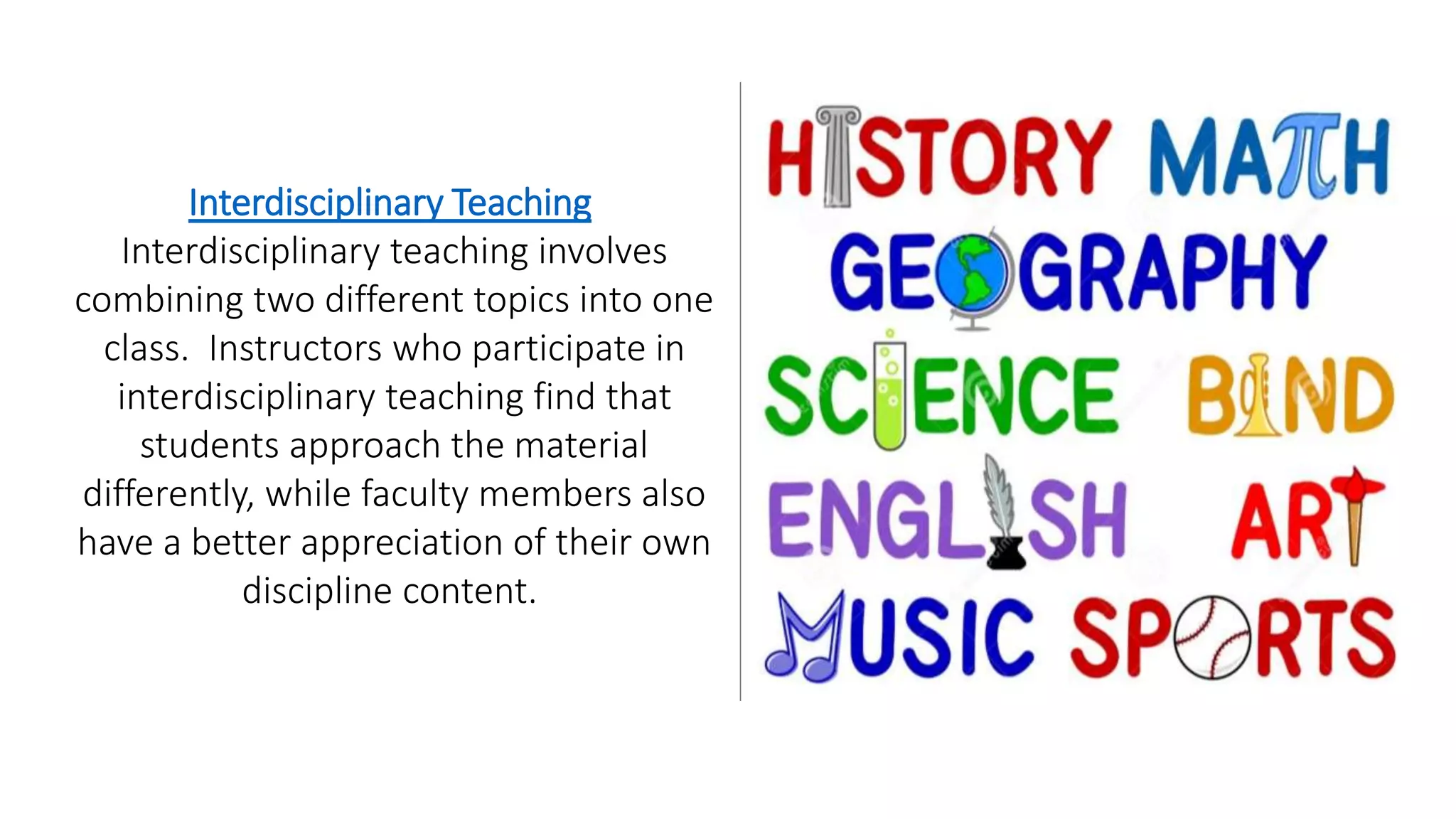
Interdisciplinary Teaching
Interdisciplinary teaching involves
combining two different topics into one
class. Instructors who participate in
interdisciplinary teaching find that
students approach the material
differently, while faculty members also
have a better appreciation of their own
discipline content.
The unpacked standards
Recall
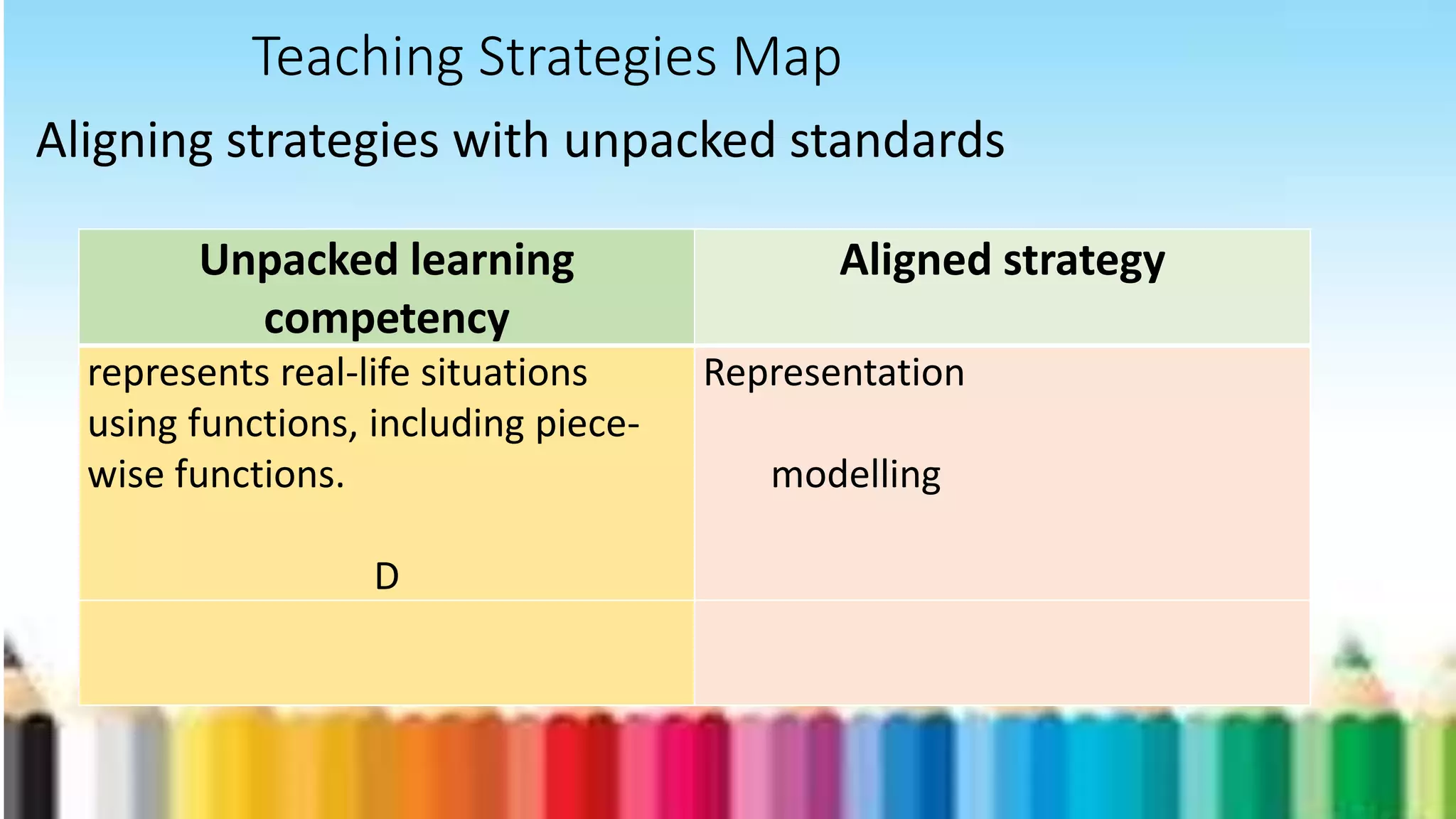
Teaching Strategies Map
Aligning strategies with unpacked standards
Unpacked learning
competency
Aligned strategy
represents real-life situations
using functions, including piece-
wise functions.
D
Representation
modelling
“A thousand teachers,
a thousand methods.”
Chinese Proverb
Shs strategies in teaching mathematics may 3 am

Shs strategies in teaching mathematics may 3 am

  • 1.
    Teaching Strategies Dr.. DaniloG. Baradillo UIC Language, Literature and Communications Coordinator
  • 2.
    Selecting the AppropriateStrategy What you will need…. Curriculum Guide of the Subject List of strategies you can use Teaching strategies map
  • 3.
    Selecting the AppropriateStrategy What you will need…. Content standard Performance standard Learning competency Unpacked standards
  • 4.
    21st Century Skills area set of abilities that students need to develop in order to succeed in the information age 3 Types of Partnership for 21st Century Skills Learning Skills Critical Thinking Creative Thinking Collaborating Communicating Literacy Skills Information Literacy Media Literacy Technology Literacy Life Skills Flexibility Initiative Social Skills Productivity Leadership
  • 5.
    How to Teach? Strategiesand Techniques How to assess and evaluate? Assessment and Evaluation Mechanism Why teach? Unit Mission + Nature of the subject +Goal in teaching the subject What to teach? Curriculum Guide *Learning Standards -Content -Performance -Learning Competencies Alignment Ensure Alignment from Content, Assessment, & Strategies
  • 6.
    Factors to Consider inChoosing a Method
  • 7.
    The Learners • thefirst to consider in choosing a method • the characteristics and nature of the students: -Age Maturity - Grade Level Abilities -Interests Growth -Health Problems Should be considered for learning to take place.
  • 8.
    The Subject Matter •this factor deals with the nature of the content to be learned which may be difficult or uninteresting, hence, the teacher must be able to use or choose the methods/strategy that will make learning effective a nd meaningful.
  • 9.
    The Learning Outcomes • theexpected outcome of the lesson also dictates the strategy to be used. It must be one that will ensure full achievement of the set of objectives.
  • 10.
    Time Allotment • Howmuch time does the teacher have to teach the lesson? • the strategy must be able to help target the desired outcomes within the time frame.
  • 11.
    The Teacher • theteacher’s style and academic preparation, skills, interests, and abilities are also points of consideration. • it is important that he/she could effectively execute the method/ strategy of his/her choice to ensure success in learning.
  • 12.
    School Equipments & Facilities •the availability of materials, devices, & technologies needed should be considered for the lack of them may hamper the achievement of target.
  • 13.
  • 14.
    • How acontent is being taught • What materials to be used • Making connections Strategy is about….
  • 15.
    • How acontent is being taught • Lecture? • Hands on? • Explicit Instruction? • Peer tutoring? • Cooperative Learning? Strategy is about….
  • 16.
  • 17.
    • What materialsto be used Consider the visuals Consider manipulatives Consider game boards Consider technology-based Strategy is about….
  • 18.
    • Making connectionsto the real world to previous lesson • Begin a new lesson with a reminder of the past lesson • Pay attention how the students react to making connections Strategy is about….
  • 19.
    Lecture/Presentation: Primarily didactic presentationof information, usually to a large group and often with the use of audiovisual aids to transmit information.
  • 20.
    Independent Study: Designed toenhance and support other instructional activities. Learning activity is typically done entirely by the individual learner (or group of learners) using resource materials. May be done using computer/web based technology.
  • 21.
    Problem-Based Learning The problem comesfirst and learners work through the problem through progressive disclosure by making hypotheses, exploring mechanisms, developing and researching learning issues, and applying new information to the case.
  • 22.
    Integrating Technology Today, educatorsrealize that computer literacy is an important part of a student's education. Integrating technology into a course curriculum when appropriate is proving to be valuable for enhancing and extending the learning experience for faculty and students or discipline- specific software to increase student understanding of difficult concepts.
  • 23.
    One-to-One, Precepting: Instruction isprovided by direct personal interaction between teacher and learner, and may involve giving information, demonstrating, questioning, problem-solving, directing learner’s work, observing and assessing learner’s performance, and providing feedback.
  • 24.
    Inquiry-Guided Learning With theinquiry method of instruction, students arrive at an understanding of concepts by themselves and the responsibility for learning rests with them. This method encourages students to build research skills that can be used throughout their educational experiences.
  • 25.
    Cooperative Learning Is theinstructional use of small groups so that students work together to maximize their own and each other’s learning. Types of Cooperative Learning 1. Formal Cooperative Learning Students working together for one class period to several week to achieve shared learning goals and completely jointly specific tasks and assignments (Johnson, Johnson, & Holubec, 2008) 2. Informal Cooperative Learning Students work together to achieve a joint learning goal in temporary, ad-hoc groups that last from a few minutes to one class period (Johnson, Johnson, & Holubec, 2008). Used to focus student attention on the material to be learned, set a mood conducive to learning, help set expectations , etc). 3. Cooperative Base Groups Long term heterogenous cooperative learning with stable membership.
  • 26.
    Active Learning Meyers andJones (1993) define active learning as learning environments that allow “students to talk and listen, read, write, and reflect as they approach course content through problem-solving exercises, informal small groups, simulations, case studies, role playing, and other activities -- all of which require students to apply what they are learning” (p. xi).
  • 27.
    Games/Experiments/Simulations Games, experiments andsimulations can be rich learning environments for students. Students today have grown up playing games and using interactive tools such as the Internet, phones, and other appliances. Games and simulations enable students to solve real-world problems in a safe environment and enjoy themselves while doing so.
  • 28.
    Interdisciplinary Teaching Interdisciplinary teachinginvolves combining two different topics into one class. Instructors who participate in interdisciplinary teaching find that students approach the material differently, while faculty members also have a better appreciation of their own discipline content.
  • 29.
  • 30.
    Teaching Strategies Map Aligningstrategies with unpacked standards Unpacked learning competency Aligned strategy represents real-life situations using functions, including piece- wise functions. D Representation modelling
  • 31.
    “A thousand teachers, athousand methods.” Chinese Proverb

Editor's Notes

  • #2 GOAL: Teacher – participants are appropriately coached in the preparation of the delivery of instructions in the SHS.
  • #5 Recall the generic list of strategies discussed yesterda
  • #6 From the DepEd order #8 s 2015: “Assessment is a process that is used to keep track of learners’ progress in relation to learning standards and in the development of 21st Century skllls, to promote self-reflection, and personal accountability among students about their own learning and to provide bases for profiling of student performance on the learning competencies and standards of the curriculum
  • #7 Recall the generic list of strategies discussed yesterda
  • #8 Recall the generic list of strategies discussed yesterda
  • #10 Recall the generic list of strategies discussed yesterda
  • #16 How a content is taught? Lecture? Hands-on? (choose from the generic list) Materials used – consider the visuals … using visuals can be more challenging Making connections – to the real world or previously taught concept – begin a new lesson with a reminder of the past lesson – pay attention how the students react to making connections
  • #17 Recall the generic list of strategies discussed yesterda
  • #18 How a content is taught? Lecture? Hands-on? (choose from the generic list) Materials used – consider the visuals … using visuals can be more challenging Making connections – to the real world or previously taught concept – begin a new lesson with a reminder of the past lesson – pay attention how the students react to making connections
  • #19 How a content is taught? Lecture? Hands-on? (choose from the generic list) Materials used – consider the visuals … using visuals can be more challenging Making connections – to the real world or previously taught concept – begin a new lesson with a reminder of the past lesson – pay attention how the students react to making connections
  • #30 How a content is taught? Lecture? Hands-on? (choose from the generic list) Materials used – consider the visuals … using visuals can be more challenging Making connections – to the real world or previously taught concept – begin a new lesson with a reminder of the past lesson – pay attention how the students react to making connections
  • #31 Representing piecewise functions can be through the following Graphical illustration Equation