Using ePortfolios for Integrated Learning
Dilani Gedera, Stephen Bright and Anthea Fester
Overview
• Pedagogical underpinnings
• EAP studies and ePortfolio use
• Case study
• The design
• Process and implementation
• Evaluation
• Usability survey
• Q&A
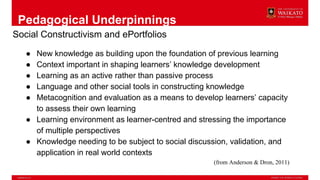
Pedagogical Underpinnings
Social Constructivism and ePortfolios
● New knowledge as building upon the foundation of previous learning
● Context important in shaping learners’ knowledge development
● Learning as an active rather than passive process
● Language and other social tools in constructing knowledge
● Metacognition and evaluation as a means to develop learners’ capacity
to assess their own learning
● Learning environment as learner-centred and stressing the importance
of multiple perspectives
● Knowledge needing to be subject to social discussion, validation, and
application in real world contexts
(from Anderson & Dron, 2011)
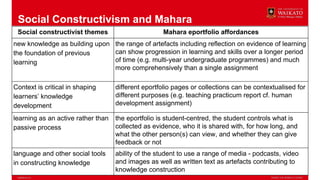
Social Constructivism and Mahara
Social constructivist themes Mahara eportfolio affordances
new knowledge as building upon
the foundation of previous
learning
the range of artefacts including reflection on evidence of learning
can show progression in learning and skills over a longer period
of time (e.g. multi-year undergraduate programmes) and much
more comprehensively than a single assignment
Context is critical in shaping
learners’ knowledge
development
different eportfolio pages or collections can be contextualised for
different purposes (e.g. teaching practicum report cf. human
development assignment)
learning as an active rather than
passive process
the eportfolio is student-centred, the student controls what is
collected as evidence, who it is shared with, for how long, and
what the other person(s) can view, and whether they can give
feedback or not
language and other social tools
in constructing knowledge
ability of the student to use a range of media - podcasts, video
and images as well as written text as artefacts contributing to
knowledge construction
Focus question
Your turn for ideas … make
connections with this social
constructivist principle and
Mahara affordances
Knowledge needs to be
subject to social discussion,
validation, and application in
real world contexts
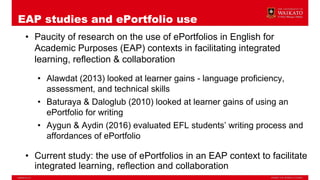
EAP studies and ePortfolio use
• Paucity of research on the use of ePortfolios in English for
Academic Purposes (EAP) contexts in facilitating integrated
learning, reflection & collaboration
• Alawdat (2013) looked at learner gains - language proficiency,
assessment, and technical skills
• Baturaya & Daloglub (2010) looked at learner gains of using an
ePortfolio for writing
• Aygun & Aydin (2016) evaluated EFL students’ writing process and
affordances of ePortfolio
• Current study: the use of ePortfolios in an EAP context to facilitate
integrated learning, reflection and collaboration
Case Study
• ESLA 301-17A Academic text: Understanding Meaning
• Understanding of meaning in academic listening and reading
texts with a focus on theoretical and research-reporting
content
• Year 3 generic paper
• Moodle LMS
• 10 International students
• Learning and showcase portfolio
The Design
• Influenced by Social Constructivism
• Redesigned assessments to facilitate:
integrated learning
collaboration
peer feedback (oral/text)
reflection
• ePortfolio features
Create pages for each assignment
Journal
share page
comment
The Design
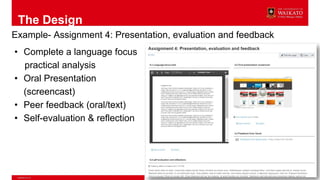
Example- Assignment 4: Presentation, evaluation and feedback
• Complete a language focus
practical analysis
• Oral Presentation
(screencast)
• Peer feedback (oral/text)
• Self-evaluation & reflection
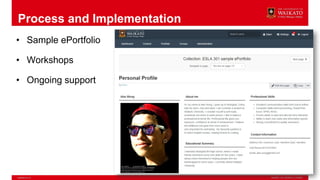
Process and Implementation
• Sample ePortfolio
• Workshops
• Ongoing support
Evaluation
Aim
To evaluate the use of ePortfolios in facilitating integrated
learning, reflection and collaboration in an EAP tertiary context
Ethical approval
Methods
• Online survey (Google form)
• Semi-structured interviews with the students
• Document analysis (students’ ePortfolios)
• Usability survey
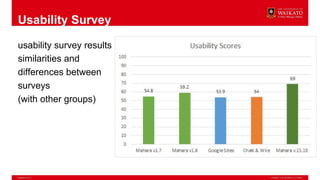
Usability Survey
usability survey results
similarities and
differences between
surveys
(with other groups)
Questions

Using ePortfolios for Integrated Learning

  • 1.
    Using ePortfolios forIntegrated Learning Dilani Gedera, Stephen Bright and Anthea Fester
  • 2.
    Overview • Pedagogical underpinnings •EAP studies and ePortfolio use • Case study • The design • Process and implementation • Evaluation • Usability survey • Q&A
  • 3.
    Pedagogical Underpinnings Social Constructivismand ePortfolios ● New knowledge as building upon the foundation of previous learning ● Context important in shaping learners’ knowledge development ● Learning as an active rather than passive process ● Language and other social tools in constructing knowledge ● Metacognition and evaluation as a means to develop learners’ capacity to assess their own learning ● Learning environment as learner-centred and stressing the importance of multiple perspectives ● Knowledge needing to be subject to social discussion, validation, and application in real world contexts (from Anderson & Dron, 2011)
  • 4.
    Social Constructivism andMahara Social constructivist themes Mahara eportfolio affordances new knowledge as building upon the foundation of previous learning the range of artefacts including reflection on evidence of learning can show progression in learning and skills over a longer period of time (e.g. multi-year undergraduate programmes) and much more comprehensively than a single assignment Context is critical in shaping learners’ knowledge development different eportfolio pages or collections can be contextualised for different purposes (e.g. teaching practicum report cf. human development assignment) learning as an active rather than passive process the eportfolio is student-centred, the student controls what is collected as evidence, who it is shared with, for how long, and what the other person(s) can view, and whether they can give feedback or not language and other social tools in constructing knowledge ability of the student to use a range of media - podcasts, video and images as well as written text as artefacts contributing to knowledge construction
  • 5.
    Focus question Your turnfor ideas … make connections with this social constructivist principle and Mahara affordances Knowledge needs to be subject to social discussion, validation, and application in real world contexts
  • 6.
    EAP studies andePortfolio use • Paucity of research on the use of ePortfolios in English for Academic Purposes (EAP) contexts in facilitating integrated learning, reflection & collaboration • Alawdat (2013) looked at learner gains - language proficiency, assessment, and technical skills • Baturaya & Daloglub (2010) looked at learner gains of using an ePortfolio for writing • Aygun & Aydin (2016) evaluated EFL students’ writing process and affordances of ePortfolio • Current study: the use of ePortfolios in an EAP context to facilitate integrated learning, reflection and collaboration
  • 7.
    Case Study • ESLA301-17A Academic text: Understanding Meaning • Understanding of meaning in academic listening and reading texts with a focus on theoretical and research-reporting content • Year 3 generic paper • Moodle LMS • 10 International students • Learning and showcase portfolio
  • 8.
    The Design • Influencedby Social Constructivism • Redesigned assessments to facilitate: integrated learning collaboration peer feedback (oral/text) reflection • ePortfolio features Create pages for each assignment Journal share page comment
  • 9.
    The Design Example- Assignment4: Presentation, evaluation and feedback • Complete a language focus practical analysis • Oral Presentation (screencast) • Peer feedback (oral/text) • Self-evaluation & reflection
  • 10.
    Process and Implementation •Sample ePortfolio • Workshops • Ongoing support
  • 11.
    Evaluation Aim To evaluate theuse of ePortfolios in facilitating integrated learning, reflection and collaboration in an EAP tertiary context Ethical approval Methods • Online survey (Google form) • Semi-structured interviews with the students • Document analysis (students’ ePortfolios) • Usability survey
  • 12.
    Usability Survey usability surveyresults similarities and differences between surveys (with other groups)
  • 13.