TDC 1
Pedagogical Grammar
Word Forms
Word Forms
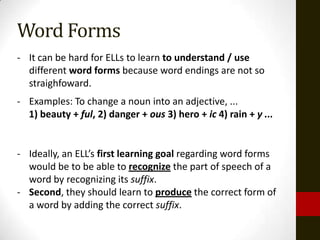
- It can be hard for ELLs to learn to understand / use
  different word forms because word endings are not so
  straighfoward.
- Examples: To change a noun into an adjective, ...
  1) beauty + ful, 2) danger + ous 3) hero + ic 4) rain + y ...


- Ideally, an ELL’s first learning goal regarding word forms
  would be to be able to recognize the part of speech of a
  word by recognizing its suffix.
- Second, they should learn to produce the correct form of
  a word by adding the correct suffix.
Word Forms
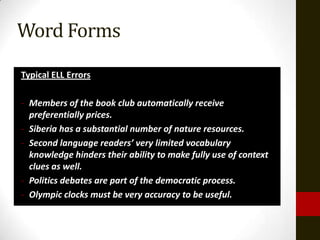
Typical ELL Errors

- Members of the book club automatically receive
  preferentially prices.
- Siberia has a substantial number of nature resources.
- Second language readers’ very limited vocabulary
  knowledge hinders their ability to make fully use of context
  clues as well.
- Politics debates are part of the democratic process.
- Olympic clocks must be very accuracy to be useful.
Word Forms
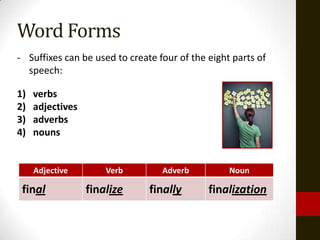
- Suffixes can be used to create four of the eight parts of
  speech:

1)   verbs
2)   adjectives
3)   adverbs
4)   nouns


     Adjective        Verb        Adverb          Noun

 final            finalize     finally       finalization
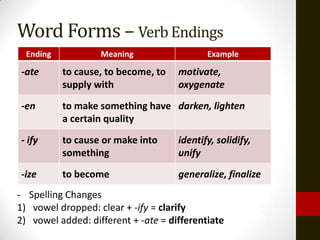
Word Forms – Verb Endings
  Ending           Meaning                  Example

-ate       to cause, to become, to   motivate,
           supply with               oxygenate

-en        to make something have darken, lighten
           a certain quality

- ify      to cause or make into     identify, solidify,
           something                 unify

-ize       to become                 generalize, finalize
- Spelling Changes
1) vowel dropped: clear + -ify = clarify
2) vowel added: different + -ate = differentiate
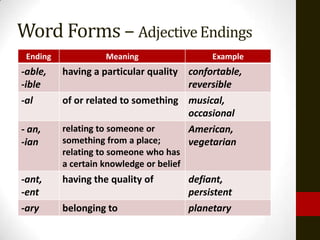
Word Forms – Adjective Endings
 Ending             Meaning                  Example
-able,    having a particular qualityconfortable,
-ible                                reversible
-al       of or related to something musical,
                                     occasional
- an,     relating to someone or        American,
-ian      something from a place;       vegetarian
          relating to someone who has
          a certain knowledge or belief
-ant,     having the quality of         defiant,
-ent                                    persistent
-ary      belonging to                  planetary
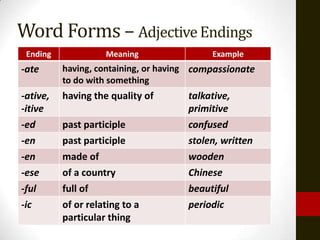
Word Forms – Adjective Endings
 Ending             Meaning                Example
-ate      having, containing, or having compassionate
          to do with something
-ative,   having the quality of       talkative,
-itive                                primitive
-ed       past participle             confused
-en       past participle             stolen, written
-en       made of                     wooden
-ese      of a country                Chinese
-ful      full of                     beautiful
-ic       of or relating to a         periodic
          particular thing
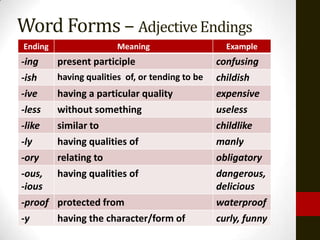
Word Forms – Adjective Endings
Ending                  Meaning                    Example
-ing     present participle                      confusing
-ish     having qualities of, or tending to be   childish
-ive     having a particular quality             expensive
-less    without something                       useless
-like    similar to                              childlike
-ly      having qualities of                     manly
-ory     relating to                             obligatory
-ous,    having qualities of                     dangerous,
-ious                                            delicious
-proof   protected from                          waterproof
-y       having the character/form of            curly, funny
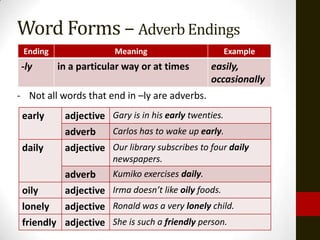
Word Forms – Adverb Endings
 Ending                Meaning                       Example
-ly       in a particular way or at times      easily,
                                               occasionally
- Not all words that end in –ly are adverbs.
 early     adjective Gary is in his early twenties.
           adverb    Carlos has to wake up early.
 daily     adjective Our library subscribes to four daily
                       newspapers.
           adverb    Kumiko exercises daily.
 oily      adjective Irma doesn’t like oily foods.
 lonely adjective Ronald was a very lonely child.
 friendly adjective She is such a friendly person.
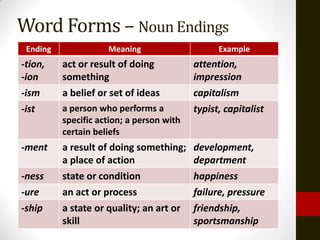
Word Forms – Noun Endings
 Ending               Meaning                  Example
-al         the act of doing somethingrehersal, denial
-ence,      action or process; qualityconfidence,
-ance,                                performance,
-cy                                   lunacy
-ent,       someone or something that president,
-ant        does something            resident
-er, -or,   someone or something that teacher, elevator,
-ar, -r     does something            registrar, writer
-hood       having a quality or state    brotherhood,
                                         childhood
-ity, -ty having a quality               equality, specialty
Word Forms – Noun Endings
 Ending              Meaning                     Example
-tion,    act or result of doing           attention,
-ion      something                        impression
-ism      a belief or set of ideas         capitalism
-ist      a person who performs a          typist, capitalist
          specific action; a person with
          certain beliefs
-ment     a result of doing something; development,
          a place of action            department
-ness     state or condition               happiness
-ure      an act or process                failure, pressure
-ship     a state or quality; an art or    friendship,
          skill                            sportsmanship
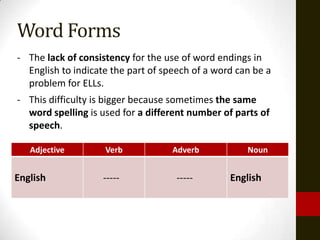
Word Forms
- The lack of consistency for the use of word endings in
  English to indicate the part of speech of a word can be a
  problem for ELLs.
- This difficulty is bigger because sometimes the same
  word spelling is used for a different number of parts of
  speech.

  Adjective         Verb            Adverb           Noun
photographic photograph photographically photograph
Photographical
English         -----         -----      English
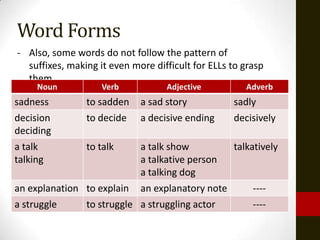
Word Forms
- Also, some words do not follow the pattern of
  suffixes, making it even more difficult for ELLs to grasp
  them.
     Noun           Verb           Adjective          Adverb
sadness         to sadden    a sad story           sadly
decision        to decide    a decisive ending     decisively
deciding
a talk          to talk      a talk show           talkatively
talking                      a talkative person
                             a talking dog
an explanation to explain an explanatory note           ----
a struggle     to struggle a struggling actor           ----
Word Forms
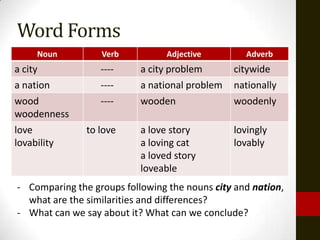
     Noun         Verb           Adjective        Adverb
a city            ----     a city problem       citywide
a nation          ----     a national problem   nationally
wood              ----     wooden               woodenly
woodenness
love           to love     a love story         lovingly
lovability                 a loving cat         lovably
                           a loved story
                           loveable
- Comparing the groups following the nouns city and nation,
  what are the similarities and differences?
- What can we say about it? What can we conclude?
Word Forms
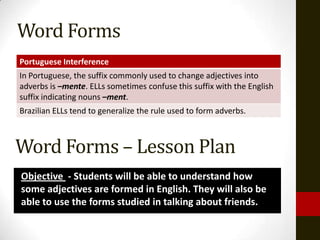
Portuguese Interference
In Portuguese, the suffix commonly used to change adjectives into
adverbs is –mente. ELLs sometimes confuse this suffix with the English
suffix indicating nouns –ment.
Brazilian ELLs tend to generalize the rule used to form adverbs.


Word Forms – Lesson Plan
Objective - Students will be able to understand how
some adjectives are formed in English. They will also be
able to use the forms studied in talking about friends.
Word Forms – Lesson Plan
        -   Students will first read the text “A Creative
            Friendship” and answer some comprehension
            questions.
         - Comprehension Questions:
         1) How old were Picasso and Matisse when they met?
         2) How did they influence the work of each other?
         3) Why was theri friendship special?
        -   Then, students will read the text again to find
            adjectives in the text that end in -ous.
         - Answers:
         1) ambitious, famous, jealous
        -   Then, students will match the three adjectives
            with their definitions.
         - Task:
         1) unhappy because someone...
         2) someone a lot of people know about...
         3) determined to do well...
Word Forms – Lesson Plan
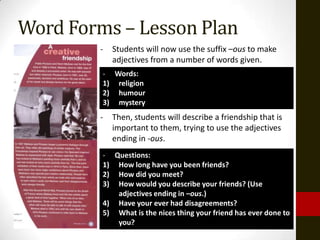
        -   Students will now use the suffix –ous to make
            adjectives from a number of words given.
         - Words:
         1) religion
         2) humour
         3) mystery
        -   Then, students will describe a friendship that is
            important to them, trying to use the adjectives
            ending in -ous.
         - Questions:
         1) How long have you been friends?
         2) How did you meet?
         3) How would you describe your friends? (Use
            adjectives ending in –ous.)
         4) Have your ever had disagreements?
         5) What is the nices thing your friend has ever done to
            you?
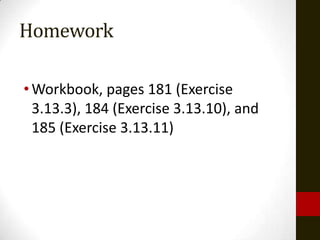
Homework

• Workbook, pages 181 (Exercise
  3.13.3), 184 (Exercise 3.13.10), and
  185 (Exercise 3.13.11)

TDC 1 - Word Forms

  • 1.
  • 2.
    Word Forms - Itcan be hard for ELLs to learn to understand / use different word forms because word endings are not so straighfoward. - Examples: To change a noun into an adjective, ... 1) beauty + ful, 2) danger + ous 3) hero + ic 4) rain + y ... - Ideally, an ELL’s first learning goal regarding word forms would be to be able to recognize the part of speech of a word by recognizing its suffix. - Second, they should learn to produce the correct form of a word by adding the correct suffix.
  • 3.
    Word Forms Typical ELLErrors - Members of the book club automatically receive preferentially prices. - Siberia has a substantial number of nature resources. - Second language readers’ very limited vocabulary knowledge hinders their ability to make fully use of context clues as well. - Politics debates are part of the democratic process. - Olympic clocks must be very accuracy to be useful.
  • 4.
    Word Forms - Suffixescan be used to create four of the eight parts of speech: 1) verbs 2) adjectives 3) adverbs 4) nouns Adjective Verb Adverb Noun final finalize finally finalization
  • 5.
    Word Forms –Verb Endings Ending Meaning Example -ate to cause, to become, to motivate, supply with oxygenate -en to make something have darken, lighten a certain quality - ify to cause or make into identify, solidify, something unify -ize to become generalize, finalize - Spelling Changes 1) vowel dropped: clear + -ify = clarify 2) vowel added: different + -ate = differentiate
  • 6.
    Word Forms –Adjective Endings Ending Meaning Example -able, having a particular qualityconfortable, -ible reversible -al of or related to something musical, occasional - an, relating to someone or American, -ian something from a place; vegetarian relating to someone who has a certain knowledge or belief -ant, having the quality of defiant, -ent persistent -ary belonging to planetary
  • 7.
    Word Forms –Adjective Endings Ending Meaning Example -ate having, containing, or having compassionate to do with something -ative, having the quality of talkative, -itive primitive -ed past participle confused -en past participle stolen, written -en made of wooden -ese of a country Chinese -ful full of beautiful -ic of or relating to a periodic particular thing
  • 8.
    Word Forms –Adjective Endings Ending Meaning Example -ing present participle confusing -ish having qualities of, or tending to be childish -ive having a particular quality expensive -less without something useless -like similar to childlike -ly having qualities of manly -ory relating to obligatory -ous, having qualities of dangerous, -ious delicious -proof protected from waterproof -y having the character/form of curly, funny
  • 9.
    Word Forms –Adverb Endings Ending Meaning Example -ly in a particular way or at times easily, occasionally - Not all words that end in –ly are adverbs. early adjective Gary is in his early twenties. adverb Carlos has to wake up early. daily adjective Our library subscribes to four daily newspapers. adverb Kumiko exercises daily. oily adjective Irma doesn’t like oily foods. lonely adjective Ronald was a very lonely child. friendly adjective She is such a friendly person.
  • 10.
    Word Forms –Noun Endings Ending Meaning Example -al the act of doing somethingrehersal, denial -ence, action or process; qualityconfidence, -ance, performance, -cy lunacy -ent, someone or something that president, -ant does something resident -er, -or, someone or something that teacher, elevator, -ar, -r does something registrar, writer -hood having a quality or state brotherhood, childhood -ity, -ty having a quality equality, specialty
  • 11.
    Word Forms –Noun Endings Ending Meaning Example -tion, act or result of doing attention, -ion something impression -ism a belief or set of ideas capitalism -ist a person who performs a typist, capitalist specific action; a person with certain beliefs -ment a result of doing something; development, a place of action department -ness state or condition happiness -ure an act or process failure, pressure -ship a state or quality; an art or friendship, skill sportsmanship
  • 12.
    Word Forms - Thelack of consistency for the use of word endings in English to indicate the part of speech of a word can be a problem for ELLs. - This difficulty is bigger because sometimes the same word spelling is used for a different number of parts of speech. Adjective Verb Adverb Noun photographic photograph photographically photograph Photographical English ----- ----- English
  • 13.
    Word Forms - Also,some words do not follow the pattern of suffixes, making it even more difficult for ELLs to grasp them. Noun Verb Adjective Adverb sadness to sadden a sad story sadly decision to decide a decisive ending decisively deciding a talk to talk a talk show talkatively talking a talkative person a talking dog an explanation to explain an explanatory note ---- a struggle to struggle a struggling actor ----
  • 14.
    Word Forms Noun Verb Adjective Adverb a city ---- a city problem citywide a nation ---- a national problem nationally wood ---- wooden woodenly woodenness love to love a love story lovingly lovability a loving cat lovably a loved story loveable - Comparing the groups following the nouns city and nation, what are the similarities and differences? - What can we say about it? What can we conclude?
  • 15.
    Word Forms Portuguese Interference InPortuguese, the suffix commonly used to change adjectives into adverbs is –mente. ELLs sometimes confuse this suffix with the English suffix indicating nouns –ment. Brazilian ELLs tend to generalize the rule used to form adverbs. Word Forms – Lesson Plan Objective - Students will be able to understand how some adjectives are formed in English. They will also be able to use the forms studied in talking about friends.
  • 16.
    Word Forms –Lesson Plan - Students will first read the text “A Creative Friendship” and answer some comprehension questions. - Comprehension Questions: 1) How old were Picasso and Matisse when they met? 2) How did they influence the work of each other? 3) Why was theri friendship special? - Then, students will read the text again to find adjectives in the text that end in -ous. - Answers: 1) ambitious, famous, jealous - Then, students will match the three adjectives with their definitions. - Task: 1) unhappy because someone... 2) someone a lot of people know about... 3) determined to do well...
  • 17.
    Word Forms –Lesson Plan - Students will now use the suffix –ous to make adjectives from a number of words given. - Words: 1) religion 2) humour 3) mystery - Then, students will describe a friendship that is important to them, trying to use the adjectives ending in -ous. - Questions: 1) How long have you been friends? 2) How did you meet? 3) How would you describe your friends? (Use adjectives ending in –ous.) 4) Have your ever had disagreements? 5) What is the nices thing your friend has ever done to you?
  • 18.
    Homework • Workbook, pages181 (Exercise 3.13.3), 184 (Exercise 3.13.10), and 185 (Exercise 3.13.11)