Verbs Verbs – words that describe action or a state of being.
Action verbs describe activity.   The action may be physical, or may describe a quiet activity. Physical actions:  eat, walk, run, sleep, swim, scream, read, write, watch Quite actions:  love, think,  care, grow, forgive, concentrate
Linking Verbs Linking verbs describe a state of being. They connect a noun or adjective to the subject of a clause or sentence. Bob  was  a great baseball coach. The dinner  looks  wonderful.
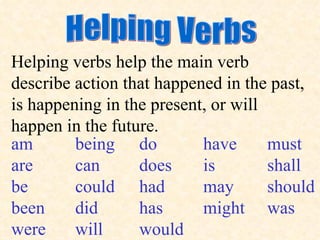
Helping Verbs Helping verbs help the main verb  describe action that happened in the past, is happening in the present, or will happen in the future. am being do have must are can does is shall be could had may should been did has might was were will would
The main verb can have up to three helping verbs. He  must have been   sleeping  soundly to sleep through the alarm . She  could have   gone  to the movies if  she  had   finished  her homework.
Infinitive Form An infinitive is a main verb usually preceded by the word  to .  It does the work of both a verb and a noun. It may be used as an adjective or adverb. To go  often is his goal. Sid likes  to play  the flute. Her desire  to study  often results in perfect scores. Noun Verb Adjective
Verb Tenses There are six main tenses: Present tense –  now The boy  has  brown hair. Past tense –  before now The boy  had  brown hair until he bleached it. Future tense –  has not happened yet The boy  will have  brown hair next week.
Present perfect tense –  started in the past and continuing up to the present. The dog  has had  fleas for five years. Past perfect tense –  finished before some   other past action. He  had gone  to college before he started his business. Future perfect tense –  action will start and finish in the future. I  will have gone  to school for four months before we get a vacation.
Participles A participle is a form of a verb that can be  used as a verb or an adjective. There are two kinds of participles –  past  and present . Present Participles usually end in  - ing. Past Participles usually end in   -ed or -en, or -d, -t, or –n , and follow the helping verbs  have  or  had .
Examples:  Present Participle John is  going  to the school  play. Joey will be  playing  the part  of Captain Lewis. He caught the two boys  cheating . The  singing  choir marched onto the stage.
Examples:  Past Participle Jane had  decided  to try out for the debate  team instead of cheerleading. Beth and Mary have been  chosen  for the team. The boy was  frightened .
Principal Parts of Verbs Each verb has three main parts called principal parts . The infinitive – to swim, to throw, to run The Past Tense – swam, threw, ran The present Participle – (to be) swimming, (to be) throwing, (to be) running The Past Participle – (have/had) swum, (have/had) thrown, (have/had) run
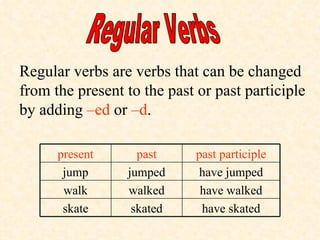
Regular Verbs Regular verbs are verbs that can be changed from the present to the past or past participle by adding  –ed  or  –d . present past past participle jump jumped have jumped walk walked have walked skate skated have skated
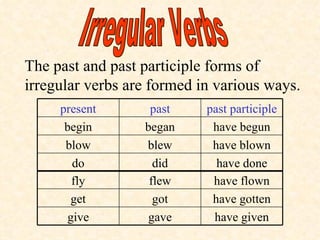
Irregular Verbs The past and past participle forms of  irregular verbs are formed in various ways. present past past participle begin began have begun blow blew have blown do did have done fly flew have flown get got have gotten give gave have given
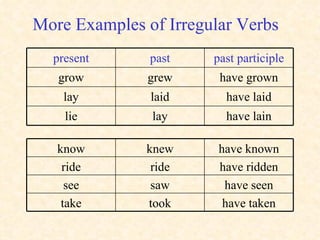
More Examples of Irregular Verbs present past past participle grow grew have grown lay laid have laid lie lay have lain know knew have known ride ride have ridden see saw have seen take took have taken
To Be The Most Often Used Irregular Verb is, am, are, was, were, be, being, been Now I  am . Yesterday I  was . I have  been . Now we  are . Yesterday we  were . We have  been . Just  being  here is great!
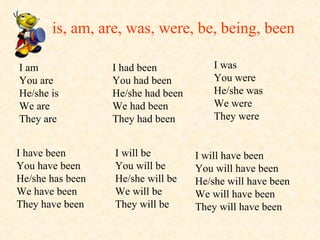
is, am, are, was, were, be, being, been I am You are He/she is We are They are I was You were He/she was We were They were I have been You have been He/she has been We have been They have been I will be You will be He/she will be We will be They will be I will have been You will have been He/she will have been We will have been They will have been I had been You had been He/she had been We had been They had been
The End Verbs

An Introduction to Verbs

  • 1.
    Verbs Verbs –words that describe action or a state of being.
  • 2.
    Action verbs describeactivity. The action may be physical, or may describe a quiet activity. Physical actions: eat, walk, run, sleep, swim, scream, read, write, watch Quite actions: love, think, care, grow, forgive, concentrate
  • 3.
    Linking Verbs Linkingverbs describe a state of being. They connect a noun or adjective to the subject of a clause or sentence. Bob was a great baseball coach. The dinner looks wonderful.
  • 4.
    Helping Verbs Helpingverbs help the main verb describe action that happened in the past, is happening in the present, or will happen in the future. am being do have must are can does is shall be could had may should been did has might was were will would
  • 5.
    The main verbcan have up to three helping verbs. He must have been sleeping soundly to sleep through the alarm . She could have gone to the movies if she had finished her homework.
  • 6.
    Infinitive Form Aninfinitive is a main verb usually preceded by the word to . It does the work of both a verb and a noun. It may be used as an adjective or adverb. To go often is his goal. Sid likes to play the flute. Her desire to study often results in perfect scores. Noun Verb Adjective
  • 7.
    Verb Tenses Thereare six main tenses: Present tense – now The boy has brown hair. Past tense – before now The boy had brown hair until he bleached it. Future tense – has not happened yet The boy will have brown hair next week.
  • 8.
    Present perfect tense– started in the past and continuing up to the present. The dog has had fleas for five years. Past perfect tense – finished before some other past action. He had gone to college before he started his business. Future perfect tense – action will start and finish in the future. I will have gone to school for four months before we get a vacation.
  • 9.
    Participles A participleis a form of a verb that can be used as a verb or an adjective. There are two kinds of participles – past and present . Present Participles usually end in - ing. Past Participles usually end in -ed or -en, or -d, -t, or –n , and follow the helping verbs have or had .
  • 10.
    Examples: PresentParticiple John is going to the school play. Joey will be playing the part of Captain Lewis. He caught the two boys cheating . The singing choir marched onto the stage.
  • 11.
    Examples: PastParticiple Jane had decided to try out for the debate team instead of cheerleading. Beth and Mary have been chosen for the team. The boy was frightened .
  • 12.
    Principal Parts ofVerbs Each verb has three main parts called principal parts . The infinitive – to swim, to throw, to run The Past Tense – swam, threw, ran The present Participle – (to be) swimming, (to be) throwing, (to be) running The Past Participle – (have/had) swum, (have/had) thrown, (have/had) run
  • 13.
    Regular Verbs Regularverbs are verbs that can be changed from the present to the past or past participle by adding –ed or –d . present past past participle jump jumped have jumped walk walked have walked skate skated have skated
  • 14.
    Irregular Verbs Thepast and past participle forms of irregular verbs are formed in various ways. present past past participle begin began have begun blow blew have blown do did have done fly flew have flown get got have gotten give gave have given
  • 15.
    More Examples ofIrregular Verbs present past past participle grow grew have grown lay laid have laid lie lay have lain know knew have known ride ride have ridden see saw have seen take took have taken
  • 16.
    To Be TheMost Often Used Irregular Verb is, am, are, was, were, be, being, been Now I am . Yesterday I was . I have been . Now we are . Yesterday we were . We have been . Just being here is great!
  • 17.
    is, am, are,was, were, be, being, been I am You are He/she is We are They are I was You were He/she was We were They were I have been You have been He/she has been We have been They have been I will be You will be He/she will be We will be They will be I will have been You will have been He/she will have been We will have been They will have been I had been You had been He/she had been We had been They had been
  • 18.