Introduction
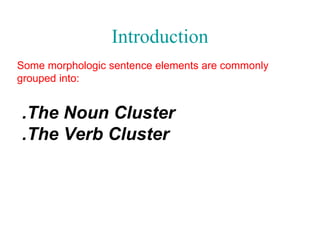
Some morphologic sentence elements are commonly
grouped into:

.The Noun Cluster
.The Verb Cluster
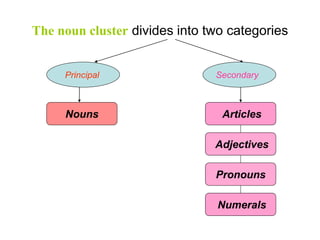
The noun cluster divides into two categories

Principal

Nouns

Secondary

Articles
Adjectives

Pronouns
Numerals
ADJECTIVES
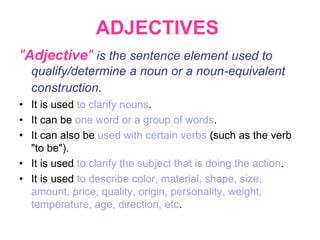
"Adjective" is the sentence element used to
qualify/determine a noun or a noun-equivalent
construction.
• It is used to clarify nouns.
• It can be one word or a group of words.
• It can also be used with certain verbs (such as the verb
"to be").
• It is used to clarify the subject that is doing the action.
• It is used to describe color, material, shape, size,
amount, price, quality, origin, personality, weight,
temperature, age, direction, etc.
CATEGORIES OF ADJECTIVES
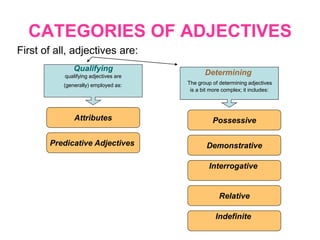
First of all, adjectives are:
Qualifying
qualifying adjectives are
(generally) employed as:

Determining
The group of determining adjectives
is a bit more complex; it includes:

Attributes

Possessive

Predicative Adjectives

Demonstrative
Interrogative

Relative
Indefinite
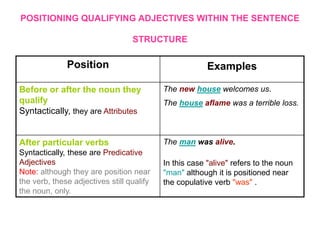
POSITIONING QUALIFYING ADJECTIVES WITHIN THE SENTENCE
STRUCTURE

Position

Examples

Before or after the noun they
qualify
Syntactically, they are Attributes

The new house welcomes us.

After particular verbs

The man was alive.

Syntactically, these are Predicative
Adjectives
Note: although they are position near
the verb, these adjectives still qualify
the noun, only.

In this case "alive" refers to the noun
"man" although it is positioned near
the copulative verb "was" .

The house aflame was a terrible loss.
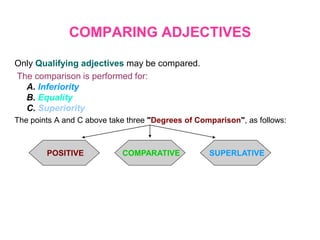
COMPARING ADJECTIVES
Only Qualifying adjectives may be compared.
The comparison is performed for:
A. Inferiority
B. Equality
C. Superiority
The points A and C above take three "Degrees of Comparison", as follows:

POSITIVE

COMPARATIVE

SUPERLATIVE
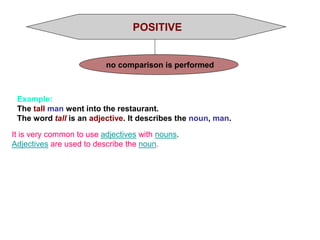
POSITIVE

no comparison is performed

Example:
The tall man went into the restaurant.
The word tall is an adjective. It describes the noun, man.
It is very common to use adjectives with nouns.
Adjectives are used to describe the noun.
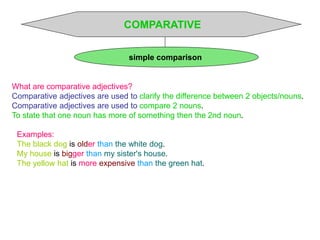
COMPARATIVE
simple comparison

What are comparative adjectives?
Comparative adjectives are used to clarify the difference between 2 objects/nouns.
Comparative adjectives are used to compare 2 nouns.
To state that one noun has more of something then the 2nd noun.
Examples:
The black dog is older than the white dog.
My house is bigger than my sister's house.
The yellow hat is more expensive than the green hat.
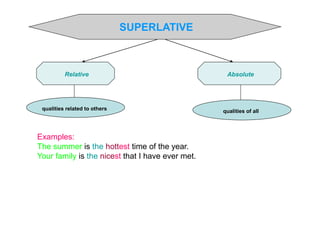
SUPERLATIVE

Relative

qualities related to others

Examples:
The summer is the hottest time of the year.
Your family is the nicest that I have ever met.

Absolute

qualities of all
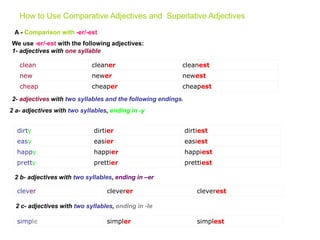
How to Use Comparative Adjectives and Superlative Adjectives
A - Comparison with -er/-est
We use -er/-est with the following adjectives:
1- adjectives with one syllable
clean

cleaner

cleanest

new

newer

newest

cheap

cheaper

cheapest

2- adjectives with two syllables and the following endings:
2 a- adjectives with two syllables, ending in -y

dirty

dirtier

dirtiest

easy

easier

easiest

happy

happier

happiest

pretty

prettier

prettiest

2 b- adjectives with two syllables, ending in –er
clever

cleverer

cleverest

2 c- adjectives with two syllables, ending in -le

simple

simpler

simplest
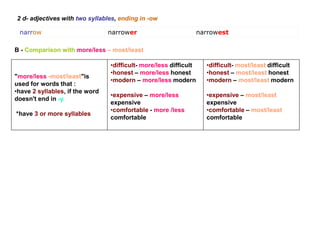
2 d- adjectives with two syllables, ending in -ow
narrow

narrower

narrowest

B - Comparison with more/less – most/least

"more/less -most/least"is
used for words that :
•have 2 syllables, if the word
doesn't end in -y.
*have 3 or more syllables

•difficult- more/less difficult
•honest – more/less honest
•modern – more/less modern

•difficult- most/least difficult
•honest – most/least honest
•modern – most/least modern

•expensive – more/less
expensive
•comfortable - more /less
comfortable

•expensive – most/least
expensive
•comfortable – most/least
comfortable
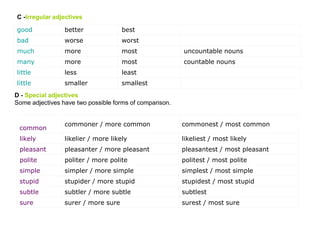
C -Irregular adjectives
good

better

best

bad

worse

worst

much

more

most

uncountable nouns

many

more

most

countable nouns

little

less

least

little

smaller

smallest

D - Special adjectives
Some adjectives have two possible forms of comparison.
commoner / more common

commonest / most common

likely

likelier / more likely

likeliest / most likely

pleasant

pleasanter / more pleasant

pleasantest / most pleasant

polite

politer / more polite

politest / most polite

simple

simpler / more simple

simplest / most simple

stupid

stupider / more stupid

stupidest / most stupid

subtle

subtler / more subtle

subtlest

sure

surer / more sure

surest / most sure

common
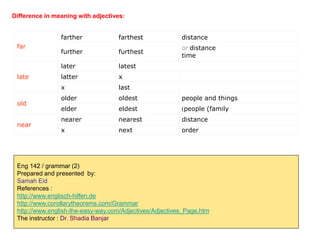
Difference in meaning with adjectives:
farther

old
near

further

furthest

or distance
time

latest

latter

x

x

late

distance

later

far

farthest

last

older

oldest

people and things

elder

eldest

)people (family

nearer

nearest

distance

x

next

order

Eng 142 / grammar (2)
Prepared and presented by:
Samah Eid
References :
http://www.englisch-hilfen.de
http://www.corollarytheorems.com/Grammar
http://www.english-the-easy-way.com/Adjectives/Adjectives_Page.htm
The instructor : Dr. Shadia Banjar

Adjectives ppt

  • 1.
    Introduction Some morphologic sentenceelements are commonly grouped into: .The Noun Cluster .The Verb Cluster
  • 2.
    The noun clusterdivides into two categories Principal Nouns Secondary Articles Adjectives Pronouns Numerals
  • 3.
    ADJECTIVES "Adjective" is thesentence element used to qualify/determine a noun or a noun-equivalent construction. • It is used to clarify nouns. • It can be one word or a group of words. • It can also be used with certain verbs (such as the verb "to be"). • It is used to clarify the subject that is doing the action. • It is used to describe color, material, shape, size, amount, price, quality, origin, personality, weight, temperature, age, direction, etc.
  • 4.
    CATEGORIES OF ADJECTIVES Firstof all, adjectives are: Qualifying qualifying adjectives are (generally) employed as: Determining The group of determining adjectives is a bit more complex; it includes: Attributes Possessive Predicative Adjectives Demonstrative Interrogative Relative Indefinite
  • 5.
    POSITIONING QUALIFYING ADJECTIVESWITHIN THE SENTENCE STRUCTURE Position Examples Before or after the noun they qualify Syntactically, they are Attributes The new house welcomes us. After particular verbs The man was alive. Syntactically, these are Predicative Adjectives Note: although they are position near the verb, these adjectives still qualify the noun, only. In this case "alive" refers to the noun "man" although it is positioned near the copulative verb "was" . The house aflame was a terrible loss.
  • 6.
    COMPARING ADJECTIVES Only Qualifyingadjectives may be compared. The comparison is performed for: A. Inferiority B. Equality C. Superiority The points A and C above take three "Degrees of Comparison", as follows: POSITIVE COMPARATIVE SUPERLATIVE
  • 7.
    POSITIVE no comparison isperformed Example: The tall man went into the restaurant. The word tall is an adjective. It describes the noun, man. It is very common to use adjectives with nouns. Adjectives are used to describe the noun.
  • 8.
    COMPARATIVE simple comparison What arecomparative adjectives? Comparative adjectives are used to clarify the difference between 2 objects/nouns. Comparative adjectives are used to compare 2 nouns. To state that one noun has more of something then the 2nd noun. Examples: The black dog is older than the white dog. My house is bigger than my sister's house. The yellow hat is more expensive than the green hat.
  • 9.
    SUPERLATIVE Relative qualities related toothers Examples: The summer is the hottest time of the year. Your family is the nicest that I have ever met. Absolute qualities of all
  • 10.
    How to UseComparative Adjectives and Superlative Adjectives A - Comparison with -er/-est We use -er/-est with the following adjectives: 1- adjectives with one syllable clean cleaner cleanest new newer newest cheap cheaper cheapest 2- adjectives with two syllables and the following endings: 2 a- adjectives with two syllables, ending in -y dirty dirtier dirtiest easy easier easiest happy happier happiest pretty prettier prettiest 2 b- adjectives with two syllables, ending in –er clever cleverer cleverest 2 c- adjectives with two syllables, ending in -le simple simpler simplest
  • 11.
    2 d- adjectiveswith two syllables, ending in -ow narrow narrower narrowest B - Comparison with more/less – most/least "more/less -most/least"is used for words that : •have 2 syllables, if the word doesn't end in -y. *have 3 or more syllables •difficult- more/less difficult •honest – more/less honest •modern – more/less modern •difficult- most/least difficult •honest – most/least honest •modern – most/least modern •expensive – more/less expensive •comfortable - more /less comfortable •expensive – most/least expensive •comfortable – most/least comfortable
  • 12.
    C -Irregular adjectives good better best bad worse worst much more most uncountablenouns many more most countable nouns little less least little smaller smallest D - Special adjectives Some adjectives have two possible forms of comparison. commoner / more common commonest / most common likely likelier / more likely likeliest / most likely pleasant pleasanter / more pleasant pleasantest / most pleasant polite politer / more polite politest / most polite simple simpler / more simple simplest / most simple stupid stupider / more stupid stupidest / most stupid subtle subtler / more subtle subtlest sure surer / more sure surest / most sure common
  • 13.
    Difference in meaningwith adjectives: farther old near further furthest or distance time latest latter x x late distance later far farthest last older oldest people and things elder eldest )people (family nearer nearest distance x next order Eng 142 / grammar (2) Prepared and presented by: Samah Eid References : http://www.englisch-hilfen.de http://www.corollarytheorems.com/Grammar http://www.english-the-easy-way.com/Adjectives/Adjectives_Page.htm The instructor : Dr. Shadia Banjar