Articles
Articles in English
There are only three articles in English: a , an
and the. Besides the usage of those three
ones we have to be aware of the use of no
article ( ).ᴓ
Indefinite articles
They are a and an.
They are used before singular count nouns or
adjective + count nouns;
“an” is used for nouns that begin with vowel
sond. Remember that “h” and “u” can be
tricky. Ex: an hour and a university.
* The use of “a” and “an” is determined by the
sound not the spelling.
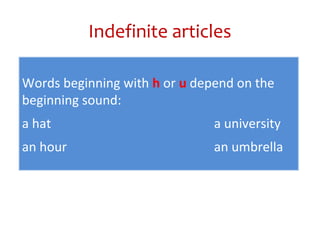
Indefinite articles
Words beginning with h or u depend on the
beginning sound:
a hat a university
an hour an umbrella
Definite article
We use “the” when we are talking about
something specific;
When the speaker and the listener are
talking about the same specific item;
For the second and all other references to
the same noun;
With the superlative form of an adjective;
Definite article
For the name of countries that look plural,
ending in -s or with the words united, union,
republic or kingdom;
Parts of something (except for body parts);
Most bodies of water (except individual
lakes);
With geographic parts of the globe and
geographic areas, deserts and peninsulas.
No articles
• Before plural and noncountable nouns when talking about
things in general:
“I like potatoes.” / “Milk is good for you.”
• Before countries, towns, streets, languages, magazines,
meals, airports, stations, and mountains:
“I had dinner with John.” / I bought Cosmopolitan at South
Station.”
• Before some places and some forms of transport (at home,
at/to school, at/to work, in/to bed, by bus, by train, by car,
by plane, on foot):
“She goes to work by bus.” / “I was at home last night.”
• In exclamations with what + a noncount noun:
Common ELL mistakes
No use of a singular count noun without an
article (or other determiner)
Example: job instead of a job
Use of a with a noun that begins with a vowel
sound
Example: a heir instead of an heir
No use of the with a plural count noun that
refers to the whole category
Example: I dont trust politicians.
Not I don’t trust the politicians.
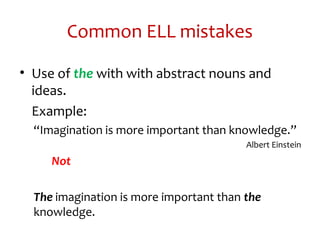
Common ELL mistakes
• Use of the with with abstract nouns and
ideas.
Example:
“Imagination is more important than knowledge.”
Albert Einstein
Not
The imagination is more important than the
knowledge.
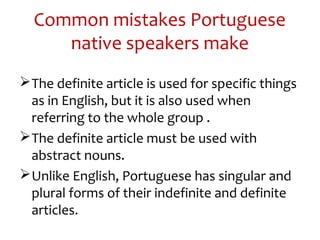
Common mistakes Portuguese
native speakers make
The definite article is used for specific things
as in English, but it is also used when
referring to the whole group .
The definite article must be used with
abstract nouns.
Unlike English, Portuguese has singular and
plural forms of their indefinite and definite
articles.
Now, let’s practice
the correct use of
the articles.
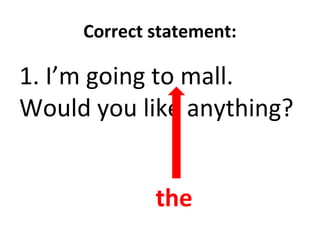
Correct statement:
1. I’m going to mall.
Would you like anything?
the
Correct the statement:
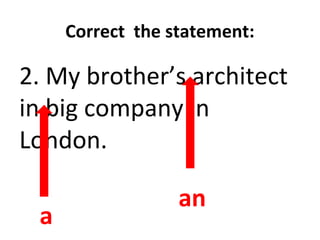
2. My brother’s architect
in big company in
London.
an
a
Correct the statement:
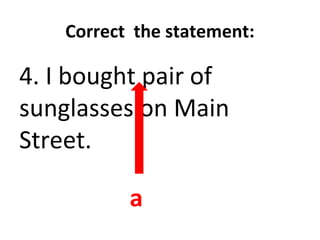
4. I bought pair of
sunglasses on Main
Street.
a
Correct the statement:
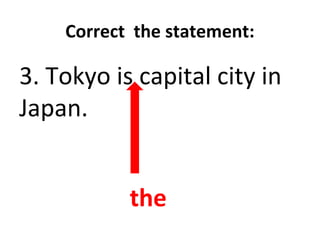
3. Tokyo is capital city in
Japan.
the
Correct the statement:
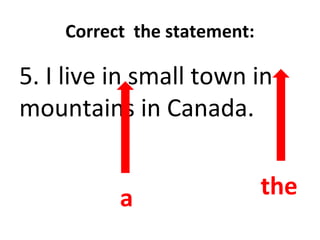
5. I live in small town in
mountains in Canada.
a the
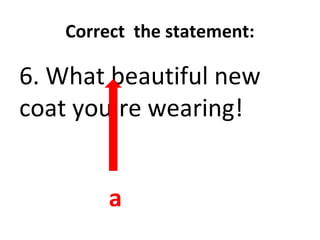
Correct the statement:
6. What beautiful new
coat you’re wearing!
a
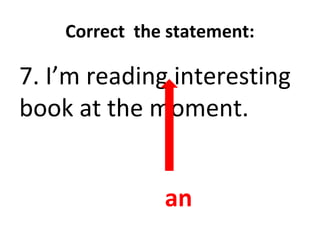
Correct the statement:
7. I’m reading interesting
book at the moment.
an
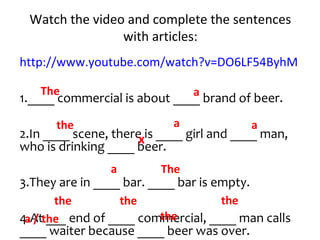
Watch the video and complete the sentences
with articles:
http://www.youtube.com/watch?v=DO6LF54ByhM
1.____ commercial is about ____ brand of beer.
2.In ____ scene, there is ____ girl and ____ man,
who is drinking ____ beer.
3.They are in ____ bar. ____ bar is empty.
4.At ___ end of ____ commercial, ____ man calls
____ waiter because ____ beer was over.
The a
the a
x
a / the
a
a The
thethe
the
the

Alexandre isomura

  • 1.
  • 2.
    Articles in English Thereare only three articles in English: a , an and the. Besides the usage of those three ones we have to be aware of the use of no article ( ).ᴓ
  • 3.
    Indefinite articles They area and an. They are used before singular count nouns or adjective + count nouns; “an” is used for nouns that begin with vowel sond. Remember that “h” and “u” can be tricky. Ex: an hour and a university. * The use of “a” and “an” is determined by the sound not the spelling.
  • 4.
    Indefinite articles Words beginningwith h or u depend on the beginning sound: a hat a university an hour an umbrella
  • 5.
    Definite article We use“the” when we are talking about something specific; When the speaker and the listener are talking about the same specific item; For the second and all other references to the same noun; With the superlative form of an adjective;
  • 6.
    Definite article For thename of countries that look plural, ending in -s or with the words united, union, republic or kingdom; Parts of something (except for body parts); Most bodies of water (except individual lakes); With geographic parts of the globe and geographic areas, deserts and peninsulas.
  • 7.
    No articles • Beforeplural and noncountable nouns when talking about things in general: “I like potatoes.” / “Milk is good for you.” • Before countries, towns, streets, languages, magazines, meals, airports, stations, and mountains: “I had dinner with John.” / I bought Cosmopolitan at South Station.” • Before some places and some forms of transport (at home, at/to school, at/to work, in/to bed, by bus, by train, by car, by plane, on foot): “She goes to work by bus.” / “I was at home last night.” • In exclamations with what + a noncount noun:
  • 8.
    Common ELL mistakes Nouse of a singular count noun without an article (or other determiner) Example: job instead of a job Use of a with a noun that begins with a vowel sound Example: a heir instead of an heir No use of the with a plural count noun that refers to the whole category Example: I dont trust politicians. Not I don’t trust the politicians.
  • 9.
    Common ELL mistakes •Use of the with with abstract nouns and ideas. Example: “Imagination is more important than knowledge.” Albert Einstein Not The imagination is more important than the knowledge.
  • 10.
    Common mistakes Portuguese nativespeakers make The definite article is used for specific things as in English, but it is also used when referring to the whole group . The definite article must be used with abstract nouns. Unlike English, Portuguese has singular and plural forms of their indefinite and definite articles.
  • 11.
    Now, let’s practice thecorrect use of the articles.
  • 12.
    Correct statement: 1. I’mgoing to mall. Would you like anything? the
  • 13.
    Correct the statement: 2.My brother’s architect in big company in London. an a
  • 14.
    Correct the statement: 4.I bought pair of sunglasses on Main Street. a
  • 15.
    Correct the statement: 3.Tokyo is capital city in Japan. the
  • 16.
    Correct the statement: 5.I live in small town in mountains in Canada. a the
  • 17.
    Correct the statement: 6.What beautiful new coat you’re wearing! a
  • 18.
    Correct the statement: 7.I’m reading interesting book at the moment. an
  • 19.
    Watch the videoand complete the sentences with articles: http://www.youtube.com/watch?v=DO6LF54ByhM 1.____ commercial is about ____ brand of beer. 2.In ____ scene, there is ____ girl and ____ man, who is drinking ____ beer. 3.They are in ____ bar. ____ bar is empty. 4.At ___ end of ____ commercial, ____ man calls ____ waiter because ____ beer was over. The a the a x a / the a a The thethe the the