ADVERB MANNER

 PREPARED BY:
 SUTASINI
 KASTHURI
 PATRISHA
 VHINAHSHINI
 LU SHIAU YEE
ADVERB

 Adverbs are used to modify a verb, an
  adjective, or another adverb:
 [1] Mary sings beautifully
  [2] David is extremely clever
  [3] This car goes incredibly fast
Formal Characteristics of
  Adverbs
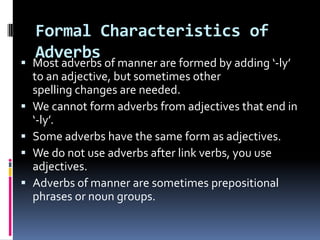
 Most adverbs of manner are formed by adding ‘-ly’
  to an adjective, but sometimes other
  spelling changes are needed.
 We cannot form adverbs from adjectives that end in
  ‘-ly’.
 Some adverbs have the same form as adjectives.
 We do not use adverbs after link verbs, you use
  adjectives.
 Adverbs of manner are sometimes prepositional
  phrases or noun groups.
Spelling rules for adding -
ly
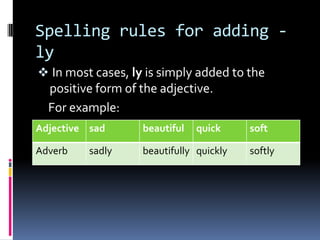
 In most cases, ly is simply added to the
  positive form of the adjective.
  For example:
Adjective sad      beautiful   quick     soft

Adverb    sadly    beautifully quickly   softly
Adjectives ending in -ic
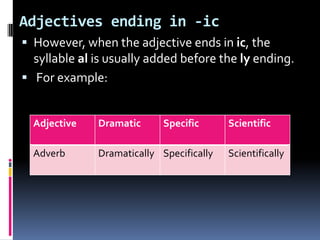
 However, when the adjective ends in ic, the
  syllable al is usually added before the ly ending.
 For example:


  Adjective   Dramatic      Specific      Scientific

  Adverb      Dramatically Specifically   Scientifically
. Adjectives ending in le

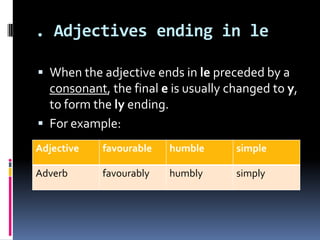
 When the adjective ends in le preceded by a
  consonant, the final e is usually changed to y,
  to form the ly ending.
 For example:
Adjective   favourable   humble      simple

Adverb      favourably   humbly      simply
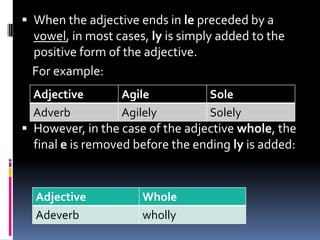
 When the adjective ends in le preceded by a
 vowel, in most cases, ly is simply added to the
 positive form of the adjective.
 For example:
  Adjective       Agile           Sole
  Adverb          Agilely         Solely
 However, in the case of the adjective whole, the
  final e is removed before the ending ly is added:


  Adjective           Whole
  Adeverb             wholly
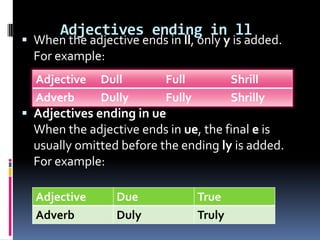
Adjectives ending in ll
 When the adjective ends in ll, only y is added.
  For example:
  Adjective   Dull         Full            Shrill
  Adverb      Dully        Fully           Shrilly
 Adjectives ending in ue
  When the adjective ends in ue, the final e is
  usually omitted before the ending ly is added.
  For example:

  Adjective      Due               True
  Adverb         Duly              Truly
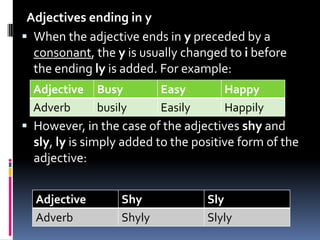
Adjectives ending in y
 When the adjective ends in y preceded by a
  consonant, the y is usually changed to i before
  the ending ly is added. For example:
  Adjective   Busy        Easy        Happy
  Adverb      busily      Easily      Happily
 However, in the case of the adjectives shy and
  sly, ly is simply added to the positive form of the
  adjective:


  Adjective       Shy              Sly
  Adverb          Shyly            Slyly
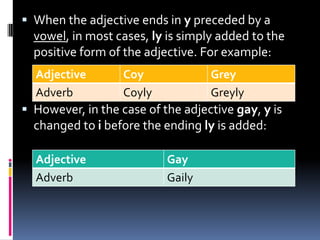
 When the adjective ends in y preceded by a
  vowel, in most cases, ly is simply added to the
  positive form of the adjective. For example:
  Adjective        Coy             Grey
  Adverb           Coyly           Greyly
 However, in the case of the adjective gay, y is
  changed to i before the ending ly is added:

  Adjective                Gay
  Adverb                   Gaily
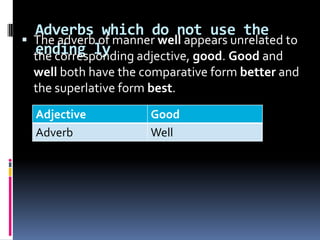
Adverbs which do not use the
   The adverb of manner well appears unrelated to
    ending ly
    the corresponding adjective, good. Good and
    well both have the comparative form better and
    the superlative form best.
    Adjective           Good
    Adverb              Well
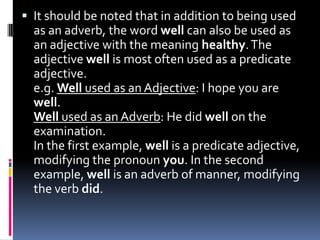
 It should be noted that in addition to being used
  as an adverb, the word well can also be used as
  an adjective with the meaning healthy. The
  adjective well is most often used as a predicate
  adjective.
  e.g. Well used as an Adjective: I hope you are
  well.
  Well used as an Adverb: He did well on the
  examination.
  In the first example, well is a predicate adjective,
  modifying the pronoun you. In the second
  example, well is an adverb of manner, modifying
  the verb did.
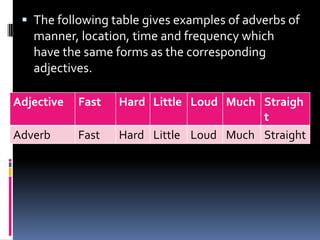
 The following table gives examples of adverbs of
   manner, location, time and frequency which
   have the same forms as the corresponding
   adjectives.

Adjective   Fast   Hard Little Loud Much Straigh
                                         t
Adverb      Fast   Hard Little Loud Much Straight
Adverb manner slide

Adverb manner slide

  • 1.
    ADVERB MANNER PREPAREDBY: SUTASINI KASTHURI PATRISHA VHINAHSHINI LU SHIAU YEE
  • 2.
    ADVERB  Adverbs areused to modify a verb, an adjective, or another adverb:  [1] Mary sings beautifully [2] David is extremely clever [3] This car goes incredibly fast
  • 3.
    Formal Characteristics of Adverbs  Most adverbs of manner are formed by adding ‘-ly’ to an adjective, but sometimes other spelling changes are needed.  We cannot form adverbs from adjectives that end in ‘-ly’.  Some adverbs have the same form as adjectives.  We do not use adverbs after link verbs, you use adjectives.  Adverbs of manner are sometimes prepositional phrases or noun groups.
  • 4.
    Spelling rules foradding - ly  In most cases, ly is simply added to the positive form of the adjective. For example: Adjective sad beautiful quick soft Adverb sadly beautifully quickly softly
  • 5.
    Adjectives ending in-ic  However, when the adjective ends in ic, the syllable al is usually added before the ly ending.  For example: Adjective Dramatic Specific Scientific Adverb Dramatically Specifically Scientifically
  • 6.
    . Adjectives endingin le  When the adjective ends in le preceded by a consonant, the final e is usually changed to y, to form the ly ending.  For example: Adjective favourable humble simple Adverb favourably humbly simply
  • 7.
     When theadjective ends in le preceded by a vowel, in most cases, ly is simply added to the positive form of the adjective. For example: Adjective Agile Sole Adverb Agilely Solely  However, in the case of the adjective whole, the final e is removed before the ending ly is added: Adjective Whole Adeverb wholly
  • 8.
    Adjectives ending inll  When the adjective ends in ll, only y is added. For example: Adjective Dull Full Shrill Adverb Dully Fully Shrilly  Adjectives ending in ue When the adjective ends in ue, the final e is usually omitted before the ending ly is added. For example: Adjective Due True Adverb Duly Truly
  • 9.
    Adjectives ending iny  When the adjective ends in y preceded by a consonant, the y is usually changed to i before the ending ly is added. For example: Adjective Busy Easy Happy Adverb busily Easily Happily  However, in the case of the adjectives shy and sly, ly is simply added to the positive form of the adjective: Adjective Shy Sly Adverb Shyly Slyly
  • 10.
     When theadjective ends in y preceded by a vowel, in most cases, ly is simply added to the positive form of the adjective. For example: Adjective Coy Grey Adverb Coyly Greyly  However, in the case of the adjective gay, y is changed to i before the ending ly is added: Adjective Gay Adverb Gaily
  • 11.
    Adverbs which donot use the  The adverb of manner well appears unrelated to ending ly the corresponding adjective, good. Good and well both have the comparative form better and the superlative form best. Adjective Good Adverb Well
  • 12.
     It shouldbe noted that in addition to being used as an adverb, the word well can also be used as an adjective with the meaning healthy. The adjective well is most often used as a predicate adjective. e.g. Well used as an Adjective: I hope you are well. Well used as an Adverb: He did well on the examination. In the first example, well is a predicate adjective, modifying the pronoun you. In the second example, well is an adverb of manner, modifying the verb did.
  • 13.
     The followingtable gives examples of adverbs of manner, location, time and frequency which have the same forms as the corresponding adjectives. Adjective Fast Hard Little Loud Much Straigh t Adverb Fast Hard Little Loud Much Straight