






Dr. Ashraf El Adawy 
Consultant Chest Physician 
TB TEAM EXPERT – WHO 
Mansoura -Egypt 
TB Suspect Management
Identify TB suspects
Tuberculosis should be suspected if the patient has one or more of the following symptoms: 
1.Persistent cough for two or more weeks with or without Production of sputum which may be blood- stained not responding to non-specific treatment (including antibiotics with no anti-TB effect i.e. avoid Rifampicin, aminoglycosides and Quinolones) 
2.Breathlessness 
3.Chest pain 
4.General symptoms such as loss of appetite, loss of weight, night sweat and fever 
5.A history of contact with a TB patient
Tuberculosis should be suspected if the patient has one or more of the following symptoms: 
1.Persistent cough for two or more weeks with or without Production of sputum which may be blood- stained not responding to non-specific treatment (including antibiotics with no anti-TB effect i.e. avoid Rifampicin, aminoglycosides and Quinolones) 
2.Breathlessness 
3.Chest pain 
4.General symptoms such as loss of appetite, loss of weight, night sweat and fever 
5.A history of contact with a TB patient
Identify TB suspects 
 Cough is the most common symptom of pulmonary TB and is present in 95% of all sputum smear- positive TB cases. However, the large majority of persons with cough do not have TB. 
 Many conditions affecting the lower respiratory tract cause cough. Therefore, examining the sputum of all persons who cough is not recommended, because this would be expensive and time-consuming.
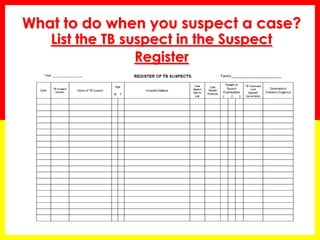
What to do when you suspect a case? List the TB suspect in the Suspect Register
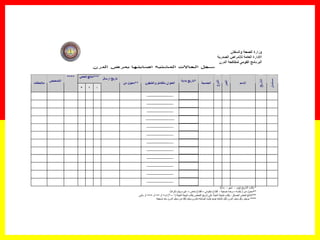
List the TB suspect in the Suspect Register 
The Register of TB Suspects is a record of: - , 
-All patients identified as TB suspects at the health facility 
- All sputum samples sent to the laboratory. List the name and complete detailed address of every TB suspect in the TB Suspects Register.
Be sure to write down a complete name and address so that the TB suspect can be located if the result is positive and the TB suspect does not return. 
If the patient does not return to the health facility for the results, someone from the health facility must visit the patient’s home 
List the TB suspect in the Suspect Register
If the TB suspect with all samples are negative does not return to find out the results, it is necessary to locate that patient to confirm or exclude other conditions.
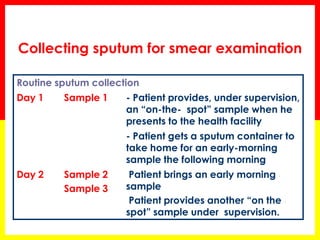
Collecting sputum for smear examination 
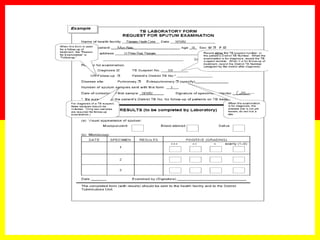
Send the TB suspect directly to the laboratory for sputum examination for AFB. 
A diagnostic sputum examination is most accurate with three sputum samples.
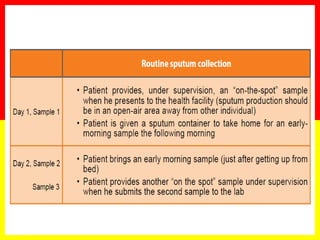
Routine sputum collection 
- Patient provides, under supervision, an “on-the- spot” sample when he presents to the health facility 
Sample 1 
Day 1 
- Patient gets a sputum container to take home for an early-morning sample the following morning 
- Patient brings an early morning sample 
- Patient provides another “on the spot” sample under supervision. 
Sample 2 
Sample 3 
Day 2 
Collecting sputum for smear examination
15
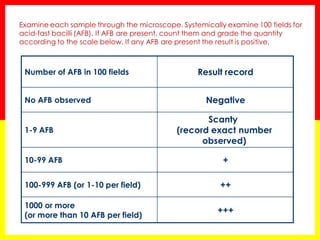
Result record 
Number of AFB in 100 fields 
Negative 
No AFB observed 
Scanty 
(record exact number observed) 
1-9 AFB 
+ 
10-99 AFB 
++ 
100-999 AFB (or 1-10 per field) 
+++ 
1000 or more 
(or more than 10 AFB per field) 
Examine each sample through the microscope. Systemically examine 100 fields for acid-fast bacilli (AFB). If AFB are present, count them and grade the quantity according to the scale below. If any AFB are present the result is positive.
Remember 
These precautions are followed by the Lab technician 
1. The containers are labeled not the lids before collecting the sputum samples. 
2.Sputum collection should be in a well-ventilated area, preferably outdoors. 
3.The sample should contain sufficient sputum, not just saliva. 
4.After collecting the sputum, the lid should be tightly closed.
Sensitivity of sputum smear microscopy 
Sputum smear microscopy for tubercle bacilli is positive when there are at least 10,000 organisms present per 1 ml of sputum.
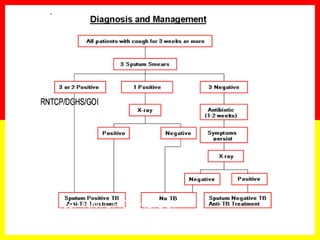
•When the laboratory results are received, record results in the Register of TB Suspects and decide on appropriate action
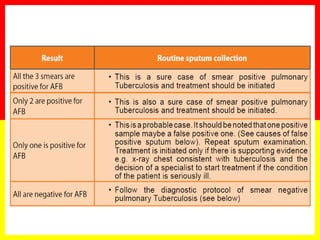
Possibilities of sputum results 
1 sample is positive 
2 samples are positive 
3 samples are positive 
3 samples are negative
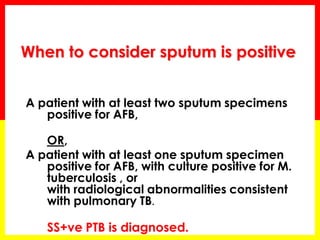
A patient with at least two sputum specimens positive for AFB, 
OR, 
A patient with at least one sputum specimen positive for AFB, with culture positive for M. tuberculosis , or with radiological abnormalities consistent with pulmonary TB. 
SS+ve PTB is diagnosed. 
When to consider sputum is positive
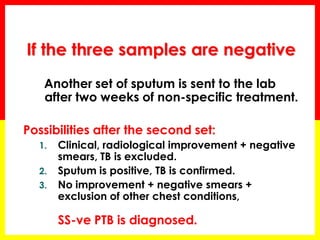
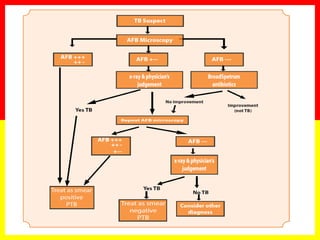
If the three samples are negative 
Another set of sputum is sent to the lab after two weeks of non-specific treatment. 
Possibilities after the second set: 
1.Clinical, radiological improvement + negative smears, TB is excluded. 
2.Sputum is positive, TB is confirmed. 
3.No improvement + negative smears + exclusion of other chest conditions, SS-ve PTB is diagnosed.
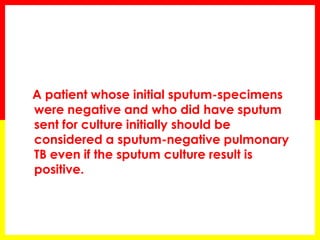
A patient whose initial sputum-specimens were negative and who did have sputum sent for culture initially should be considered a sputum-negative pulmonary TB even if the sputum culture result is positive.
25
Source: RNTCP/DGHS/GOI
27
Bacteriology 
T 
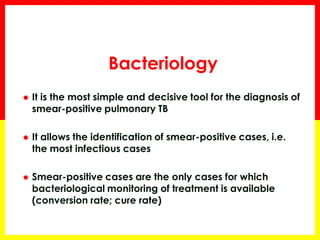
It is the most simple and decisive tool for the diagnosis of smear-positive pulmonary TB 
It allows the identification of smear-positive cases, i.e. the most infectious cases 
Smear-positive cases are the only cases for which bacteriological monitoring of treatment is available (conversion rate; cure rate)
Causes of false positive direct sputum smear examination for AFB with ZN stain 
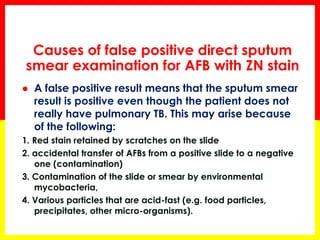
A false positive result means that the sputum smear result is positive even though the patient does not really have pulmonary TB. This may arise because of the following: 
1. Red stain retained by scratches on the slide 
2. accidental transfer of AFBs from a positive slide to a negative one (contamination) 
3. Contamination of the slide or smear by environmental mycobacteria, 
4. Various particles that are acid-fast (e.g. food particles, precipitates, other micro-organisms).
False positive results of sputum smear microscopy 
A false positive result means that the sputum smear result is positive even though the patient dose not really have sputum smear-positive PTB. 
●This may arise because of the following: 
1.Red stain retained by scratches on the slide; 
2.Contamination of the slide. 
3.Various particles that are acid-fast (e.g. food particle, dye precipitates, other micro- organisms).
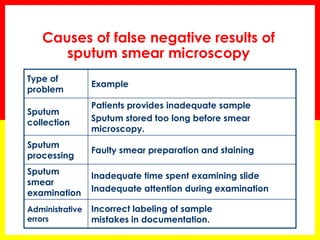
Causes of false negative results of sputum smear microscopy 
Example 
Type of problem 
Patients provides inadequate sample 
Sputum stored too long before smear microscopy. 
Sputum collection 
Faulty smear preparation and staining 
Sputum processing 
Inadequate time spent examining slide 
Inadequate attention during examination 
Sputum smear examination 
Incorrect labeling of sample mistakes in documentation. 
Administrative errors
Diagnosis of Pulmonary TB 
is 
a bacteriological one.
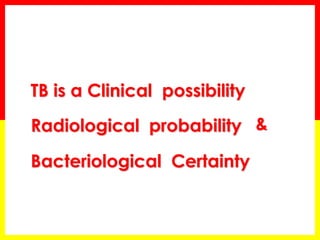
TB is a Clinical possibility 
Radiological probability Bacteriological Certainty 
&
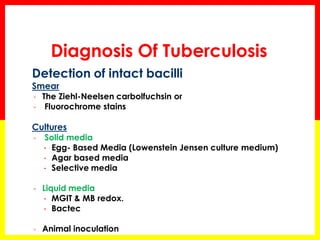
Diagnosis Of Tuberculosis 
•Detection of intact bacilli 
•Smear 
▫The Ziehl-Neelsen carbolfuchsin or 
▫ Fluorochrome stains 
•Cultures 
▫ Solid media 
Egg- Based Media (Lowenstein Jensen culture medium) 
Agar based media 
Selective media 
▫Liquid media 
MGIT & MB redox. 
Bactec 
▫Animal inoculation
Solid Conventional Culture (Lowenstein-Jansen medium ) 
Culture of sputum is more sensitive (require from 10- 100 mycobacteria /ml sputum) than smear examination (which will be positive if there are 104- 105 mycobacteria/1ml sputum) 
It takes from four to eight weeks before the result is known. 
It also requires well-equipped laboratories with skilled staff. 
37
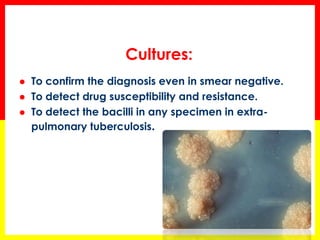
Cultures: 
To confirm the diagnosis even in smear negative. 
To detect drug susceptibility and resistance. 
To detect the bacilli in any specimen in extra- pulmonary tuberculosis.
Indications of culture: 
1. Some of extra-pulmonary tuberculosis. 
2. For all cases of smear negative pulmonary tuberculosis. 
3. For differentiating Mycobacteria tuberculosis complex from other non-Tuberculosis Mycobacteria. 
4. Culture is done with drug susceptibility testing, DST, for new smear positive pulmonary tuberculosis who remain positive at the end of the second month of treatment with Cat I treatment course and for all retreatment (after relapse, after failure and after default) before starting Cat II retreatment course. 
39
Informing TB suspects of results of sputum examination 
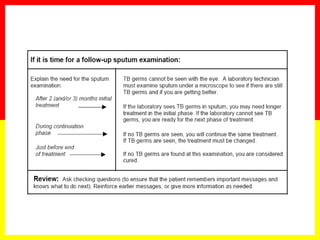
1.When you inform the patient that the sputum examination showed TB, explain in simple terms what TB is and what type of TB the patient has. Reassure the patient that TB can be cured and that treatment is given free of charge. 
2.Inform the patient about TB, directly observed treatment, the treatment regimen, TB transmission 
3. Discuss main worries or doubts and answer any questions.
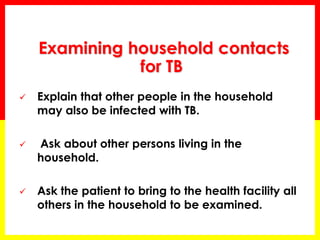
Examining household contacts for TB 
Explain that other people in the household may also be infected with TB. 
 Ask about other persons living in the household. 
Ask the patient to bring to the health facility all others in the household to be examined.
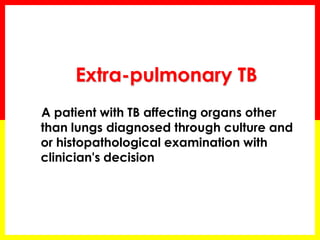
Extra-pulmonary TB 
A patient with TB affecting organs other than lungs diagnosed through culture and or histopathological examination with clinician's decision
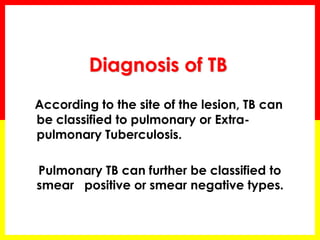
Diagnosis of TB 
According to the site of the lesion, TB can be classified to pulmonary or Extra- pulmonary Tuberculosis. 
Pulmonary TB can further be classified to smear positive or smear negative types.
Diagnosis of Pulmonary TB is A bacteriological one 
Microscopic Direct Smear Examination 
Cultures: 
1.To confirm the diagnosis even in smear negative. 
2.To detect drug susceptibility and resistance. 
3.To detect the bacilli in any specimen in extra pulmonary tuberculosis.
Chest X-rays in diagnosis 
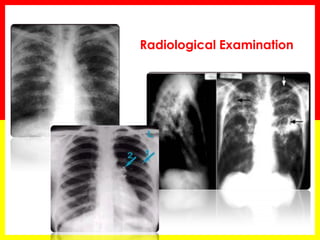
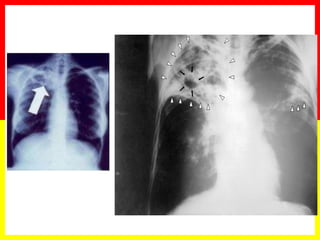
No certain x-ray pattern is specific to TB 
INDICATIONS FOR CHEST X-RAY 
The first screening test for PTB suspects is sputum smear microscopy. 
In most cases of sputum smear-positive PTB a chest X-ray is un-necessary.
a) Suspected complications in the breathless patient, needing specific treatment, e.g. pneumothorax, pericardial effusion or pleural effusion - positive sputum smear is rare); 
b) Frequent or severe haemoptysis (to exclude bronchiectasis or aspergilloma); 
c) Only 1 sputum smear positive out of 3 (in this case, an abnormal chest X-ray is a necessary additional criterion for the diagnosis of sputum smear-positive PTB). 
INDICATIONS FOR CHEST X-RAY
Radiology 
No radiological picture can be characteristic of TB. 
CXR can be helpful in localizing abnormalities but not to establish the diagnosis of tuberculosis. Only bacteriology can provide the final proof. 
Chest x-rays are necessary in TB suspects who cannot produce sputum or who have negative smears, and where extra-pulmonary TB (such as pleural effusions and pericardial TB) is suspected. They must be interpreted in the light of the patient’s history and other clinical findings. 
48
Indications for the use of chest x-rays 
1. To assist in the diagnosis of TB: 
When smears are negative 
Where extra-pulmonary or miliary TB is suspected 
 For primary TB in children 
2. During or at the end of treatment to evaluate the response to treatment or when response to treatment is not satisfactory. 
3. To assist in the diagnosis of suspected complications: 
In a breathless patient to exclude a pneumothorax or pleural effusion. 
 For frequent or severe hemoptysis. 
49
Radiological Examination
4. Computed tomography (CT) scan findings in tuberculosis are equally non-specific. 
However, in cases of mediastinal Lymphadenopathy, peripheral rim enhancement with relatively low attenuation centers can suggest a diagnosis of tuberculosis in the appropriate clinical setting. 
Also in extra-pulmonary case e.g. tuberculosis osteoarthritis. 
52
Other methods of diagnosis 
Biopsies 
PCR
Childhood Tuberculosis
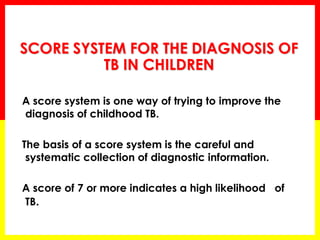
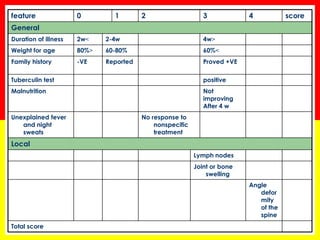
SCORE SYSTEM FOR THE DIAGNOSIS OF TB IN CHILDREN 
A score system is one way of trying to improve the diagnosis of childhood TB. 
The basis of a score system is the careful and systematic collection of diagnostic information. 
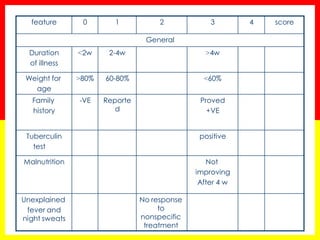
A score of 7 or more indicates a high likelihood of TB.
score 
4 
3 
2 
1 
0 
feature 
General 
4w < 
2-4w 
2w > 
Duration 
of illness 
60% > 
60-80% 
80% < 
Weight for 
age 
Proved 
+VE 
Reported 
-VE 
Family 
history 
positive 
Tuberculin 
test 
Not 
improving 
After 4 w 
Malnutrition 
No response to nonspecific treatment 
Unexplained 
fever and night sweats
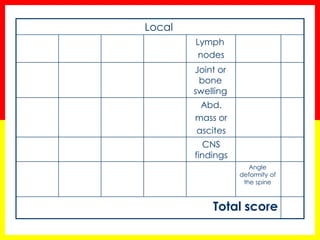
Local 
Lymph 
nodes 
Joint or bone swelling 
Abd. 
mass or 
ascites 
CNS findings 
Angle deformity of the spine 
Total score
score 
4 
3 
2 
1 
0 
feature 
General 
4w< 
2-4w 
2w> 
Duration of illness 
60%> 
60-80% 
80%< 
Weight for age 
Proved +VE 
Reported 
-VE 
Family history 
positive 
Tuberculin test 
Not 
improving 
After 4 w 
Malnutrition 
No response to nonspecific treatment 
Unexplained fever and night sweats 
Local 
Lymph nodes 
Joint or bone swelling 
Angle deformity of the spine 
Total score
Tb suspect management

Tb suspect management

  • 2.
    Dr. Ashraf ElAdawy Consultant Chest Physician TB TEAM EXPERT – WHO Mansoura -Egypt TB Suspect Management
  • 3.
  • 4.
    Tuberculosis should besuspected if the patient has one or more of the following symptoms: 1.Persistent cough for two or more weeks with or without Production of sputum which may be blood- stained not responding to non-specific treatment (including antibiotics with no anti-TB effect i.e. avoid Rifampicin, aminoglycosides and Quinolones) 2.Breathlessness 3.Chest pain 4.General symptoms such as loss of appetite, loss of weight, night sweat and fever 5.A history of contact with a TB patient
  • 5.
    Tuberculosis should besuspected if the patient has one or more of the following symptoms: 1.Persistent cough for two or more weeks with or without Production of sputum which may be blood- stained not responding to non-specific treatment (including antibiotics with no anti-TB effect i.e. avoid Rifampicin, aminoglycosides and Quinolones) 2.Breathlessness 3.Chest pain 4.General symptoms such as loss of appetite, loss of weight, night sweat and fever 5.A history of contact with a TB patient
  • 6.
    Identify TB suspects  Cough is the most common symptom of pulmonary TB and is present in 95% of all sputum smear- positive TB cases. However, the large majority of persons with cough do not have TB.  Many conditions affecting the lower respiratory tract cause cough. Therefore, examining the sputum of all persons who cough is not recommended, because this would be expensive and time-consuming.
  • 7.
    What to dowhen you suspect a case? List the TB suspect in the Suspect Register
  • 9.
    List the TBsuspect in the Suspect Register The Register of TB Suspects is a record of: - , -All patients identified as TB suspects at the health facility - All sputum samples sent to the laboratory. List the name and complete detailed address of every TB suspect in the TB Suspects Register.
  • 10.
    Be sure towrite down a complete name and address so that the TB suspect can be located if the result is positive and the TB suspect does not return. If the patient does not return to the health facility for the results, someone from the health facility must visit the patient’s home List the TB suspect in the Suspect Register
  • 11.
    If the TBsuspect with all samples are negative does not return to find out the results, it is necessary to locate that patient to confirm or exclude other conditions.
  • 12.
    Collecting sputum forsmear examination Send the TB suspect directly to the laboratory for sputum examination for AFB. A diagnostic sputum examination is most accurate with three sputum samples.
  • 14.
    Routine sputum collection - Patient provides, under supervision, an “on-the- spot” sample when he presents to the health facility Sample 1 Day 1 - Patient gets a sputum container to take home for an early-morning sample the following morning - Patient brings an early morning sample - Patient provides another “on the spot” sample under supervision. Sample 2 Sample 3 Day 2 Collecting sputum for smear examination
  • 15.
  • 16.
    Result record Numberof AFB in 100 fields Negative No AFB observed Scanty (record exact number observed) 1-9 AFB + 10-99 AFB ++ 100-999 AFB (or 1-10 per field) +++ 1000 or more (or more than 10 AFB per field) Examine each sample through the microscope. Systemically examine 100 fields for acid-fast bacilli (AFB). If AFB are present, count them and grade the quantity according to the scale below. If any AFB are present the result is positive.
  • 18.
    Remember These precautionsare followed by the Lab technician 1. The containers are labeled not the lids before collecting the sputum samples. 2.Sputum collection should be in a well-ventilated area, preferably outdoors. 3.The sample should contain sufficient sputum, not just saliva. 4.After collecting the sputum, the lid should be tightly closed.
  • 19.
    Sensitivity of sputumsmear microscopy Sputum smear microscopy for tubercle bacilli is positive when there are at least 10,000 organisms present per 1 ml of sputum.
  • 20.
    •When the laboratoryresults are received, record results in the Register of TB Suspects and decide on appropriate action
  • 21.
    Possibilities of sputumresults 1 sample is positive 2 samples are positive 3 samples are positive 3 samples are negative
  • 22.
    A patient withat least two sputum specimens positive for AFB, OR, A patient with at least one sputum specimen positive for AFB, with culture positive for M. tuberculosis , or with radiological abnormalities consistent with pulmonary TB. SS+ve PTB is diagnosed. When to consider sputum is positive
  • 23.
    If the threesamples are negative Another set of sputum is sent to the lab after two weeks of non-specific treatment. Possibilities after the second set: 1.Clinical, radiological improvement + negative smears, TB is excluded. 2.Sputum is positive, TB is confirmed. 3.No improvement + negative smears + exclusion of other chest conditions, SS-ve PTB is diagnosed.
  • 24.
    A patient whoseinitial sputum-specimens were negative and who did have sputum sent for culture initially should be considered a sputum-negative pulmonary TB even if the sputum culture result is positive.
  • 25.
  • 26.
  • 27.
  • 30.
    Bacteriology T Itis the most simple and decisive tool for the diagnosis of smear-positive pulmonary TB It allows the identification of smear-positive cases, i.e. the most infectious cases Smear-positive cases are the only cases for which bacteriological monitoring of treatment is available (conversion rate; cure rate)
  • 31.
    Causes of falsepositive direct sputum smear examination for AFB with ZN stain A false positive result means that the sputum smear result is positive even though the patient does not really have pulmonary TB. This may arise because of the following: 1. Red stain retained by scratches on the slide 2. accidental transfer of AFBs from a positive slide to a negative one (contamination) 3. Contamination of the slide or smear by environmental mycobacteria, 4. Various particles that are acid-fast (e.g. food particles, precipitates, other micro-organisms).
  • 32.
    False positive resultsof sputum smear microscopy A false positive result means that the sputum smear result is positive even though the patient dose not really have sputum smear-positive PTB. ●This may arise because of the following: 1.Red stain retained by scratches on the slide; 2.Contamination of the slide. 3.Various particles that are acid-fast (e.g. food particle, dye precipitates, other micro- organisms).
  • 33.
    Causes of falsenegative results of sputum smear microscopy Example Type of problem Patients provides inadequate sample Sputum stored too long before smear microscopy. Sputum collection Faulty smear preparation and staining Sputum processing Inadequate time spent examining slide Inadequate attention during examination Sputum smear examination Incorrect labeling of sample mistakes in documentation. Administrative errors
  • 34.
    Diagnosis of PulmonaryTB is a bacteriological one.
  • 35.
    TB is aClinical possibility Radiological probability Bacteriological Certainty &
  • 36.
    Diagnosis Of Tuberculosis •Detection of intact bacilli •Smear ▫The Ziehl-Neelsen carbolfuchsin or ▫ Fluorochrome stains •Cultures ▫ Solid media Egg- Based Media (Lowenstein Jensen culture medium) Agar based media Selective media ▫Liquid media MGIT & MB redox. Bactec ▫Animal inoculation
  • 37.
    Solid Conventional Culture(Lowenstein-Jansen medium ) Culture of sputum is more sensitive (require from 10- 100 mycobacteria /ml sputum) than smear examination (which will be positive if there are 104- 105 mycobacteria/1ml sputum) It takes from four to eight weeks before the result is known. It also requires well-equipped laboratories with skilled staff. 37
  • 38.
    Cultures: To confirmthe diagnosis even in smear negative. To detect drug susceptibility and resistance. To detect the bacilli in any specimen in extra- pulmonary tuberculosis.
  • 39.
    Indications of culture: 1. Some of extra-pulmonary tuberculosis. 2. For all cases of smear negative pulmonary tuberculosis. 3. For differentiating Mycobacteria tuberculosis complex from other non-Tuberculosis Mycobacteria. 4. Culture is done with drug susceptibility testing, DST, for new smear positive pulmonary tuberculosis who remain positive at the end of the second month of treatment with Cat I treatment course and for all retreatment (after relapse, after failure and after default) before starting Cat II retreatment course. 39
  • 40.
    Informing TB suspectsof results of sputum examination 1.When you inform the patient that the sputum examination showed TB, explain in simple terms what TB is and what type of TB the patient has. Reassure the patient that TB can be cured and that treatment is given free of charge. 2.Inform the patient about TB, directly observed treatment, the treatment regimen, TB transmission 3. Discuss main worries or doubts and answer any questions.
  • 42.
    Examining household contactsfor TB Explain that other people in the household may also be infected with TB.  Ask about other persons living in the household. Ask the patient to bring to the health facility all others in the household to be examined.
  • 43.
    Extra-pulmonary TB Apatient with TB affecting organs other than lungs diagnosed through culture and or histopathological examination with clinician's decision
  • 44.
    Diagnosis of TB According to the site of the lesion, TB can be classified to pulmonary or Extra- pulmonary Tuberculosis. Pulmonary TB can further be classified to smear positive or smear negative types.
  • 45.
    Diagnosis of PulmonaryTB is A bacteriological one Microscopic Direct Smear Examination Cultures: 1.To confirm the diagnosis even in smear negative. 2.To detect drug susceptibility and resistance. 3.To detect the bacilli in any specimen in extra pulmonary tuberculosis.
  • 46.
    Chest X-rays indiagnosis No certain x-ray pattern is specific to TB INDICATIONS FOR CHEST X-RAY The first screening test for PTB suspects is sputum smear microscopy. In most cases of sputum smear-positive PTB a chest X-ray is un-necessary.
  • 47.
    a) Suspected complicationsin the breathless patient, needing specific treatment, e.g. pneumothorax, pericardial effusion or pleural effusion - positive sputum smear is rare); b) Frequent or severe haemoptysis (to exclude bronchiectasis or aspergilloma); c) Only 1 sputum smear positive out of 3 (in this case, an abnormal chest X-ray is a necessary additional criterion for the diagnosis of sputum smear-positive PTB). INDICATIONS FOR CHEST X-RAY
  • 48.
    Radiology No radiologicalpicture can be characteristic of TB. CXR can be helpful in localizing abnormalities but not to establish the diagnosis of tuberculosis. Only bacteriology can provide the final proof. Chest x-rays are necessary in TB suspects who cannot produce sputum or who have negative smears, and where extra-pulmonary TB (such as pleural effusions and pericardial TB) is suspected. They must be interpreted in the light of the patient’s history and other clinical findings. 48
  • 49.
    Indications for theuse of chest x-rays 1. To assist in the diagnosis of TB: When smears are negative Where extra-pulmonary or miliary TB is suspected  For primary TB in children 2. During or at the end of treatment to evaluate the response to treatment or when response to treatment is not satisfactory. 3. To assist in the diagnosis of suspected complications: In a breathless patient to exclude a pneumothorax or pleural effusion.  For frequent or severe hemoptysis. 49
  • 50.
  • 52.
    4. Computed tomography(CT) scan findings in tuberculosis are equally non-specific. However, in cases of mediastinal Lymphadenopathy, peripheral rim enhancement with relatively low attenuation centers can suggest a diagnosis of tuberculosis in the appropriate clinical setting. Also in extra-pulmonary case e.g. tuberculosis osteoarthritis. 52
  • 53.
    Other methods ofdiagnosis Biopsies PCR
  • 54.
  • 55.
    SCORE SYSTEM FORTHE DIAGNOSIS OF TB IN CHILDREN A score system is one way of trying to improve the diagnosis of childhood TB. The basis of a score system is the careful and systematic collection of diagnostic information. A score of 7 or more indicates a high likelihood of TB.
  • 56.
    score 4 3 2 1 0 feature General 4w < 2-4w 2w > Duration of illness 60% > 60-80% 80% < Weight for age Proved +VE Reported -VE Family history positive Tuberculin test Not improving After 4 w Malnutrition No response to nonspecific treatment Unexplained fever and night sweats
  • 57.
    Local Lymph nodes Joint or bone swelling Abd. mass or ascites CNS findings Angle deformity of the spine Total score
  • 58.
    score 4 3 2 1 0 feature General 4w< 2-4w 2w> Duration of illness 60%> 60-80% 80%< Weight for age Proved +VE Reported -VE Family history positive Tuberculin test Not improving After 4 w Malnutrition No response to nonspecific treatment Unexplained fever and night sweats Local Lymph nodes Joint or bone swelling Angle deformity of the spine Total score