DR JOSE OSORIO
Atrial Fibrillation
Update on Stroke Prevention
www.theafibclinic.com
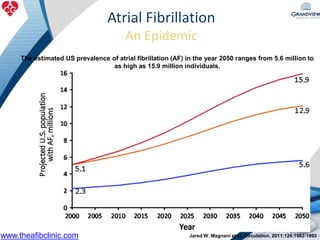
The estimated US prevalence of atrial fibrillation (AF) in the year 2050 ranges from 5.6 million to
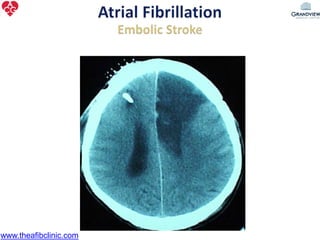
as high as 15.9 million individuals.
Jared W. Magnani et al. Circulation. 2011;124:1982-1993
Atrial Fibrillation
An Epidemic
www.theafibclinic.com
0
5
10
15
20
25
30
35
50-59 60-69 70-79 80-89
3000838-7
%
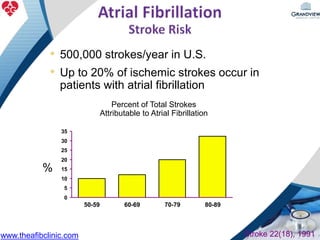
Percent of Total Strokes
Attributable to Atrial Fibrillation
Stroke 22(18), 1991
• 500,000 strokes/year in U.S.
• Up to 20% of ischemic strokes occur in
patients with atrial fibrillation
www.theafibclinic.com
AF increases Risk and Stroke Severity
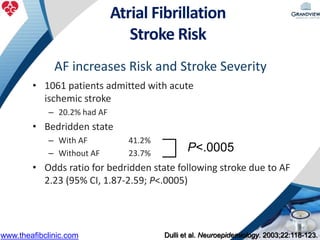
• 1061 patients admitted with acute
ischemic stroke
– 20.2% had AF
• Bedridden state
– With AF 41.2%
– Without AF 23.7%
• Odds ratio for bedridden state following stroke due to AF
2.23 (95% CI, 1.87-2.59; P<.0005)
P<.0005
Dulli et al. Neuroepidemiology. 2003;22:118-123.
Atrial Fibrillation
Stroke Risk
www.theafibclinic.com
Atrial Fibrillation
Stroke Pathology
3000838-9
Blackshear: Ann Thoracic Surg 61, 1996
Johnson: Eur J Cardiothoracic Surg 17, 2000
Fagan: Echocardiography 17, 2000
• Insufficient contraction of LA and LAA leads to
stagnant blood flow
• Most likely culprit:
• Embolization of LAA clot
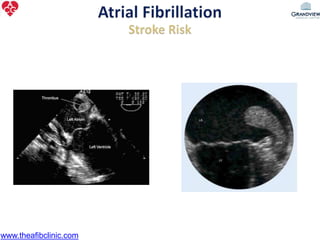
• 90% of thrombus found in LAA
• TEE-based risk factors
• Enlarged LAA
• Reduced inflow and outflow velocities
• Spontaneous Echo contrast
www.theafibclinic.com
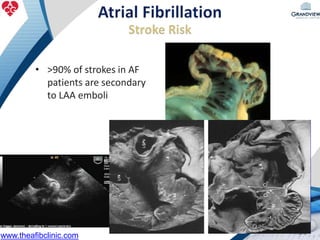
• >90% of strokes in AF
patients are secondary
to LAA emboli
www.theafibclinic.com
Atrial Fibrillation
Stroke Risk
Assessment
www.theafibclinic.com
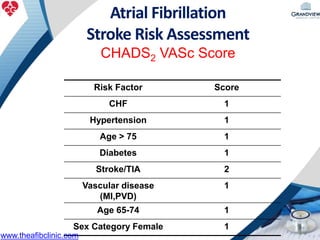
Risk Factor Score
CHF 1
Hypertension 1
Age > 75 1
Diabetes 1
Stroke/TIA 2
Vascular disease
(MI,PVD)
1
Age 65-74 1
Sex Category Female 1
Atrial Fibrillation
Stroke Risk Assessment
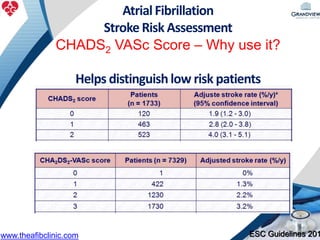
CHADS2 VASc Score
www.theafibclinic.com
ESC Guidelines 201
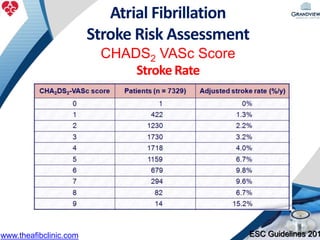
Atrial Fibrillation
Stroke Risk Assessment
CHADS2 VASc Score
Stroke Rate
www.theafibclinic.com
ESC Guidelines 201
AtrialFibrillation
Stroke Risk Assessment
CHADS2 VASc Score – Why use it?
Helps distinguishlow risk patients
www.theafibclinic.com
Atrial Fibrillation
Stroke Prevention
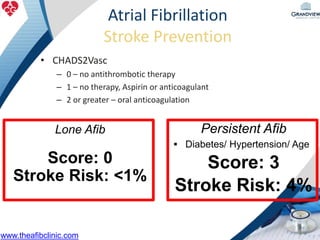
• CHADS2Vasc
– 0 – no antithrombotic therapy
– 1 – no therapy, Aspirin or anticoagulant
– 2 or greater – oral anticoagulation
Lone Afib
Score: 0
Stroke Risk: <1%
Persistent Afib
 Diabetes/ Hypertension/ Age
Score: 3
Stroke Risk: 4%
www.theafibclinic.com
Atrial Fibrillation
Stroke Prevention
Medical Therapy
www.theafibclinic.com
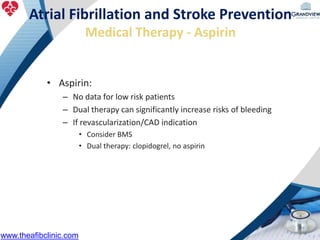
• Aspirin:
– No data for low risk patients
– Dual therapy can significantly increase risks of bleeding
– If revascularization/CAD indication
• Consider BMS
• Dual therapy: clopidogrel, no aspirin
Atrial Fibrillation and Stroke Prevention
Medical Therapy - Aspirin
www.theafibclinic.com
Atrial Fibrillation and Stroke Prevention
Warfarin
3000838-10
Cooper: Arch Int Med 166, 2006
Lip: Thromb Res 118, 2006
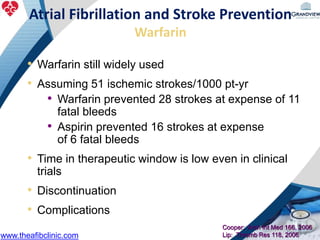
• Warfarin still widely used
• Assuming 51 ischemic strokes/1000 pt-yr
• Warfarin prevented 28 strokes at expense of 11
fatal bleeds
• Aspirin prevented 16 strokes at expense
of 6 fatal bleeds
• Time in therapeutic window is low even in clinical
trials
• Discontinuation
• Complications
www.theafibclinic.com
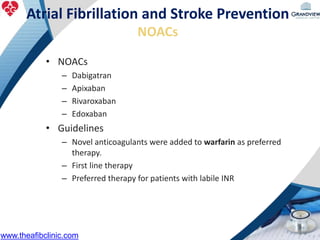
• NOACs
– Dabigatran
– Apixaban
– Rivaroxaban
– Edoxaban
• Guidelines
– Novel anticoagulants were added to warfarin as preferred
therapy.
– First line therapy
– Preferred therapy for patients with labile INR
Atrial Fibrillation and Stroke Prevention
NOACs
www.theafibclinic.com
Atrial Fibrillation and Stroke Prevention
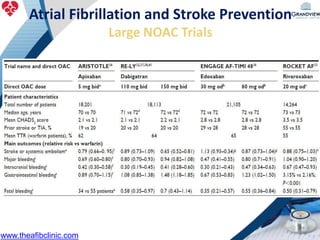
Large NOAC Trials
www.theafibclinic.com
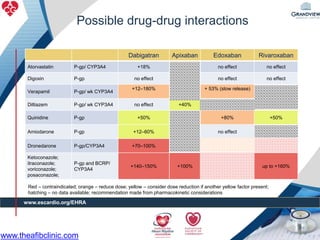
Possible drug-drug interactions
Dabigatran Apixaban Edoxaban Rivaroxaban
Atorvastatin P-gp/ CYP3A4 +18% no data yet no effect no effect
Digoxin P-gp no effect no data yet no effect no effect
Verapamil P-gp/ wk CYP3A4
+12–180%
no data yet
+ 53% (slow release)
minor effect
Diltiazem P-gp/ wk CYP3A4 no effect +40% No data minor effect
Quinidine P-gp +50% no data yet +80% +50%
Amiodarone P-gp +12–60% no data yet no effect minor effect
Dronedarone P-gp/CYP3A4 +70–100% no data yet +85% no data yet
Ketoconazole;
itraconazole;
voriconazole;
posaconazole;
P-gp and BCRP/
CYP3A4
+140–150% +100% no data yet up to +160%
19
www.escardio.org/EHRA
Red – contraindicated; orange – reduce dose; yellow – consider dose reduction if another yellow factor present;
hatching – no data available; recommendation made from pharmacokinetic considerations
www.theafibclinic.com
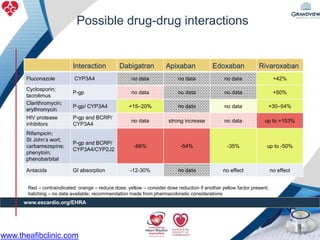
Interaction Dabigatran Apixaban Edoxaban Rivaroxaban
Fluconazole CYP3A4 no data no data no data +42%
Cyclosporin;
tacrolimus
P-gp no data no data no data +50%
Clarithromycin;
erythromycin
P-gp/ CYP3A4 +15–20% no data no data +30–54%
HIV protease
inhibitors
P-gp and BCRP/
CYP3A4
no data strong increase no data up to +153%
Rifampicin;
St John’s wort;
carbamezepine;
phenytoin;
phenobarbital
P-gp and BCRP/
CYP3A4/CYP2J2
-66% -54% -35% up to -50%
Antacids GI absorption -12-30% no data no effect no effect
20
www.escardio.org/EHRA
Red – contraindicated; orange – reduce dose; yellow – consider dose reduction if another yellow factor present;
hatching – no data available; recommendation made from pharmacokinetic considerations
Possible drug-drug interactions
www.theafibclinic.com
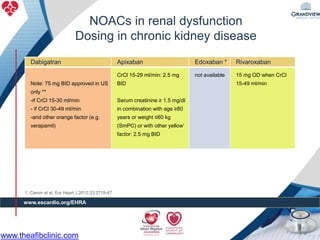
NOACs in renal dysfunction
Dosing in chronic kidney disease
Dabigatran Apixaban Edoxaban * Rivaroxaban
Note: 75 mg BID approved in US
only **
-if CrCl 15-30 ml/min
- if CrCl 30-49 ml/min
-and other orange factor (e.g.
verapamil)
CrCl 15-29 ml/min: 2.5 mg
BID
Serum creatinine ≥ 1.5 mg/dl
in combination with age ≥80
years or weight ≤60 kg
(SmPC) or with other yellow’
factor: 2.5 mg BID
not available 15 mg OD when CrCl
15-49 ml/min
28
www.escardio.org/EHRA
1. Camm et al, Eur Heart J 2012;33:2719-47
www.theafibclinic.com
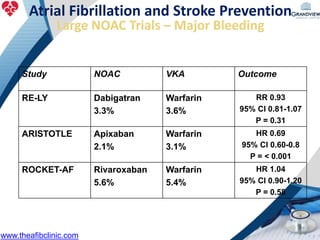
Study NOAC VKA Outcome
RE-LY Dabigatran
3.3%
Warfarin
3.6%
RR 0.93
95% CI 0.81-1.07
P = 0.31
ARISTOTLE Apixaban
2.1%
Warfarin
3.1%
HR 0.69
95% CI 0.60-0.8
P = < 0.001
ROCKET-AF Rivaroxaban
5.6%
Warfarin
5.4%
HR 1.04
95% CI 0.90-1.20
P = 0.58
Atrial Fibrillation and Stroke Prevention
Large NOAC Trials – Major Bleeding
www.theafibclinic.com
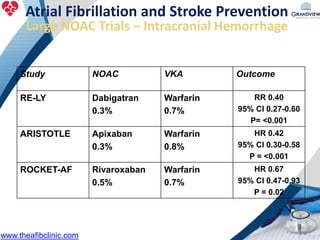
Study NOAC VKA Outcome
RE-LY Dabigatran
0.3%
Warfarin
0.7%
RR 0.40
95% CI 0.27-0.60
P= <0.001
ARISTOTLE Apixaban
0.3%
Warfarin
0.8%
HR 0.42
95% CI 0.30-0.58
P = <0.001
ROCKET-AF Rivaroxaban
0.5%
Warfarin
0.7%
HR 0.67
95% CI 0.47-0.93
P = 0.02
Atrial Fibrillation and Stroke Prevention
Large NOAC Trials – Intracranial Hemorrhage
www.theafibclinic.com
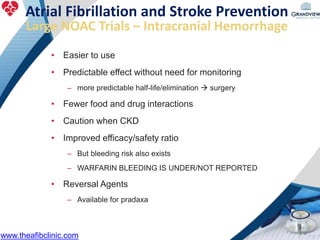
• Easier to use
• Predictable effect without need for monitoring
– more predictable half-life/elimination  surgery
• Fewer food and drug interactions
• Caution when CKD
• Improved efficacy/safety ratio
– But bleeding risk also exists
– WARFARIN BLEEDING IS UNDER/NOT REPORTED
• Reversal Agents
– Available for pradaxa
Atrial Fibrillation and Stroke Prevention
Large NOAC Trials – Intracranial Hemorrhage
www.theafibclinic.com
Atrial Fibrillation
Left Atrial Appendage
Closure
www.theafibclinic.com
Patient’s choice
Atrial Fibrillation and Stroke Prevention
Challenges with OAC
0%
10%
20%
30%
40%
50%
60%
70%
80%
90%
100%
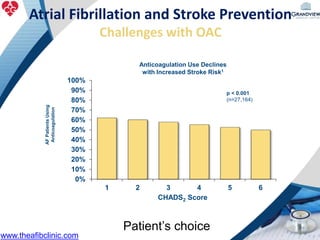
1 2 3 4 5 6
CHADS2 Score
p < 0.001
(n=27,164)
AFPatientsUsing
Anticoagulation
Anticoagulation Use Declines
with Increased Stroke Risk1
www.theafibclinic.com
 Less than 50% of patients eligible are being
treated with OACs
 Risk of bleeding
 GI bleeding
 Hemorrhagic Strokes
 Contraindications for anticoagulants:
 Bleeding
 Hemorrhagic Stroke
 Frequent Falls
 low Platelet Count
 Recent Surgery
Patient’s choice
Atrial Fibrillation and Stroke Prevention
Challenges with OAC
www.theafibclinic.com
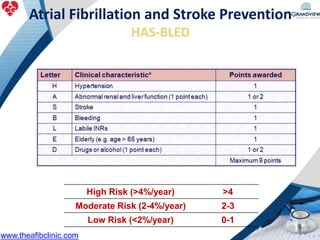
High Risk (>4%/year) >4
Moderate Risk (2-4%/year) 2-3
Low Risk (<2%/year) 0-1
Atrial Fibrillation and Stroke Prevention
HAS-BLED
www.theafibclinic.com
Atrial Fibrillation and Stroke Prevention
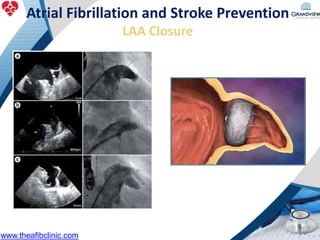
LAA Closure
www.theafibclinic.com
Atrial Fibrillation and Stroke Prevention
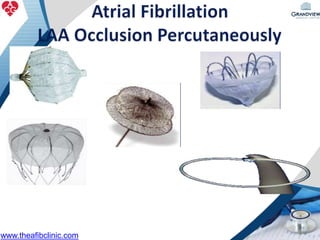
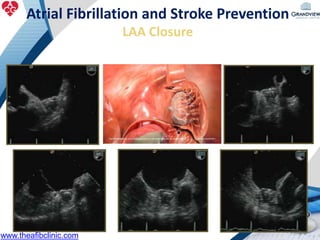
LAA Closure
www.theafibclinic.com
Atrial Fibrillation and Stroke Prevention
LAA Closure – Watchman Device
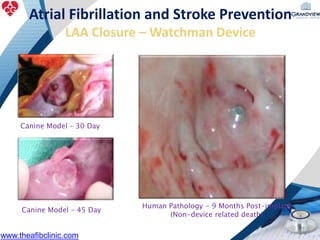
Canine Model – 30 Day
Canine Model – 45 Day
Human Pathology - 9 Months Post-implant
(Non-device related death)
www.theafibclinic.com
Atrial Fibrillation and Stroke Prevention
Watchman Device - Trials
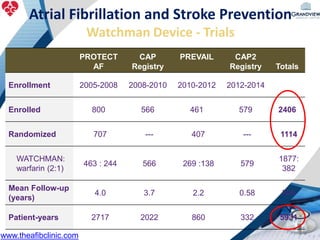
PROTECT
AF
CAP
Registry
PREVAIL CAP2
Registry Totals
Enrollment 2005-2008 2008-2010 2010-2012 2012-2014
Enrolled 800 566 461 579 2406
Randomized 707 --- 407 --- 1114
WATCHMAN:
warfarin (2:1)
463 : 244 566 269 :138 579
1877:
382
Mean Follow-up
(years)
4.0 3.7 2.2 0.58 N/A
Patient-years 2717 2022 860 332 5931
www.theafibclinic.com
Atrial Fibrillation and Stroke Prevention
Watchman Device - Trials
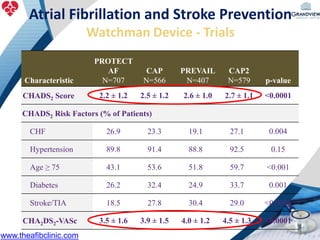
Characteristic
PROTECT
AF
N=707
CAP
N=566
PREVAIL
N=407
CAP2
N=579 p-value
CHADS2 Score 2.2 ± 1.2 2.5 ± 1.2 2.6 ± 1.0 2.7 ± 1.1 <0.0001
CHADS2 Risk Factors (% of Patients)
CHF 26.9 23.3 19.1 27.1 0.004
Hypertension 89.8 91.4 88.8 92.5 0.15
Age ≥ 75 43.1 53.6 51.8 59.7 <0.001
Diabetes 26.2 32.4 24.9 33.7 0.001
Stroke/TIA 18.5 27.8 30.4 29.0 <0.0001
CHA2DS2-VASc 3.5 ± 1.6 3.9 ± 1.5 4.0 ± 1.2 4.5 ± 1.3 <0.0001
www.theafibclinic.com
Atrial Fibrillation and Stroke Prevention
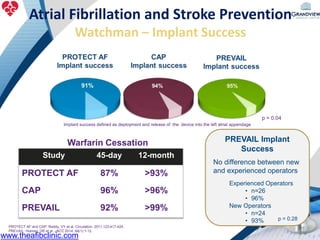
Watchman – Implant Success
p = 0.04
Study 45-day 12-month
PROTECT AF 87% >93%
CAP 96% >96%
PREVAIL 92% >99%
Implant success defined as deployment and release of the device into the left atrial appendage
Warfarin Cessation PREVAIL Implant
Success
No difference between new
and experienced operators
Experienced Operators
• n=26
• 96%
New Operators
• n=24
• 93% p = 0.28
PROTECT AF and CAP: Reddy, VY et al. Circulation. 2011;123:417-424.
PREVAIL: Holmes, DR et al. JACC 2014; 64(1):1-12.
www.theafibclinic.com
Atrial Fibrillation and Stroke Prevention
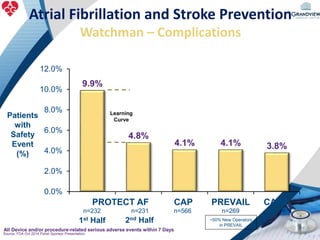
Watchman – Complications
9.9%
4.8%
4.1% 4.1% 3.8%
0.0%
2.0%
4.0%
6.0%
8.0%
10.0%
12.0%
CAP PREVAIL CAP2
Patients
with
Safety
Event
(%)
PROTECT AF
1st Half 2nd Half
n=232 n=231 n=566 n=269 n=579
All Device and/or procedure-related serious adverse events within 7 Days
Learning
Curve
~50% New Operators
in PREVAIL
Source: FDA Oct 2014 Panel Sponsor Presentation.
Atrial Fibrillation and Stroke Prevention
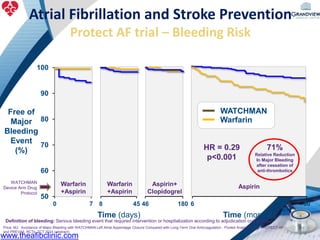
Protect AF trial – Bleeding Risk
50
60
70
80
90
100
0 7
Time (months)
Free of
Major
Bleeding
Event
(%)
6 6046 1808 45
Time (days)
Warfarin
+Aspirin
Warfarin
+Aspirin
Aspirin+
Clopidogrel
Aspirin
WATCHMAN
Warfarin
Definition of bleeding: Serious bleeding event that required intervention or hospitalization according to adjudication committee
71%
Relative Reduction
In Major Bleeding
after cessation of
anti-thrombotics
HR = 0.29
p<0.001
WATCHMAN
Device Arm Drug
Protocol
Price, MJ. Avoidance of Major Bleeding with WATCHMAN Left Atrial Appendage Closure Compared with Long-Term Oral Anticoagulation : Pooled Analysis of the PROTECT-AF
and PREVAIL RCTs. TCT 2014 (abstract)
www.theafibclinic.com
Atrial Fibrillation and Stroke Prevention
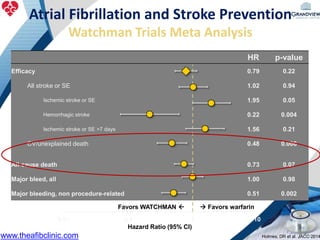
Watchman Trials Meta Analysis
HR p-value
Efficacy 0.79 0.22
All stroke or SE 1.02 0.94
Ischemic stroke or SE 1.95 0.05
Hemorrhagic stroke 0.22 0.004
Ischemic stroke or SE >7 days 1.56 0.21
CV/unexplained death 0.48 0.006
All-cause death 0.73 0.07
Major bleed, all 1.00 0.98
Major bleeding, non procedure-related 0.51 0.002
0.01 0.1 1 10
Favors WATCHMAN   Favors warfarin
Hazard Ratio (95% CI)
Holmes, DR et al. JACC 2014www.theafibclinic.com
Atrial Fibrillation and Stroke Prevention
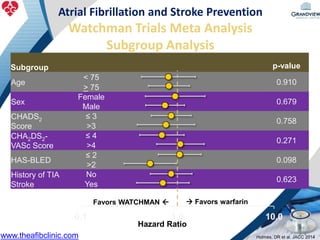
Watchman Trials Meta Analysis
Subgroup Analysis
Subgroup p-value
Age
< 75
0.910
> 75
Sex
Female
0.679
Male
CHADS2
Score
≤ 3
0.758
>3
CHA2DS2-
VASc Score
≤ 4
0.271
>4
HAS-BLED
≤ 2
0.098
>2
History of TIA
Stroke
No
0.623
Yes
0.1 1.0 10.0
Hazard Ratio
Favors WATCHMAN   Favors warfarin
Holmes, DR et al. JACC 2014www.theafibclinic.com
Atrial Fibrillation and Stroke Prevention
Watchman Trials Meta Analysis
Summary
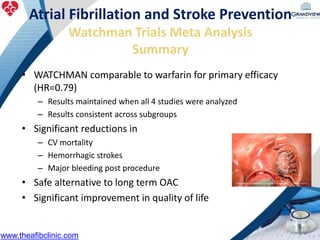
• WATCHMAN comparable to warfarin for primary efficacy
(HR=0.79)
– Results maintained when all 4 studies were analyzed
– Results consistent across subgroups
• Significant reductions in
– CV mortality
– Hemorrhagic strokes
– Major bleeding post procedure
• Safe alternative to long term OAC
• Significant improvement in quality of life
www.theafibclinic.com
Atrial Fibrillation and Stroke Prevention
Conclusion
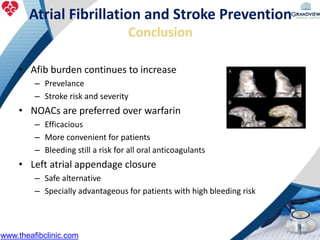
• Afib burden continues to increase
– Prevelance
– Stroke risk and severity
• NOACs are preferred over warfarin
– Efficacious
– More convenient for patients
– Bleeding still a risk for all oral anticoagulants
• Left atrial appendage closure
– Safe alternative
– Specially advantageous for patients with high bleeding risk
www.theafibclinic.com

Afib and Stroke Prevention Update

  • 1.
    DR JOSE OSORIO AtrialFibrillation Update on Stroke Prevention www.theafibclinic.com
  • 2.
    The estimated USprevalence of atrial fibrillation (AF) in the year 2050 ranges from 5.6 million to as high as 15.9 million individuals. Jared W. Magnani et al. Circulation. 2011;124:1982-1993 Atrial Fibrillation An Epidemic www.theafibclinic.com
  • 3.
    0 5 10 15 20 25 30 35 50-59 60-69 70-7980-89 3000838-7 % Percent of Total Strokes Attributable to Atrial Fibrillation Stroke 22(18), 1991 • 500,000 strokes/year in U.S. • Up to 20% of ischemic strokes occur in patients with atrial fibrillation www.theafibclinic.com
  • 4.
    AF increases Riskand Stroke Severity • 1061 patients admitted with acute ischemic stroke – 20.2% had AF • Bedridden state – With AF 41.2% – Without AF 23.7% • Odds ratio for bedridden state following stroke due to AF 2.23 (95% CI, 1.87-2.59; P<.0005) P<.0005 Dulli et al. Neuroepidemiology. 2003;22:118-123. Atrial Fibrillation Stroke Risk www.theafibclinic.com
  • 5.
    Atrial Fibrillation Stroke Pathology 3000838-9 Blackshear:Ann Thoracic Surg 61, 1996 Johnson: Eur J Cardiothoracic Surg 17, 2000 Fagan: Echocardiography 17, 2000 • Insufficient contraction of LA and LAA leads to stagnant blood flow • Most likely culprit: • Embolization of LAA clot • 90% of thrombus found in LAA • TEE-based risk factors • Enlarged LAA • Reduced inflow and outflow velocities • Spontaneous Echo contrast www.theafibclinic.com
  • 6.
    • >90% ofstrokes in AF patients are secondary to LAA emboli www.theafibclinic.com
  • 7.
  • 8.
  • 9.
  • 10.
  • 11.
    Risk Factor Score CHF1 Hypertension 1 Age > 75 1 Diabetes 1 Stroke/TIA 2 Vascular disease (MI,PVD) 1 Age 65-74 1 Sex Category Female 1 Atrial Fibrillation Stroke Risk Assessment CHADS2 VASc Score www.theafibclinic.com
  • 12.
    ESC Guidelines 201 AtrialFibrillation Stroke Risk Assessment CHADS2 VASc Score Stroke Rate www.theafibclinic.com
  • 13.
    ESC Guidelines 201 AtrialFibrillation StrokeRisk Assessment CHADS2 VASc Score – Why use it? Helps distinguishlow risk patients www.theafibclinic.com
  • 14.
    Atrial Fibrillation Stroke Prevention •CHADS2Vasc – 0 – no antithrombotic therapy – 1 – no therapy, Aspirin or anticoagulant – 2 or greater – oral anticoagulation Lone Afib Score: 0 Stroke Risk: <1% Persistent Afib  Diabetes/ Hypertension/ Age Score: 3 Stroke Risk: 4% www.theafibclinic.com
  • 15.
    Atrial Fibrillation Stroke Prevention MedicalTherapy www.theafibclinic.com
  • 16.
    • Aspirin: – Nodata for low risk patients – Dual therapy can significantly increase risks of bleeding – If revascularization/CAD indication • Consider BMS • Dual therapy: clopidogrel, no aspirin Atrial Fibrillation and Stroke Prevention Medical Therapy - Aspirin www.theafibclinic.com
  • 17.
    Atrial Fibrillation andStroke Prevention Warfarin 3000838-10 Cooper: Arch Int Med 166, 2006 Lip: Thromb Res 118, 2006 • Warfarin still widely used • Assuming 51 ischemic strokes/1000 pt-yr • Warfarin prevented 28 strokes at expense of 11 fatal bleeds • Aspirin prevented 16 strokes at expense of 6 fatal bleeds • Time in therapeutic window is low even in clinical trials • Discontinuation • Complications www.theafibclinic.com
  • 18.
    • NOACs – Dabigatran –Apixaban – Rivaroxaban – Edoxaban • Guidelines – Novel anticoagulants were added to warfarin as preferred therapy. – First line therapy – Preferred therapy for patients with labile INR Atrial Fibrillation and Stroke Prevention NOACs www.theafibclinic.com
  • 19.
    Atrial Fibrillation andStroke Prevention Large NOAC Trials www.theafibclinic.com
  • 20.
    Possible drug-drug interactions DabigatranApixaban Edoxaban Rivaroxaban Atorvastatin P-gp/ CYP3A4 +18% no data yet no effect no effect Digoxin P-gp no effect no data yet no effect no effect Verapamil P-gp/ wk CYP3A4 +12–180% no data yet + 53% (slow release) minor effect Diltiazem P-gp/ wk CYP3A4 no effect +40% No data minor effect Quinidine P-gp +50% no data yet +80% +50% Amiodarone P-gp +12–60% no data yet no effect minor effect Dronedarone P-gp/CYP3A4 +70–100% no data yet +85% no data yet Ketoconazole; itraconazole; voriconazole; posaconazole; P-gp and BCRP/ CYP3A4 +140–150% +100% no data yet up to +160% 19 www.escardio.org/EHRA Red – contraindicated; orange – reduce dose; yellow – consider dose reduction if another yellow factor present; hatching – no data available; recommendation made from pharmacokinetic considerations www.theafibclinic.com
  • 21.
    Interaction Dabigatran ApixabanEdoxaban Rivaroxaban Fluconazole CYP3A4 no data no data no data +42% Cyclosporin; tacrolimus P-gp no data no data no data +50% Clarithromycin; erythromycin P-gp/ CYP3A4 +15–20% no data no data +30–54% HIV protease inhibitors P-gp and BCRP/ CYP3A4 no data strong increase no data up to +153% Rifampicin; St John’s wort; carbamezepine; phenytoin; phenobarbital P-gp and BCRP/ CYP3A4/CYP2J2 -66% -54% -35% up to -50% Antacids GI absorption -12-30% no data no effect no effect 20 www.escardio.org/EHRA Red – contraindicated; orange – reduce dose; yellow – consider dose reduction if another yellow factor present; hatching – no data available; recommendation made from pharmacokinetic considerations Possible drug-drug interactions www.theafibclinic.com
  • 22.
    NOACs in renaldysfunction Dosing in chronic kidney disease Dabigatran Apixaban Edoxaban * Rivaroxaban Note: 75 mg BID approved in US only ** -if CrCl 15-30 ml/min - if CrCl 30-49 ml/min -and other orange factor (e.g. verapamil) CrCl 15-29 ml/min: 2.5 mg BID Serum creatinine ≥ 1.5 mg/dl in combination with age ≥80 years or weight ≤60 kg (SmPC) or with other yellow’ factor: 2.5 mg BID not available 15 mg OD when CrCl 15-49 ml/min 28 www.escardio.org/EHRA 1. Camm et al, Eur Heart J 2012;33:2719-47 www.theafibclinic.com
  • 24.
    Study NOAC VKAOutcome RE-LY Dabigatran 3.3% Warfarin 3.6% RR 0.93 95% CI 0.81-1.07 P = 0.31 ARISTOTLE Apixaban 2.1% Warfarin 3.1% HR 0.69 95% CI 0.60-0.8 P = < 0.001 ROCKET-AF Rivaroxaban 5.6% Warfarin 5.4% HR 1.04 95% CI 0.90-1.20 P = 0.58 Atrial Fibrillation and Stroke Prevention Large NOAC Trials – Major Bleeding www.theafibclinic.com
  • 25.
    Study NOAC VKAOutcome RE-LY Dabigatran 0.3% Warfarin 0.7% RR 0.40 95% CI 0.27-0.60 P= <0.001 ARISTOTLE Apixaban 0.3% Warfarin 0.8% HR 0.42 95% CI 0.30-0.58 P = <0.001 ROCKET-AF Rivaroxaban 0.5% Warfarin 0.7% HR 0.67 95% CI 0.47-0.93 P = 0.02 Atrial Fibrillation and Stroke Prevention Large NOAC Trials – Intracranial Hemorrhage www.theafibclinic.com
  • 26.
    • Easier touse • Predictable effect without need for monitoring – more predictable half-life/elimination  surgery • Fewer food and drug interactions • Caution when CKD • Improved efficacy/safety ratio – But bleeding risk also exists – WARFARIN BLEEDING IS UNDER/NOT REPORTED • Reversal Agents – Available for pradaxa Atrial Fibrillation and Stroke Prevention Large NOAC Trials – Intracranial Hemorrhage www.theafibclinic.com
  • 27.
    Atrial Fibrillation Left AtrialAppendage Closure www.theafibclinic.com
  • 28.
    Patient’s choice Atrial Fibrillationand Stroke Prevention Challenges with OAC 0% 10% 20% 30% 40% 50% 60% 70% 80% 90% 100% 1 2 3 4 5 6 CHADS2 Score p < 0.001 (n=27,164) AFPatientsUsing Anticoagulation Anticoagulation Use Declines with Increased Stroke Risk1 www.theafibclinic.com
  • 29.
     Less than50% of patients eligible are being treated with OACs  Risk of bleeding  GI bleeding  Hemorrhagic Strokes  Contraindications for anticoagulants:  Bleeding  Hemorrhagic Stroke  Frequent Falls  low Platelet Count  Recent Surgery Patient’s choice Atrial Fibrillation and Stroke Prevention Challenges with OAC www.theafibclinic.com
  • 30.
    High Risk (>4%/year)>4 Moderate Risk (2-4%/year) 2-3 Low Risk (<2%/year) 0-1 Atrial Fibrillation and Stroke Prevention HAS-BLED www.theafibclinic.com
  • 31.
    Atrial Fibrillation andStroke Prevention LAA Closure www.theafibclinic.com
  • 32.
  • 33.
    Atrial Fibrillation andStroke Prevention LAA Closure www.theafibclinic.com
  • 34.
    Atrial Fibrillation andStroke Prevention LAA Closure – Watchman Device Canine Model – 30 Day Canine Model – 45 Day Human Pathology - 9 Months Post-implant (Non-device related death) www.theafibclinic.com
  • 35.
    Atrial Fibrillation andStroke Prevention Watchman Device - Trials PROTECT AF CAP Registry PREVAIL CAP2 Registry Totals Enrollment 2005-2008 2008-2010 2010-2012 2012-2014 Enrolled 800 566 461 579 2406 Randomized 707 --- 407 --- 1114 WATCHMAN: warfarin (2:1) 463 : 244 566 269 :138 579 1877: 382 Mean Follow-up (years) 4.0 3.7 2.2 0.58 N/A Patient-years 2717 2022 860 332 5931 www.theafibclinic.com
  • 36.
    Atrial Fibrillation andStroke Prevention Watchman Device - Trials Characteristic PROTECT AF N=707 CAP N=566 PREVAIL N=407 CAP2 N=579 p-value CHADS2 Score 2.2 ± 1.2 2.5 ± 1.2 2.6 ± 1.0 2.7 ± 1.1 <0.0001 CHADS2 Risk Factors (% of Patients) CHF 26.9 23.3 19.1 27.1 0.004 Hypertension 89.8 91.4 88.8 92.5 0.15 Age ≥ 75 43.1 53.6 51.8 59.7 <0.001 Diabetes 26.2 32.4 24.9 33.7 0.001 Stroke/TIA 18.5 27.8 30.4 29.0 <0.0001 CHA2DS2-VASc 3.5 ± 1.6 3.9 ± 1.5 4.0 ± 1.2 4.5 ± 1.3 <0.0001 www.theafibclinic.com
  • 37.
    Atrial Fibrillation andStroke Prevention Watchman – Implant Success p = 0.04 Study 45-day 12-month PROTECT AF 87% >93% CAP 96% >96% PREVAIL 92% >99% Implant success defined as deployment and release of the device into the left atrial appendage Warfarin Cessation PREVAIL Implant Success No difference between new and experienced operators Experienced Operators • n=26 • 96% New Operators • n=24 • 93% p = 0.28 PROTECT AF and CAP: Reddy, VY et al. Circulation. 2011;123:417-424. PREVAIL: Holmes, DR et al. JACC 2014; 64(1):1-12. www.theafibclinic.com
  • 38.
    Atrial Fibrillation andStroke Prevention Watchman – Complications 9.9% 4.8% 4.1% 4.1% 3.8% 0.0% 2.0% 4.0% 6.0% 8.0% 10.0% 12.0% CAP PREVAIL CAP2 Patients with Safety Event (%) PROTECT AF 1st Half 2nd Half n=232 n=231 n=566 n=269 n=579 All Device and/or procedure-related serious adverse events within 7 Days Learning Curve ~50% New Operators in PREVAIL Source: FDA Oct 2014 Panel Sponsor Presentation.
  • 39.
    Atrial Fibrillation andStroke Prevention Protect AF trial – Bleeding Risk 50 60 70 80 90 100 0 7 Time (months) Free of Major Bleeding Event (%) 6 6046 1808 45 Time (days) Warfarin +Aspirin Warfarin +Aspirin Aspirin+ Clopidogrel Aspirin WATCHMAN Warfarin Definition of bleeding: Serious bleeding event that required intervention or hospitalization according to adjudication committee 71% Relative Reduction In Major Bleeding after cessation of anti-thrombotics HR = 0.29 p<0.001 WATCHMAN Device Arm Drug Protocol Price, MJ. Avoidance of Major Bleeding with WATCHMAN Left Atrial Appendage Closure Compared with Long-Term Oral Anticoagulation : Pooled Analysis of the PROTECT-AF and PREVAIL RCTs. TCT 2014 (abstract) www.theafibclinic.com
  • 40.
    Atrial Fibrillation andStroke Prevention Watchman Trials Meta Analysis HR p-value Efficacy 0.79 0.22 All stroke or SE 1.02 0.94 Ischemic stroke or SE 1.95 0.05 Hemorrhagic stroke 0.22 0.004 Ischemic stroke or SE >7 days 1.56 0.21 CV/unexplained death 0.48 0.006 All-cause death 0.73 0.07 Major bleed, all 1.00 0.98 Major bleeding, non procedure-related 0.51 0.002 0.01 0.1 1 10 Favors WATCHMAN   Favors warfarin Hazard Ratio (95% CI) Holmes, DR et al. JACC 2014www.theafibclinic.com
  • 41.
    Atrial Fibrillation andStroke Prevention Watchman Trials Meta Analysis Subgroup Analysis Subgroup p-value Age < 75 0.910 > 75 Sex Female 0.679 Male CHADS2 Score ≤ 3 0.758 >3 CHA2DS2- VASc Score ≤ 4 0.271 >4 HAS-BLED ≤ 2 0.098 >2 History of TIA Stroke No 0.623 Yes 0.1 1.0 10.0 Hazard Ratio Favors WATCHMAN   Favors warfarin Holmes, DR et al. JACC 2014www.theafibclinic.com
  • 42.
    Atrial Fibrillation andStroke Prevention Watchman Trials Meta Analysis Summary • WATCHMAN comparable to warfarin for primary efficacy (HR=0.79) – Results maintained when all 4 studies were analyzed – Results consistent across subgroups • Significant reductions in – CV mortality – Hemorrhagic strokes – Major bleeding post procedure • Safe alternative to long term OAC • Significant improvement in quality of life www.theafibclinic.com
  • 43.
    Atrial Fibrillation andStroke Prevention Conclusion • Afib burden continues to increase – Prevelance – Stroke risk and severity • NOACs are preferred over warfarin – Efficacious – More convenient for patients – Bleeding still a risk for all oral anticoagulants • Left atrial appendage closure – Safe alternative – Specially advantageous for patients with high bleeding risk www.theafibclinic.com

Editor's Notes

  • #5 In order to assess if the severity of AF-associated acute ischemic stroke is worse than ischemic stroke associated with other etiologies, Dulli et al examined an acute ischemic stroke patient population for the clinical characteristics of acute ischemic stroke in patients with and without underlying AF in a retrospective study. AF was present in 20.2% of the patient population (acute ischemic stroke patients admitted between 1990 and 2001). Many of the factors associated with ischemic stroke varied between patients with AF and without AF. Hypertension, ischemic heart disease (IHD), and other cardioembolic risks were significantly higher in patients with AF. The study also showed that the frequency of the bedridden state was markedly higher in patients with AF (41.2%) versus patients without AF (23.7%); P<.0005. The odds ratio for the bedridden state following stroke with AF was 2.23 (95% confidence interval [CI], 1.87-2.59; P<.0005). The significance of AF in the severity of stroke compared with other variables demonstrated that AF was a strong independent predictor of severe ischemic stroke. The study also showed that the disability caused by acute ischemic stroke increases with age, and is significantly worse when associated with AF in groups aged 65 to 74 (P<.05) and 75 to 84 years (P<.0005). The study investigators concluded that acute ischemic stroke in the presence of underlying AF is often more severe than ischemic stroke due to other etiologies.