ENSURING IDENTIFICATION OF
TUBERCULOSIS PATIENT
INTRODUCTION
Tuberculosis affects the lungs in more than
85% of the cases. This form of the disease
is known as Pulmonary Tuberculosis.
Undiagnosed & untreated Pulmonary
sputum-smear positive Tuberculosis cases
are the source of infection in the community
i.e. they have the potential to transmit
infection to others. So an early detection is
necessary.
TOOLS FOR DIAGNOSIS
 Sputum microscopy [key diagnostic tool of RNTCP]
– Simple, not expensive, requires minimum training.
– Specific with minimum inter-reader variation.
– Used for diagnosis, monitoring & defining cure.
– Can be done at the Peripheral Health Institutions.
– Correlates with infectivity in undiagnosed Pulmonary TB cases.
 X-Ray
– Supportive to microscopy.
– High inter-reader variation.
– No shadow is typical for TB.
– 10-15 % of culture positive cases remain undiagnosed.
 Tuberculin test
– May be useful as additional tool for diagnosing Pediatric TB.
 Culture of Mycobacterium Tuberculosis
– Very sensitive and specific.
– Expensive, requires a specialized laboratory.
– Results are available after a several weeks.
PROCESS OF DIAGNOSIS
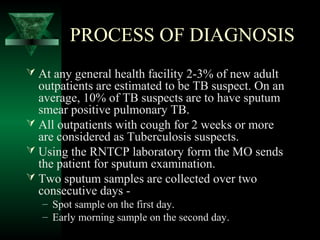
 At any general health facility 2-3% of new adult
outpatients are estimated to be TB suspect. On an
average, 10% of TB suspects are to have sputum
smear positive pulmonary TB.
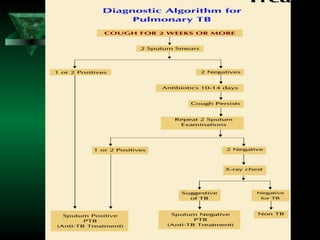
 All outpatients with cough for 2 weeks or more
are considered as Tuberculosis suspects.
 Using the RNTCP laboratory form the MO sends
the patient for sputum examination.
 Two sputum samples are collected over two
consecutive days -
– Spot sample on the first day.
– Early morning sample on the second day.
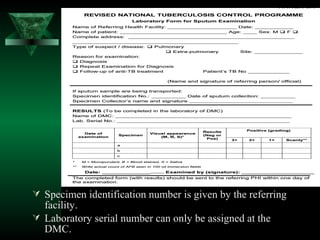
 Specimen identification number is given by the referring
facility.
 Laboratory serial number can only be assigned at the
DMC.
SPUTUM EXAMINATION ARE
DONE IN THE FOLLOWING CASES
All patients with cough for 2 weeks or more.
Extra-pulmonary TB patient with cough for
any duration.
Contacts of smear positive TB patient with
cough for any duration.
HIV patient with cough for any duration.
SPUTUM EXAMINATION
 Sputum examination is done at the DMC.
 If the PHI is not a DMC then –
– Patient may be referred to the nearest DMC. or
– Patient’s sputum is collected & transported to the neatest DMC.
 The MO / Health Worker / Laboratory Technician should
instruct the patient for proper sputum collection.
 The LT should label the sputum container by writing the
patients lab. serial no. by the side of the container & not on
the lid.
 Sputum should be at least 2ml in quantity and preferably
mucopurulent.
 Sputum sample should be transported & examined as soon
as possible & not later than 7 days of collection.
 Result of sputum test should be reported with in one day.
EXTRA-PULMONARY TB
SUSPECT
 Symptoms are related to the organ involved –
– Swelling of the lymph node, occasionally with
discharge of pus.
– Pain & swelling of joints.
– Headache, fever, neck stiffness & mental confusion
when the brain & the meninges are involved.
– In addition general symptoms may be there –
• Weight loss.
• Fever, particularly rise of temperature in the evening.
• Night sweats.
COLLECTING SPUTUM FROM
TUBERCULOSIS SUSPECT
 Patient is given the sputum container with laboratory serial
no. written on the side.
 Person collecting the sputum demonstrate how to open &
close the container.
 Person guiding the patient for sputum collection should
stand behind & encourage him.
 Sputum should be collected in an open place or well
ventilated room.
 Patient should be separated from others during collecting
sputum.
 Patient is instructed to inhale deeply (2-3 times), cough out
sputum from chest, spit into the container and close it.
 If the outside is contaminated with sputum, wipe the
container clean and destroy whatever is used to clean the
container.

Ensuring identification of tuberculosis suspects

  • 1.
  • 2.
    INTRODUCTION Tuberculosis affects thelungs in more than 85% of the cases. This form of the disease is known as Pulmonary Tuberculosis. Undiagnosed & untreated Pulmonary sputum-smear positive Tuberculosis cases are the source of infection in the community i.e. they have the potential to transmit infection to others. So an early detection is necessary.
  • 3.
    TOOLS FOR DIAGNOSIS Sputum microscopy [key diagnostic tool of RNTCP] – Simple, not expensive, requires minimum training. – Specific with minimum inter-reader variation. – Used for diagnosis, monitoring & defining cure. – Can be done at the Peripheral Health Institutions. – Correlates with infectivity in undiagnosed Pulmonary TB cases.  X-Ray – Supportive to microscopy. – High inter-reader variation. – No shadow is typical for TB. – 10-15 % of culture positive cases remain undiagnosed.  Tuberculin test – May be useful as additional tool for diagnosing Pediatric TB.  Culture of Mycobacterium Tuberculosis – Very sensitive and specific. – Expensive, requires a specialized laboratory. – Results are available after a several weeks.
  • 4.
    PROCESS OF DIAGNOSIS At any general health facility 2-3% of new adult outpatients are estimated to be TB suspect. On an average, 10% of TB suspects are to have sputum smear positive pulmonary TB.  All outpatients with cough for 2 weeks or more are considered as Tuberculosis suspects.  Using the RNTCP laboratory form the MO sends the patient for sputum examination.  Two sputum samples are collected over two consecutive days - – Spot sample on the first day. – Early morning sample on the second day.
  • 5.
     Specimen identificationnumber is given by the referring facility.  Laboratory serial number can only be assigned at the DMC.
  • 6.
    SPUTUM EXAMINATION ARE DONEIN THE FOLLOWING CASES All patients with cough for 2 weeks or more. Extra-pulmonary TB patient with cough for any duration. Contacts of smear positive TB patient with cough for any duration. HIV patient with cough for any duration.
  • 7.
    SPUTUM EXAMINATION  Sputumexamination is done at the DMC.  If the PHI is not a DMC then – – Patient may be referred to the nearest DMC. or – Patient’s sputum is collected & transported to the neatest DMC.  The MO / Health Worker / Laboratory Technician should instruct the patient for proper sputum collection.  The LT should label the sputum container by writing the patients lab. serial no. by the side of the container & not on the lid.  Sputum should be at least 2ml in quantity and preferably mucopurulent.  Sputum sample should be transported & examined as soon as possible & not later than 7 days of collection.  Result of sputum test should be reported with in one day.
  • 9.
    EXTRA-PULMONARY TB SUSPECT  Symptomsare related to the organ involved – – Swelling of the lymph node, occasionally with discharge of pus. – Pain & swelling of joints. – Headache, fever, neck stiffness & mental confusion when the brain & the meninges are involved. – In addition general symptoms may be there – • Weight loss. • Fever, particularly rise of temperature in the evening. • Night sweats.
  • 10.
    COLLECTING SPUTUM FROM TUBERCULOSISSUSPECT  Patient is given the sputum container with laboratory serial no. written on the side.  Person collecting the sputum demonstrate how to open & close the container.  Person guiding the patient for sputum collection should stand behind & encourage him.  Sputum should be collected in an open place or well ventilated room.  Patient should be separated from others during collecting sputum.  Patient is instructed to inhale deeply (2-3 times), cough out sputum from chest, spit into the container and close it.  If the outside is contaminated with sputum, wipe the container clean and destroy whatever is used to clean the container.