Project number: NPAD-2017/10097 TAU project
Seminar 1 Material[Part 3]
Motivating Learners
Creation of favorable educational
environment, management and
planning work with adult learners
Document details
Country: Finland
Company: Learnmera Oy
Elaborated by: Inês Messias
Date of submission 13.12.2017
Seminar details
Seminar date 22.11.2017
Partners present Ingmarie Rohdin - SE
Åsa Kajsdotter - SE
Yulia Bazyukina - FI
Inês Messias - FI
Marja-Liisa Helenius - FI
Veronica Gelfgren - FI
Responsible All partner countries. Activity to be held by each partner in their institution
for its participants.
Result Participants will improve their educational and management competence.
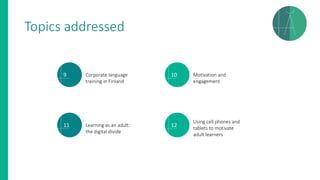
9 Corporate language
training in Finland
10 Motivation and
engagement
11 Learning as an adult:
the digital divide
12
Using cell phones and
tablets to motivate
adult learners
Topics addressed
Topic 9
Corporate language training in Finland
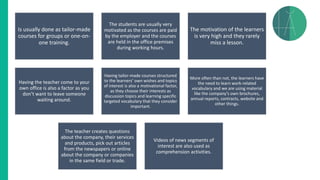
Is usually done as tailor-made
courses for groups or one-on-
one training.
The students are usually very
motivated as the courses are paid
by the employer and the courses
are held in the office premises
during working hours.
The motivation of the learners
is very high and they rarely
miss a lesson.
Having the teacher come to your
own office is also a factor as you
don’t want to leave someone
waiting around.
Having tailor-made courses structured
to the learners’ own wishes and topics
of interest is also a motivational factor,
as they choose their interests as
discussion topics and learning specific
targeted vocabulary that they consider
important.
More often than not, the learners have
the need to learn work-related
vocabulary and we are using material
like the company’s own brochures,
annual reports, contracts, website and
other things.
The teacher creates questions
about the company, their services
and products, pick out articles
from the newspapers or online
about the company or companies
in the same field or trade.
Videos of news segments of
interest are also used as
comprehension activities.
The language cafe/exchange format to learn
or practice languages outside the classroom
in an informal setting is an excellent
environment for language learning.
A quiet but relaxed environment, such
as a cafe or a restaurant or even a
private room at a public venue, away
from the classroom, is the best place
for such exchange.
The social aspect of meeting and
conversing with new people and
sharing a common language can be
very motivating in language learning.
Regularly attending a language cafe gives an
opportunity to adult learners to both
practice their language skills and form social
connections, even a community of language
learners and speakers.
It can also be very rewarding to teach one’s
own language to others in exchange, and
motivate people to come learn and share
their own language.
It is very useful to have an assigned tutor in
all languages spoken in the cafe, when
possible, as well as some structure using
discussion cards, picture cards or other easy-
to-use material, in case attendees run out of
discussion topics or start to get bored.
Topic 10
Motivation and engagement
Motivation and
engagement are defined by
the effort and dedication
students devote to their
educational activities.
is usually reflected
on the time
students spend
with their learning,
on the degree of
fun they
experience while
doing it
and on the quality
of work they
present as a result
of the learning
processes they
have gone through
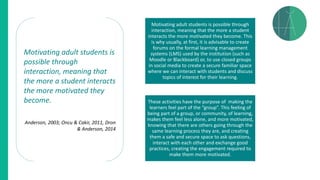
Motivating adult students is
possible through
interaction, meaning that
the more a student interacts
the more motivated they
become.
Anderson, 2003; Oncu & Cakir, 2011, Dron
& Anderson, 2014
Motivating adult students is possible through
interaction, meaning that the more a student
interacts the more motivated they become. This
is why usually, at first, it is advisable to create
forums on the formal learning management
systems (LMS) used by the institution (such as
Moodle or Blackboard) or, to use closed groups
in social media to create a secure familiar space
where we can interact with students and discuss
topics of interest for their learning.
These activities have the purpose of making the
learners feel part of the “group”. This feeling of
being part of a group, or community, of learning,
makes them feel less alone, and more motivated,
knowing that there are others going through the
same learning process they are, and creating
them a safe and secure space to ask questions,
interact with each other and exchange good
practices, creating the engagement required to
make them more motivated.
Topic 11
Learning as an adult: the digital divide
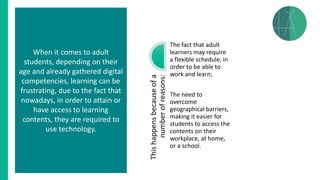
Thishappensbecauseofa
numberofreasons:
The fact that adult
learners may require
a flexible schedule, in
order to be able to
work and learn;
The need to
overcome
geographical barriers,
making it easier for
students to access the
contents on their
workplace, at home,
or a school.
When it comes to adult
students, depending on their
age and already gathered digital
competencies, learning can be
frustrating, due to the fact that
nowadays, in order to attain or
have access to learning
contents, they are required to
use technology.
Itisusuallyherethatlies
theirfrustration:
How do I use this tool?
How can I access the
document I want?
Where can I find my teachers?
Where are my classmates?
Where do I start?
To be able to access the
contents on these digital
platforms, today’s student must
know how to use them.
Using digital tools is
difficult for adult learners
that have never used a
computer to learn.
That is why, usually, the teachers have to first give them
simple tasks and tools and gradually introduce the more
difficult ones, in order to give them time to get to know
the tool they are require to master, to then be able to
actually learn the contents they want.
Topic 12
Using cell phones and tablets to motivate adult learners?
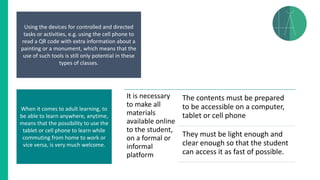
Using the devices for controlled and directed
tasks or activities, e.g. using the cell phone to
read a QR code with extra information about a
painting or a monument, which means that the
use of such tools is still only potential in these
types of classes.
When it comes to adult learning, to
be able to learn anywhere, anytime,
means that the possibility to use the
tablet or cell phone to learn while
commuting from home to work or
vice versa, is very much welcome.
It is necessary
to make all
materials
available online
to the student,
on a formal or
informal
platform
The contents must be prepared
to be accessible on a computer,
tablet or cell phone
They must be light enough and
clear enough so that the student
can access it as fast of possible.
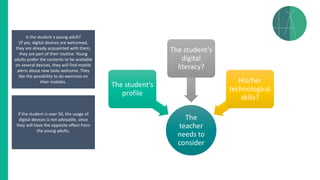
The
teacher
needs to
consider
The student’s
profile
The student’s
digital
literacy?
His/her
technological
skills?
Is the student a young adult?
(if yes, digital devices are welcomed,
they are already acquainted with them,
they are part of their routine. Young
adults prefer the contents to be available
on several devices, they will find mobile
alerts about new tasks welcome. They
like the possibility to do exercices on
their mobiles.
If the student is over 50, the usage of
digital devices is not advisable, since
they will have the opposite effect from
the young adults.

Tau Seminar1 material part3

  • 1.
    Project number: NPAD-2017/10097TAU project Seminar 1 Material[Part 3] Motivating Learners Creation of favorable educational environment, management and planning work with adult learners
  • 2.
    Document details Country: Finland Company:Learnmera Oy Elaborated by: Inês Messias Date of submission 13.12.2017
  • 3.
    Seminar details Seminar date22.11.2017 Partners present Ingmarie Rohdin - SE Åsa Kajsdotter - SE Yulia Bazyukina - FI Inês Messias - FI Marja-Liisa Helenius - FI Veronica Gelfgren - FI Responsible All partner countries. Activity to be held by each partner in their institution for its participants. Result Participants will improve their educational and management competence.
  • 4.
    9 Corporate language trainingin Finland 10 Motivation and engagement 11 Learning as an adult: the digital divide 12 Using cell phones and tablets to motivate adult learners Topics addressed
  • 5.
    Topic 9 Corporate languagetraining in Finland
  • 6.
    Is usually doneas tailor-made courses for groups or one-on- one training. The students are usually very motivated as the courses are paid by the employer and the courses are held in the office premises during working hours. The motivation of the learners is very high and they rarely miss a lesson. Having the teacher come to your own office is also a factor as you don’t want to leave someone waiting around. Having tailor-made courses structured to the learners’ own wishes and topics of interest is also a motivational factor, as they choose their interests as discussion topics and learning specific targeted vocabulary that they consider important. More often than not, the learners have the need to learn work-related vocabulary and we are using material like the company’s own brochures, annual reports, contracts, website and other things. The teacher creates questions about the company, their services and products, pick out articles from the newspapers or online about the company or companies in the same field or trade. Videos of news segments of interest are also used as comprehension activities.
  • 7.
    The language cafe/exchangeformat to learn or practice languages outside the classroom in an informal setting is an excellent environment for language learning. A quiet but relaxed environment, such as a cafe or a restaurant or even a private room at a public venue, away from the classroom, is the best place for such exchange. The social aspect of meeting and conversing with new people and sharing a common language can be very motivating in language learning. Regularly attending a language cafe gives an opportunity to adult learners to both practice their language skills and form social connections, even a community of language learners and speakers. It can also be very rewarding to teach one’s own language to others in exchange, and motivate people to come learn and share their own language. It is very useful to have an assigned tutor in all languages spoken in the cafe, when possible, as well as some structure using discussion cards, picture cards or other easy- to-use material, in case attendees run out of discussion topics or start to get bored.
  • 8.
  • 9.
    Motivation and engagement aredefined by the effort and dedication students devote to their educational activities. is usually reflected on the time students spend with their learning, on the degree of fun they experience while doing it and on the quality of work they present as a result of the learning processes they have gone through
  • 10.
    Motivating adult studentsis possible through interaction, meaning that the more a student interacts the more motivated they become. Anderson, 2003; Oncu & Cakir, 2011, Dron & Anderson, 2014 Motivating adult students is possible through interaction, meaning that the more a student interacts the more motivated they become. This is why usually, at first, it is advisable to create forums on the formal learning management systems (LMS) used by the institution (such as Moodle or Blackboard) or, to use closed groups in social media to create a secure familiar space where we can interact with students and discuss topics of interest for their learning. These activities have the purpose of making the learners feel part of the “group”. This feeling of being part of a group, or community, of learning, makes them feel less alone, and more motivated, knowing that there are others going through the same learning process they are, and creating them a safe and secure space to ask questions, interact with each other and exchange good practices, creating the engagement required to make them more motivated.
  • 11.
    Topic 11 Learning asan adult: the digital divide
  • 12.
    Thishappensbecauseofa numberofreasons: The fact thatadult learners may require a flexible schedule, in order to be able to work and learn; The need to overcome geographical barriers, making it easier for students to access the contents on their workplace, at home, or a school. When it comes to adult students, depending on their age and already gathered digital competencies, learning can be frustrating, due to the fact that nowadays, in order to attain or have access to learning contents, they are required to use technology.
  • 13.
    Itisusuallyherethatlies theirfrustration: How do Iuse this tool? How can I access the document I want? Where can I find my teachers? Where are my classmates? Where do I start? To be able to access the contents on these digital platforms, today’s student must know how to use them. Using digital tools is difficult for adult learners that have never used a computer to learn. That is why, usually, the teachers have to first give them simple tasks and tools and gradually introduce the more difficult ones, in order to give them time to get to know the tool they are require to master, to then be able to actually learn the contents they want.
  • 14.
    Topic 12 Using cellphones and tablets to motivate adult learners?
  • 15.
    Using the devicesfor controlled and directed tasks or activities, e.g. using the cell phone to read a QR code with extra information about a painting or a monument, which means that the use of such tools is still only potential in these types of classes. When it comes to adult learning, to be able to learn anywhere, anytime, means that the possibility to use the tablet or cell phone to learn while commuting from home to work or vice versa, is very much welcome. It is necessary to make all materials available online to the student, on a formal or informal platform The contents must be prepared to be accessible on a computer, tablet or cell phone They must be light enough and clear enough so that the student can access it as fast of possible.
  • 16.
    The teacher needs to consider The student’s profile Thestudent’s digital literacy? His/her technological skills? Is the student a young adult? (if yes, digital devices are welcomed, they are already acquainted with them, they are part of their routine. Young adults prefer the contents to be available on several devices, they will find mobile alerts about new tasks welcome. They like the possibility to do exercices on their mobiles. If the student is over 50, the usage of digital devices is not advisable, since they will have the opposite effect from the young adults.