2017
Rosa Calzado
UNICDA
18/02/2017
Flipped Classroom and blended
learning, pros, cons, similarities
and differences
Flipped classroom and blended learning, pros, cons,
similarities and differences.
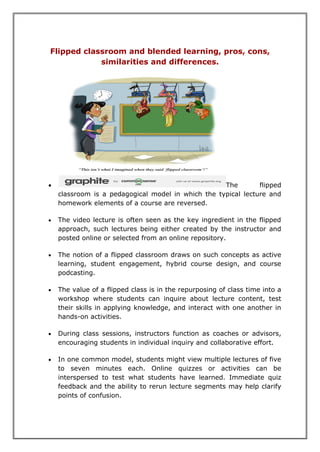
 The flipped
classroom is a pedagogical model in which the typical lecture and
homework elements of a course are reversed.
 The video lecture is often seen as the key ingredient in the flipped
approach, such lectures being either created by the instructor and
posted online or selected from an online repository.
 The notion of a flipped classroom draws on such concepts as active
learning, student engagement, hybrid course design, and course
podcasting.
 The value of a flipped class is in the repurposing of class time into a
workshop where students can inquire about lecture content, test
their skills in applying knowledge, and interact with one another in
hands-on activities.
 During class sessions, instructors function as coaches or advisors,
encouraging students in individual inquiry and collaborative effort.
 In one common model, students might view multiple lectures of five
to seven minutes each. Online quizzes or activities can be
interspersed to test what students have learned. Immediate quiz
feedback and the ability to rerun lecture segments may help clarify
points of confusion.
 Instructors might lead in-class discussions or turn the classroom
into a studio where students create, collaborate, and put into
practice what they learned from the lectures they view outside
class.
 The flipped model puts more of the responsibility for learning on the
shoulders of students while giving them greater impetus to
experiment.
 Blended learning may also allow teachers to spend less time giving
whole-class lessons, and more time meeting with students
individually or in small groups to help them with specific concepts,
skills, questions, or learning problems—the basic educational
rationale behind “flipped classrooms” or “flipped instruction,” a form
of blended learning.
BLENDED LEARNING
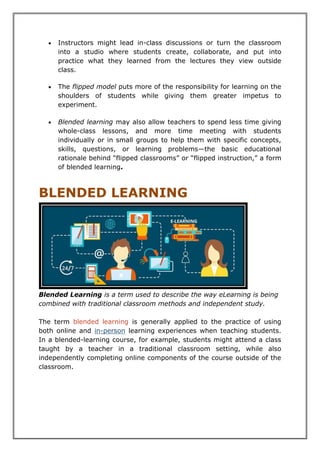
Blended Learning is a term used to describe the way eLearning is being
combined with traditional classroom methods and independent study.
The term blended learning is generally applied to the practice of using
both online and in-person learning experiences when teaching students.
In a blended-learning course, for example, students might attend a class
taught by a teacher in a traditional classroom setting, while also
independently completing online components of the course outside of the
classroom.
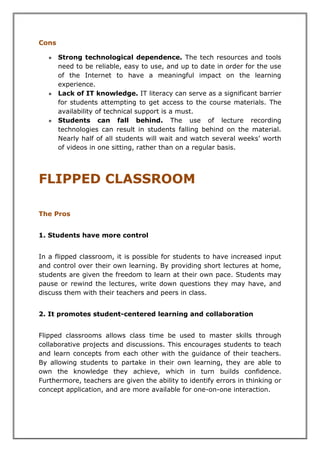
Pros
● Collaborative learning experiences. Collaboration between the
students and instructor can increase substantially via an online
training platform. With many collaborative tools (online discussions,
blogs, instant messages, etc.) the students are able to connect with
each other in or out of the classroom.
● Increased accessibility. Improves access as well as student
attitudes towards learning. The students are given the tools to
access the course materials anytime, anywhere.
● Better communication. Communication is improved between
lecturers and part-time/full-time students. An online training
platform can provide many communication tools such as news
announcements, e-mail, instant messaging, online discussions,
online grading tool, dropboxes, and more.
● Successful evaluations. Better student evaluations via the use of
online testing and assessments with reporting features. Often times,
the students can evaluate themselves better as well with immediate
grading or feedback.
Cons
● Strong technological dependence. The tech resources and tools
need to be reliable, easy to use, and up to date in order for the use
of the Internet to have a meaningful impact on the learning
experience.
● Lack of IT knowledge. IT literacy can serve as a significant barrier
for students attempting to get access to the course materials. The
availability of technical support is a must.
● Students can fall behind. The use of lecture recording
technologies can result in students falling behind on the material.
Nearly half of all students will wait and watch several weeks’ worth
of videos in one sitting, rather than on a regular basis.
FLIPPED CLASSROOM
The Pros
1. Students have more control
In a flipped classroom, it is possible for students to have increased input
and control over their own learning. By providing short lectures at home,
students are given the freedom to learn at their own pace. Students may
pause or rewind the lectures, write down questions they may have, and
discuss them with their teachers and peers in class.
2. It promotes student-centered learning and collaboration
Flipped classrooms allows class time be used to master skills through
collaborative projects and discussions. This encourages students to teach
and learn concepts from each other with the guidance of their teachers.
By allowing students to partake in their own learning, they are able to
own the knowledge they achieve, which in turn builds confidence.
Furthermore, teachers are given the ability to identify errors in thinking or
concept application, and are more available for one-on-one interaction.
3. Lessons and content are more accessible (provided there is
tech access)
By making video lectures available at all times online, students who are
forced to miss class due to illness, sports, vacations or emergencies, can
catch up quickly. This also gives teachers more flexibility when they
themselves are sick and also eliminates make-up assignments.
4. Access = easier for parents to see what’s going on
Unlike traditional classroom models, flipped classrooms give parents 24/7
access to their student’s video lectures. This allows parents to be better
prepared when attempting to help their students and gives them insight
into the quality of instruction their students are receiving.
5. It can be more efficient
Done properly, in a flipped classroom, kids can have more time to be kids,
whether that means more free time, or more academic practice.
The Cons
1. It can create or exacerbate a digital divide
One of the most prominent issues is the necessity for students to have
access to a computer and Internet in order to view the lectures. This is
particularly hard on students from low-income districts who already have
limited access to resources.
2. It relies on preparation and trust
There is also the concern that since flipped classrooms are dependent on
student participation, one must trust students to watch the lectures at
home. Unfortunately, there is no way to guarantee students will oblige or
cooperate with the flipped model.
3. There is significant work on the front-end
Additionally, there is a concern that implementing a flipped classroom
adds an extra workload on teachers, as there are several elements that
must be integrated carefully to allow the class to flourish. Responsibilities
include taping and uploading condensed lectures, which take time and
skill, and introducing activities in the classroom that will enhance the
subject matter as well as motivate students to participate and prepare for
class.
4. Not naturally a test-prep form of learning
Flipped classrooms do not follow the model of teaching to improve
standardized test scores. However, teachers and students are still
required to spend a sizable portion of time preparing for state mandated
testing, which in turn interrupts the flipped classroom process.
5. Time in front of screens–instead of people and places–is
increased
There are some who believe that if every teacher starts flipping their
classrooms, students will spend hours in front of a computer watching the
lectures. One may argue that this has the potential to cause serious
problems to student’s learning processes, as not everyone may be as
adept to learning through a computer.
Similarities
The similarities that have are the implementation or integration of
technology in their teaching.
Differences
 Blended learning involves online and face-to-face instruction.
Both are used alongside each other in order to provide a
comprehensive learning experience. In the case of blended learning,
online materials do not take the place of face-to-face instruction;
instead, the two modalities complement one another.
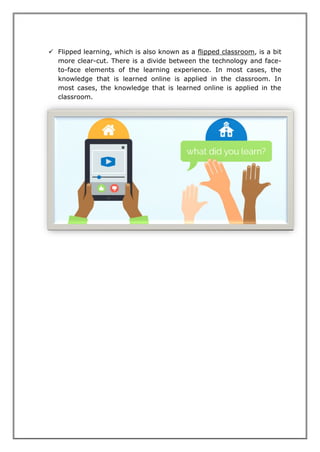
 Flipped learning, which is also known as a flipped classroom, is a bit
more clear-cut. There is a divide between the technology and face-
to-face elements of the learning experience. In most cases, the
knowledge that is learned online is applied in the classroom. In
most cases, the knowledge that is learned online is applied in the
classroom.

Flipped Classroom and blended learning, pros, cons, similarities and differences

  • 1.
    2017 Rosa Calzado UNICDA 18/02/2017 Flipped Classroomand blended learning, pros, cons, similarities and differences
  • 2.
    Flipped classroom andblended learning, pros, cons, similarities and differences.  The flipped classroom is a pedagogical model in which the typical lecture and homework elements of a course are reversed.  The video lecture is often seen as the key ingredient in the flipped approach, such lectures being either created by the instructor and posted online or selected from an online repository.  The notion of a flipped classroom draws on such concepts as active learning, student engagement, hybrid course design, and course podcasting.  The value of a flipped class is in the repurposing of class time into a workshop where students can inquire about lecture content, test their skills in applying knowledge, and interact with one another in hands-on activities.  During class sessions, instructors function as coaches or advisors, encouraging students in individual inquiry and collaborative effort.  In one common model, students might view multiple lectures of five to seven minutes each. Online quizzes or activities can be interspersed to test what students have learned. Immediate quiz feedback and the ability to rerun lecture segments may help clarify points of confusion.
  • 3.
     Instructors mightlead in-class discussions or turn the classroom into a studio where students create, collaborate, and put into practice what they learned from the lectures they view outside class.  The flipped model puts more of the responsibility for learning on the shoulders of students while giving them greater impetus to experiment.  Blended learning may also allow teachers to spend less time giving whole-class lessons, and more time meeting with students individually or in small groups to help them with specific concepts, skills, questions, or learning problems—the basic educational rationale behind “flipped classrooms” or “flipped instruction,” a form of blended learning. BLENDED LEARNING Blended Learning is a term used to describe the way eLearning is being combined with traditional classroom methods and independent study. The term blended learning is generally applied to the practice of using both online and in-person learning experiences when teaching students. In a blended-learning course, for example, students might attend a class taught by a teacher in a traditional classroom setting, while also independently completing online components of the course outside of the classroom.
  • 4.
    Pros ● Collaborative learningexperiences. Collaboration between the students and instructor can increase substantially via an online training platform. With many collaborative tools (online discussions, blogs, instant messages, etc.) the students are able to connect with each other in or out of the classroom. ● Increased accessibility. Improves access as well as student attitudes towards learning. The students are given the tools to access the course materials anytime, anywhere. ● Better communication. Communication is improved between lecturers and part-time/full-time students. An online training platform can provide many communication tools such as news announcements, e-mail, instant messaging, online discussions, online grading tool, dropboxes, and more. ● Successful evaluations. Better student evaluations via the use of online testing and assessments with reporting features. Often times, the students can evaluate themselves better as well with immediate grading or feedback.
  • 5.
    Cons ● Strong technologicaldependence. The tech resources and tools need to be reliable, easy to use, and up to date in order for the use of the Internet to have a meaningful impact on the learning experience. ● Lack of IT knowledge. IT literacy can serve as a significant barrier for students attempting to get access to the course materials. The availability of technical support is a must. ● Students can fall behind. The use of lecture recording technologies can result in students falling behind on the material. Nearly half of all students will wait and watch several weeks’ worth of videos in one sitting, rather than on a regular basis. FLIPPED CLASSROOM The Pros 1. Students have more control In a flipped classroom, it is possible for students to have increased input and control over their own learning. By providing short lectures at home, students are given the freedom to learn at their own pace. Students may pause or rewind the lectures, write down questions they may have, and discuss them with their teachers and peers in class. 2. It promotes student-centered learning and collaboration Flipped classrooms allows class time be used to master skills through collaborative projects and discussions. This encourages students to teach and learn concepts from each other with the guidance of their teachers. By allowing students to partake in their own learning, they are able to own the knowledge they achieve, which in turn builds confidence. Furthermore, teachers are given the ability to identify errors in thinking or concept application, and are more available for one-on-one interaction.
  • 6.
    3. Lessons andcontent are more accessible (provided there is tech access) By making video lectures available at all times online, students who are forced to miss class due to illness, sports, vacations or emergencies, can catch up quickly. This also gives teachers more flexibility when they themselves are sick and also eliminates make-up assignments. 4. Access = easier for parents to see what’s going on Unlike traditional classroom models, flipped classrooms give parents 24/7 access to their student’s video lectures. This allows parents to be better prepared when attempting to help their students and gives them insight into the quality of instruction their students are receiving. 5. It can be more efficient Done properly, in a flipped classroom, kids can have more time to be kids, whether that means more free time, or more academic practice. The Cons 1. It can create or exacerbate a digital divide One of the most prominent issues is the necessity for students to have access to a computer and Internet in order to view the lectures. This is particularly hard on students from low-income districts who already have limited access to resources. 2. It relies on preparation and trust There is also the concern that since flipped classrooms are dependent on student participation, one must trust students to watch the lectures at home. Unfortunately, there is no way to guarantee students will oblige or cooperate with the flipped model. 3. There is significant work on the front-end
  • 7.
    Additionally, there isa concern that implementing a flipped classroom adds an extra workload on teachers, as there are several elements that must be integrated carefully to allow the class to flourish. Responsibilities include taping and uploading condensed lectures, which take time and skill, and introducing activities in the classroom that will enhance the subject matter as well as motivate students to participate and prepare for class. 4. Not naturally a test-prep form of learning Flipped classrooms do not follow the model of teaching to improve standardized test scores. However, teachers and students are still required to spend a sizable portion of time preparing for state mandated testing, which in turn interrupts the flipped classroom process. 5. Time in front of screens–instead of people and places–is increased There are some who believe that if every teacher starts flipping their classrooms, students will spend hours in front of a computer watching the lectures. One may argue that this has the potential to cause serious problems to student’s learning processes, as not everyone may be as adept to learning through a computer. Similarities The similarities that have are the implementation or integration of technology in their teaching. Differences  Blended learning involves online and face-to-face instruction. Both are used alongside each other in order to provide a comprehensive learning experience. In the case of blended learning, online materials do not take the place of face-to-face instruction; instead, the two modalities complement one another.
  • 8.
     Flipped learning,which is also known as a flipped classroom, is a bit more clear-cut. There is a divide between the technology and face- to-face elements of the learning experience. In most cases, the knowledge that is learned online is applied in the classroom. In most cases, the knowledge that is learned online is applied in the classroom.