Project number: NPAD-2017/10097 TAU project
Seminar 2 Material [Part 2]
Learning while at work and Online Learning
Contemporary methods and forms
of work with adult learner
Document details
Country: Sweden
Company: Folkuniversitetet Kristianstad
Elaborated by: Abdullah Badawi & Åsa Kajsdotter
Seminar details
Seminar date Feb 2018
Partners present
Åsa Kajsdotter – SE
Åsa Hedlin Olsson - SE
Yulia Bazyukina - FI
Marja-Liisa Helenius - FI
Inês Messias - FI
Veronica Gelfgren - FI
Responsible All partner countries. Activity to be held by each partner in their institution for its
participants.
Result Participants will improve their educational and management competence.
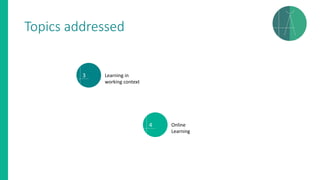
Topics addressed
3 Learning in
working context
4 Online
Learning
Topic 3
Learning in working context
Teacher professional development is viewed as a major policy tool to advance
educational reform, and to improve teaching and learning in the United States.
Professional learning opportunities need to be incorporated into the daily work
routines of teachers through in-school and beyond school training and
development. Teacher training and development ‘at work’ traditionally has
meant creating opportunities for teachers to learn in schools through such
activities as workshops, lectures from experts, study groups and, more recently,
action research projects. The definition of teacher learning ‘at work’, however,
needs to be expanded beyond the school if teachers hope to accomplish school-
to-work curriculum goals.
Source: http://www.tandfonline.com/doi/pdf/10.1080/13674580000200104
Informal and formal learning
Examples from Finland in language learning:
• As an example, executive learning languages can be taught using the
company’s own material like annual reports, brochures and other
documents to practice vocabulary used within that area.
• Language learning in general can also be done outside a classroom by
going to museums to discuss art by using adjectives, going to a
restaurant to work on food related vocabulary, cooking to learn
cooking verbs etc
In Portugal there is special training projects to give training to
company workers, especially to make them more technologically
savvy. All workers, even basic education teachers must have a
minimum of training hours per year to be up to date with new
pedagogies and new technology. How ever there is still struggle
with correctly adapting new technology in the workplace, and
most end up using technology but just for the sake of it.
Topic 4
Online Learning
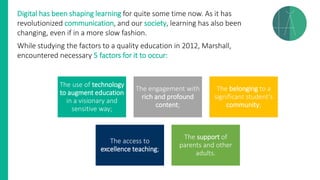
Digital has been shaping learning for quite some time now. As it has
revolutionized communication, and our society, learning has also been
changing, even if in a more slow fashion.
While studying the factors to a quality education in 2012, Marshall,
encountered necessary 5 factors for it to occur:
The use of technology
to augment education
in a visionary and
sensitive way;
The engagement with
rich and profound
content;
The belonging to a
significant student’s
community;
The access to
excellence teaching;
The support of
parents and other
adults.
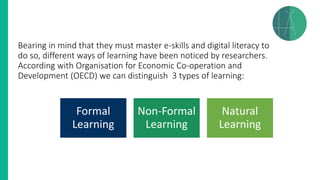
Bearing in mind that they must master e-skills and digital literacy to
do so, different ways of learning have been noticed by researchers.
According with Organisation for Economic Co-operation and
Development (OECD) we can distinguish 3 types of learning:
Formal
Learning
Non-Formal
Learning
Natural
Learning
Formal Learning
Formal learning is the most well known. It occurs in a formal
context, such as in a classroom. But it can be online as well. This
type of learning is mediated by a teacher or a tutor, in a teaching
institution. It has predefined goals by someone else rather than
the student, and it confers a degree, acknowledging the student’s
participation in the form of a certificate or an official diploma.
Non-Formal Lerning
Informal learning is the one we make non-intentionally. It
is not planned, yet but it occurs, in any context. It is
disorganized, without purpose or intention. It can consist
of result of our daily tasks. And it is often referred to our
experience, or learning by experience.
Natural Learning
As for natural learning, it happens individually and
autonomously. It happens when the student wants to
learn, but at his own rhythm, and by himself. This learning
can happen in all environments, including immersive
digital ones, where the student interacts in a natural way
with what he wants to learn, by being part of a
community, that not only guides him but transfers him
knowledge, and that gains knowledge from and with the
student. I encompass collective intelligence.
All these types of learning can occur online, and in distance
learning. As it so happens, with online learning, they can even
happen simultaneously, augmenting our learning capacity and
our knowledge input.
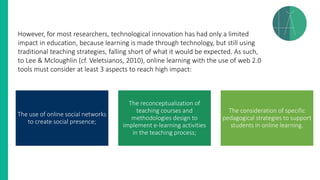
However, for most researchers, technological innovation has had only a limited
impact in education, because learning is made through technology, but still using
traditional teaching strategies, falling short of what it would be expected. As such,
to Lee & Mcloughlin (cf. Veletsianos, 2010), online learning with the use of web 2.0
tools must consider at least 3 aspects to reach high impact:
The use of online social networks
to create social presence;
The reconceptualization of
teaching courses and
methodologies design to
implement e-learning activities
in the teaching process;
The consideration of specific
pedagogical strategies to support
students in online learning.

Tau Seminar 2 material [part 2]

  • 1.
    Project number: NPAD-2017/10097TAU project Seminar 2 Material [Part 2] Learning while at work and Online Learning Contemporary methods and forms of work with adult learner
  • 2.
    Document details Country: Sweden Company:Folkuniversitetet Kristianstad Elaborated by: Abdullah Badawi & Åsa Kajsdotter
  • 3.
    Seminar details Seminar dateFeb 2018 Partners present Åsa Kajsdotter – SE Åsa Hedlin Olsson - SE Yulia Bazyukina - FI Marja-Liisa Helenius - FI Inês Messias - FI Veronica Gelfgren - FI Responsible All partner countries. Activity to be held by each partner in their institution for its participants. Result Participants will improve their educational and management competence.
  • 4.
    Topics addressed 3 Learningin working context 4 Online Learning
  • 5.
    Topic 3 Learning inworking context
  • 6.
    Teacher professional developmentis viewed as a major policy tool to advance educational reform, and to improve teaching and learning in the United States. Professional learning opportunities need to be incorporated into the daily work routines of teachers through in-school and beyond school training and development. Teacher training and development ‘at work’ traditionally has meant creating opportunities for teachers to learn in schools through such activities as workshops, lectures from experts, study groups and, more recently, action research projects. The definition of teacher learning ‘at work’, however, needs to be expanded beyond the school if teachers hope to accomplish school- to-work curriculum goals. Source: http://www.tandfonline.com/doi/pdf/10.1080/13674580000200104
  • 7.
    Informal and formallearning Examples from Finland in language learning: • As an example, executive learning languages can be taught using the company’s own material like annual reports, brochures and other documents to practice vocabulary used within that area. • Language learning in general can also be done outside a classroom by going to museums to discuss art by using adjectives, going to a restaurant to work on food related vocabulary, cooking to learn cooking verbs etc
  • 8.
    In Portugal thereis special training projects to give training to company workers, especially to make them more technologically savvy. All workers, even basic education teachers must have a minimum of training hours per year to be up to date with new pedagogies and new technology. How ever there is still struggle with correctly adapting new technology in the workplace, and most end up using technology but just for the sake of it.
  • 9.
  • 10.
    Digital has beenshaping learning for quite some time now. As it has revolutionized communication, and our society, learning has also been changing, even if in a more slow fashion. While studying the factors to a quality education in 2012, Marshall, encountered necessary 5 factors for it to occur: The use of technology to augment education in a visionary and sensitive way; The engagement with rich and profound content; The belonging to a significant student’s community; The access to excellence teaching; The support of parents and other adults.
  • 11.
    Bearing in mindthat they must master e-skills and digital literacy to do so, different ways of learning have been noticed by researchers. According with Organisation for Economic Co-operation and Development (OECD) we can distinguish 3 types of learning: Formal Learning Non-Formal Learning Natural Learning
  • 12.
    Formal Learning Formal learningis the most well known. It occurs in a formal context, such as in a classroom. But it can be online as well. This type of learning is mediated by a teacher or a tutor, in a teaching institution. It has predefined goals by someone else rather than the student, and it confers a degree, acknowledging the student’s participation in the form of a certificate or an official diploma.
  • 13.
    Non-Formal Lerning Informal learningis the one we make non-intentionally. It is not planned, yet but it occurs, in any context. It is disorganized, without purpose or intention. It can consist of result of our daily tasks. And it is often referred to our experience, or learning by experience.
  • 14.
    Natural Learning As fornatural learning, it happens individually and autonomously. It happens when the student wants to learn, but at his own rhythm, and by himself. This learning can happen in all environments, including immersive digital ones, where the student interacts in a natural way with what he wants to learn, by being part of a community, that not only guides him but transfers him knowledge, and that gains knowledge from and with the student. I encompass collective intelligence.
  • 15.
    All these typesof learning can occur online, and in distance learning. As it so happens, with online learning, they can even happen simultaneously, augmenting our learning capacity and our knowledge input.
  • 16.
    However, for mostresearchers, technological innovation has had only a limited impact in education, because learning is made through technology, but still using traditional teaching strategies, falling short of what it would be expected. As such, to Lee & Mcloughlin (cf. Veletsianos, 2010), online learning with the use of web 2.0 tools must consider at least 3 aspects to reach high impact: The use of online social networks to create social presence; The reconceptualization of teaching courses and methodologies design to implement e-learning activities in the teaching process; The consideration of specific pedagogical strategies to support students in online learning.