 Blended learning – also known as “hybrid
learning” – consists of different teaching
methods to transfer knowledge in the most
effective way. The combination of
traditional classroom education and
computer-based or online learning is
considered to be the essence of blended
learning.
 Blended learning allows organizations to
gradually move learners from traditional
classrooms to e-learning in small steps
making change easier to accept.
 Blended learning is used to describe
learning that mixes various event-based
activities, including faceto-face classrooms,
live e-learning, and self-paced learning.
 Blended learning is an approach to
education that combines online educational
materials and opportunities for interaction
online with traditional place-
based classroom methods. It requires the
physical presence of both teacher and
student, with some elements of student
control over time, place, path, or pace.
Source: https://miro.medium.com/max/1024/0*CxTlR_ZVQwpYf3d9
BLENDED LEARNING
GOALS
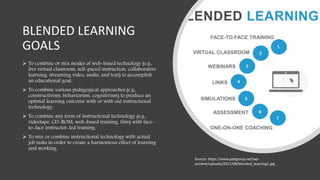
 To combine or mix modes of web-based technology (e.g.,
live virtual classroom, self-paced instruction, collaborative
learning, streaming video, audio, and text) to accomplish
an educational goal.
 To combine various pedagogical approaches (e.g.,
constructivism, behaviorism, cognitivism) to produce an
optimal learning outcome with or with out instructional
technology.
 To combine any form of instructional technology (e.g.,
videotape, CD-ROM, web-based training, film) with face-
to-face instructor-led training.
 To mix or combine instructional technology with actual
job tasks in order to create a harmonious effect of learning
and working.
Source: https://www.pdagroup.net/wp-
content/uploads/2017/08/blended_learning1.jpg
BLENDED LEARNING
MODELS
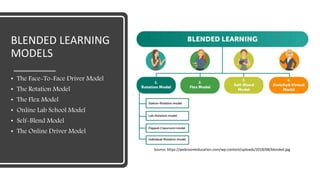
• The Face-To-Face Driver Model
• The Rotation Model
• The Flex Model
• Online Lab School Model
• Self-Blend Model
• The Online Driver Model
Source: https://webroomeducation.com/wp-content/uploads/2018/08/blended.jpg
Blended Learning in Architecture
and Design Education
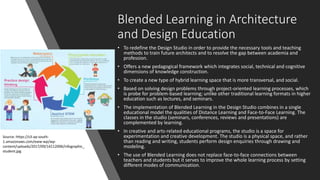
• To redefine the Design Studio in order to provide the necessary tools and teaching
methods to train future architects and to resolve the gap between academia and
profession.
• Offers a new pedagogical framework which integrates social, technical and cognitive
dimensions of knowledge construction.
• To create a new type of hybrid learning space that is more transversal, and social.
• Based on solving design problems through project-oriented learning processes, which
is probe for problem-based learning; unlike other traditional learning formats in higher
education such as lectures, and seminars.
• The implementation of Blended Learning in the Design Studio combines in a single
educational model the qualities of Distance Learning and Face-to-Face Learning. The
classes in the studio (seminars, conferences, reviews and presentations) are
complemented by learning.
• In creative and arts-related educational programs, the studio is a space for
experimentation and creative development. The studio is a physical space, and rather
than reading and writing, students perform design enquiries through drawing and
modeling.
• The use of Blended Learning does not replace face-to-face connections between
teachers and students but it serves to improve the whole learning process by setting
different modes of communication.
Source: https://s3-ap-south-
1.amazonaws.com/eww-wp/wp-
content/uploads/2017/09/14112006/infographic_
student.jpg
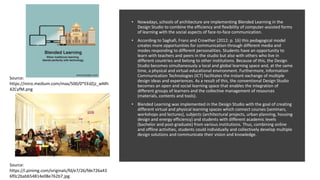
• Nowadays, schools of architecture are implementing Blended Learning in the
Design Studio to combine the efficiency and flexibility of computer-assisted forms
of learning with the social aspects of face-to-face communication.
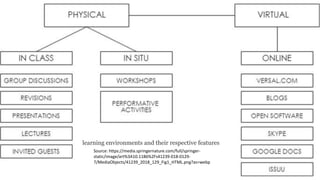
• According to Saghafi, Franz and Crowther (2012: p. 16) this pedagogical model
creates more opportunities for communication through different media and
modes responding to different personalities. Students have an opportunity to
learn with teachers and peers in the studio but also with others who live in
different countries and belong to other institutions. Because of this, the Design
Studio becomes simultaneously a local and global learning space and, at the same
time, a physical and virtual educational environment. Furthermore, Information
Communication Technologies (ICT) facilitates the instant exchange of multiple
design ideas and experiences. As a result of this, the conventional Design Studio
becomes an open and social learning space that enables the integration of
different groups of learners and the collective management of resources
(materials, contents and tools).
• Blended Learning was implemented in the Design Studio with the goal of creating
different virtual and physical learning spaces which connect courses (seminars,
workshops and lectures), subjects (architectural projects, urban planning, housing
design and energy efficiency) and students with different academic levels
(bachelor and post-graduate) from various institutions. Thus, combining online
and offline activities, students could individually and collectively develop multiple
design solutions and communicate their vision and knowledge.
Source:
https://i.pinimg.com/originals/fd/e7/26/fde726a43
6f0c2babb54814e08e762b7.jpg
Source:
https://miro.medium.com/max/500/0*EEdZjz_wMh
42CyfM.png
learning environments and their respective features
Source: https://media.springernature.com/full/springer-
static/image/art%3A10.1186%2Fs41239-018-0129-
7/MediaObjects/41239_2018_129_Fig1_HTML.png?as=webp
REFERENCES:
• Driscoll Margaret; Blended Learning: Let's Get
Beyond the Hype; IBM Global Services
• The 6 Blended Learning Models and When They
Work The Best;Web room Education, 2018
• Fuses Josep; Reconceptualizing the design
studio in architectural education: Distance
learning and blended learning as transformation
factors; IJAR, 2017

Blended learning

  • 2.
     Blended learning– also known as “hybrid learning” – consists of different teaching methods to transfer knowledge in the most effective way. The combination of traditional classroom education and computer-based or online learning is considered to be the essence of blended learning.  Blended learning allows organizations to gradually move learners from traditional classrooms to e-learning in small steps making change easier to accept.  Blended learning is used to describe learning that mixes various event-based activities, including faceto-face classrooms, live e-learning, and self-paced learning.  Blended learning is an approach to education that combines online educational materials and opportunities for interaction online with traditional place- based classroom methods. It requires the physical presence of both teacher and student, with some elements of student control over time, place, path, or pace. Source: https://miro.medium.com/max/1024/0*CxTlR_ZVQwpYf3d9
  • 3.
    BLENDED LEARNING GOALS  Tocombine or mix modes of web-based technology (e.g., live virtual classroom, self-paced instruction, collaborative learning, streaming video, audio, and text) to accomplish an educational goal.  To combine various pedagogical approaches (e.g., constructivism, behaviorism, cognitivism) to produce an optimal learning outcome with or with out instructional technology.  To combine any form of instructional technology (e.g., videotape, CD-ROM, web-based training, film) with face- to-face instructor-led training.  To mix or combine instructional technology with actual job tasks in order to create a harmonious effect of learning and working. Source: https://www.pdagroup.net/wp- content/uploads/2017/08/blended_learning1.jpg
  • 4.
    BLENDED LEARNING MODELS • TheFace-To-Face Driver Model • The Rotation Model • The Flex Model • Online Lab School Model • Self-Blend Model • The Online Driver Model Source: https://webroomeducation.com/wp-content/uploads/2018/08/blended.jpg
  • 6.
    Blended Learning inArchitecture and Design Education • To redefine the Design Studio in order to provide the necessary tools and teaching methods to train future architects and to resolve the gap between academia and profession. • Offers a new pedagogical framework which integrates social, technical and cognitive dimensions of knowledge construction. • To create a new type of hybrid learning space that is more transversal, and social. • Based on solving design problems through project-oriented learning processes, which is probe for problem-based learning; unlike other traditional learning formats in higher education such as lectures, and seminars. • The implementation of Blended Learning in the Design Studio combines in a single educational model the qualities of Distance Learning and Face-to-Face Learning. The classes in the studio (seminars, conferences, reviews and presentations) are complemented by learning. • In creative and arts-related educational programs, the studio is a space for experimentation and creative development. The studio is a physical space, and rather than reading and writing, students perform design enquiries through drawing and modeling. • The use of Blended Learning does not replace face-to-face connections between teachers and students but it serves to improve the whole learning process by setting different modes of communication. Source: https://s3-ap-south- 1.amazonaws.com/eww-wp/wp- content/uploads/2017/09/14112006/infographic_ student.jpg
  • 7.
    • Nowadays, schoolsof architecture are implementing Blended Learning in the Design Studio to combine the efficiency and flexibility of computer-assisted forms of learning with the social aspects of face-to-face communication. • According to Saghafi, Franz and Crowther (2012: p. 16) this pedagogical model creates more opportunities for communication through different media and modes responding to different personalities. Students have an opportunity to learn with teachers and peers in the studio but also with others who live in different countries and belong to other institutions. Because of this, the Design Studio becomes simultaneously a local and global learning space and, at the same time, a physical and virtual educational environment. Furthermore, Information Communication Technologies (ICT) facilitates the instant exchange of multiple design ideas and experiences. As a result of this, the conventional Design Studio becomes an open and social learning space that enables the integration of different groups of learners and the collective management of resources (materials, contents and tools). • Blended Learning was implemented in the Design Studio with the goal of creating different virtual and physical learning spaces which connect courses (seminars, workshops and lectures), subjects (architectural projects, urban planning, housing design and energy efficiency) and students with different academic levels (bachelor and post-graduate) from various institutions. Thus, combining online and offline activities, students could individually and collectively develop multiple design solutions and communicate their vision and knowledge. Source: https://i.pinimg.com/originals/fd/e7/26/fde726a43 6f0c2babb54814e08e762b7.jpg Source: https://miro.medium.com/max/500/0*EEdZjz_wMh 42CyfM.png
  • 8.
    learning environments andtheir respective features Source: https://media.springernature.com/full/springer- static/image/art%3A10.1186%2Fs41239-018-0129- 7/MediaObjects/41239_2018_129_Fig1_HTML.png?as=webp
  • 9.
    REFERENCES: • Driscoll Margaret;Blended Learning: Let's Get Beyond the Hype; IBM Global Services • The 6 Blended Learning Models and When They Work The Best;Web room Education, 2018 • Fuses Josep; Reconceptualizing the design studio in architectural education: Distance learning and blended learning as transformation factors; IJAR, 2017