Project number: NPAD-2017/10097 TAU project
Seminar 1 Material[Part 4]
Teaching methods & management
Creation of favorable educational
environment, management and
planning work with adult learners
Document details
Country: Finland
Company: Learnmera Oy
Elaborated by: Inês Messias
Date of submission 13.12.2017
Seminar details
Seminar date 22.11.2017
Partners present Ingmarie Rohdin - SE
Åsa Kajsdotter - SE
Yulia Bazyukina - FI
Inês Messias - FI
Marja-Liisa Helenius - FI
Veronica Gelfgren - FI
Responsible All partner countries. Activity to be held by each partner in their institution
for its participants.
Result Participants will improve their educational and management competence.
Topics addressed
13 Where will the learners publish
their material
14 Teaching methods: Upgrading from a traditional
classroom to a digital dynamic classroom
15 Blended learning
16 Management: Managing adult learning courses?
17 Learning management systems: What strategies?
Topic 13
Where will the learners publish their material
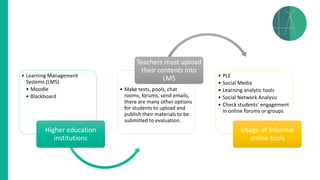
• Learning Management
Systems (LMS)
• Moodle
• Blackboard
Higher education
institutions
• Make tests, pools, chat
rooms, forums, send emails,
there are many other options
for students to upload and
publish their materials to be
submitted to evaluation.
Teachers must upload
their contents into
LMS • PLE
• Social Media
• Learning analytic tools
• Social Network Analysis
• Check students’ engagement
in online forums or groups
Usage of informal
online tools
Topic 14
Teaching methods: Upgrading from a traditional classroom
to a digital dynamic classroom
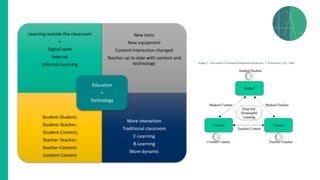
Learning outside the classroom
=
Digital tools
Internet
Informal Learning
New tools
New equipment
Content interaction changed
Teacher up to date with content and
technology
Student-Student;
Student-Teacher;
Student-Content;
Teacher-Teacher;
Teacher-Content;
Content-Content
More interaction
Traditional classroom
E-Learning
B-Learning
More dynamic
Education
+
Technology
Image 1 - Interaction in Distance Education (Anderson, T. & Garrison, D.R.; 2003
Brooks-Young (2007) suggests that the ideal digital teacher profile has the
following 10 characteristics:
“Demonstrate a sound
understanding of the nature and
operation of technology systems.
Demonstrate proficiency in the
use of common input and output
devices; solve routine hardware
and software problems; and
make informed choices about
technology systems, resources,
and services.
Use content-specific tools (e.g.,
software, simulation,
environmental probes, graphing
calculators, exploratory
environments, Web tools) to
support learning and research.
Use technology resources to
facilitate higher order and
complex thinking skills, including
problem solving, critical thinking,
informed decision-making.
Knowledge construction, and
creativity.
Collaborate in constructing
technology-enhanced models,
preparing publications, and
producing other creative works
using productivity tools.
Use technology to locate,
evaluate, and collect information
from a variety of sources.
Use technology tools to process
data and report results.
Use technology in the
development of strategies for
solving problems in the real
world.
Evaluate and select new
information resources and
technological innovations based
on their appropriateness to
specific tasks.
Use a variety of media and
formats, including
telecommunications, to
collaborate, publish, and interact
with peers, experts and other
audiences.”
Adult students are even more demanding.
They already have a
notion of what they
need for their work
They require training to
improve their skills at
work
They require training to
find new better jobs
Opportunity is the key
word for these students
They need timely
feedback from their
teachers
Their schedules are
tight
They want to know if
the time they are
spending while learning
is spent creating quality
knowledge
The faster they learn,
the faster they improve
in their work
Structured feedback is
of the essence here
The rule as to
feedback gap is
that no more than
48 hours shall pass
between when the
student makes
contact and the
teacher’s answer.
The need of a teacher that facilitates learning, rather than just lectures, that
gives students the set of tools they require to make their own individual
learning outside of the classroom, requires the teacher to master digital
tools and skills.
According to Barone (2005) “The arrival
of the Net Generation on campus is
causing unrest in the classroom. A wave
of young people empowered to create
knowledge, not merely absorb it. Now
it flows in and out of the classroom”.
Grow out of the traditional
teaching context and
successfully embrace new
pedagogical tools and models.
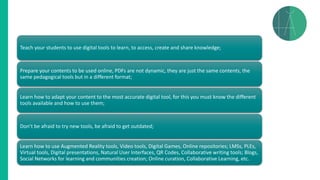
Teach your students to use digital tools to learn, to access, create and share knowledge;
Prepare your contents to be used online, PDFs are not dynamic, they are just the same contents, the
same pedagogical tools but in a different format;
Learn how to adapt your content to the most accurate digital tool, for this you must know the different
tools available and how to use them;
Don’t be afraid to try new tools, be afraid to get outdated;
Learn how to use Augmented Reality tools, Video tools, Digital Games, Online repositories; LMSs, PLEs,
Virtual tools, Digital presentations, Natural User Interfaces, QR Codes, Collaborative writing tools; Blogs,
Social Networks for learning and communities creation; Online curation, Collaborative Learning, etc.
Topic 15
Blended learning
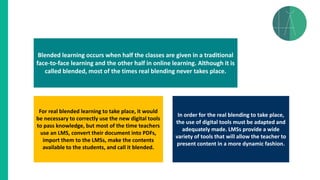
Blended learning occurs when half the classes are given in a traditional
face-to-face learning and the other half in online learning. Although it is
called blended, most of the times real blending never takes place.
For real blended learning to take place, it would
be necessary to correctly use the new digital tools
to pass knowledge, but most of the time teachers
use an LMS, convert their document into PDFs,
import them to the LMSs, make the contents
available to the students, and call it blended.
In order for the real blending to take place,
the use of digital tools must be adapted and
adequately made. LMSs provide a wide
variety of tools that will allow the teacher to
present content in a more dynamic fashion.
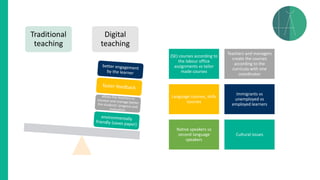
Topic 16
Management: managing adult learning courses?
Traditional
teaching
Digital
teaching
(SE) courses according to
the labour office
assignments vs tailor
made courses
Teachers and managers
create the courses
according to the
curricula with one
coordinator
Language courses, skills
courses
Immigrants vs
unemployed vs
employed learners
Native speakers vs
second language
speakers
Cultural issues
Topic 17
Learning management systems: what strategies?
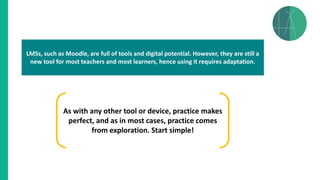
LMSs, such as Moodle, are full of tools and digital potential. However, they are still a
new tool for most teachers and most learners, hence using it requires adaptation.
As with any other tool or device, practice makes
perfect, and as in most cases, practice comes
from exploration. Start simple!
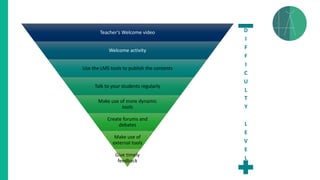
Teacher’s Welcome video
Welcome activity
Use the LMS tools to publish the contents
Talk to your students regularly
Make use of more dynamic
tools
Create forums and
debates
Make use of
external tools
Give timely
feedback
D
I
F
F
I
C
U
L
T
Y
L
E
V
E
L

Tau Seminar1 material part4

  • 1.
    Project number: NPAD-2017/10097TAU project Seminar 1 Material[Part 4] Teaching methods & management Creation of favorable educational environment, management and planning work with adult learners
  • 2.
    Document details Country: Finland Company:Learnmera Oy Elaborated by: Inês Messias Date of submission 13.12.2017
  • 3.
    Seminar details Seminar date22.11.2017 Partners present Ingmarie Rohdin - SE Åsa Kajsdotter - SE Yulia Bazyukina - FI Inês Messias - FI Marja-Liisa Helenius - FI Veronica Gelfgren - FI Responsible All partner countries. Activity to be held by each partner in their institution for its participants. Result Participants will improve their educational and management competence.
  • 4.
    Topics addressed 13 Wherewill the learners publish their material 14 Teaching methods: Upgrading from a traditional classroom to a digital dynamic classroom 15 Blended learning 16 Management: Managing adult learning courses? 17 Learning management systems: What strategies?
  • 5.
    Topic 13 Where willthe learners publish their material
  • 6.
    • Learning Management Systems(LMS) • Moodle • Blackboard Higher education institutions • Make tests, pools, chat rooms, forums, send emails, there are many other options for students to upload and publish their materials to be submitted to evaluation. Teachers must upload their contents into LMS • PLE • Social Media • Learning analytic tools • Social Network Analysis • Check students’ engagement in online forums or groups Usage of informal online tools
  • 7.
    Topic 14 Teaching methods:Upgrading from a traditional classroom to a digital dynamic classroom
  • 8.
    Learning outside theclassroom = Digital tools Internet Informal Learning New tools New equipment Content interaction changed Teacher up to date with content and technology Student-Student; Student-Teacher; Student-Content; Teacher-Teacher; Teacher-Content; Content-Content More interaction Traditional classroom E-Learning B-Learning More dynamic Education + Technology Image 1 - Interaction in Distance Education (Anderson, T. & Garrison, D.R.; 2003
  • 9.
    Brooks-Young (2007) suggeststhat the ideal digital teacher profile has the following 10 characteristics: “Demonstrate a sound understanding of the nature and operation of technology systems. Demonstrate proficiency in the use of common input and output devices; solve routine hardware and software problems; and make informed choices about technology systems, resources, and services. Use content-specific tools (e.g., software, simulation, environmental probes, graphing calculators, exploratory environments, Web tools) to support learning and research. Use technology resources to facilitate higher order and complex thinking skills, including problem solving, critical thinking, informed decision-making. Knowledge construction, and creativity. Collaborate in constructing technology-enhanced models, preparing publications, and producing other creative works using productivity tools. Use technology to locate, evaluate, and collect information from a variety of sources. Use technology tools to process data and report results. Use technology in the development of strategies for solving problems in the real world. Evaluate and select new information resources and technological innovations based on their appropriateness to specific tasks. Use a variety of media and formats, including telecommunications, to collaborate, publish, and interact with peers, experts and other audiences.”
  • 10.
    Adult students areeven more demanding. They already have a notion of what they need for their work They require training to improve their skills at work They require training to find new better jobs Opportunity is the key word for these students They need timely feedback from their teachers Their schedules are tight They want to know if the time they are spending while learning is spent creating quality knowledge The faster they learn, the faster they improve in their work Structured feedback is of the essence here The rule as to feedback gap is that no more than 48 hours shall pass between when the student makes contact and the teacher’s answer.
  • 11.
    The need ofa teacher that facilitates learning, rather than just lectures, that gives students the set of tools they require to make their own individual learning outside of the classroom, requires the teacher to master digital tools and skills. According to Barone (2005) “The arrival of the Net Generation on campus is causing unrest in the classroom. A wave of young people empowered to create knowledge, not merely absorb it. Now it flows in and out of the classroom”. Grow out of the traditional teaching context and successfully embrace new pedagogical tools and models.
  • 12.
    Teach your studentsto use digital tools to learn, to access, create and share knowledge; Prepare your contents to be used online, PDFs are not dynamic, they are just the same contents, the same pedagogical tools but in a different format; Learn how to adapt your content to the most accurate digital tool, for this you must know the different tools available and how to use them; Don’t be afraid to try new tools, be afraid to get outdated; Learn how to use Augmented Reality tools, Video tools, Digital Games, Online repositories; LMSs, PLEs, Virtual tools, Digital presentations, Natural User Interfaces, QR Codes, Collaborative writing tools; Blogs, Social Networks for learning and communities creation; Online curation, Collaborative Learning, etc.
  • 13.
  • 14.
    Blended learning occurswhen half the classes are given in a traditional face-to-face learning and the other half in online learning. Although it is called blended, most of the times real blending never takes place. For real blended learning to take place, it would be necessary to correctly use the new digital tools to pass knowledge, but most of the time teachers use an LMS, convert their document into PDFs, import them to the LMSs, make the contents available to the students, and call it blended. In order for the real blending to take place, the use of digital tools must be adapted and adequately made. LMSs provide a wide variety of tools that will allow the teacher to present content in a more dynamic fashion.
  • 15.
    Topic 16 Management: managingadult learning courses?
  • 16.
    Traditional teaching Digital teaching (SE) courses accordingto the labour office assignments vs tailor made courses Teachers and managers create the courses according to the curricula with one coordinator Language courses, skills courses Immigrants vs unemployed vs employed learners Native speakers vs second language speakers Cultural issues
  • 17.
    Topic 17 Learning managementsystems: what strategies?
  • 18.
    LMSs, such asMoodle, are full of tools and digital potential. However, they are still a new tool for most teachers and most learners, hence using it requires adaptation. As with any other tool or device, practice makes perfect, and as in most cases, practice comes from exploration. Start simple!
  • 19.
    Teacher’s Welcome video Welcomeactivity Use the LMS tools to publish the contents Talk to your students regularly Make use of more dynamic tools Create forums and debates Make use of external tools Give timely feedback D I F F I C U L T Y L E V E L