Project number: NPAD-2017/10097 TAU project
Seminar 2 Material [Part 3]
e-Skills & e-Literacy: using digital tools to learn
Contemporary methods and forms
of work with adult learner
Document details
Country: Sweden
Company: Folkuniversitetet Kristianstad
Elaborated by: Abdullah Badawi & Åsa Kajsdotter
Seminar details
Seminar date Feb 2018
Partners present
Åsa Kajsdotter – SE
Åsa Hedlin Olsson - SE
Yulia Bazyukina - FI
Marja-Liisa Helenius - FI
Inês Messias - FI
Veronica Gelfgren - FI
Responsible All partner countries. Activity to be held by each partner in their institution for its
participants.
Result Participants will improve their educational and management competence.
Topics addressed
5 e-Skills and e-
Literacy
6 Mastering the digital
learning tools
Topic 5
e-Skills and e-Literacy
❖ This happens after upper secondary school.
❖ There are hundreds of occupations to choose from.
❖ The programmes are most often between one and three years long,
and weave theory in school with practice out at workplaces.
❖ Sufficient knowledge of Swedish to manage the programme is a
requirement; the school determines whether it is sufficient.
❖ A number of schools provide extra support in vocational Swedish.
While in the past learning consisted on individual knowledge acquisition, storage
and retrieval, nowadays, in the digital society, it implies the connected learning that
occurs through interaction with various sources of knowledge (including the Internet
and learning management systems) and participation in communities of common
interest, social networks and group tasks" (Siemens, 2004). We must possess a
specific set of skills and competencies that will allow us to effectively benefit from e-
government, elearning and e-health services, and participate actively in the
knowledge society as co-creators, and not simply consumers, as highlighted by the
European e-skills strategy (McCormack, 2010).
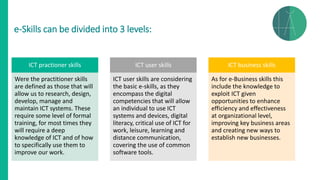
e-Skills can be divided into 3 levels:
ICT practioner skills
Were the practitioner skills
are defined as those that will
allow us to research, design,
develop, manage and
maintain ICT systems. These
require some level of formal
training, for most times they
will require a deep
knowledge of ICT and of how
to specifically use them to
improve our work.
ICT user skills
ICT user skills are considering
the basic e-skills, as they
encompass the digital
competencies that will allow
an individual to use ICT
systems and devices, digital
literacy, critical use of ICT for
work, leisure, learning and
distance communication,
covering the use of common
software tools.
ICT business skills
As for e-Business skills this
include the knowledge to
exploit ICT given
opportunities to enhance
efficiency and effectiveness
at organizational level,
improving key business areas
and creating new ways to
establish new businesses.
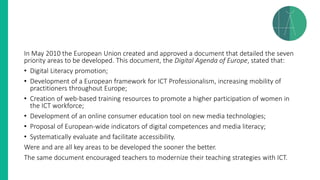
In May 2010 the European Union created and approved a document that detailed the seven
priority areas to be developed. This document, the Digital Agenda of Europe, stated that:
• Digital Literacy promotion;
• Development of a European framework for ICT Professionalism, increasing mobility of
practitioners throughout Europe;
• Creation of web-based training resources to promote a higher participation of women in
the ICT workforce;
• Development of an online consumer education tool on new media technologies;
• Proposal of European-wide indicators of digital competences and media literacy;
• Systematically evaluate and facilitate accessibility.
Were and are all key areas to be developed the sooner the better.
The same document encouraged teachers to modernize their teaching strategies with ICT.
The need to develop these skills is being set by society, economy, companies and
evolution. The e-Skills Manifesto presents a correlation between IT and growth of
economy, making them and the people who have them very valuable to companies
and to the economy. As McCormack (2010) says we need e-skilled people to provide
the infrastructure and e-skilled people to use it. An e-skilled society is thus a
precursor to a knowledge based society.
E-Literacy, or digital literacy can be defined by the competencies that allow for
someone to acquire knowledge using digital technology. According to the Journal of
eLiteracy, digital literacy refers “to the awarenesses, skills, understandings, and
reflective approaches necessary for an individual to operate comfortably in
information-rich and IT-enabled environments” (Martin & Ashworth, 2004).
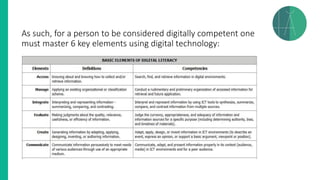
As such, for a person to be considered digitally competent one
must master 6 key elements using digital technology:
Topic 6
Mastering the digital learning tools
Using technology for adult learning is as much a necessity as an
obstacle. Most adult learning in done in workplace context of after
work hours, meaning usually online distance learning is prefered over
traditional face-to-face learning. This gives the learner more schedule
flexibility, and the benefit of accessing the content wherever he wants.
However, as good this may sound to a technologically savvy person, a
high percentage of adults have trouble mastering technology.
Most adults have not had access to digital technology until they were
already in university, as for the use of a cell phone, most find it hard to use
them for more than just phone calls.
As such, when using new technology for adult learning, one must consider
that a considerable percentage of the students may need a closer follow up.
It is advisable to consider the students possible difficulties while using
technology. User guides are advisable, explaining step by step the necessary
steps to successfully complete the task. This guide should always be present,
but not mandatory, as we must never disregard the students that already
possess the required know how.
New tools, or new ways of using digital technology platforms are
however taking place over the formal ones, as they are more dynamic,
and more flexible, and for the common and future i-generation learner,
these are easier, friendlier and already known. Informal strategies of
using these tools have been being set up, such as PLE.
VLE or Virtual learning environments, can be considered any virtual
platform usable for learning, usually they are even multiple
platforms, each one specific for each of the students needs, and
therefore, more adapted to each type of learning, or subject.
According to Vovides et al (2007) a VLE “should be designed to
address learners’ diversity in terms of learning styles, prior
knowledge, culture, and self-regulation skills” (Vovides et al, 2007).

Tau Seminar 2 material [part 3]

  • 1.
    Project number: NPAD-2017/10097TAU project Seminar 2 Material [Part 3] e-Skills & e-Literacy: using digital tools to learn Contemporary methods and forms of work with adult learner
  • 2.
    Document details Country: Sweden Company:Folkuniversitetet Kristianstad Elaborated by: Abdullah Badawi & Åsa Kajsdotter
  • 3.
    Seminar details Seminar dateFeb 2018 Partners present Åsa Kajsdotter – SE Åsa Hedlin Olsson - SE Yulia Bazyukina - FI Marja-Liisa Helenius - FI Inês Messias - FI Veronica Gelfgren - FI Responsible All partner countries. Activity to be held by each partner in their institution for its participants. Result Participants will improve their educational and management competence.
  • 4.
    Topics addressed 5 e-Skillsand e- Literacy 6 Mastering the digital learning tools
  • 5.
  • 6.
    ❖ This happensafter upper secondary school. ❖ There are hundreds of occupations to choose from. ❖ The programmes are most often between one and three years long, and weave theory in school with practice out at workplaces. ❖ Sufficient knowledge of Swedish to manage the programme is a requirement; the school determines whether it is sufficient. ❖ A number of schools provide extra support in vocational Swedish.
  • 7.
    While in thepast learning consisted on individual knowledge acquisition, storage and retrieval, nowadays, in the digital society, it implies the connected learning that occurs through interaction with various sources of knowledge (including the Internet and learning management systems) and participation in communities of common interest, social networks and group tasks" (Siemens, 2004). We must possess a specific set of skills and competencies that will allow us to effectively benefit from e- government, elearning and e-health services, and participate actively in the knowledge society as co-creators, and not simply consumers, as highlighted by the European e-skills strategy (McCormack, 2010).
  • 8.
    e-Skills can bedivided into 3 levels: ICT practioner skills Were the practitioner skills are defined as those that will allow us to research, design, develop, manage and maintain ICT systems. These require some level of formal training, for most times they will require a deep knowledge of ICT and of how to specifically use them to improve our work. ICT user skills ICT user skills are considering the basic e-skills, as they encompass the digital competencies that will allow an individual to use ICT systems and devices, digital literacy, critical use of ICT for work, leisure, learning and distance communication, covering the use of common software tools. ICT business skills As for e-Business skills this include the knowledge to exploit ICT given opportunities to enhance efficiency and effectiveness at organizational level, improving key business areas and creating new ways to establish new businesses.
  • 9.
    In May 2010the European Union created and approved a document that detailed the seven priority areas to be developed. This document, the Digital Agenda of Europe, stated that: • Digital Literacy promotion; • Development of a European framework for ICT Professionalism, increasing mobility of practitioners throughout Europe; • Creation of web-based training resources to promote a higher participation of women in the ICT workforce; • Development of an online consumer education tool on new media technologies; • Proposal of European-wide indicators of digital competences and media literacy; • Systematically evaluate and facilitate accessibility. Were and are all key areas to be developed the sooner the better. The same document encouraged teachers to modernize their teaching strategies with ICT.
  • 10.
    The need todevelop these skills is being set by society, economy, companies and evolution. The e-Skills Manifesto presents a correlation between IT and growth of economy, making them and the people who have them very valuable to companies and to the economy. As McCormack (2010) says we need e-skilled people to provide the infrastructure and e-skilled people to use it. An e-skilled society is thus a precursor to a knowledge based society.
  • 11.
    E-Literacy, or digitalliteracy can be defined by the competencies that allow for someone to acquire knowledge using digital technology. According to the Journal of eLiteracy, digital literacy refers “to the awarenesses, skills, understandings, and reflective approaches necessary for an individual to operate comfortably in information-rich and IT-enabled environments” (Martin & Ashworth, 2004).
  • 12.
    As such, fora person to be considered digitally competent one must master 6 key elements using digital technology:
  • 13.
    Topic 6 Mastering thedigital learning tools
  • 14.
    Using technology foradult learning is as much a necessity as an obstacle. Most adult learning in done in workplace context of after work hours, meaning usually online distance learning is prefered over traditional face-to-face learning. This gives the learner more schedule flexibility, and the benefit of accessing the content wherever he wants. However, as good this may sound to a technologically savvy person, a high percentage of adults have trouble mastering technology.
  • 15.
    Most adults havenot had access to digital technology until they were already in university, as for the use of a cell phone, most find it hard to use them for more than just phone calls. As such, when using new technology for adult learning, one must consider that a considerable percentage of the students may need a closer follow up. It is advisable to consider the students possible difficulties while using technology. User guides are advisable, explaining step by step the necessary steps to successfully complete the task. This guide should always be present, but not mandatory, as we must never disregard the students that already possess the required know how.
  • 16.
    New tools, ornew ways of using digital technology platforms are however taking place over the formal ones, as they are more dynamic, and more flexible, and for the common and future i-generation learner, these are easier, friendlier and already known. Informal strategies of using these tools have been being set up, such as PLE.
  • 17.
    VLE or Virtuallearning environments, can be considered any virtual platform usable for learning, usually they are even multiple platforms, each one specific for each of the students needs, and therefore, more adapted to each type of learning, or subject. According to Vovides et al (2007) a VLE “should be designed to address learners’ diversity in terms of learning styles, prior knowledge, culture, and self-regulation skills” (Vovides et al, 2007).