
Getting the Most out of the  Social Web to Create New Cultures of Learning & Guiding in the EFL Classroom A 2-Day Workshop for EFL Teachers at the Foundation Program of Qatar University  by Buthaina Al Othman  Doha, Qatar - February 25-26, 2009
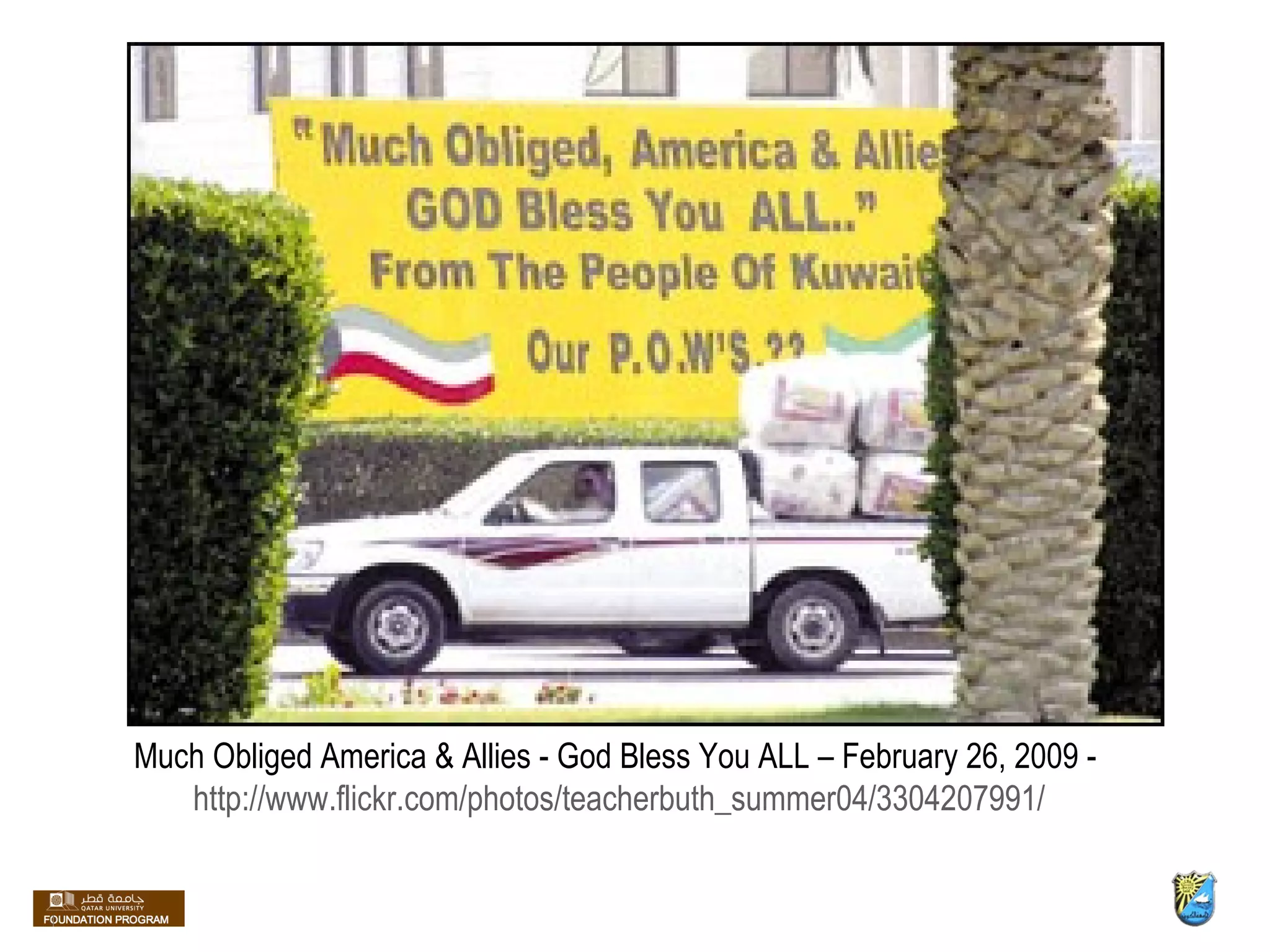
Much Obliged America & Allies - God Bless You ALL – February 26, 2009 -  http://www.flickr.com/photos/teacherbuth_summer04/3304207991/
Agenda What is Learning  Learning theories & approaches Informal Learning  Formal Learning vs. Informal Learning  The Social Web / Web 2.0  Communities of practice & Multiliteracy (Webhead Guest Speaker)  The new role of teachers – Be a Multilit. To Fit Wikis & Ning (Webhead Guest Speaker) Flickr & Twitter (Webhead Guest Speaker)  AlOthman, B.
What is Learning?
“ Learning can be defined  formally  as the  act ,  process ,  or  experience  of gaining knowledge or skills  –  Learning  helps  us  move  from  novices  to  experts  and  allows  us to gain new knowledge and abilities” Marcia L. Conner, (2007) http://www.agelesslearner.com/intros/adultlearning.html This site is licensed under a  Creative Commons License . 11
“ Learning  is seen as something  that  you  do   in order to  understand  the  real world ”; so,  “ learning  how  or  improving  an  ability  is not  like learning  that  or acquiring information” Gilbert Ryle (1900-1967) 11
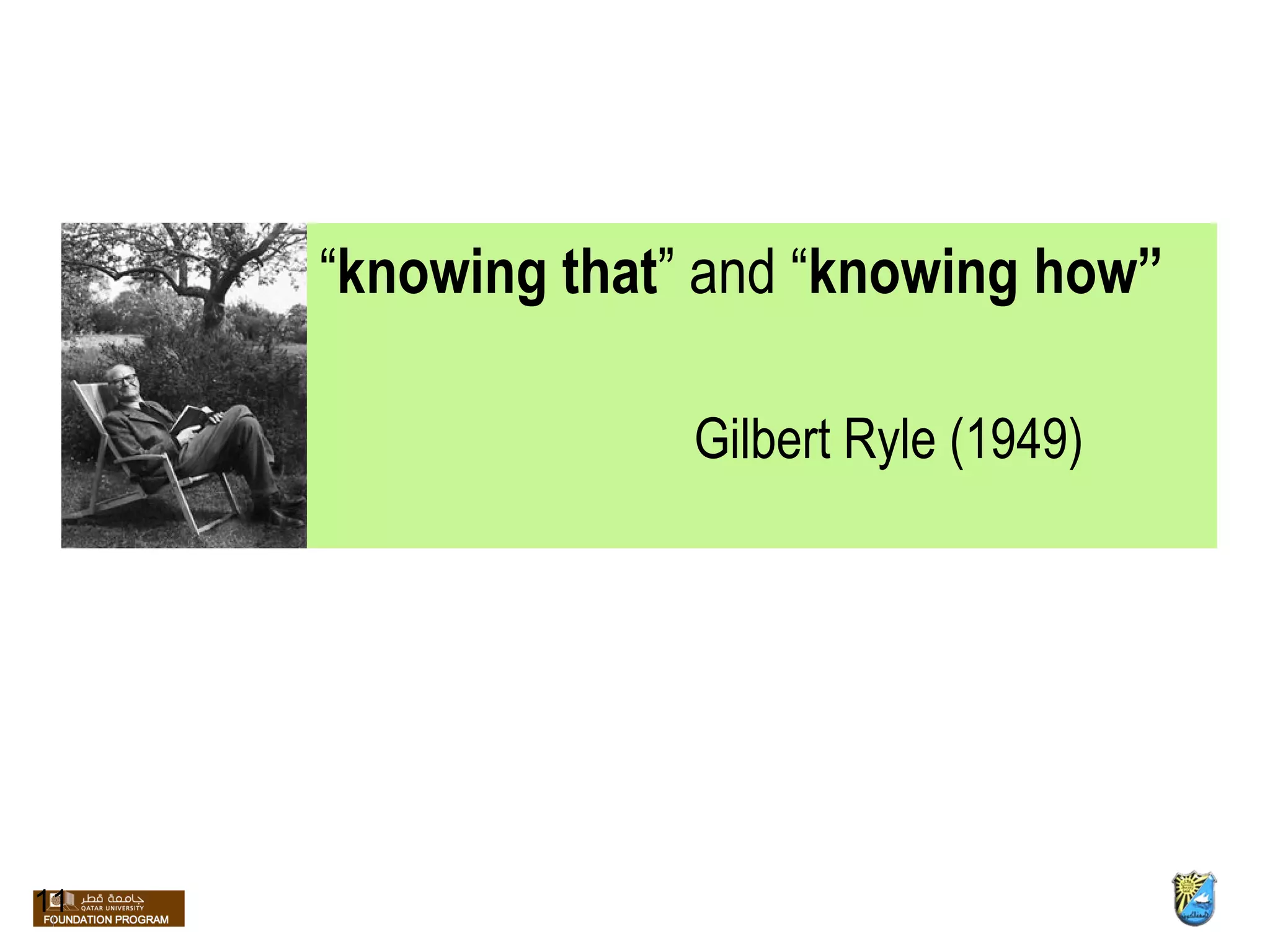
“ knowing that ” and “ knowing how” Gilbert Ryle (1949) 11
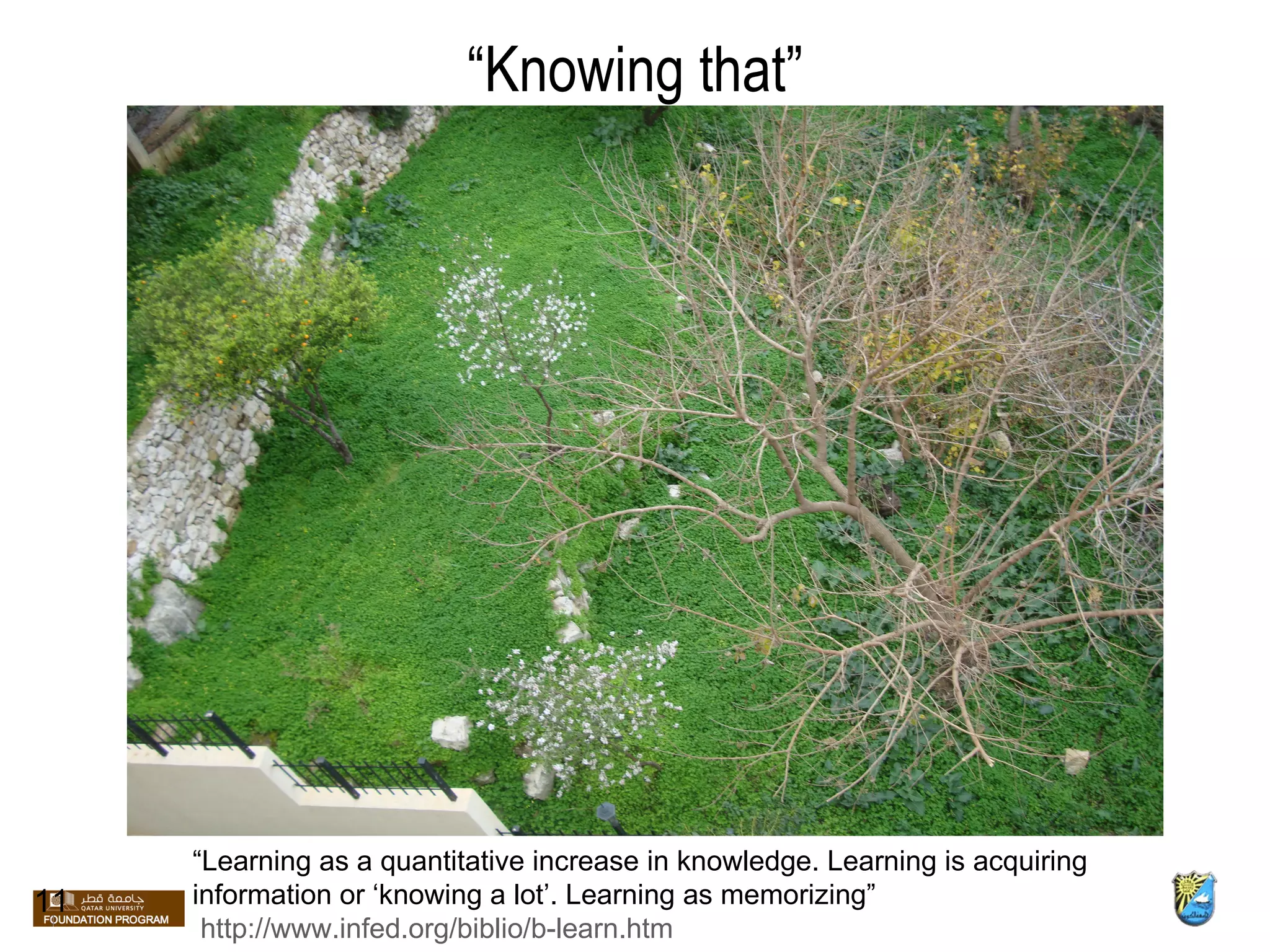
“ Knowing that” 11 “ Learning as a quantitative increase in knowledge. Learning is acquiring information or ‘knowing a lot’. Learning as memorizing”   http://www.infed.org/biblio/b-learn.htm
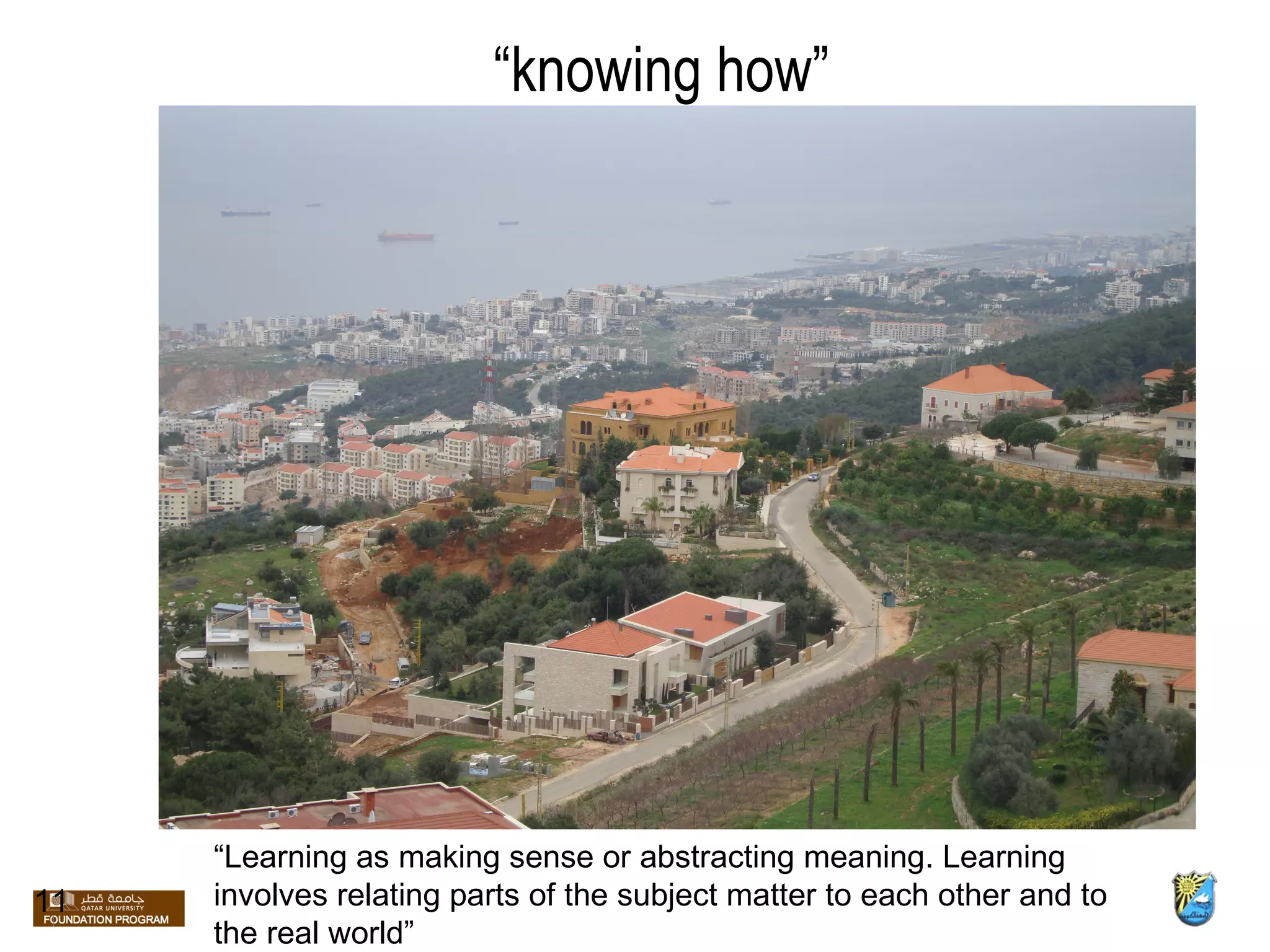
“ knowing how” 11 “ Learning as making sense or abstracting meaning. Learning involves relating parts of the subject matter to each other and to the real world”
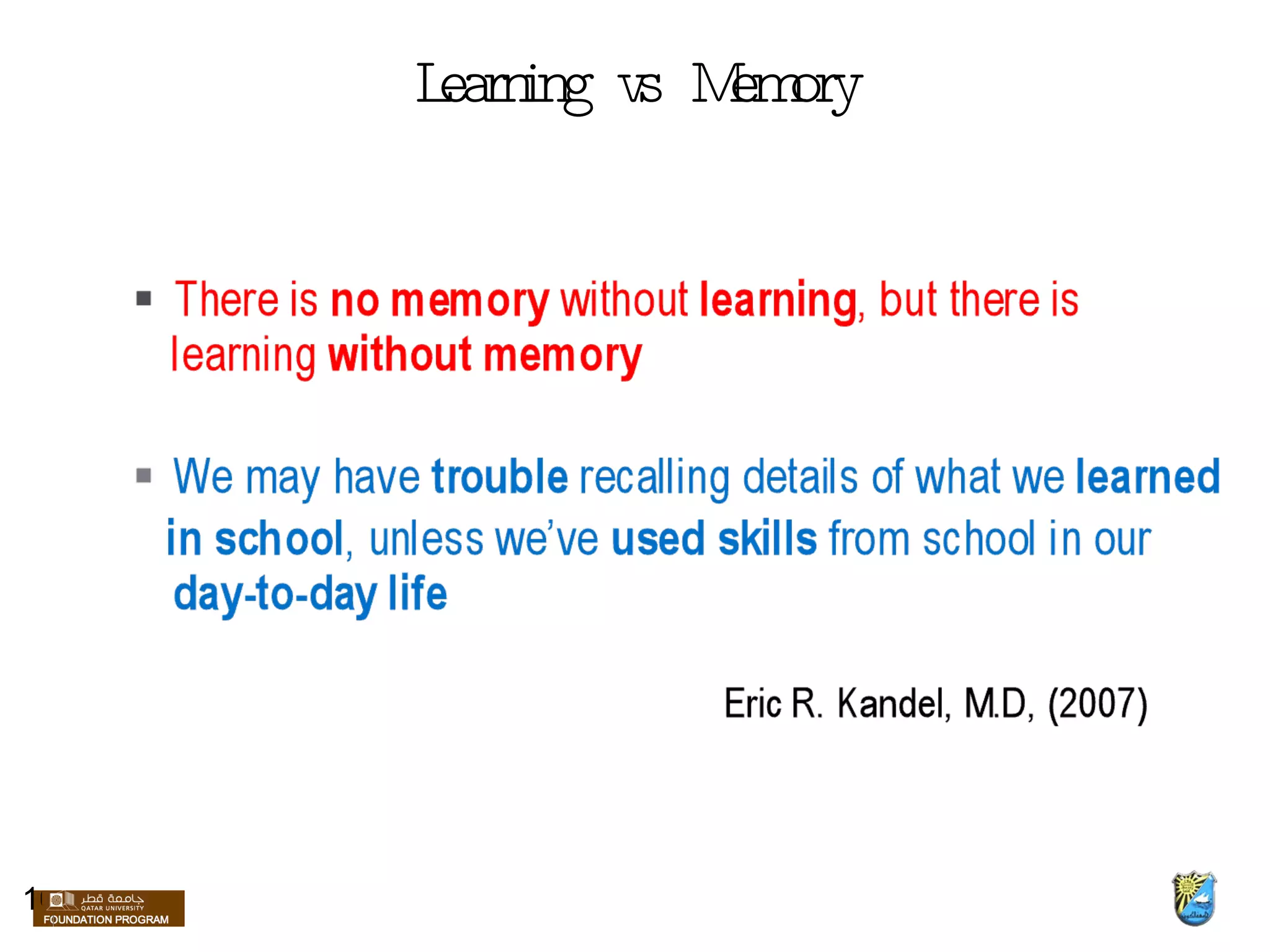
Learning vs Memory
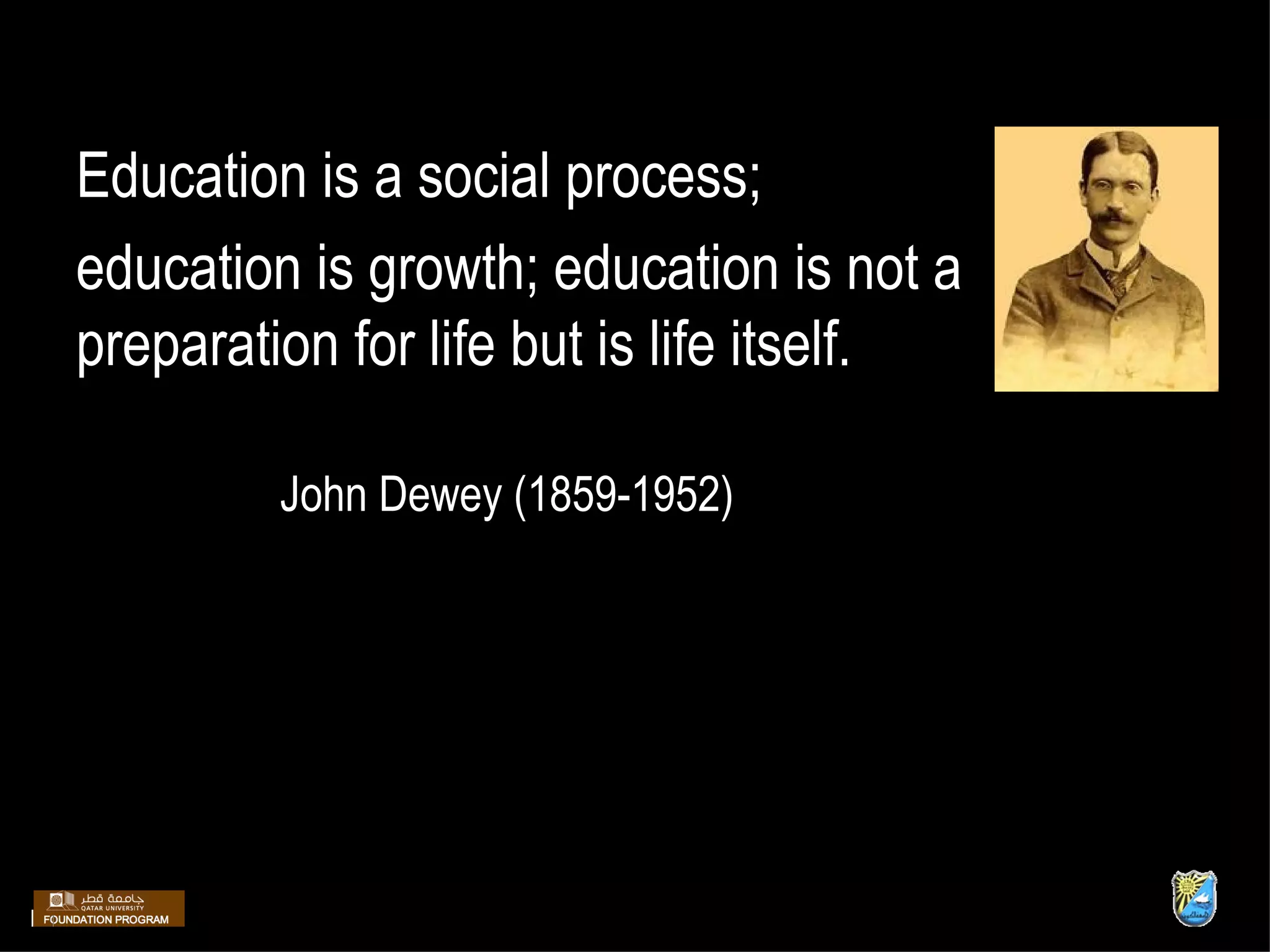
Education is a social process;  education is growth; education is not a preparation for life but is life itself.  John Dewey (1859-1952)
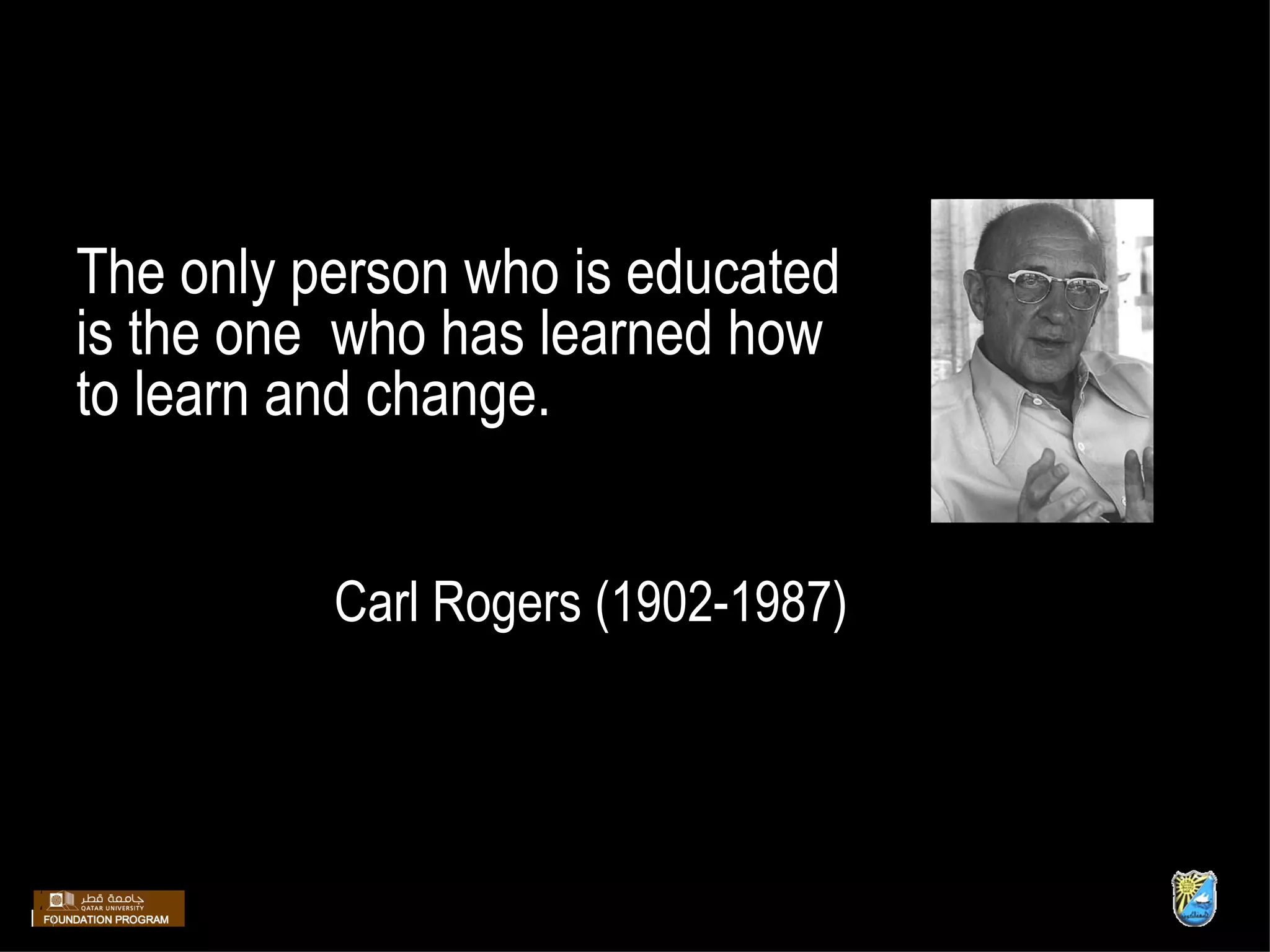
The only person who is educated is the one  who has learned how to learn and change. Carl Rogers (1902-1987)
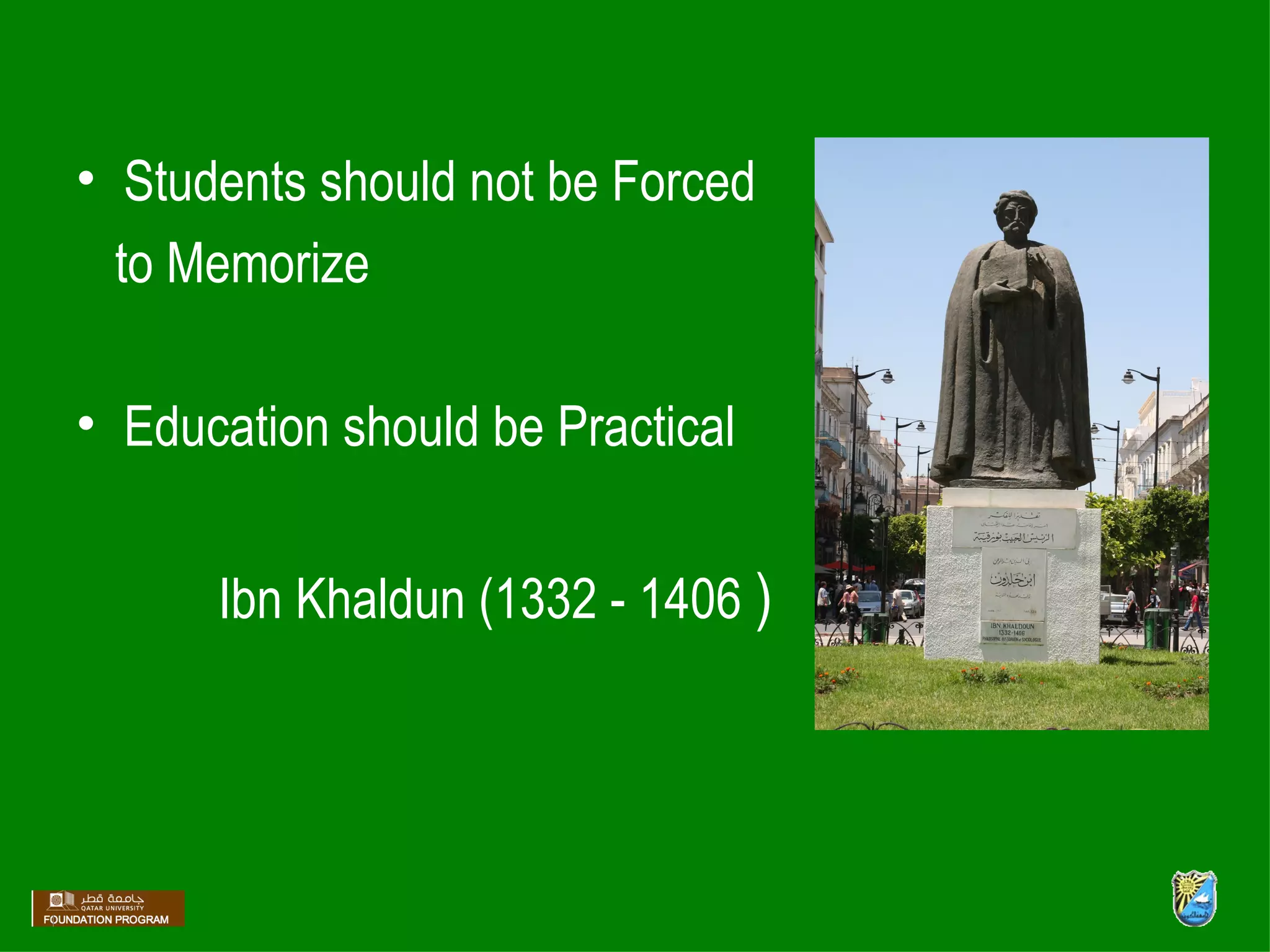
Students should not be Forced  to Memorize Education should be Practical Ibn Khaldun (1332 - 1406  )
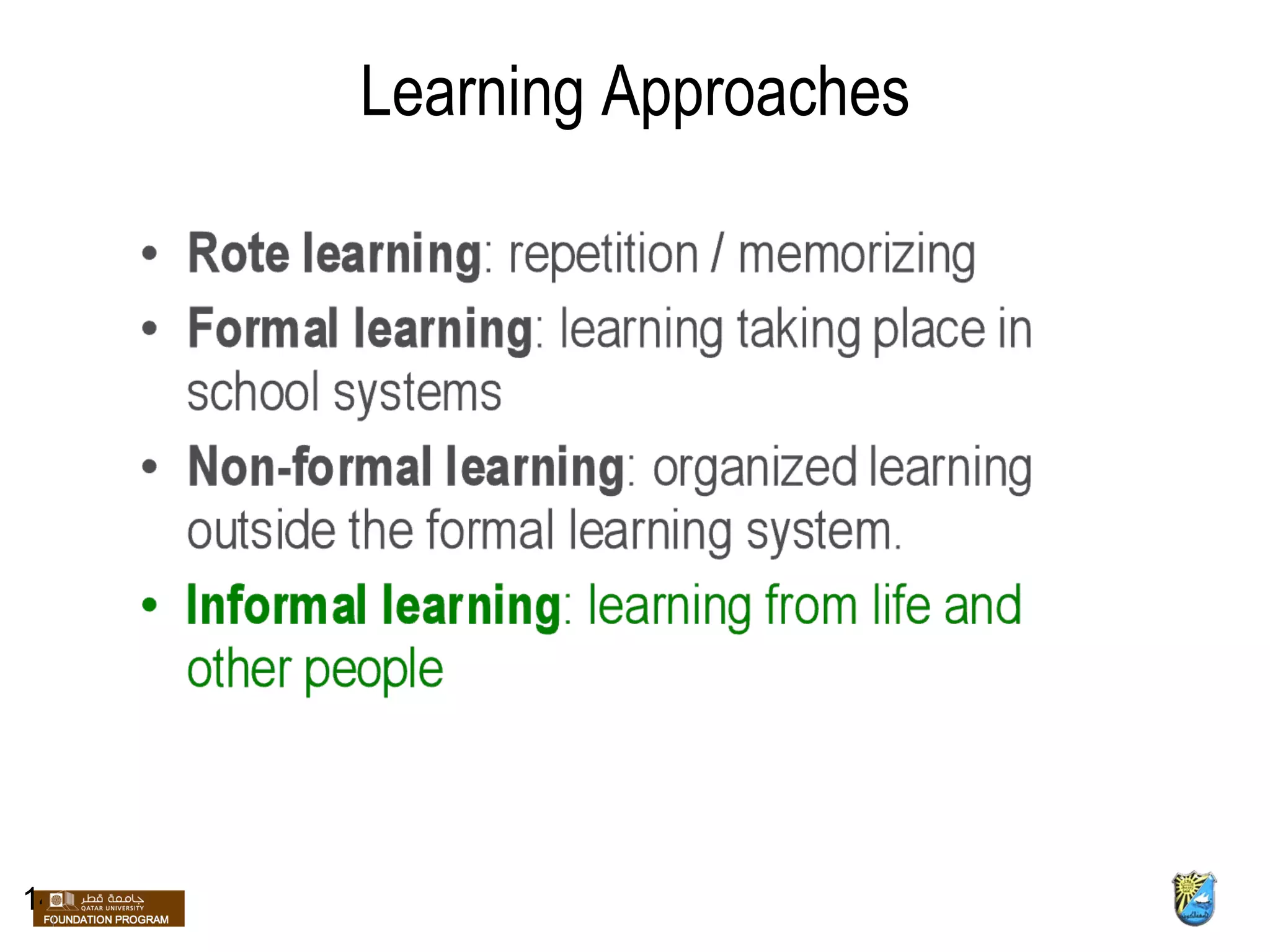
Learning Approaches
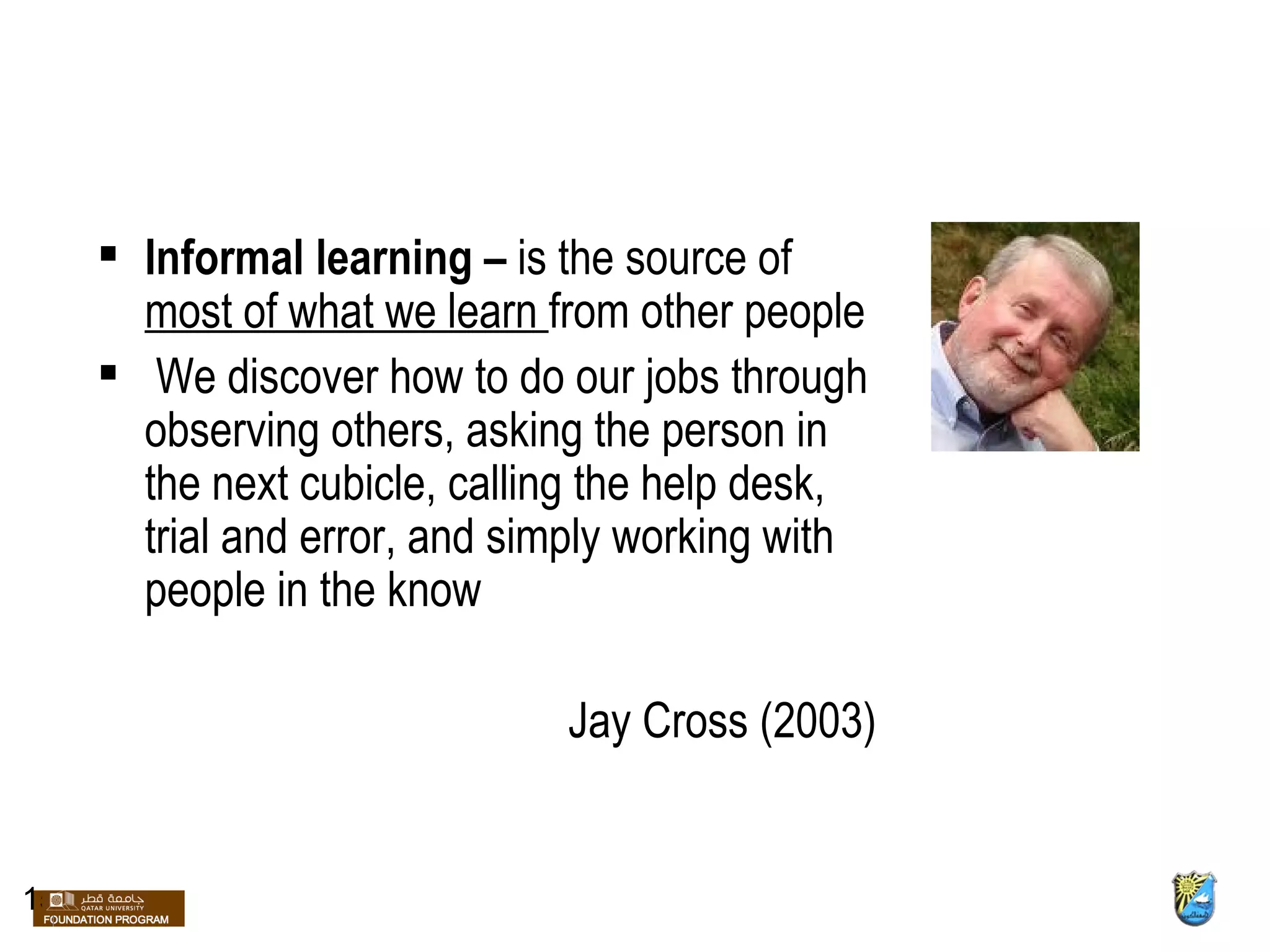
Informal learning –  is the source of  most of what we learn  from other people We discover how to do our jobs through observing others, asking the person in the next cubicle, calling the help desk, trial and error, and simply working with people in the know Jay Cross (2003)
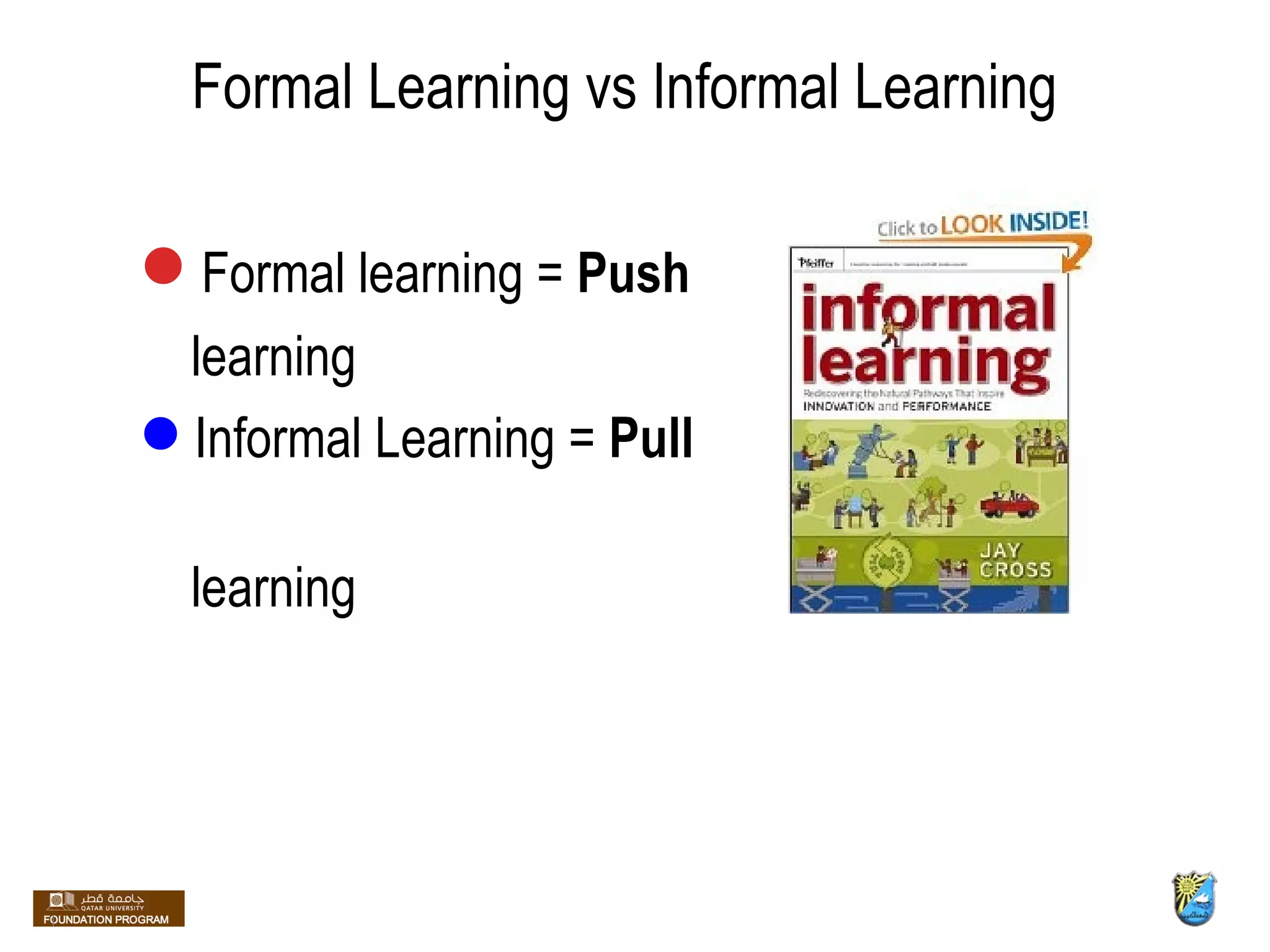
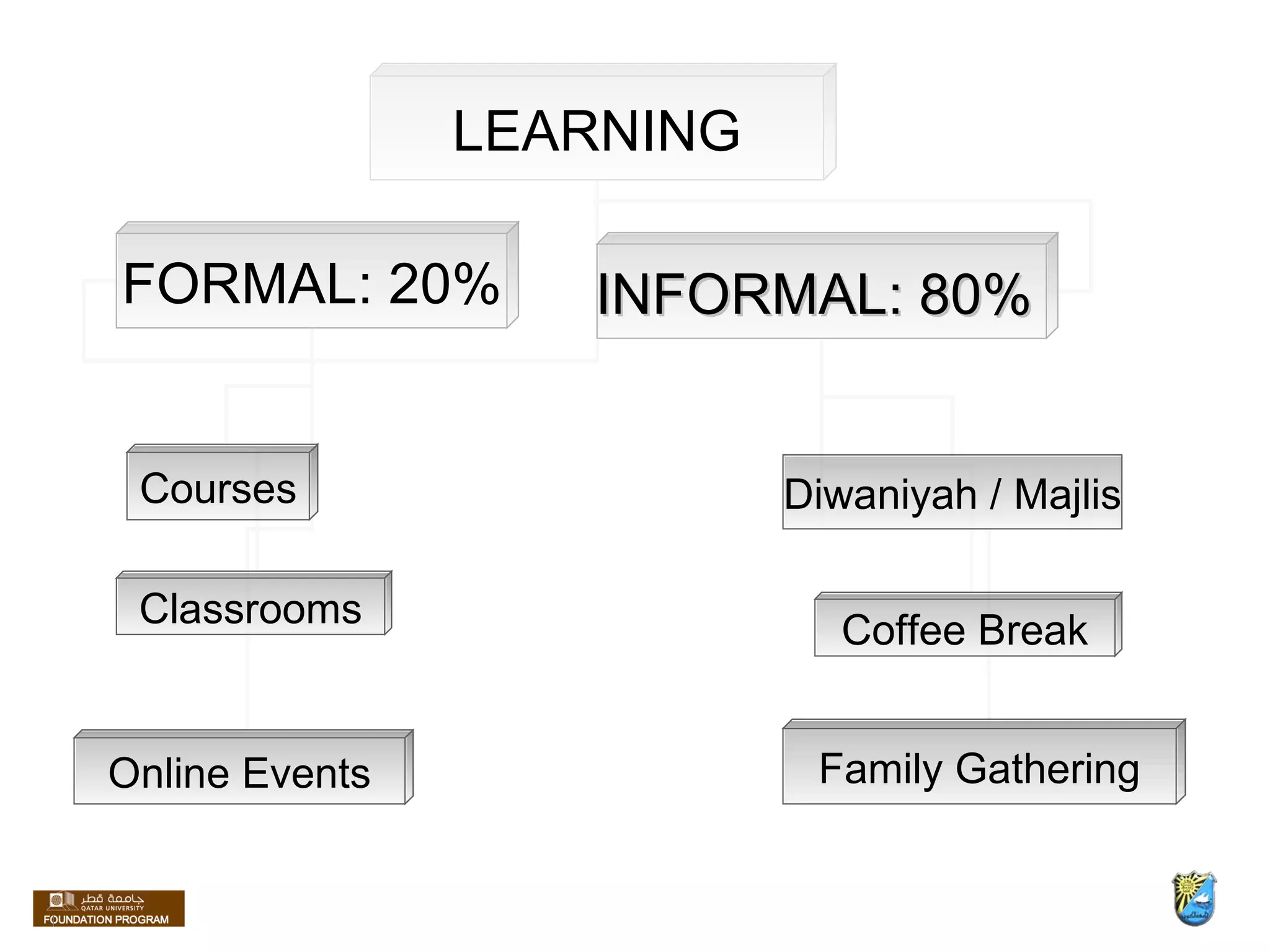
Formal Learning vs Informal Learning Formal learning =  Push   learning Informal Learning =  Pull   learning
LEARNING FORMAL: 20% INFORMAL: 80%  Family Gathering Diwaniyah / Majlis Coffee Break Courses Online Events Classrooms
“ eLearning must become social learning”     6 minutes video:  http://www.informl.com/2009/02/23/elearning-must-be-social/    Jay Cross (Feb. 23, 2009) http://www.informl.com/2009/02/23/elearning-must-be-social/
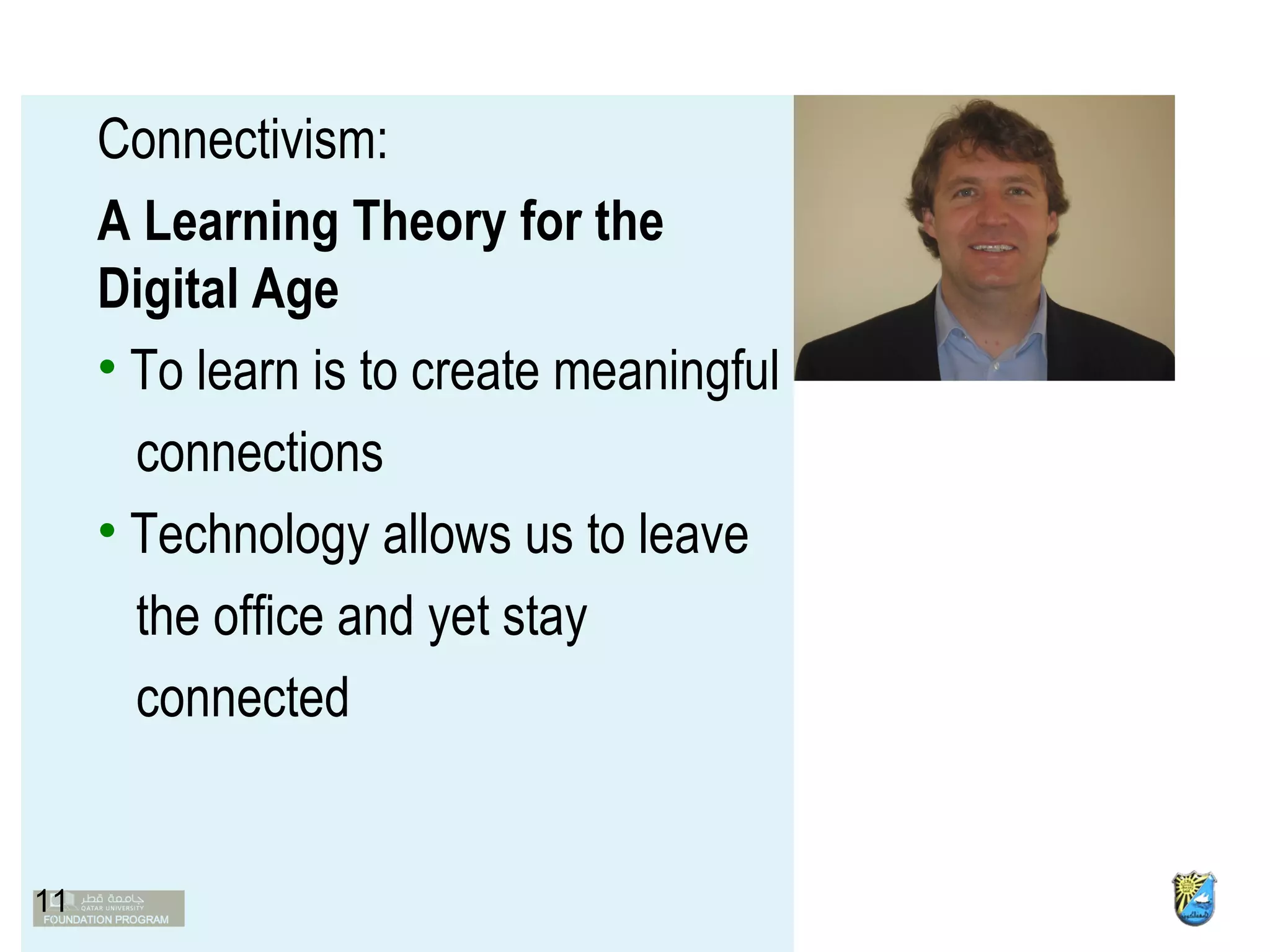
Connectivism:  A Learning Theory for the Digital Age To learn is to create meaningful  connections  Technology allows us to leave  the office and yet stay  connected  George Siemens (2004)  11
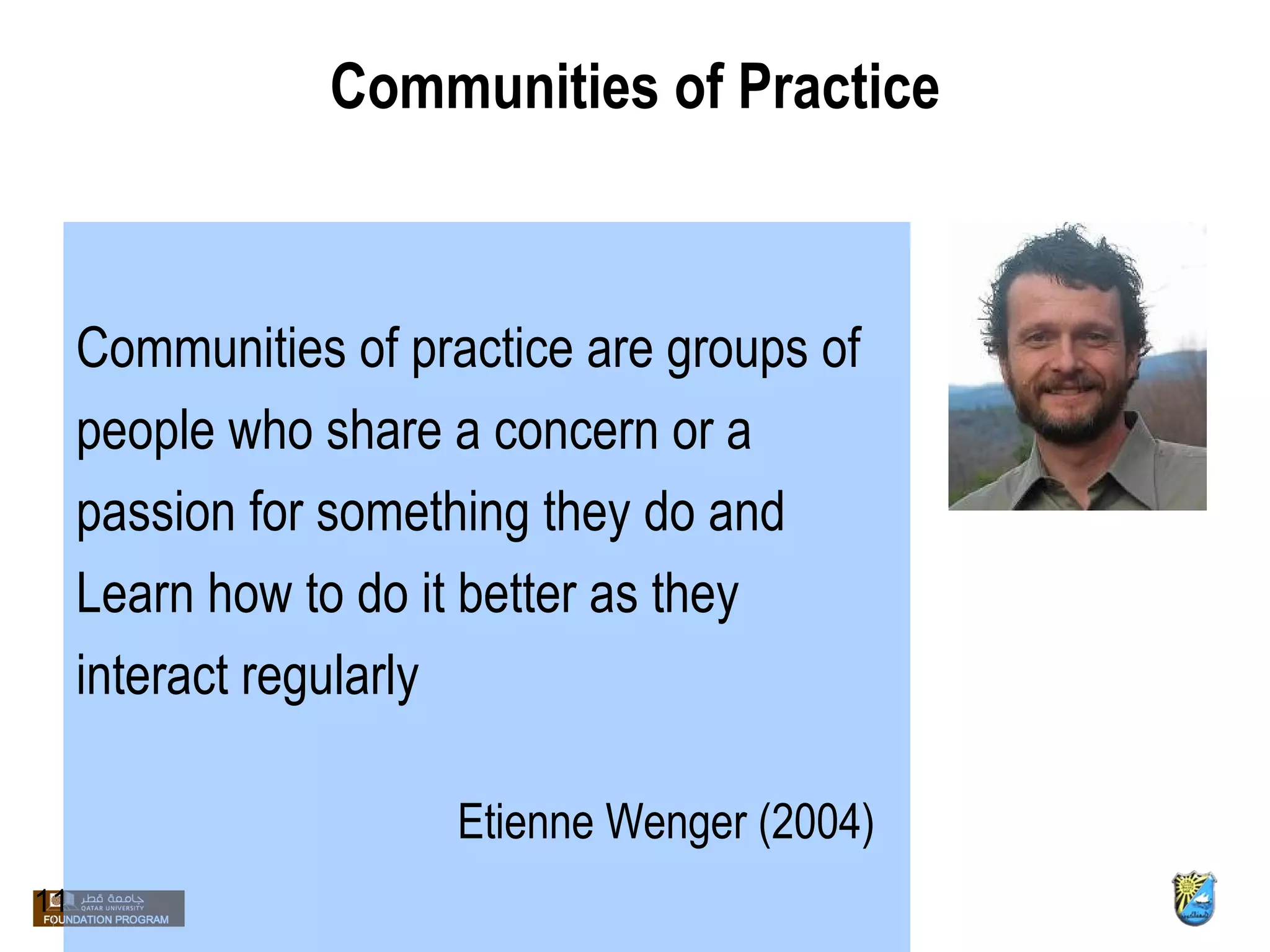
Communities of Practice Communities of practice are groups of  people who share a concern or a  passion for something they do and  Learn how to do it better as they  interact regularly Etienne Wenger (2004) 11
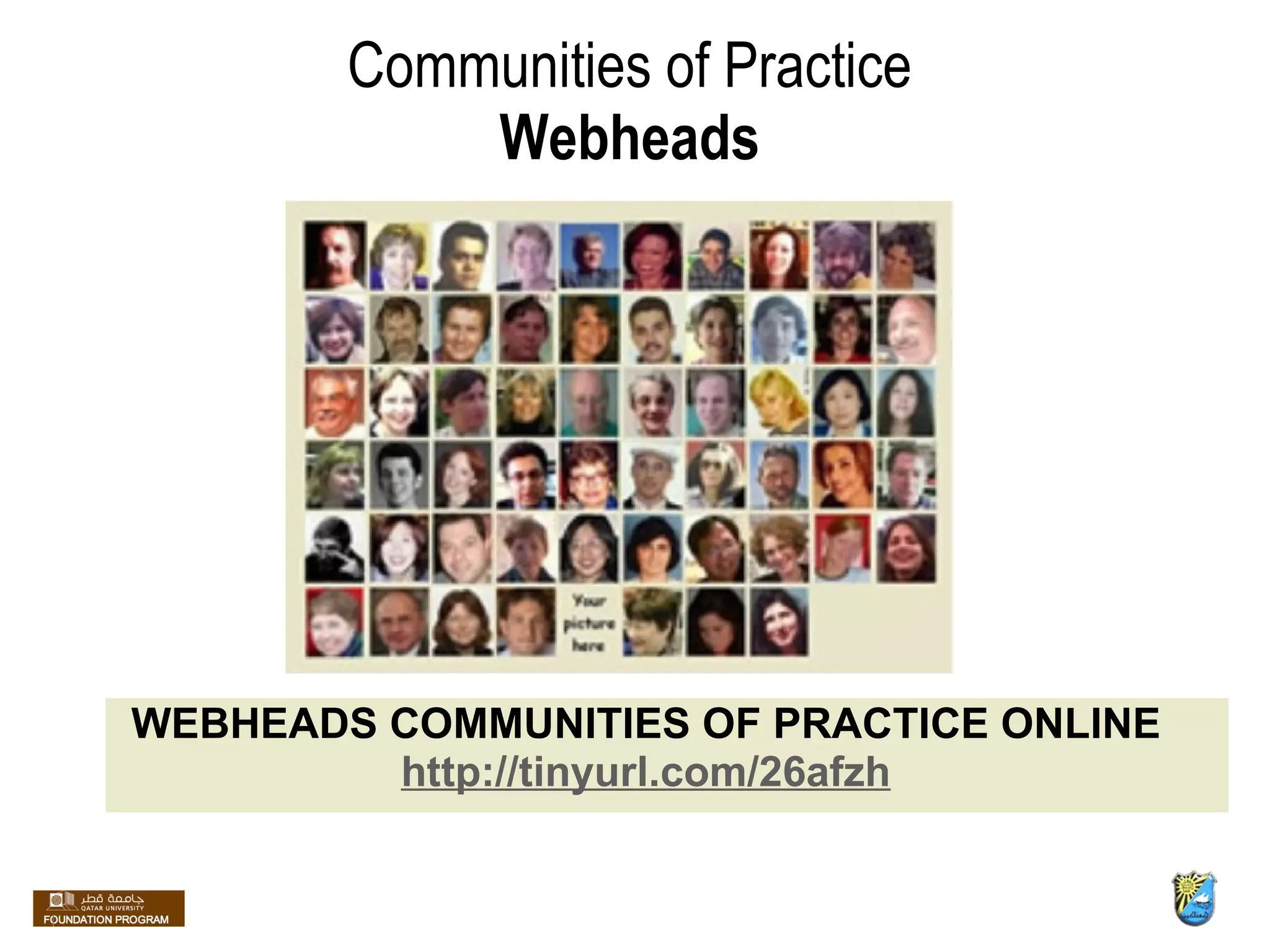
Communities of Practice Webheads WEBHEADS COMMUNITIES OF PRACTICE ONLINE http://tinyurl.com/26afzh
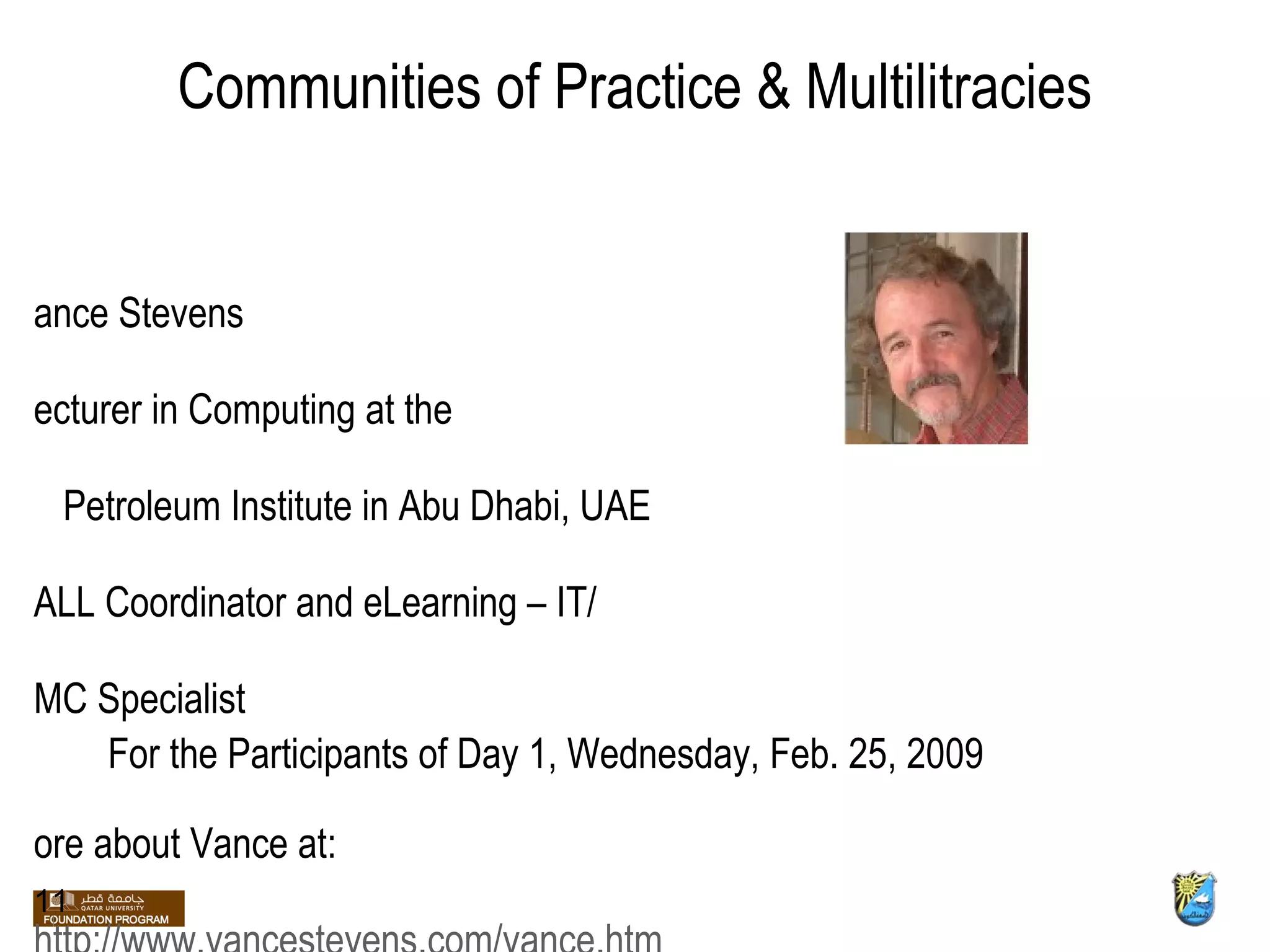
Communities of Practice & Multilitracies Vance Stevens Lecturer in Computing at the  Petroleum Institute in Abu Dhabi, UAE CALL Coordinator and eLearning – IT/ CMC Specialist More about Vance at: http://www.vancestevens.com/vance.htm 11 For the Participants of Day 1, Wednesday, Feb. 25, 2009
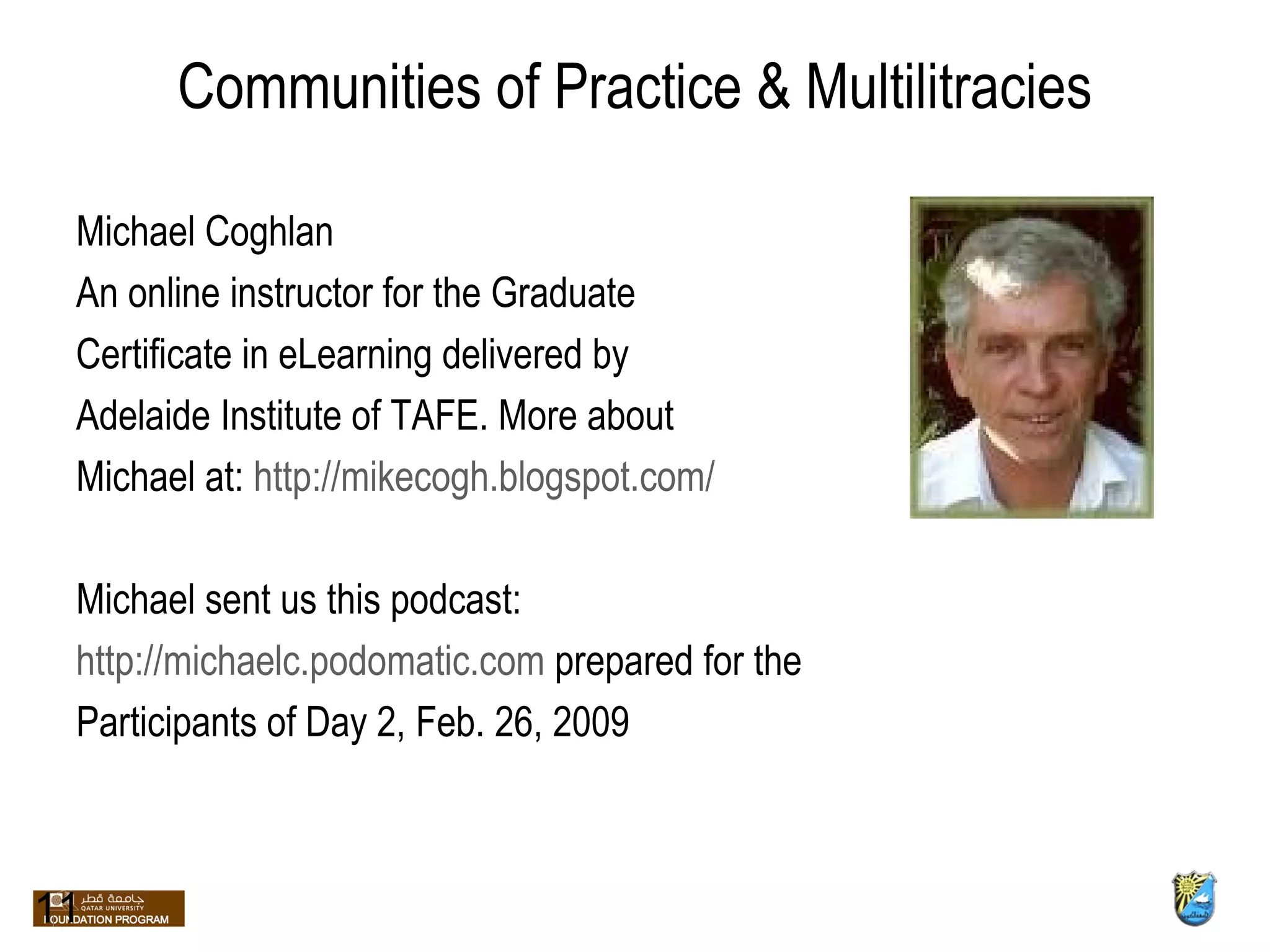
Communities of Practice & Multilitracies Michael Coghlan An online instructor for the Graduate  Certificate in eLearning delivered by  Adelaide Institute of TAFE. More about  Michael at:  http://mikecogh.blogspot.com/ Michael sent us this podcast:  http://michaelc.podomatic.com  prepared for the Participants of Day 2, Feb. 26, 2009  11
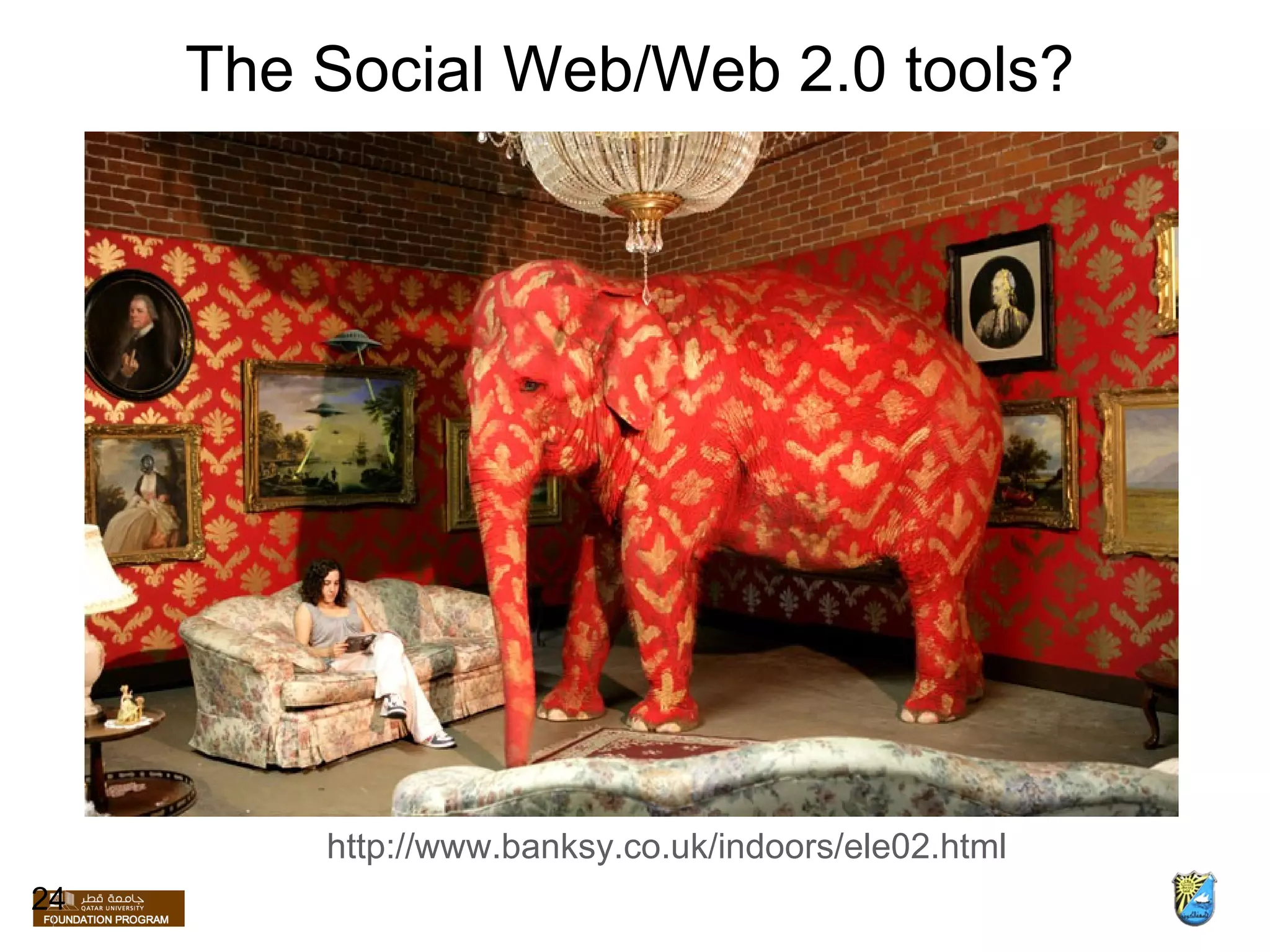
The Social Web/Web 2.0 tools? http://www.banksy.co.uk/indoors/ele02.html
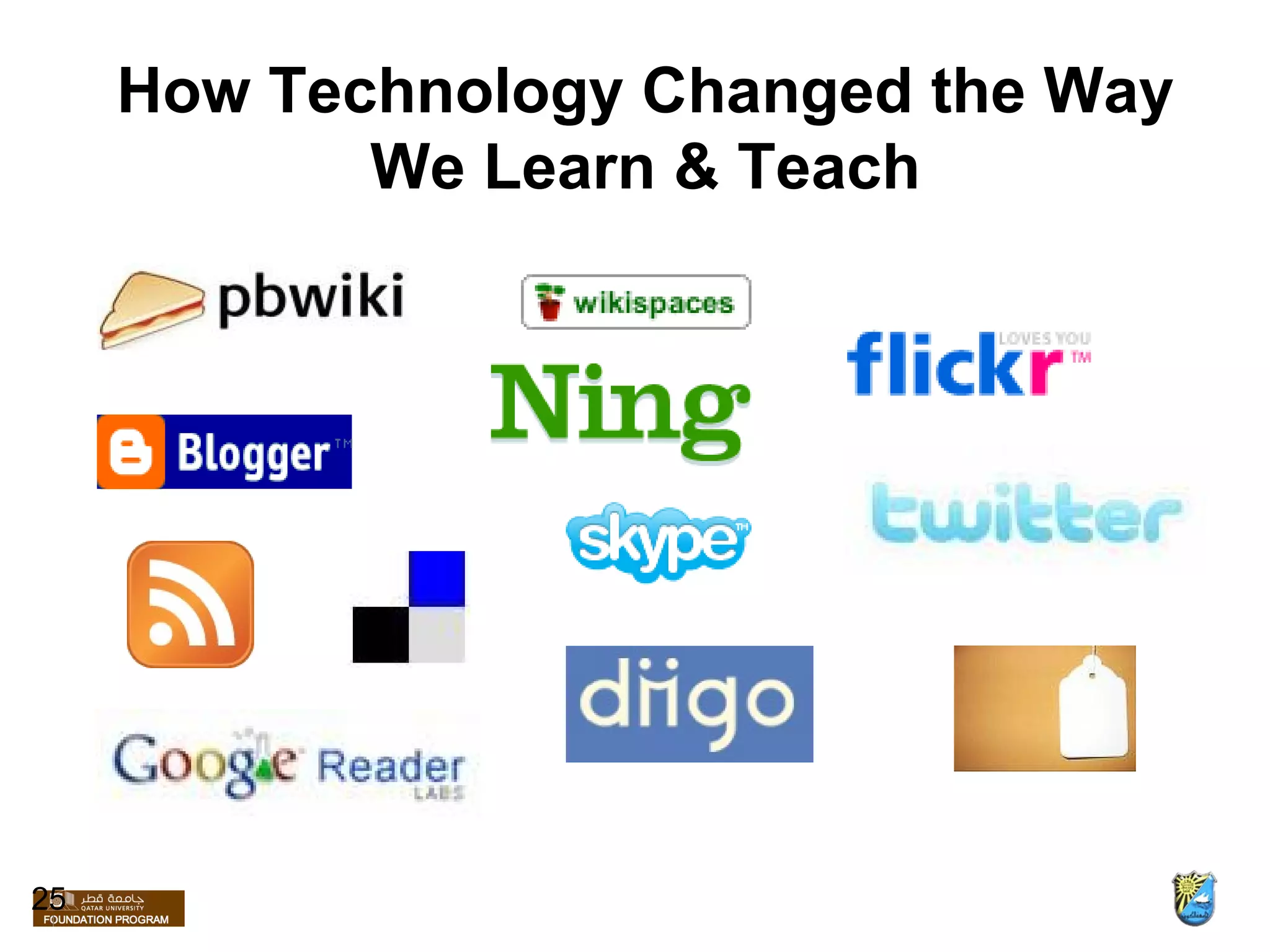
How Technology Changed the Way We Learn & Teach
Ning & Wikis Nellie Deutsch EFL Instructor for more than 30 years She is a Canadian, currently residing in Israel A researcher in Building Relationship and International Collaboration More about Nellie at:  http://tinyurl.com/3wumyh 9/27/2008 For the Participants of Day 1, Wednesday, Feb. 25, 2009
Doris Molero EFL Professor at Universidad Dr. Rafael Belloso Chacin in Maracaibo Venezuela Doris's EFL Center at:  www.doris3meflcenter.bravehost.com More about Doris at:  http://tinyurl.com/46swmd Ning & Wikis For the Participants of Day 2, Wednesday, Feb. 26, 2009
Using Web 2.0 Tools to Support  Just in Time Learning Microblogging Photo Sharing / Photo Blogging
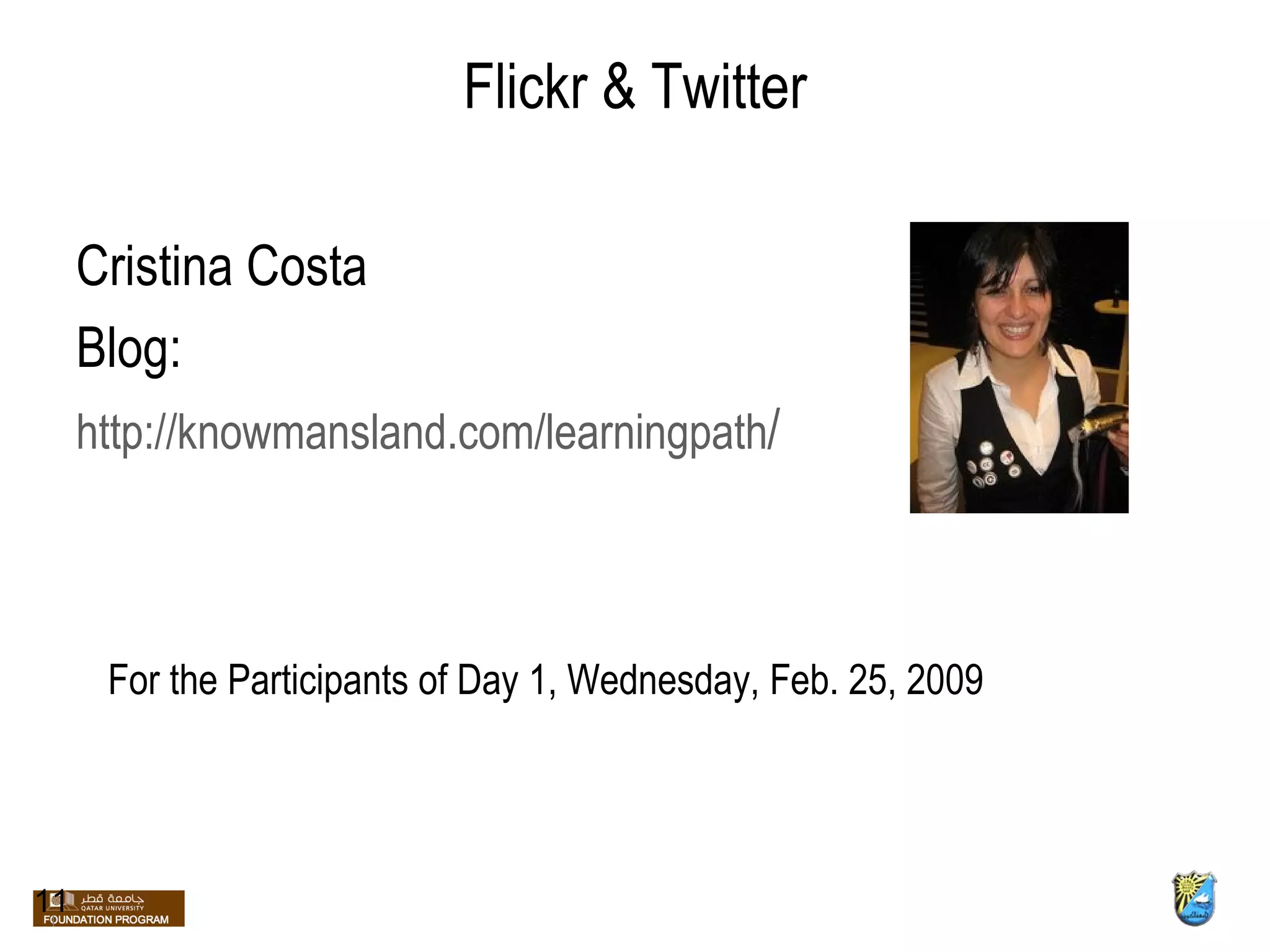
Flickr & Twitter Cristina Costa  Blog:  http://knowmansland.com/learningpath / 11 For the Participants of Day 1, Wednesday, Feb. 25, 2009
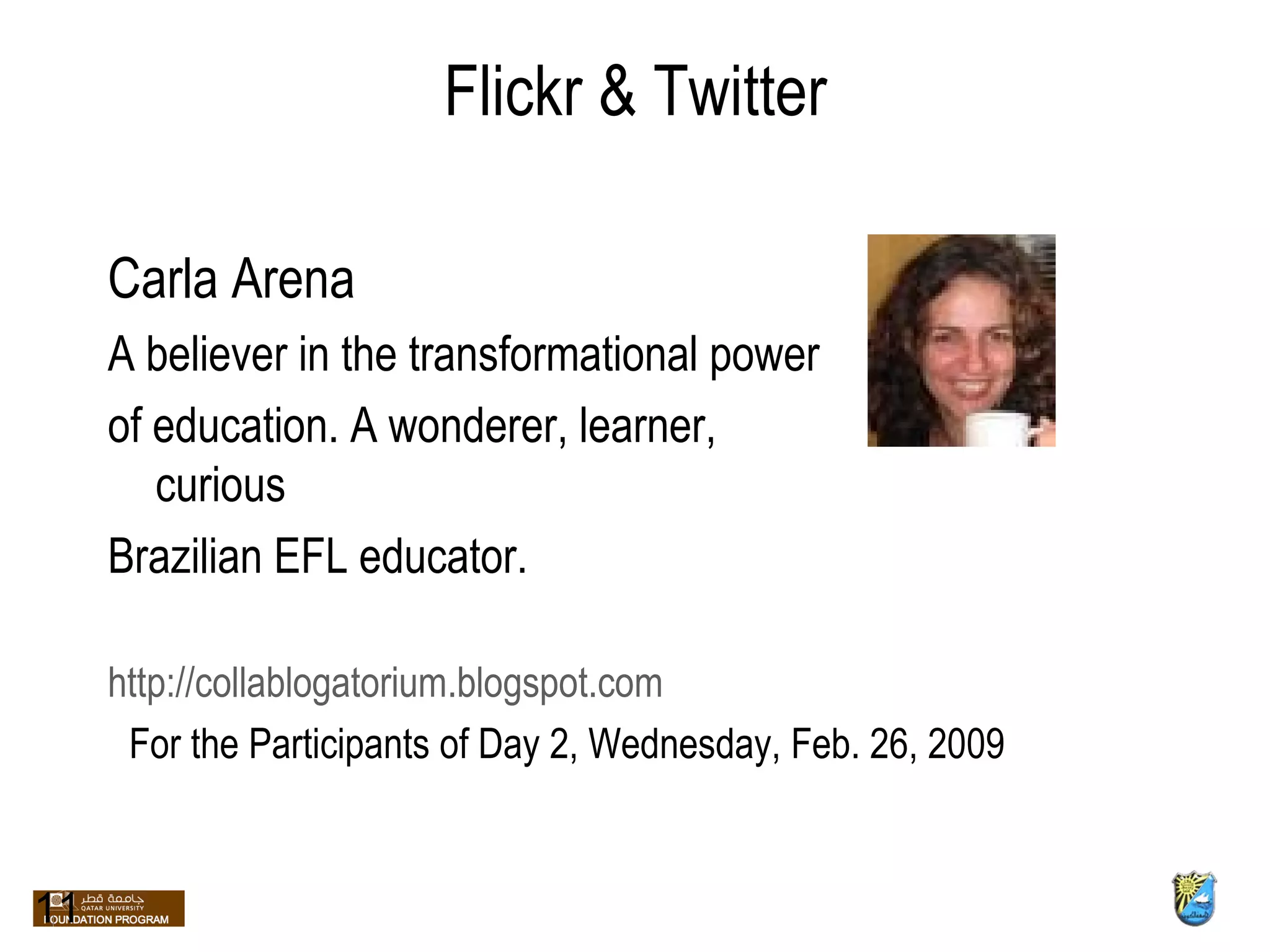
Flickr & Twitter Carla Arena A believer in the transformational power  of education. A wonderer, learner, curious  Brazilian EFL educator. http://collablogatorium.blogspot.com 11 For the Participants of Day 2, Wednesday, Feb. 26, 2009
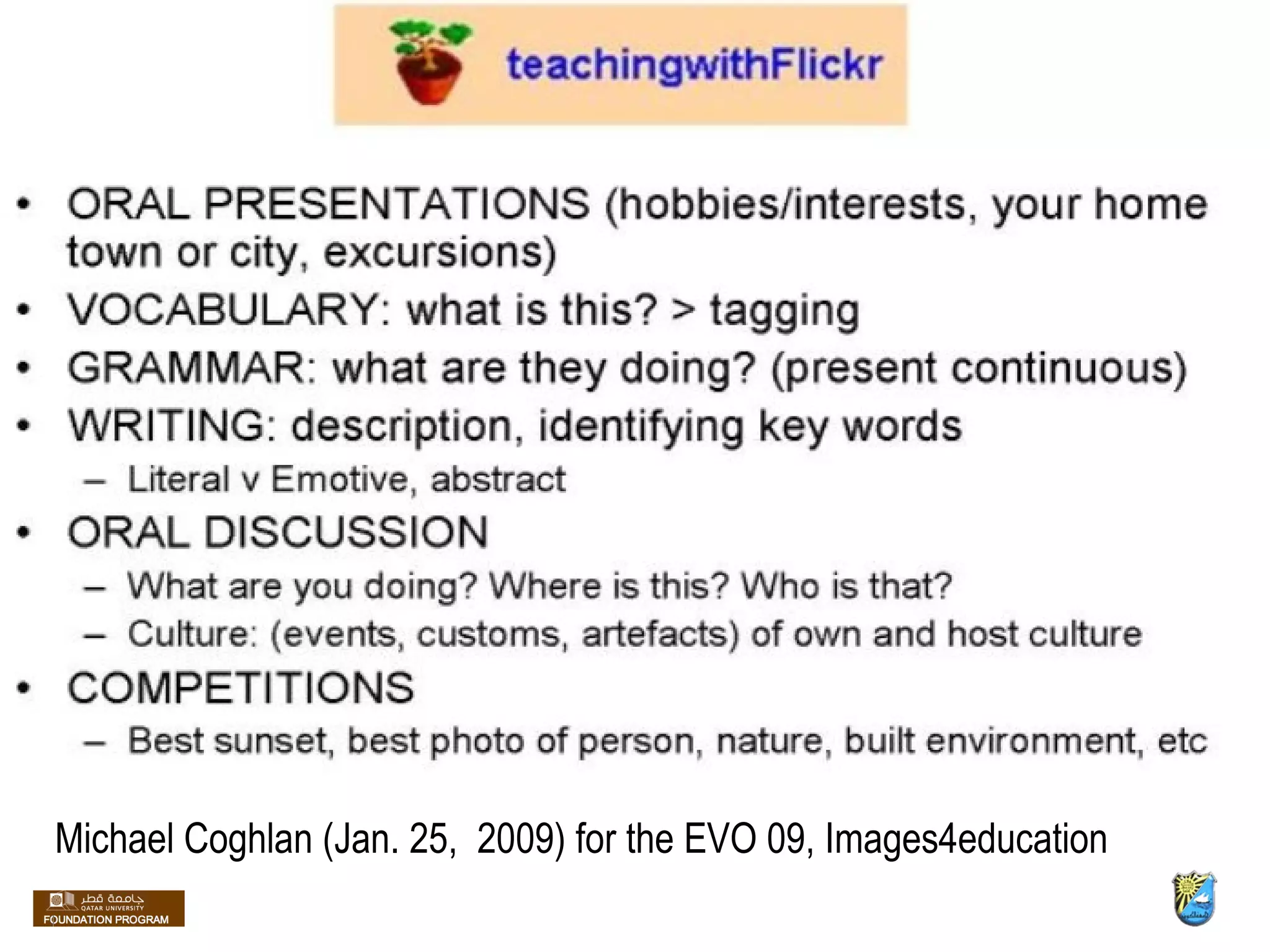
Michael Coghlan (Jan. 25,  2009) for the EVO 09, Images4education
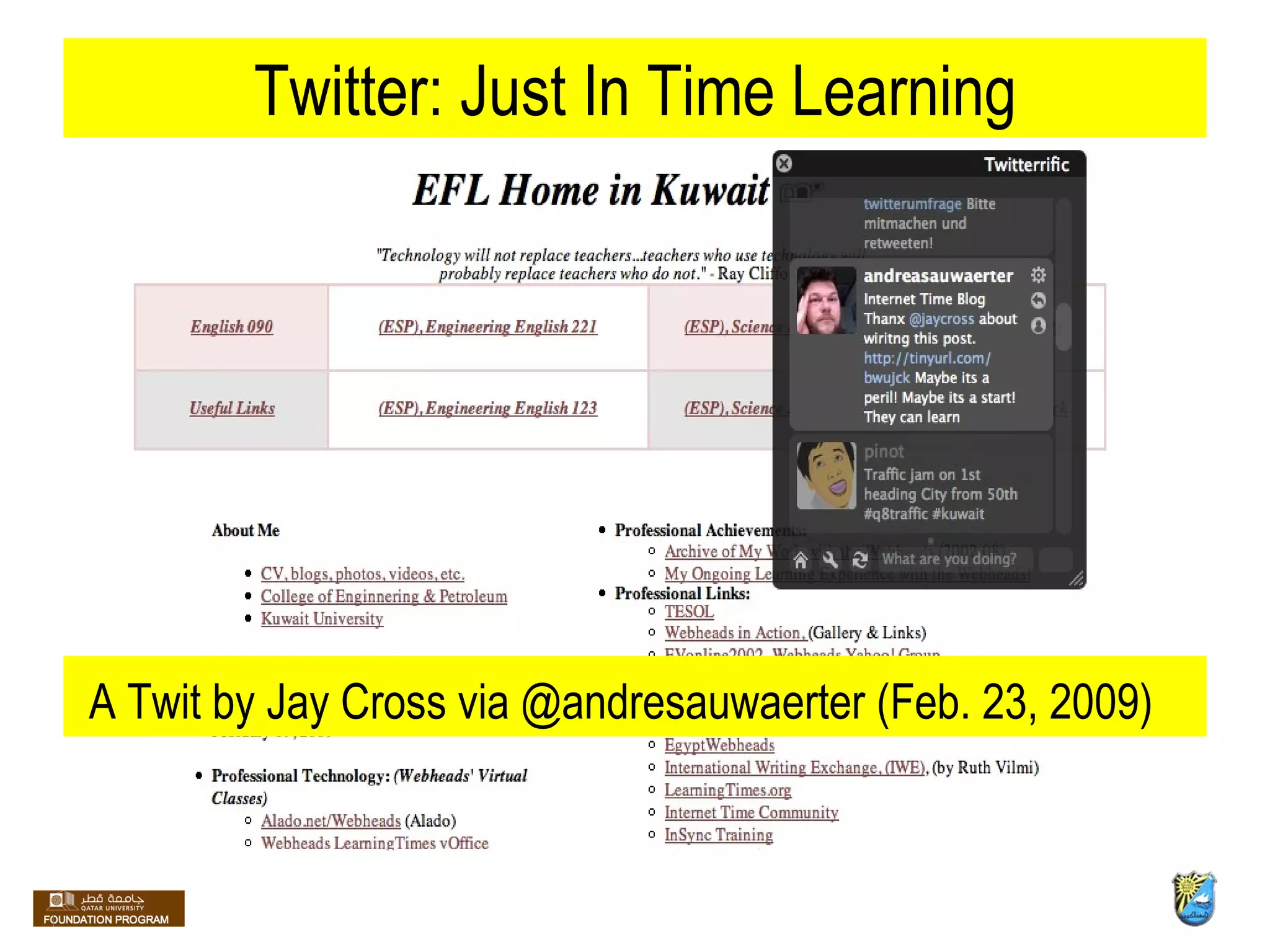
Twitter: Just In Time Learning A Twit by Jay Cross via @andresauwaerter (Feb. 23, 2009)
Blogs   Tags Using the Social Web to Support  Working & Learning Social Bookmarking
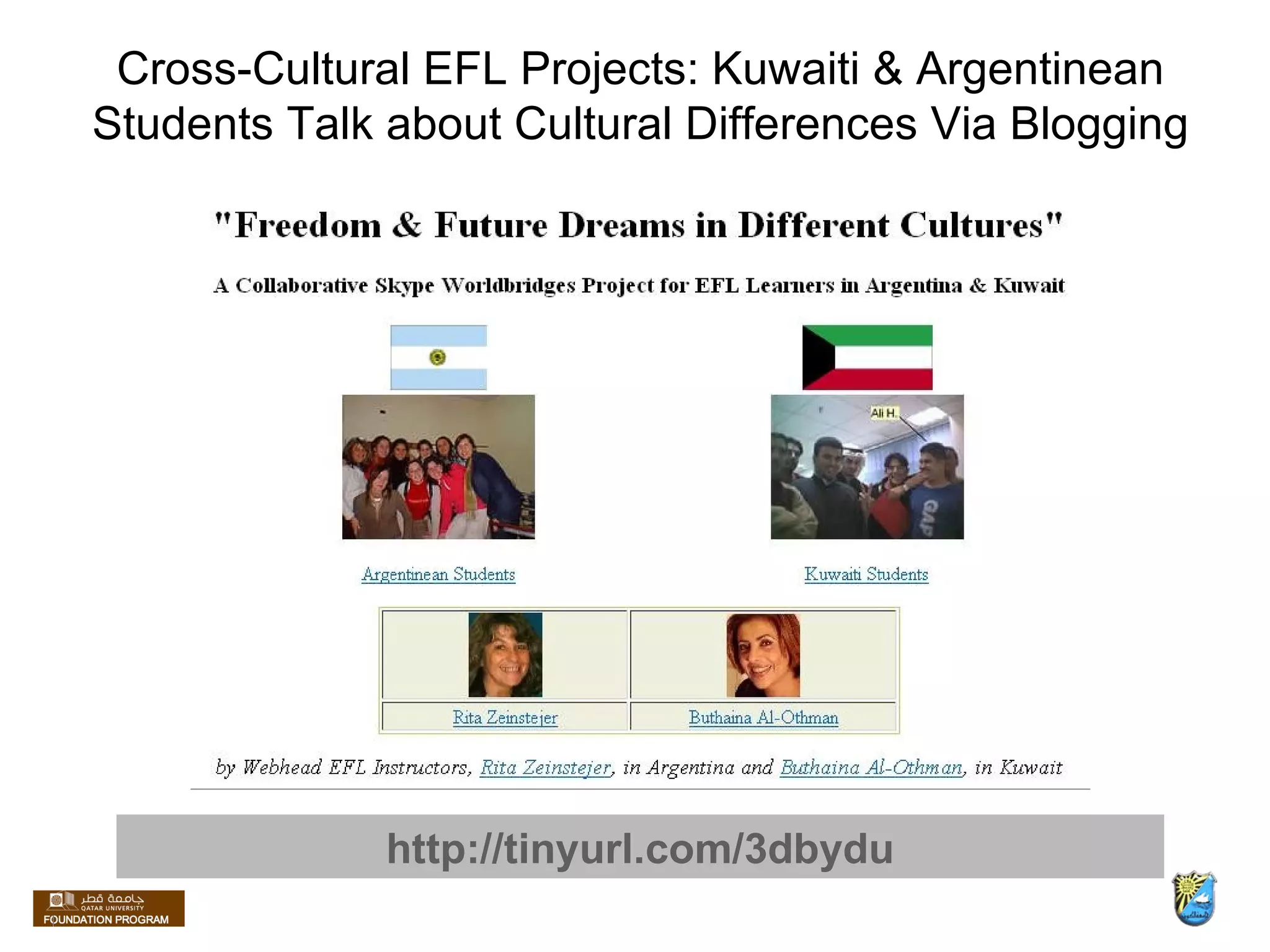
Cross-Cultural EFL Projects: Kuwaiti & Argentinean Students Talk about Cultural Differences Via Blogging http://tinyurl.com/3dbydu
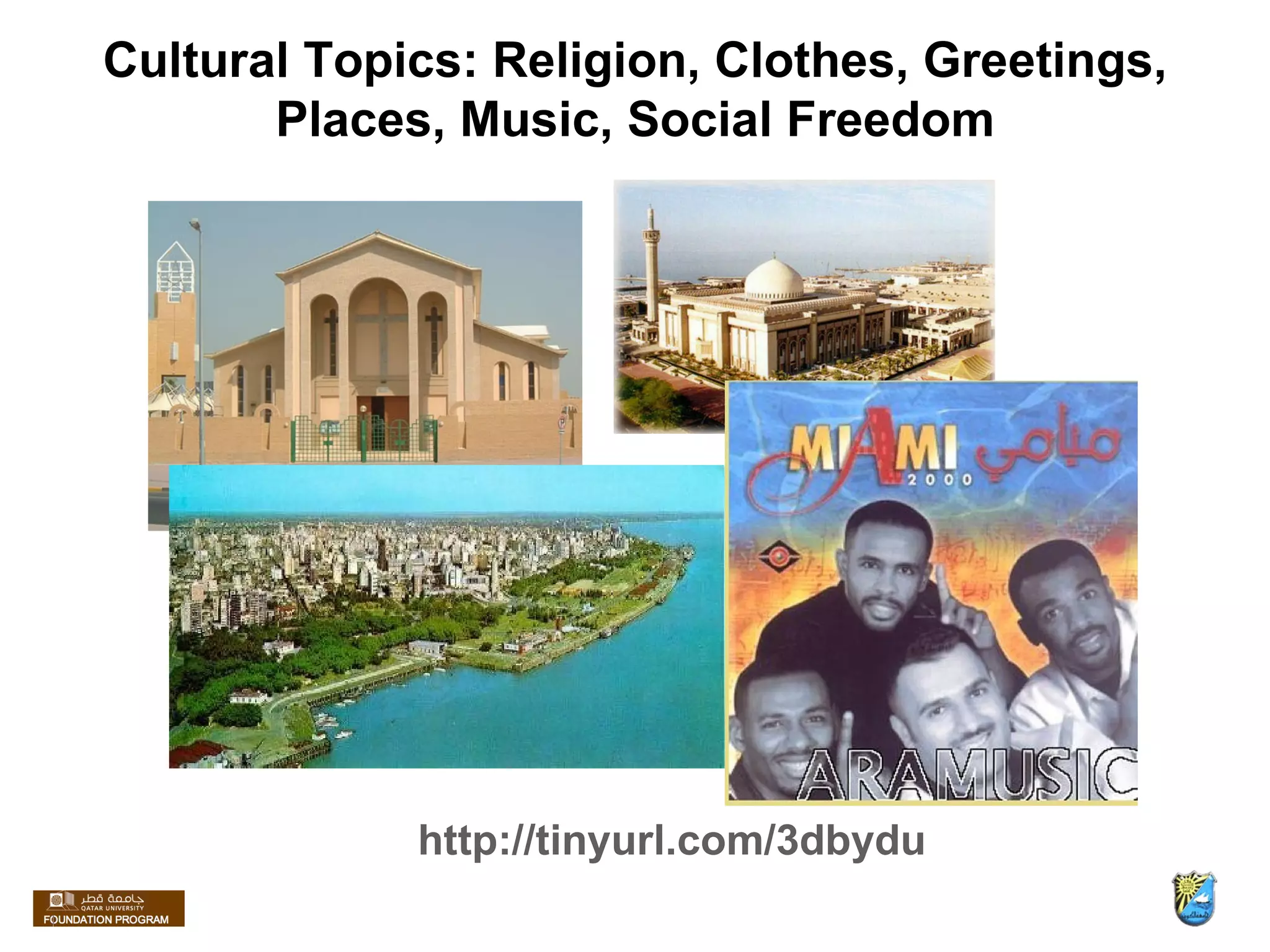
Cultural Topics: Religion, Clothes, Greetings, Places, Music, Social Freedom http://tinyurl.com/3dbydu
Using Web 2.0 Tools to Support  Pull Learning Really Simple Syndication Aggregators
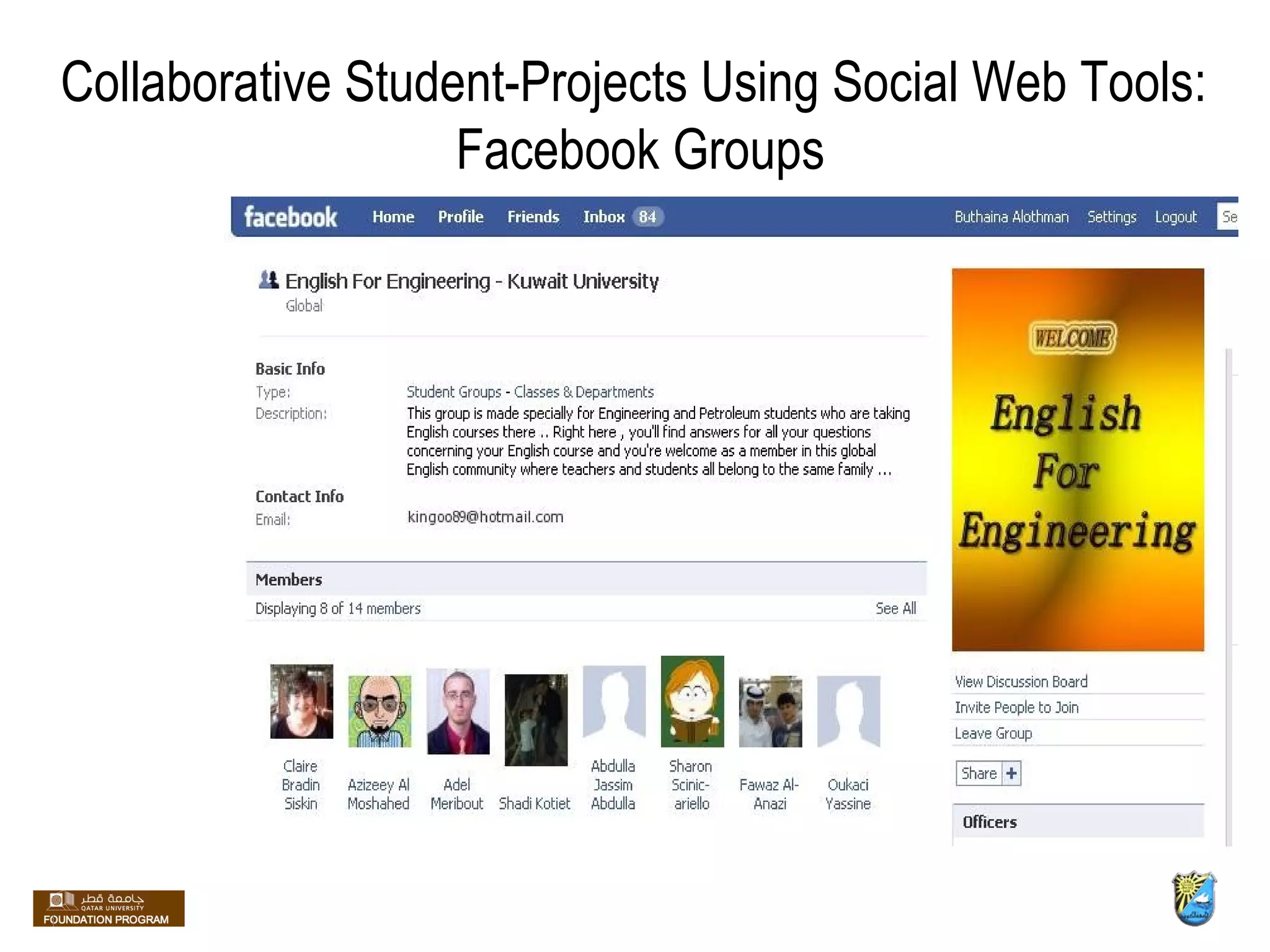
Collaborative Student-Projects Using Social Web Tools:  Facebook Groups
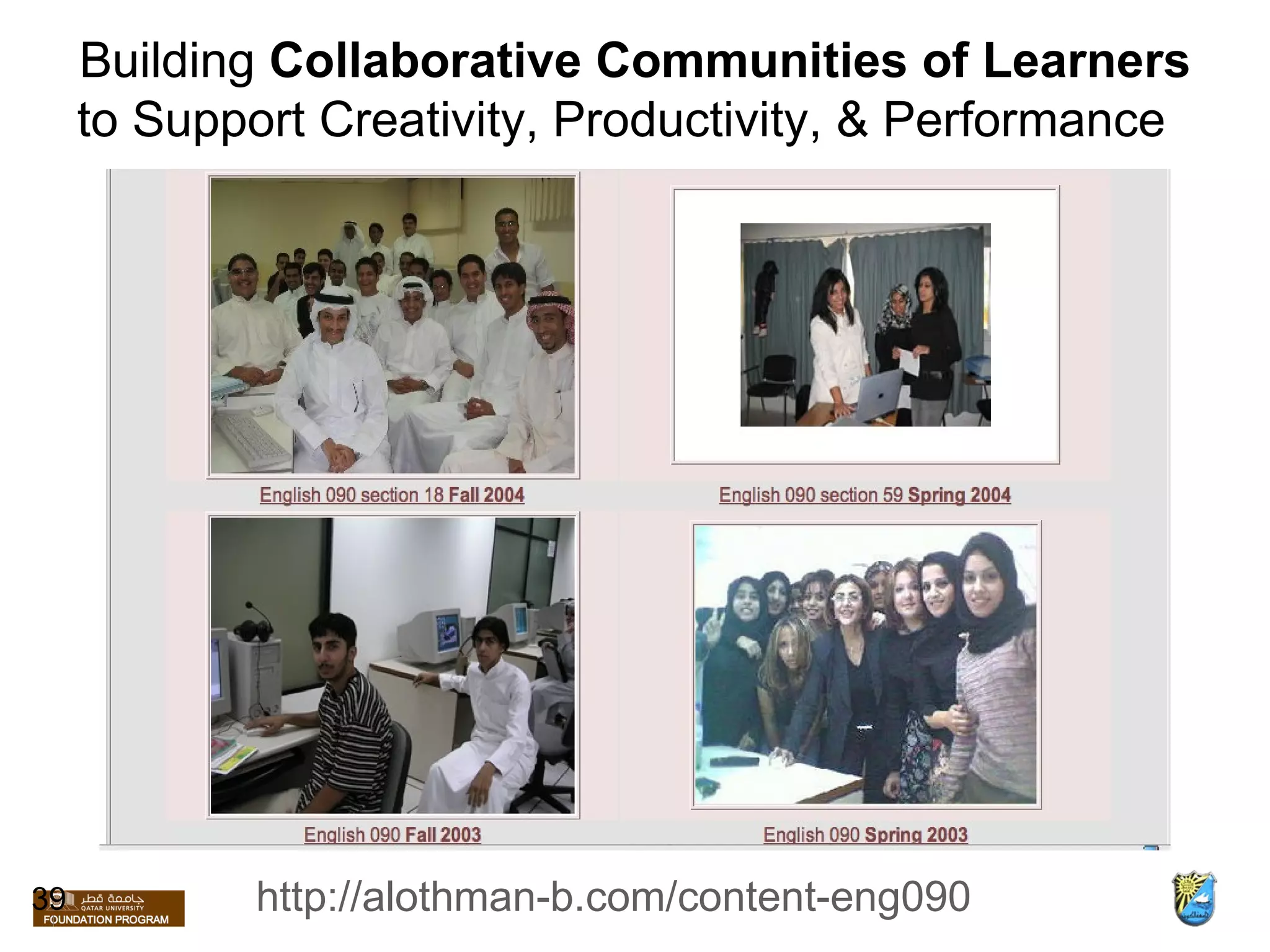
Building  Collaborative Communities of Learners  to Support Creativity, Productivity, & Performance  http://alothman-b.com/content-eng090
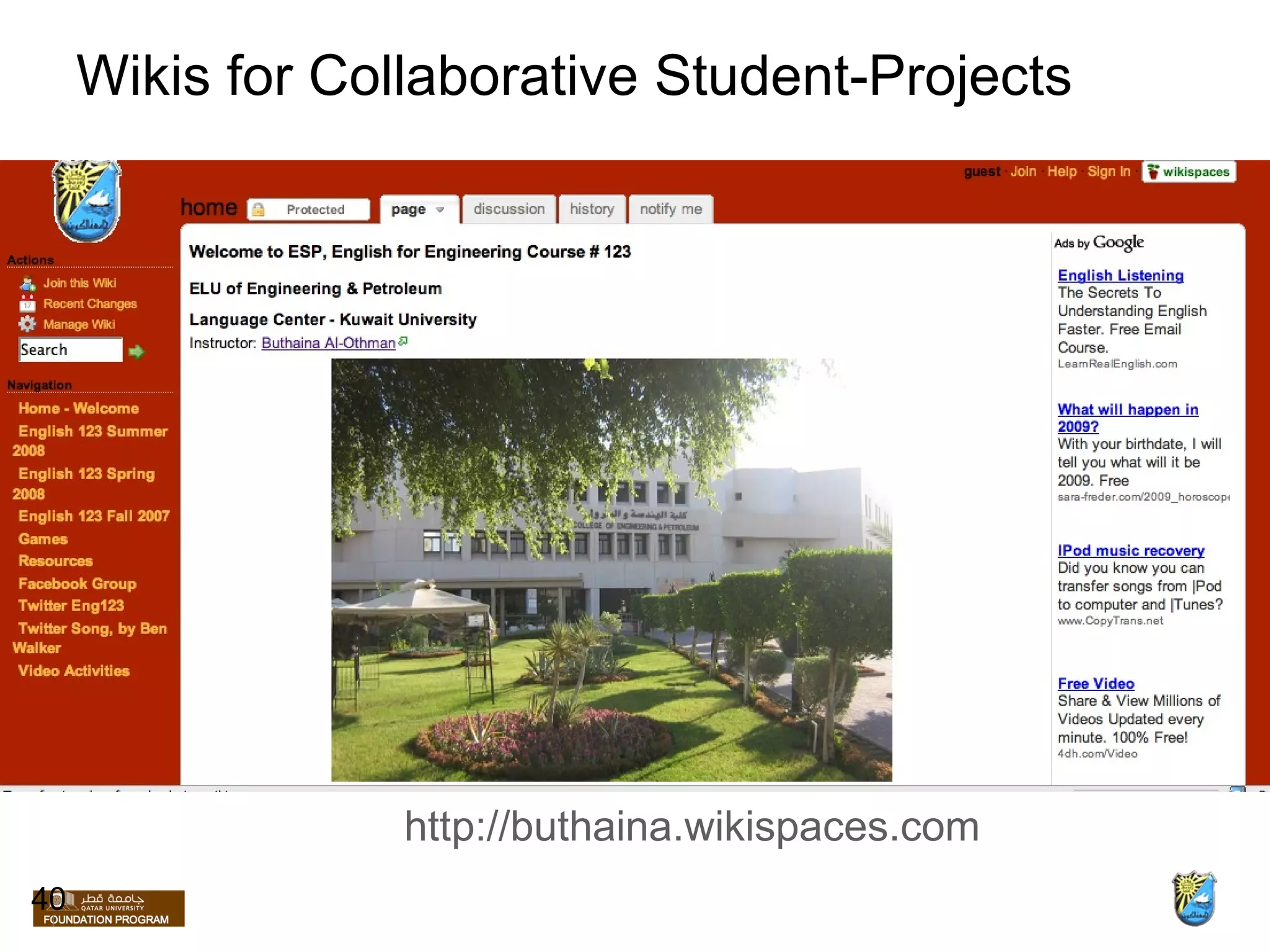
Wikis for Collaborative Student-Projects http://buthaina.wikispaces.com
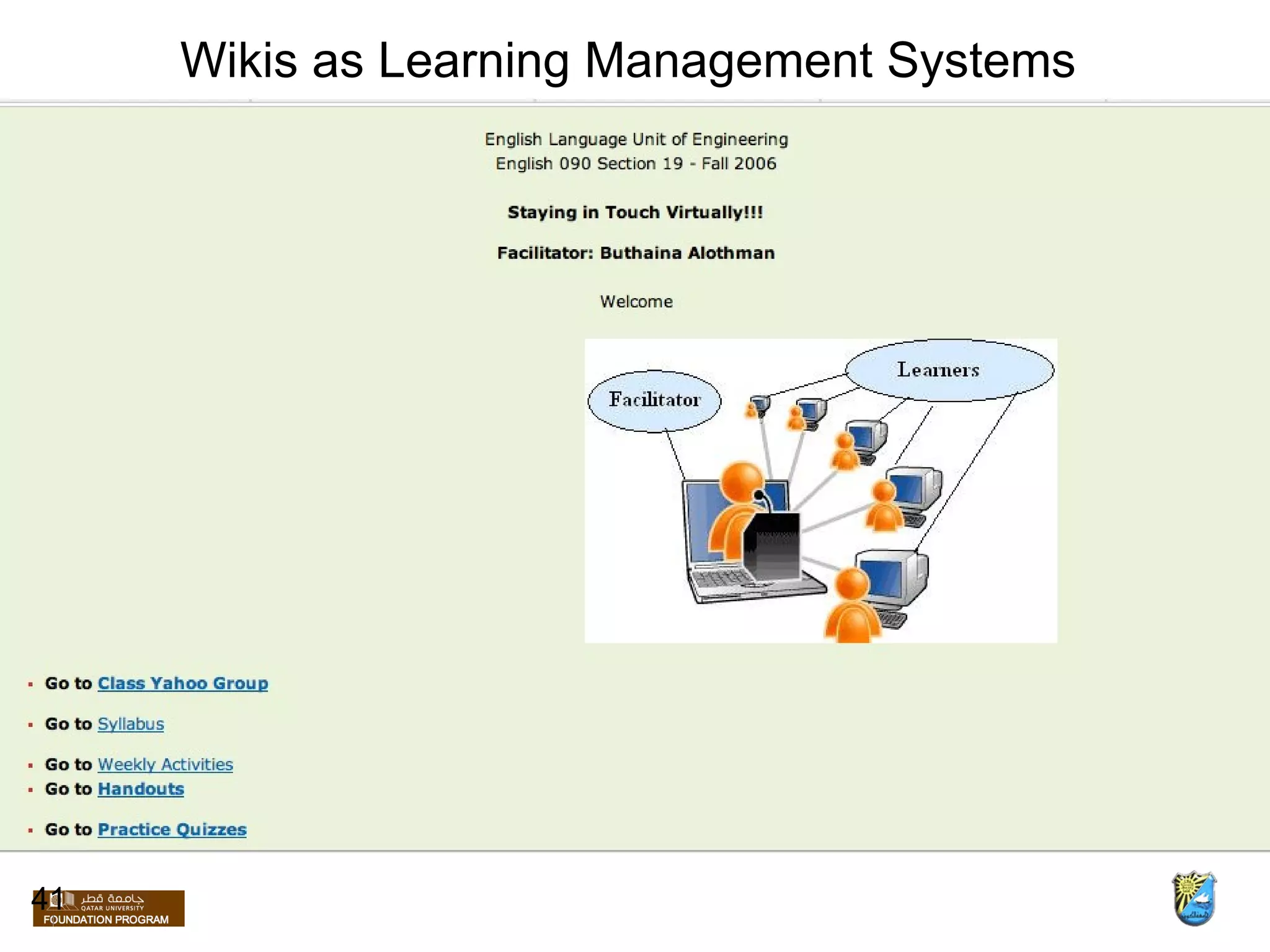
Wikis as Learning Management Systems
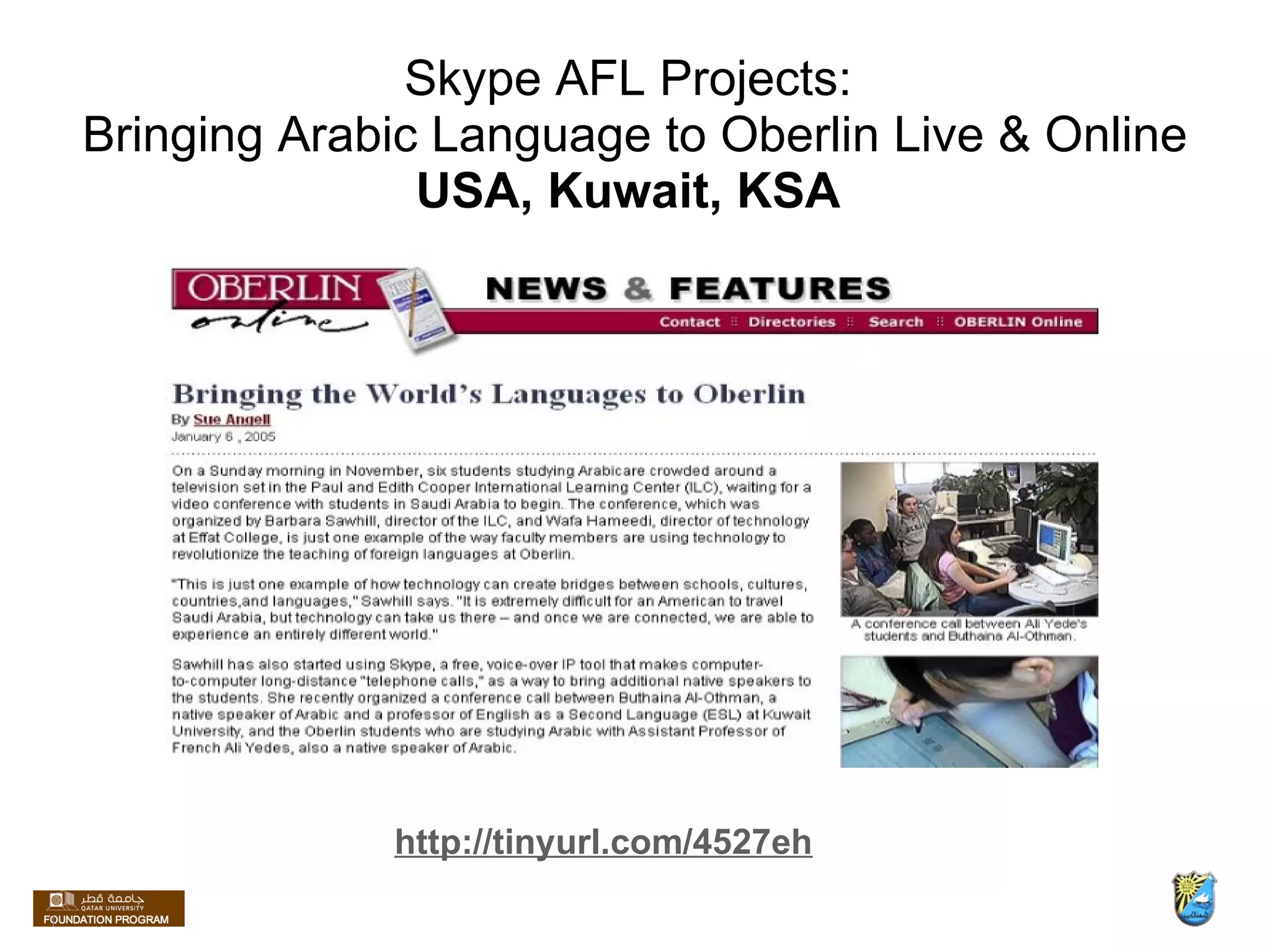
Skype AFL Projects:  Bringing Arabic Language to Oberlin Live & Online USA, Kuwait, KSA  http://tinyurl.com/4527eh
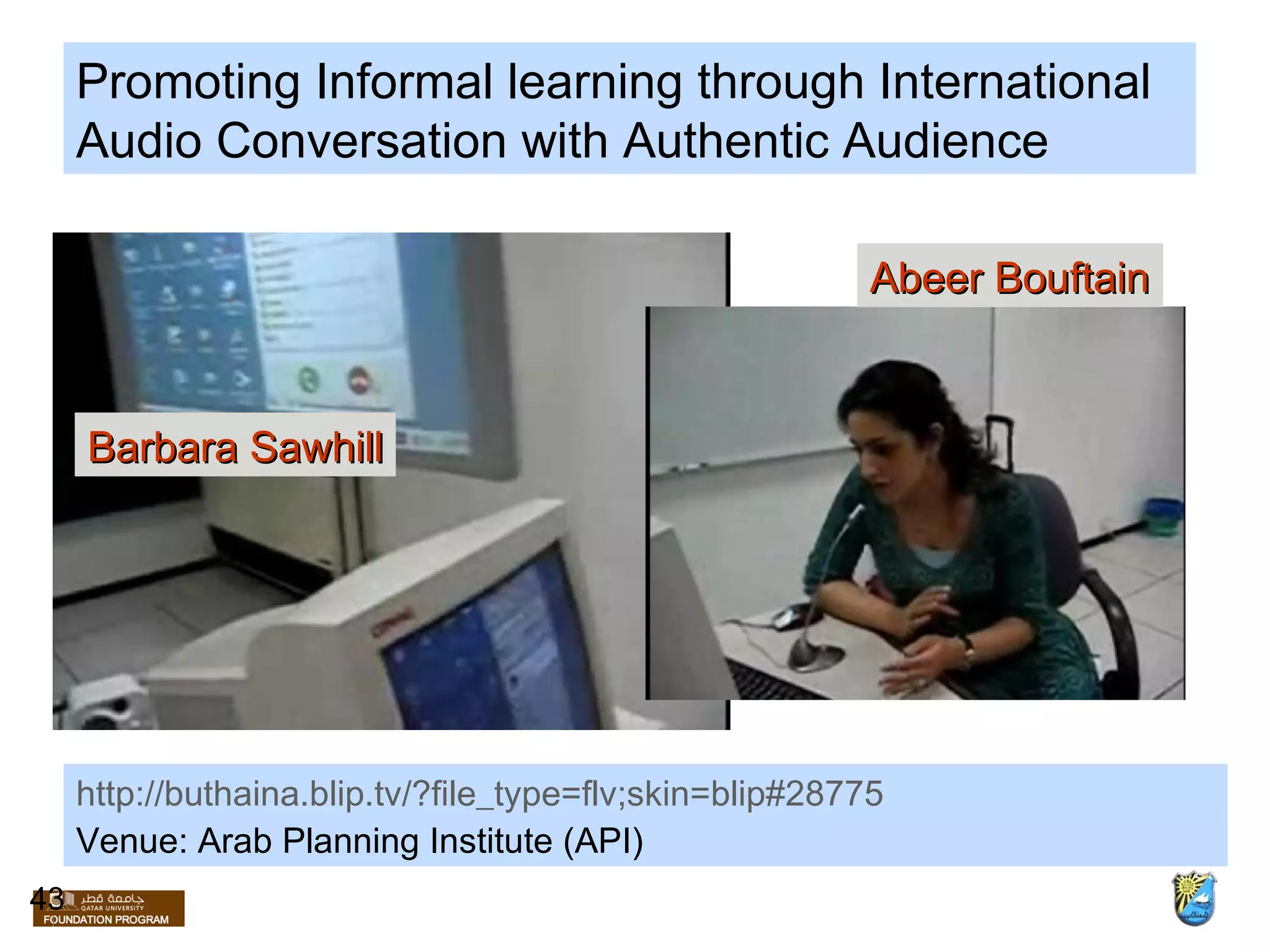
Promoting Informal learning through International Audio Conversation with Authentic Audience  http://buthaina.blip.tv/?file_type=flv;skin=blip#28775 Venue: Arab Planning Institute (API) Barbara Sawhill Abeer Bouftain
Q & A Thank you! buthaina.alothman (at) gmail.com http://quniv-workshop0902.wikispaces.com/

Getting the Most out of the Social Web to Create New Cultures of Learning & Guiding in the EFL Classroom

  • 1.
    Getting the Mostout of the Social Web to Create New Cultures of Learning & Guiding in the EFL Classroom A 2-Day Workshop for EFL Teachers at the Foundation Program of Qatar University by Buthaina Al Othman Doha, Qatar - February 25-26, 2009
  • 2.
    Much Obliged America& Allies - God Bless You ALL – February 26, 2009 - http://www.flickr.com/photos/teacherbuth_summer04/3304207991/
  • 3.
    Agenda What isLearning Learning theories & approaches Informal Learning Formal Learning vs. Informal Learning The Social Web / Web 2.0 Communities of practice & Multiliteracy (Webhead Guest Speaker) The new role of teachers – Be a Multilit. To Fit Wikis & Ning (Webhead Guest Speaker) Flickr & Twitter (Webhead Guest Speaker) AlOthman, B.
  • 4.
  • 5.
    “ Learning canbe defined formally as the act , process , or experience of gaining knowledge or skills – Learning helps us move from novices to experts and allows us to gain new knowledge and abilities” Marcia L. Conner, (2007) http://www.agelesslearner.com/intros/adultlearning.html This site is licensed under a Creative Commons License . 11
  • 6.
    “ Learning is seen as something that you do in order to understand the real world ”; so, “ learning how or improving an ability is not like learning that or acquiring information” Gilbert Ryle (1900-1967) 11
  • 7.
    “ knowing that” and “ knowing how” Gilbert Ryle (1949) 11
  • 8.
    “ Knowing that”11 “ Learning as a quantitative increase in knowledge. Learning is acquiring information or ‘knowing a lot’. Learning as memorizing” http://www.infed.org/biblio/b-learn.htm
  • 9.
    “ knowing how”11 “ Learning as making sense or abstracting meaning. Learning involves relating parts of the subject matter to each other and to the real world”
  • 10.
  • 11.
    Education is asocial process; education is growth; education is not a preparation for life but is life itself. John Dewey (1859-1952)
  • 12.
    The only personwho is educated is the one who has learned how to learn and change. Carl Rogers (1902-1987)
  • 13.
    Students should notbe Forced to Memorize Education should be Practical Ibn Khaldun (1332 - 1406 )
  • 14.
  • 15.
    Informal learning – is the source of most of what we learn from other people We discover how to do our jobs through observing others, asking the person in the next cubicle, calling the help desk, trial and error, and simply working with people in the know Jay Cross (2003)
  • 16.
    Formal Learning vsInformal Learning Formal learning = Push learning Informal Learning = Pull learning
  • 17.
    LEARNING FORMAL: 20%INFORMAL: 80% Family Gathering Diwaniyah / Majlis Coffee Break Courses Online Events Classrooms
  • 18.
    “ eLearning mustbecome social learning” 6 minutes video: http://www.informl.com/2009/02/23/elearning-must-be-social/ Jay Cross (Feb. 23, 2009) http://www.informl.com/2009/02/23/elearning-must-be-social/
  • 19.
    Connectivism: ALearning Theory for the Digital Age To learn is to create meaningful connections Technology allows us to leave the office and yet stay connected George Siemens (2004) 11
  • 20.
    Communities of PracticeCommunities of practice are groups of people who share a concern or a passion for something they do and Learn how to do it better as they interact regularly Etienne Wenger (2004) 11
  • 21.
    Communities of PracticeWebheads WEBHEADS COMMUNITIES OF PRACTICE ONLINE http://tinyurl.com/26afzh
  • 22.
    Communities of Practice& Multilitracies Vance Stevens Lecturer in Computing at the Petroleum Institute in Abu Dhabi, UAE CALL Coordinator and eLearning – IT/ CMC Specialist More about Vance at: http://www.vancestevens.com/vance.htm 11 For the Participants of Day 1, Wednesday, Feb. 25, 2009
  • 23.
    Communities of Practice& Multilitracies Michael Coghlan An online instructor for the Graduate Certificate in eLearning delivered by Adelaide Institute of TAFE. More about Michael at: http://mikecogh.blogspot.com/ Michael sent us this podcast: http://michaelc.podomatic.com prepared for the Participants of Day 2, Feb. 26, 2009 11
  • 24.
    The Social Web/Web2.0 tools? http://www.banksy.co.uk/indoors/ele02.html
  • 25.
    How Technology Changedthe Way We Learn & Teach
  • 26.
    Ning & WikisNellie Deutsch EFL Instructor for more than 30 years She is a Canadian, currently residing in Israel A researcher in Building Relationship and International Collaboration More about Nellie at: http://tinyurl.com/3wumyh 9/27/2008 For the Participants of Day 1, Wednesday, Feb. 25, 2009
  • 27.
    Doris Molero EFLProfessor at Universidad Dr. Rafael Belloso Chacin in Maracaibo Venezuela Doris's EFL Center at: www.doris3meflcenter.bravehost.com More about Doris at: http://tinyurl.com/46swmd Ning & Wikis For the Participants of Day 2, Wednesday, Feb. 26, 2009
  • 28.
    Using Web 2.0Tools to Support Just in Time Learning Microblogging Photo Sharing / Photo Blogging
  • 29.
    Flickr & TwitterCristina Costa Blog: http://knowmansland.com/learningpath / 11 For the Participants of Day 1, Wednesday, Feb. 25, 2009
  • 30.
    Flickr & TwitterCarla Arena A believer in the transformational power of education. A wonderer, learner, curious Brazilian EFL educator. http://collablogatorium.blogspot.com 11 For the Participants of Day 2, Wednesday, Feb. 26, 2009
  • 31.
    Michael Coghlan (Jan.25, 2009) for the EVO 09, Images4education
  • 33.
    Twitter: Just InTime Learning A Twit by Jay Cross via @andresauwaerter (Feb. 23, 2009)
  • 34.
    Blogs Tags Using the Social Web to Support Working & Learning Social Bookmarking
  • 35.
    Cross-Cultural EFL Projects:Kuwaiti & Argentinean Students Talk about Cultural Differences Via Blogging http://tinyurl.com/3dbydu
  • 36.
    Cultural Topics: Religion,Clothes, Greetings, Places, Music, Social Freedom http://tinyurl.com/3dbydu
  • 37.
    Using Web 2.0Tools to Support Pull Learning Really Simple Syndication Aggregators
  • 38.
    Collaborative Student-Projects UsingSocial Web Tools: Facebook Groups
  • 39.
    Building CollaborativeCommunities of Learners to Support Creativity, Productivity, & Performance http://alothman-b.com/content-eng090
  • 40.
    Wikis for CollaborativeStudent-Projects http://buthaina.wikispaces.com
  • 41.
    Wikis as LearningManagement Systems
  • 42.
    Skype AFL Projects: Bringing Arabic Language to Oberlin Live & Online USA, Kuwait, KSA http://tinyurl.com/4527eh
  • 43.
    Promoting Informal learningthrough International Audio Conversation with Authentic Audience http://buthaina.blip.tv/?file_type=flv;skin=blip#28775 Venue: Arab Planning Institute (API) Barbara Sawhill Abeer Bouftain
  • 44.
    Q & AThank you! buthaina.alothman (at) gmail.com http://quniv-workshop0902.wikispaces.com/