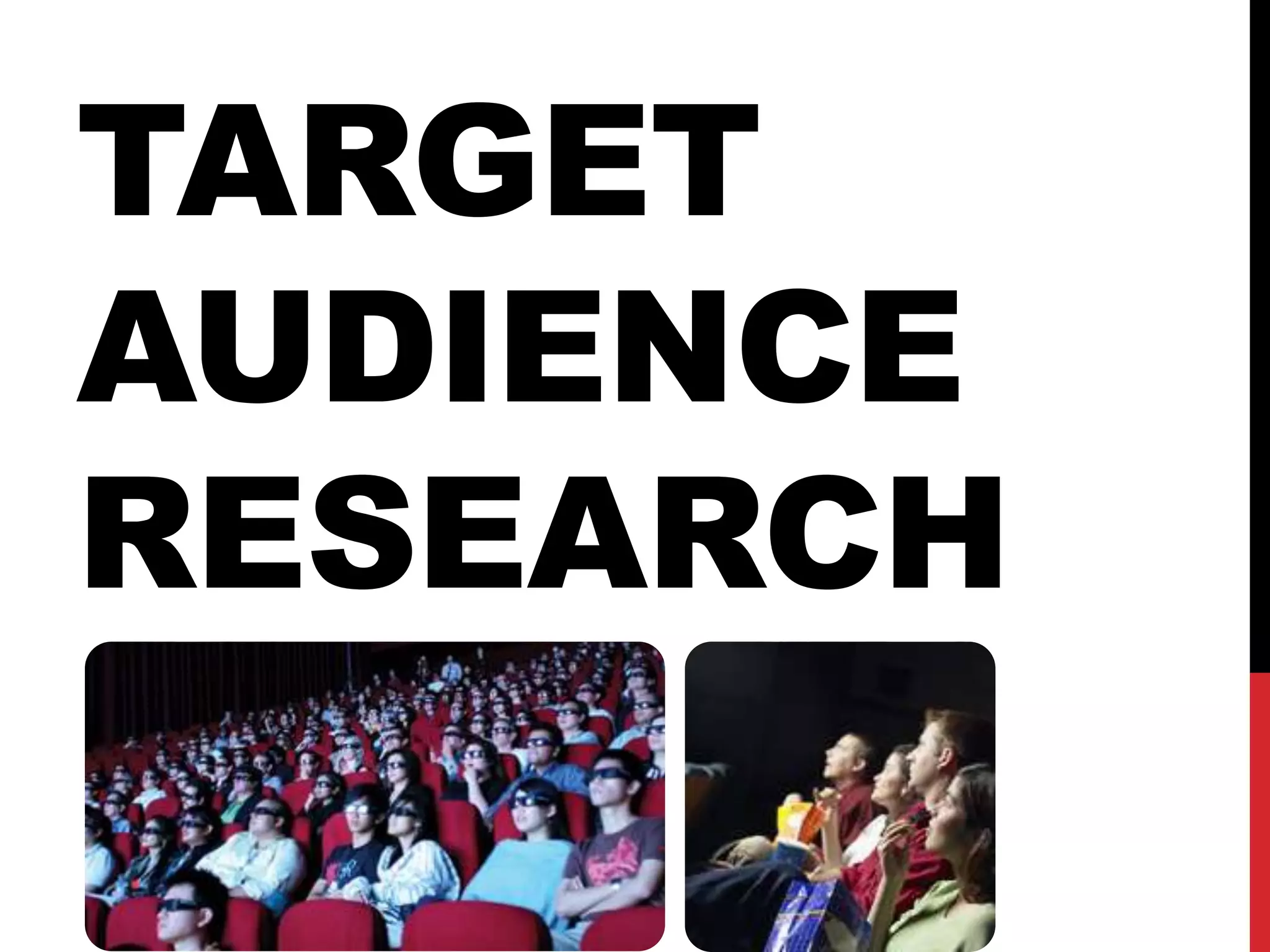
TARGET
AUDIENCE
RESEARCH
TARGET AUDIENCE
RESEARCH – WHY?
‘No film is for everyone. Each film has a target
audience. It’s your job to know – specifically – who they
are. Your film can’t communicate effectively or succeed at
the box office unless you know the group of people for
whom you are making it’
Taken from Canadian Filmmaker Website (2012)
How many of you have seen:
• The Best Exotic Marigold Hotel?
• Salmon Fishing in the Yemen?
• Paranormal Activity?
• The Hunger Games?
• The Inbetweeners Movie?
TARGET AUDIENCE –
WHO?
How can we categorise different audience
groups?
TARGET AUDIENCE –
WHO?
A target audience is defined primarily by gender and age
range.
Additional elements may include:
• socioeconomic status
• rural or urban
• ethnicity
• family status
• level of education
• special interests
These interests can include anything from political leanings to
religion or the particular subject matter of the film, such as football
(Mike Bassett: England Manager), visual art (Pollock) and human
rights (Hotel Rwanda).
TARGET AUDIENCE
RESEARCH – HOW?
You will be doing both primary and secondary
research.
Primary – questioning members of your target
audience and using their responses to inform your
planning.
Secondary – using existing audience profile data to
inform your planning.
PRIMARY RESEARCH
• Vox pops to get feedback directly from potential
audience members.
• Pitch presentation feedback to get some
responses to your film idea.
• You will use this to help your group develop
your film ideas.
• You must evidence all of this on your
coursework journal.
SECONDARY RESEARCH
You need to find audience data for existing films that are relevant
to the type of film you are making an opening for.
You will then be able to use this, along with your primary
research, to help you determine who your particular target
audience will be.
Pearl and Dean deal with cinema advertising so are a useful
source of information about target audiences.
SECONDARY RESEARCH
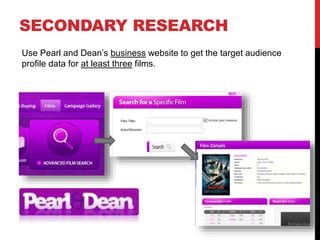
Use Pearl and Dean’s business website to get the target audience
profile data for at least three films.
SECONDARY RESEARCH
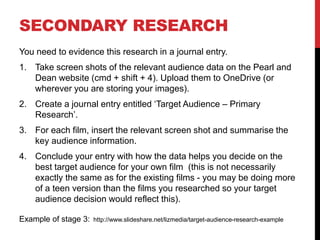
You need to evidence this research in a journal entry.
1. Take screen shots of the relevant audience data on the Pearl and
Dean website (cmd + shift + 4). Upload them to OneDrive (or
wherever you are storing your images).
2. Create a journal entry entitled ‘Target Audience – Secondary
Research’.
3. For each film, insert the relevant screen shot and summarise the
key audience information.
4. Conclude your entry with how the data helps you decide on the
best target audience for your own film (this is not necessarily
exactly the same as for the existing films - you may be doing more
of a teen version than the films you researched so your target
audience decision would reflect this).
Example of stage 3: http://www.slideshare.net/lizmedia/target-audience-research-example
USEFUL WEBSITES
• http://business.pearlanddean.com/
• http://uk.imdb.com/
• http://www.raindance.org/8-questions-writers-must-ask-when-
developing-audience-profiles/
• http://www.bfi.org.uk/education-research/film-industry-statistics-
research/reports/audiences
• http://www.sawa.com/resources/audience
Higher level work will show proactivity and independence in
research as well as the use of a range of sources of information.
To extend your work, explore the above links. If you find
additional information on target audiences that you think is
relevant, add it to your journal. Avoid student work. Make sure
you reference any sources of information you use and explain
why it is useful.
SOMETHING TO
THINK ABOUT
‘Audience-profile data – age, sex, income level,
education, etc. is influential in determining the
kinds of films that get finance and the shape the
projects take.’
(Nelmes, 2012)
• What are the implications of this on the films that get
made?
• Which audiences might be marginalised?

Target Audience Research

  • 1.
  • 2.
    TARGET AUDIENCE RESEARCH –WHY? ‘No film is for everyone. Each film has a target audience. It’s your job to know – specifically – who they are. Your film can’t communicate effectively or succeed at the box office unless you know the group of people for whom you are making it’ Taken from Canadian Filmmaker Website (2012) How many of you have seen: • The Best Exotic Marigold Hotel? • Salmon Fishing in the Yemen? • Paranormal Activity? • The Hunger Games? • The Inbetweeners Movie?
  • 3.
    TARGET AUDIENCE – WHO? Howcan we categorise different audience groups?
  • 4.
    TARGET AUDIENCE – WHO? Atarget audience is defined primarily by gender and age range. Additional elements may include: • socioeconomic status • rural or urban • ethnicity • family status • level of education • special interests These interests can include anything from political leanings to religion or the particular subject matter of the film, such as football (Mike Bassett: England Manager), visual art (Pollock) and human rights (Hotel Rwanda).
  • 5.
    TARGET AUDIENCE RESEARCH –HOW? You will be doing both primary and secondary research. Primary – questioning members of your target audience and using their responses to inform your planning. Secondary – using existing audience profile data to inform your planning.
  • 6.
    PRIMARY RESEARCH • Voxpops to get feedback directly from potential audience members. • Pitch presentation feedback to get some responses to your film idea. • You will use this to help your group develop your film ideas. • You must evidence all of this on your coursework journal.
  • 7.
    SECONDARY RESEARCH You needto find audience data for existing films that are relevant to the type of film you are making an opening for. You will then be able to use this, along with your primary research, to help you determine who your particular target audience will be. Pearl and Dean deal with cinema advertising so are a useful source of information about target audiences.
  • 8.
    SECONDARY RESEARCH Use Pearland Dean’s business website to get the target audience profile data for at least three films.
  • 9.
    SECONDARY RESEARCH You needto evidence this research in a journal entry. 1. Take screen shots of the relevant audience data on the Pearl and Dean website (cmd + shift + 4). Upload them to OneDrive (or wherever you are storing your images). 2. Create a journal entry entitled ‘Target Audience – Secondary Research’. 3. For each film, insert the relevant screen shot and summarise the key audience information. 4. Conclude your entry with how the data helps you decide on the best target audience for your own film (this is not necessarily exactly the same as for the existing films - you may be doing more of a teen version than the films you researched so your target audience decision would reflect this). Example of stage 3: http://www.slideshare.net/lizmedia/target-audience-research-example
  • 10.
    USEFUL WEBSITES • http://business.pearlanddean.com/ •http://uk.imdb.com/ • http://www.raindance.org/8-questions-writers-must-ask-when- developing-audience-profiles/ • http://www.bfi.org.uk/education-research/film-industry-statistics- research/reports/audiences • http://www.sawa.com/resources/audience Higher level work will show proactivity and independence in research as well as the use of a range of sources of information. To extend your work, explore the above links. If you find additional information on target audiences that you think is relevant, add it to your journal. Avoid student work. Make sure you reference any sources of information you use and explain why it is useful.
  • 11.
    SOMETHING TO THINK ABOUT ‘Audience-profiledata – age, sex, income level, education, etc. is influential in determining the kinds of films that get finance and the shape the projects take.’ (Nelmes, 2012) • What are the implications of this on the films that get made? • Which audiences might be marginalised?