Web 2.0
What is it?
What impact has it had?
Examples of Web 2.0 applications?
Defining Web 2.0
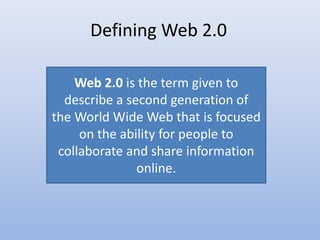
Web 2.0 is the term given to
describe a second generation of
the World Wide Web that is focused
on the ability for people to
collaborate and share information
online.
Defining Web 2.0
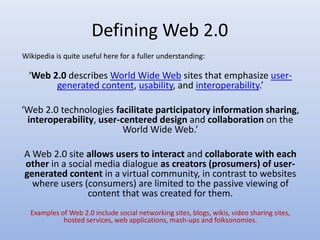
‘Web 2.0 describes World Wide Web sites that emphasize user-
generated content, usability, and interoperability.’
‘Web 2.0 technologies facilitate participatory information sharing,
interoperability, user-centered design and collaboration on the
World Wide Web.’
A Web 2.0 site allows users to interact and collaborate with each
other in a social media dialogue as creators (prosumers) of user-
generated content in a virtual community, in contrast to websites
where users (consumers) are limited to the passive viewing of
content that was created for them.
Examples of Web 2.0 include social networking sites, blogs, wikis, video sharing sites,
hosted services, web applications, mash-ups and folksonomies.
Wikipedia is quite useful here for a fuller understanding:
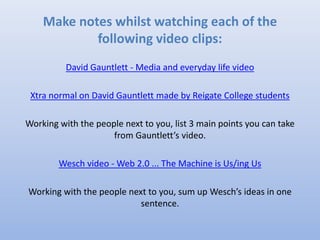
David Gauntlett
David Gauntlett - Media and everyday life video
Xtra normal on David Gauntlett made by Reigate College
students
Working with the people next to you, list 3 main points you can
take from Gauntlett’s video.
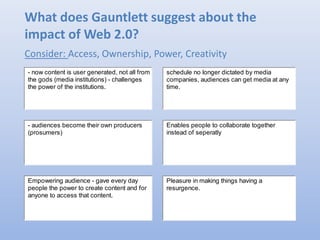
What does Gauntlett suggest about the
impact of Web 2.0?
Consider: Access, Ownership, Power, Creativity
Equipment is easier to get hold of making it
more accessible for people to create
content (e.g. smart phones)
People had no choice when to watch media,
had to follow a schedule. Media institutions
had a dominant role. Now, audiences have
more control - on demand services, online
news, music, etc.
People could make their own content
without needing expensive equiptment or
permission - resurgence in creativity -
pleasure in making things and sharing them
with others.
In the past, bigger equipment so only big
companys could produce content. Media
institutions controlled most of the production
of media. Now, audiences have more power.
Expanded reach of political propaganda
and allowed ordinary people to build up
influence. Audience have more power in
terms of creating and distributing content
and having their voices heard.
Activities
1. Go to YouTube’s homepage, what kind of
videos are featured? What does this suggest
about how things have changed since David
Gauntlett published his video in 2008?
2. Go to https://web.archive.org/ and look up
some websites (perhaps YouTube) and see
what they were like in the past.
Michael Wesch
Wesch video - Web 2.0 ... The Machine is Us/ing
Us
Discuss with the people next to you, what
stands out from this video.
Summarise one key point.

Web 2.0 2018 Class 4D

  • 1.
    Web 2.0 What isit? What impact has it had? Examples of Web 2.0 applications?
  • 2.
    Defining Web 2.0 Web2.0 is the term given to describe a second generation of the World Wide Web that is focused on the ability for people to collaborate and share information online.
  • 3.
    Defining Web 2.0 ‘Web2.0 describes World Wide Web sites that emphasize user- generated content, usability, and interoperability.’ ‘Web 2.0 technologies facilitate participatory information sharing, interoperability, user-centered design and collaboration on the World Wide Web.’ A Web 2.0 site allows users to interact and collaborate with each other in a social media dialogue as creators (prosumers) of user- generated content in a virtual community, in contrast to websites where users (consumers) are limited to the passive viewing of content that was created for them. Examples of Web 2.0 include social networking sites, blogs, wikis, video sharing sites, hosted services, web applications, mash-ups and folksonomies. Wikipedia is quite useful here for a fuller understanding:
  • 4.
    David Gauntlett David Gauntlett- Media and everyday life video Xtra normal on David Gauntlett made by Reigate College students Working with the people next to you, list 3 main points you can take from Gauntlett’s video.
  • 5.
    What does Gauntlettsuggest about the impact of Web 2.0? Consider: Access, Ownership, Power, Creativity Equipment is easier to get hold of making it more accessible for people to create content (e.g. smart phones) People had no choice when to watch media, had to follow a schedule. Media institutions had a dominant role. Now, audiences have more control - on demand services, online news, music, etc. People could make their own content without needing expensive equiptment or permission - resurgence in creativity - pleasure in making things and sharing them with others. In the past, bigger equipment so only big companys could produce content. Media institutions controlled most of the production of media. Now, audiences have more power. Expanded reach of political propaganda and allowed ordinary people to build up influence. Audience have more power in terms of creating and distributing content and having their voices heard.
  • 6.
    Activities 1. Go toYouTube’s homepage, what kind of videos are featured? What does this suggest about how things have changed since David Gauntlett published his video in 2008? 2. Go to https://web.archive.org/ and look up some websites (perhaps YouTube) and see what they were like in the past.
  • 7.
    Michael Wesch Wesch video- Web 2.0 ... The Machine is Us/ing Us Discuss with the people next to you, what stands out from this video. Summarise one key point.