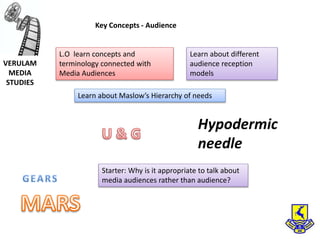
Key Concepts - Audience
L.O learn concepts and
terminology connected with
Media Audiences
Starter: Why is it appropriate to talk about
media audiences rather than audience?
VERULAM
MEDIA
STUDIES
Learn about Maslow’s Hierarchy of needs
Learn about different
audience reception
models
Hypodermic
needle
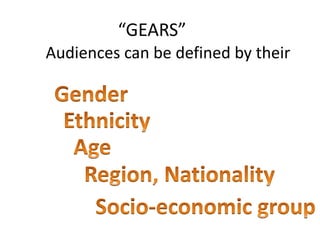
Audiences can be defined by their
“GEARS”
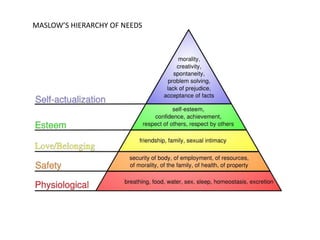
MASLOW’S HIERARCHY OF NEEDS
VERULAM
MEDIA
STUDIES
Watch VW The force
http://www.youtube.com/watch?v=R55e-uHQna0
2012 TV / cinema Ad made by the agency Deutsch
This is a perfect example of
Target audience? Use GEARS/MARS
How does it appeal to audience? Greed?
Flattery? Envy?
Is there a link to Maslow’s Hierarchy of Needs?
Hypodermic Needle Model Uses & Gratifications Model
Audiences are passive
Easily led, influenced & manipulated
Gullible, sheep-like fashion-followers
Media consumption influences
the attitudes and behaviour of
audiences
Sometimes called ‘magic bullet’ theory
Linked to propaganda & advertising
Behaviourist models of human behaviour
Audiences are active in
choosing media for their own
‘gratifications’ (pleasure)
Links to Maslow’s Hierarchy of Needs
Developed by Blumler & Katz
Main reasons for using media:
Personal Identity – to define who we are
(sometimes called self-surveillance)
Information
Entertainment – includes escape, distraction
Social Interaction – to help us socialise with
like-minded people
AS Level
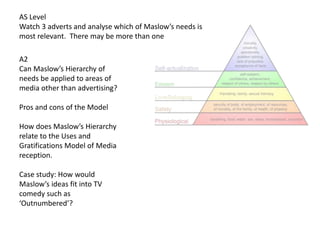
Watch 3 adverts and analyse which of Maslow’s needs is
most relevant. There may be more than one
A2
Can Maslow’s Hierarchy of
needs be applied to areas of
media other than advertising?
Pros and cons of the Model
How does Maslow’s Hierarchy
relate to the Uses and
Gratifications Model of Media
reception.
Case study: How would
Maslow’s ideas fit into TV
comedy such as
‘Outnumbered’?
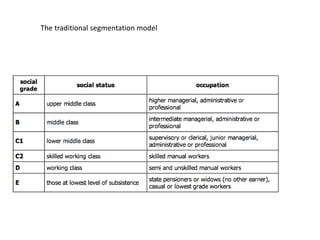
The traditional segmentation model
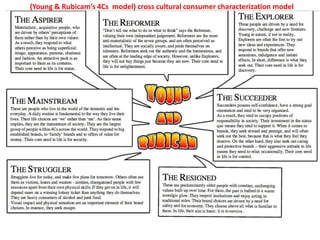
(Young & Rubicam’s 4Cs model) cross cultural consumer characterization model
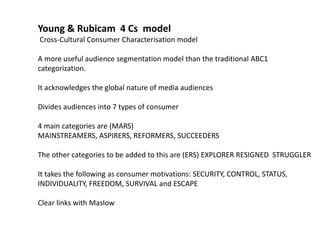
Young & Rubicam 4 Cs model
Cross-Cultural Consumer Characterisation model
A more useful audience segmentation model than the traditional ABC1
categorization.
It acknowledges the global nature of media audiences
Divides audiences into 7 types of consumer
4 main categories are (MARS)
MAINSTREAMERS, ASPIRERS, REFORMERS, SUCCEEDERS
The other categories to be added to this are (ERS) EXPLORER RESIGNED STRUGGLER
It takes the following as consumer motivations: SECURITY, CONTROL, STATUS,
INDIVIDUALITY, FREEDOM, SURVIVAL and ESCAPE
Clear links with Maslow
Click here for more info on Maslow, 4Cs and audience segmentation
AS – use the BA’ To Fly to Serve’ TV advert and work out
which of the 7 4Cs audience categories is being targeted
A2 Use 4C’s to do an audience segmentation analysis of
two contrasting ads e.g. Skoda Fabia ‘Full of Lovely Stuff
and the later Skoda Fabia ‘mean green’
What are the advantages of the Young and Rubicam 4C
model?
Outline some of the disadvantages.
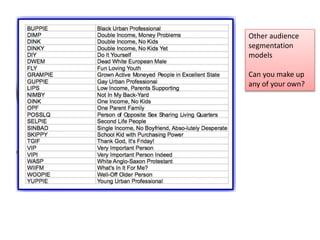
Other audience
segmentation
models
Can you make up
any of your own?
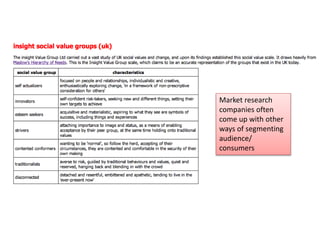
Market research
companies often
come up with other
ways of segmenting
audience/
consumers
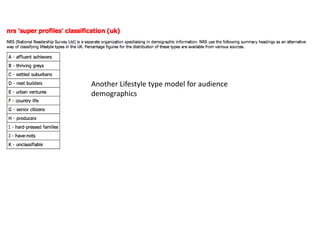
Another Lifestyle type model for audience
demographics

Audience & Media

  • 1.
    Key Concepts -Audience L.O learn concepts and terminology connected with Media Audiences Starter: Why is it appropriate to talk about media audiences rather than audience? VERULAM MEDIA STUDIES Learn about Maslow’s Hierarchy of needs Learn about different audience reception models Hypodermic needle
  • 2.
    Audiences can bedefined by their “GEARS”
  • 3.
  • 4.
    VERULAM MEDIA STUDIES Watch VW Theforce http://www.youtube.com/watch?v=R55e-uHQna0 2012 TV / cinema Ad made by the agency Deutsch This is a perfect example of Target audience? Use GEARS/MARS How does it appeal to audience? Greed? Flattery? Envy? Is there a link to Maslow’s Hierarchy of Needs?
  • 5.
    Hypodermic Needle ModelUses & Gratifications Model Audiences are passive Easily led, influenced & manipulated Gullible, sheep-like fashion-followers Media consumption influences the attitudes and behaviour of audiences Sometimes called ‘magic bullet’ theory Linked to propaganda & advertising Behaviourist models of human behaviour Audiences are active in choosing media for their own ‘gratifications’ (pleasure) Links to Maslow’s Hierarchy of Needs Developed by Blumler & Katz Main reasons for using media: Personal Identity – to define who we are (sometimes called self-surveillance) Information Entertainment – includes escape, distraction Social Interaction – to help us socialise with like-minded people
  • 6.
    AS Level Watch 3adverts and analyse which of Maslow’s needs is most relevant. There may be more than one A2 Can Maslow’s Hierarchy of needs be applied to areas of media other than advertising? Pros and cons of the Model How does Maslow’s Hierarchy relate to the Uses and Gratifications Model of Media reception. Case study: How would Maslow’s ideas fit into TV comedy such as ‘Outnumbered’?
  • 7.
  • 8.
    (Young & Rubicam’s4Cs model) cross cultural consumer characterization model
  • 9.
    Young & Rubicam4 Cs model Cross-Cultural Consumer Characterisation model A more useful audience segmentation model than the traditional ABC1 categorization. It acknowledges the global nature of media audiences Divides audiences into 7 types of consumer 4 main categories are (MARS) MAINSTREAMERS, ASPIRERS, REFORMERS, SUCCEEDERS The other categories to be added to this are (ERS) EXPLORER RESIGNED STRUGGLER It takes the following as consumer motivations: SECURITY, CONTROL, STATUS, INDIVIDUALITY, FREEDOM, SURVIVAL and ESCAPE Clear links with Maslow
  • 10.
    Click here formore info on Maslow, 4Cs and audience segmentation AS – use the BA’ To Fly to Serve’ TV advert and work out which of the 7 4Cs audience categories is being targeted A2 Use 4C’s to do an audience segmentation analysis of two contrasting ads e.g. Skoda Fabia ‘Full of Lovely Stuff and the later Skoda Fabia ‘mean green’ What are the advantages of the Young and Rubicam 4C model? Outline some of the disadvantages.
  • 11.
  • 12.
    Market research companies often comeup with other ways of segmenting audience/ consumers
  • 13.
    Another Lifestyle typemodel for audience demographics